Introduction
Running an enterprise waste operation means juggling multi-site fleets, strict regulatory deadlines, 24/7 collection cycles, and constant pressure to cut fuel costs — all at once. When something breaks down operationally, the cascading impact is immediate: missed pickups, compliance gaps, and customer complaints.
Software now sits at the center of enterprise waste operations — coordinating dispatch, compliance tracking, and fleet visibility across every shift. According to Mordor Intelligence, the smart waste management market sits at $3.54 billion in 2025 and is projected to reach $7.15 billion by 2030 — a 15.10% CAGR that reflects how fast the industry is digitizing.
A customer service management system for waste management companies works best when it pairs strong operational capability — dispatch, compliance tracking, and fleet visibility — with reliable post-go-live support. For enterprise buyers, the platform decision goes beyond features. A routing engine that fails during an active collection cycle with no support available makes every capability on the spec sheet irrelevant. Post-go-live responsiveness matters as much as the software itself.
This guide covers the best enterprise waste management platforms, with a direct focus on support quality alongside operational capability.
Key Takeaways
- Enterprise waste management software centralizes route optimization, fleet tracking, billing, compliance, and asset management in one platform
- Customer support quality matters as much as features: dedicated implementation, 24/7 availability, and solution engineers are non-negotiable at enterprise scale
- Top platforms covered: AMCS, Routeware, Evreka, Soft-Pak, NextBillion.ai, and Geotab
- No single platform does everything — enterprises often layer a route optimization tool on top of an existing ERP or telematics backbone
- Selection criteria: waste-specific functionality, scalability, integration ecosystem, support model, and pricing structure
What Is Enterprise Waste Management Software?
Enterprise waste management software manages the full operational lifecycle at scale through a single integrated platform. That means collection scheduling, route optimization, fleet and container tracking, billing, regulatory compliance, and sustainability reporting — all connected, not siloed.
What Separates Enterprise from SMB Tools
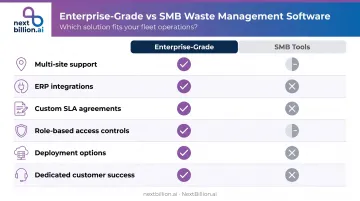
The gap between enterprise-grade and SMB tools isn't just fleet size. It's structural:
- Multi-site support across regions and depots
- ERP integrations with finance, HR, and telematics systems
- Custom SLA agreements with defined uptime and response commitments
- Role-based access controls for large, distributed teams
- On-premise or private cloud deployment for data sovereignty requirements
- Dedicated customer success resources post-implementation
Software now accounts for 41% of the smart waste management market, with cloud deployment representing 61% of that segment — a sign that most enterprise operators have already made the shift away from on-premise-only infrastructure.
Two Evaluation Dimensions
Enterprise buyers typically assess platforms on two axes:
- Operational capability — Can it handle the complexity of our routes, assets, and compliance requirements?
- Support infrastructure — Will this vendor help us succeed after the contract is signed?
Both matter equally. A feature-rich platform with a slow support queue becomes a liability fast — especially when a missed pickup window triggers a compliance audit or a customer penalty.
Best Enterprise Waste Management Software with Top Customer Support
These platforms were selected based on enterprise-scale capability, waste-specific functionality, integration flexibility, and verified customer support quality — not just feature count.
AMCS Platform
AMCS is the global market leader in enterprise waste management software, serving 4,000+ customers across 80+ countries — including private haulers, municipalities, and recycling operations. Its platform spans routes, billing, fleet, scale house operations, and ESG reporting in a fully integrated SaaS ERP.
What differentiates AMCS at enterprise scale is its end-to-end approach. AI Vision detects recycling contamination in real time, route optimization claims 5–25% reductions in CO2, mileage, and driving time alongside 5–15% fewer vehicles needed, and unified data eliminates the fragmented systems that large haulers typically struggle with.
AMCS Premium Services offers SLA-based agreements with 24/7 support and proactive monitoring — though Capterra reviews rate AMCS at 3.3/5 overall with a 2.7/5 customer service score (10 reviews), which suggests the support experience can be inconsistent at scale.
| Category | Details |
|---|---|
| Key Features | Route optimization, AI Vision contamination detection, fleet management, billing and CRM, scale house integration, ESG reporting |
| Customer Support | SLA-based enterprise agreements, 24/7 monitoring; Capterra customer service: 2.7/5 |
| Best For | Large enterprise operations (100+ trucks) needing a full ERP backbone |
| Pricing | Contact vendor for pricing |
Routeware
Routeware has spent 25 years purpose-building cloud software exclusively for waste, recycling, and heavy-duty fleet operations. Its particular strength is municipal residential collection and private enterprise fleets replacing fragmented legacy systems.
The differentiator is in-cab technology integration: truck-mounted hardware, real-time dispatching, proof-of-service capture, and resident-facing mobile apps create visibility from the cab to the back office. On support, Capterra rates Routeware at 4.5/5 overall with 4.6/5 for customer service across 11 reviews — with reviewers noting "excellent support service" and "customer service is spot on," though some flag occasional response lag.
| Category | Details |
|---|---|
| Key Features | AI-powered route balancing, in-cab technology, proof-of-service capture, customer self-service tools, compliance and sustainability reporting |
| Customer Support | Implementation-focused onboarding, dedicated customer success; Capterra customer service: 4.6/5 |
| Best For | Municipal governments and large private haulers |
| Pricing | Custom pricing (contact for quote) |
Evreka
Evreka combines enterprise waste software with native IoT hardware — fill-level sensors, container trackers, and RFID readers — to give operations teams real-time visibility across their entire asset ecosystem. Where most platforms pull in third-party telematics data, Evreka's own sensors feed live fill levels, temperatures, and container movements directly into its dashboard.
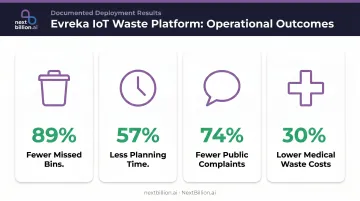
Documented client deployments show clear operational impact: 89% fewer missed bins, 57% less managerial planning time, 74% fewer public-area complaints, and 30% lower medical waste costs. These results make Evreka a strong fit for enterprises prioritizing smart waste and sustainability metrics.
| Category | Details |
|---|---|
| Key Features | Asset management, fill-level sensors, container and workforce tracking, fleet management, MRF management, route optimization, EPR/PRO compliance |
| Customer Support | Demo-driven onboarding, dedicated account support; limited public review data available |
| Best For | Enterprises focused on IoT-integrated operations and sustainability reporting |
| Pricing | Custom pricing |
Soft-Pak
Soft-Pak is a purpose-built operational platform for solid waste — serving private haulers, large corporate waste operations, and roll-off operators with an integrated suite covering billing, dispatching, route optimization, and customer management.
Its "Connected Collections" ecosystem, developed within the Environmental Solutions Group alongside Heil, Marathon, 3rd Eye, and Curotto-Can, means deep hardware-software integration that generic logistics tools can't match. The Mobile-Pak in-cab computing system, PCI compliance, and built-in IFTA solutions directly address enterprise billing and regulatory requirements. G2 rates Soft-Pak at 4.7/5 from verified reviews, though no specific support response-time metrics are publicly available.
| Category | Details |
|---|---|
| Key Features | Billing and customer management, dispatching, route optimization, Mobile-Pak in-cab system, IFTA compliance, PCI compliance, Heil and 3rd Eye integration |
| Customer Support | Waste industry-specialized support team; G2: 4.7/5 (3 reviews) |
| Best For | Enterprise haulers prioritizing billing accuracy, waste-specific compliance, and vertical ecosystem integration |
| Pricing | Custom pricing |
NextBillion.ai
NextBillion.ai is an enterprise-grade route optimization and location intelligence platform with a purpose-built waste collection solution — built for fleets that need to handle complex, multi-stop collection routes without per-API-call pricing that becomes cost-prohibitive at scale.
Key routing capabilities include:
- 50+ hard and soft constraints — weight limits, curb-side approach rules, one-sided streets, time windows, incompatible load types, multi-compartment trucks for source-separated recyclables
- Return-to-dump logic with depot assignment and multi-site support
- Mid-day re-optimization for dynamic adjustments when trucks go offline or conditions change
- Zone-based routing with geofencing for district-level service area management
- Native integrations with Samsara, Geotab, Motive, Verizon Connect, and Netradyne — no custom development required
SIR, a Mexico City-based environmental solutions provider, integrated NextBillion.ai's Route Optimization, Directions, Geofencing, and Clustering APIs to resolve heavy-vehicle routing failures and suboptimal multi-stop sequences — resulting in reduced delivery times, lower fuel consumption, and improved SLA compliance across their collection network.
Support is 24/7 access to solution engineers — not a ticket queue. The platform is rated 4.6+ across top review platforms including G2, Capterra, Software Advice, and Crozdesk, with G2 scores of 9.6/10 for quality of support and 9.6/10 for being a good business partner. SOC 2 Type II and ISO/IEC 27001:2013 certification covers enterprise data security requirements.
Pricing runs per-vehicle or per-order (not per-API-call), keeping costs predictable regardless of request volume. Across 150+ customers, the platform has delivered $11M+ in documented cost savings and 10.9M+ optimized deliveries and tasks.
| Category | Details |
|---|---|
| Key Features | Multi-stop route optimization with 50+ constraints, GPS tracking, real-time re-routing, distance matrix, truck-compliant routing, telematics integrations (Samsara, Geotab, Motive), on-premise deployment |
| Customer Support | 24/7 solution engineer support; G2 quality of support: 9.6/10; rated 4.6+ across top platforms |
| Best For | Enterprise waste fleets needing AI-powered route optimization layered onto existing ERP or telematics infrastructure |
| Pricing | Per-vehicle or per-order pricing (contact for custom quote) |
Geotab
Geotab is an open-platform fleet telematics provider serving enterprise waste fleets with GPS tracking, vehicle diagnostics, driver behavior monitoring, and predictive maintenance. It connects approximately 6 million vehicles and assets across 100,000+ customers globally.
Waste Connections of Canada runs 18,000 vehicles across 300+ North American locations on Geotab, and Ferrovial Servicios reduced waste collection routes from three to one using Geotab data. The open API marketplace — with 350+ integrations — means Geotab plugs into virtually any waste ERP or billing system. It also supports 300+ EV models, relevant as waste fleets electrify their equipment. Capterra rates Geotab at 4.4/5 with 4.2/5 for customer support across 98 reviews.
| Category | Details |
|---|---|
| Key Features | GPS and vehicle diagnostics, driver behavior monitoring, predictive maintenance, service verification, CNG/EV fleet tracking, 350+ API integrations, customizable reporting |
| Customer Support | Partner-channel support with enterprise account management; Capterra customer support: 4.2/5 |
| Best For | Enterprise fleets prioritizing telematics data depth, multi-system integration, and EV/alternative fuel management |
| Pricing | $15–$50/vehicle/month (contact vendor for enterprise tier) |
How We Chose the Best Enterprise Waste Management Software
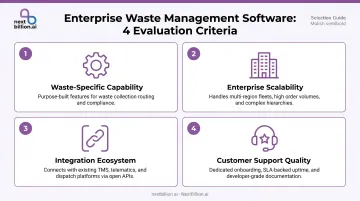
This list was evaluated across four primary factors:
- Waste-specific operational capability — does the platform handle actual collection complexity, or is it a generic logistics tool with a thin waste overlay?
- Enterprise scalability — multi-site support, role-based access, compliance infrastructure
- Integration ecosystem — can it connect with existing fleet, ERP, and telematics systems without heavy custom development?
- Customer support quality — what does post-sale support actually look like, including availability, domain expertise, and customer-verified satisfaction?
Questions to Ask Every Vendor Before Signing
Feature demos during the sales cycle are polished and compelling. What's harder to evaluate is post-go-live support — specifically, what happens six months in when a routing engine fails during an active collection cycle. Your operations team needs resolution in hours, not days.
Ask every vendor these questions before signing:
- What are your support SLAs, by severity level?
- Is support 24/7 or business hours only?
- Do your frontline engineers have waste-specific domain knowledge?
- What's the escalation path when a critical issue isn't resolved?
- Can we speak to three enterprise customers about their post-implementation experience?
Matching Platform to Operational Priority
| Priority | Best Platform(s) |
|---|---|
| Full ERP backbone for large fleets | AMCS, Routeware |
| Smart waste and IoT-integrated operations | Evreka |
| Waste-specific billing and compliance | Soft-Pak |
| High-performance route optimization layer | NextBillion.ai |
| Enterprise telematics and fleet diagnostics | Geotab |
Conclusion
The right enterprise waste management platform does more than automate routes — it compounds value over time through fuel savings, compliance coverage, and fleet scalability. None of that materializes without a vendor whose support infrastructure holds up under real operational pressure.
Before finalizing any decision, evaluate:
- Total cost of ownership — not just licensing fees
- Implementation timelines that reflect your actual rollout complexity
- Integration requirements against your existing telematics and ERP stack
- Direct references from the vendor's enterprise customers
For enterprises prioritizing route optimization at scale, NextBillion.ai's waste collection routing platform offers predictable per-vehicle pricing, 24/7 engineer-backed support, and direct integration with telematics systems like Geotab and Samsara. Contact the team to see how it fits your operations.
Frequently Asked Questions
What ERP or enterprise software do waste management companies use?
The most widely used platforms include AMCS, Routeware, Soft-Pak, and WAM Software for core operational management. Many enterprises layer specialized tools — route optimization platforms like NextBillion.ai and telematics systems like Geotab — on top of their ERP for complete operational coverage. When comparing vendors, weigh not just feature lists but implementation support and customer training resources, since these determine how quickly dispatch and driver teams adopt the system in daily operations.
What features should enterprise waste management software include?
Core requirements span route optimization, asset tracking, compliance reporting, billing, real-time dispatching, and open API integrations. Mid-day re-optimization and zone-based routing are increasingly critical for operations that change throughout the day.
How important is customer support when choosing waste management software?
For 24/7 collection operations, support quality is non-negotiable. Evaluate availability (24/7 vs. business hours), SLA response times by severity level, and whether support staff have domain expertise in waste operations — not just general software knowledge. Also check onboarding depth: whether the vendor provides structured training for dispatchers and drivers, documentation for API integrations, and a named contact for escalations rather than a generic ticket queue.
What is the typical cost of enterprise waste management software?
Costs vary widely. Full ERP platforms like AMCS use contact-vendor pricing; telematics platforms like Geotab run roughly $15–$50/vehicle/month. Route optimization tools like NextBillion.ai offer per-vehicle or per-order pricing — more predictable than per-API-call models at high volume.
How long does it take to implement enterprise waste management software?
Cloud-based route optimization and telematics tools typically deploy within a few weeks. Full ERP platforms can take several months, depending on integration count, fleet size, and data migration scope — evaluate vendor onboarding support before committing.
Can route optimization software integrate with existing waste management ERP systems?
Yes. Modern platforms like NextBillion.ai are built as API-first layers that connect with fleet telematics (Samsara, Geotab, Motive) and ERP systems through standard API integrations. Enterprises can upgrade routing capability without replacing their existing operational infrastructure.
What is the best software for waste management?
There is no single best platform — the right choice depends on fleet size, compliance needs, and existing systems. Large enterprises often run an ERP (AMCS, Routeware, Soft-Pak) for billing and compliance, paired with a dedicated route optimization API like NextBillion.ai for dynamic routing and telematics for vehicle tracking. Evaluate based on integration ease, support quality, and how well the vendor trains your dispatch team.
What is the best training management software for training providers?
This question is outside the scope of waste management operations software. For fleet and route optimization platforms, look instead at how a vendor trains your own dispatch, driver, and operations staff — through onboarding sessions, documentation, and ongoing customer support — since that training directly affects how well the software performs in daily collection routing.