](https://file-host.link/website/nextbillion-27cay0/assets/blog-images/3a4cce86-38a5-4e93-b54f-b14328dff6e5/1779360942347522_ed2c188edae3494fb1798a6f4487c930/360.webp)
The issues come up often: opaque enterprise pricing (third-party sources report starting costs around $100,000/year per Capterra), mixed reviews around UI usability noted on Gartner Peer Insights and Software Advice, and limited flexibility for non-standard routing scenarios like API-first embedding or custom multi-depot configurations. For teams building logistics technology in-house, integration rigidity can become a genuine bottleneck.
This guide breaks down the top Locus alternatives for enterprise route optimization in 2026 — what each platform does well, where it falls short, and what criteria should drive your evaluation.
Key Takeaways
- Locus has real gaps — pricing opacity, UI friction, and integration limits drive teams to look elsewhere
- Top alternatives include NextBillion.ai, FarEye, LogiNext, Shipsy, and DispatchTrack — each suited to different operational profiles
- Key evaluation criteria: constraint handling depth, API flexibility, pricing predictability, real-time re-optimization, and enterprise security
- API-first platforms like NextBillion.ai suit teams embedding routing directly into their own TMS, ERP, or logistics apps
Locus for Enterprise Route Optimization — A Brief Overview
Locus is an AI-powered logistics platform built for high-volume enterprise operations in retail, FMCG, e-commerce, and 3PL. Its core capabilities span autonomous route optimization, geocoding, vehicle allocation, driver-hour constraints, delivery time windows, and delivery analytics on a unified platform. According to G2, Locus has facilitated 1.5B+ deliveries across 30+ countries and received recognition in Gartner's Market Guide for Last-Mile Delivery Technology.
Why Enterprises Look for Alternatives
That scale doesn't guarantee fit for every operation. Enterprise buyers still run into the same friction points, which is exactly why searches for a locus route optimization alternative keep rising among US fleet and logistics teams:
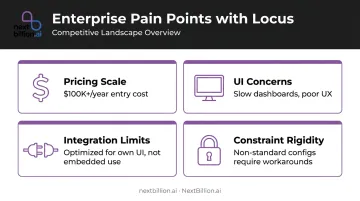
- Pricing scale: Third-party sources including Capterra report starting costs around $100,000/year — a real threshold for teams evaluating total cost of ownership
- UI concerns: Reviews on Software Advice and Gartner Peer Insights cite dashboards that load slowly and a user experience that isn't always intuitive
- Integration limits: Teams building routing into their own TMS or ERP often find Locus's architecture is optimized for its own dispatcher interface, not embedded API use
- Constraint rigidity: Non-standard routing configurations — calendar-based routing, API-first embedding, custom multi-depot dispatch — can require considerable workaround effort
Each alternative below targets one or more of these gaps specifically — so the right fit depends on where Locus is falling short for your team.
Best Locus Alternatives for Enterprise Route Optimization
These platforms were evaluated across five dimensions: enterprise constraint handling, integration architecture, pricing model, scalability, and multi-depot or multi-fleet support.
NextBillion.ai
NextBillion.ai was built by engineers from Grab's Geo team — the infrastructure behind one of Southeast Asia's largest logistics platforms. The platform now serves 150+ businesses globally, including DoorDash, AB InBev, and Meesho, with over 10.9 million deliveries optimized.
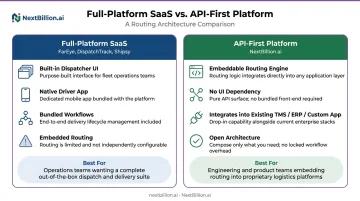
Its core differentiation from Locus is architectural. Rather than a dispatcher-first SaaS product, it's designed to embed directly into a company's existing TMS, ERP, or custom logistics application. A dispatcher UI and driver app are available for teams that need them.
Why it stands out:
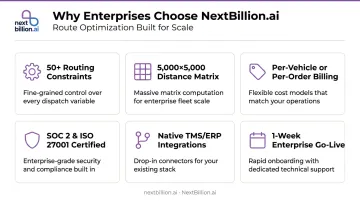
- Handles 50+ routing constraints simultaneously: time windows, driver skills, multi-compartment loads, multi-depot dispatch, HOS compliance, hazmat routing, and territory boundaries
- Supports distance matrices up to 5,000×5,000 elements, eliminating the 25×25 API cap that forces costly batching
- Bills per-vehicle or per-order (not per-API-call), with annual licenses and volume-based discounts
- Certified SOC 2 Type II, ISO/IEC 27001:2022, and GDPR-compliant, with on-premise deployment on Kubernetes or bare-metal servers
- Connects natively with Samsara, Geotab, Motive, and Verizon Connect, plus SAP, Oracle, Microsoft Dynamics 365, and Salesforce
- Most enterprise teams go live within one week, supported by a dedicated solutions engineer
| Category | Details |
|---|---|
| Best For | Enterprise logistics teams, field service operators, NEMT, last-mile delivery, and companies embedding routing into their own TMS or logistics applications |
| Key Features | 50+ routing constraints, truck-compliant routing, custom map editing, 5,000×5,000 distance matrix, on-premise deployment, fleet management integrations |
| Pricing | Per-vehicle or per-order model; no per-API-call charges; contact for enterprise quote |
FarEye
FarEye is an enterprise delivery management platform focused on end-to-end visibility and workflow automation across first, middle, and last mile. Its customer base spans retail, e-commerce, 3PL, pharmaceuticals, and auto parts distribution globally. A published case study shows Hilti reduced warehouse loading time by 40% using FarEye's last-mile delivery software.
FarEye's strength is delivery orchestration and exception management at scale — automated driver dispatch, real-time tracking, and customer experience workflows across complex multi-region operations. G2 reports an average implementation time of 5 months and a $$$$ cost signal, which sets expectations appropriately: this is a heavy deployment suited for large enterprises with the implementation bandwidth to match.
| Category | Details |
|---|---|
| Best For | Large enterprises in retail, logistics, and supply chain needing end-to-end delivery orchestration |
| Key Features | Dynamic route optimization, real-time shipment visibility, workflow automation, delivery analytics, exception management |
| Pricing | Custom enterprise pricing; Capterra lists a $100,000 one-time starting price |
LogiNext
LogiNext is a SaaS-based delivery automation platform with a stated presence across 50+ countries, serving courier, express and parcel, QSR, retail, and e-commerce sectors. Its LogiNext Mile product covers automated dispatch, predictive routing, and real-time tracking with driver performance analytics.
The platform performs well for businesses whose operations fit squarely within its core verticals. G2 notes an average implementation time of 4 months, and some enterprise reviewers highlight customization challenges and rigidity for non-standard workflows. LogiNext does offer a per-order pricing tier (its Growth plan signals $0.13/order), making it more accessible than purely quote-based competitors. For US fleets operating under FMCSA hours-of-service rules, evaluate whether a platform's dispatch logic can natively account for driver duty limits rather than requiring manual overrides.
| Category | Details |
|---|---|
| Best For | Mid-to-large enterprises in courier/parcel, QSR, retail, and e-commerce with global delivery operations |
| Key Features | Automated dispatch, real-time tracking with predictive insights, advanced route planning and scheduling, driver performance analytics |
| Pricing | Contact for enterprise pricing; per-order Growth plan available |
Shipsy
Shipsy is an AI-powered logistics intelligence platform with a dedicated route planning module integrated into its last-mile delivery suite. It serves QSR, courier, retail, manufacturing, and logistics verticals, with notable strength in the Middle East and South Asia markets.
The platform earns strong review scores — Gartner Peer Insights rates Shipsy at 4.9/5 across 391 ratings, with users citing clean dashboards, strong BI reporting, and effective real-time route adjustments as highlights. Initial setup time and integration complexity are mentioned as areas requiring attention. Shipsy also holds SOC 2 Type II, ISO, and GDPR compliance certifications.
| Category | Details |
|---|---|
| Best For | Enterprises in QSR, courier, and retail seeking AI-driven route planning with strong analytics |
| Key Features | Intelligent delivery planning, real-time route adjustments, data-driven insights, last-mile delivery module integration |
| Pricing | Custom enterprise pricing; quote-based |
DispatchTrack
DispatchTrack is an AI-powered last-mile logistics platform recognized on Capterra's 2025 Shortlist for Fleet Management, Logistics, and Route Planning. It serves furniture, building supplies, food and beverage, field services, and retail — industries where the full delivery lifecycle matters as much as route efficiency.
Unlike FarEye's multi-month deployment, DispatchTrack typically goes live in weeks. It combines routing, dispatch, customer notifications, live tracking, and proof of delivery in a single interface. The company claims 98% ETA accuracy with its optimization engine (self-reported). G2 reviewers consistently cite ease of use and a low learning curve as standout traits.
| Category | Details |
|---|---|
| Best For | Enterprises in furniture, building supplies, food and beverage, field services, and retail needing integrated route execution and customer experience |
| Key Features | AI-powered route optimization, live delivery tracking, driver management, customer notifications, proof of delivery |
| Pricing | Custom enterprise pricing; contact for quote |
How to Choose the Best Locus Alternative for Your Enterprise
The most common evaluation mistake is comparing platforms on feature count alone. Two platforms can both claim "50+ constraints" and deliver completely different results for your specific operation. Here's what actually matters:
Constraint Handling Depth
Enterprise operations involve simultaneous, layered constraints : not just time windows, but vehicle type matching, driver skill requirements, load compatibility, multi-depot dispatch logic, and HOS compliance all firing at once.
When evaluating any platform, ask:
- Does it support both hard constraints (must-satisfy) and soft constraints (prefer-satisfy with penalty)?
- Can it handle truck-specific routing restrictions — bridge weights, road classifications, dimensional limits?
- Does it reoptimize in real time when a driver falls behind, a stop is cancelled, or traffic conditions change mid-route?
API Architecture and Integration Fit
The architecture decision matters most for enterprise teams building their own logistics stack:
- Full-platform SaaS tools (FarEye, DispatchTrack, Shipsy) come with a dispatcher UI, driver app, and built-in workflows, but embedding their routing engine into your own application is limited or unavailable
- API-first platforms (NextBillion.ai) provide the routing engine as an embeddable service with no requirement to adopt any specific UI, making them the right fit for teams integrating into an existing TMS, ERP, or proprietary logistics application
Pricing Model Transparency
Per-API-call pricing becomes unpredictable at enterprise scale, particularly when real-time re-optimization, batch planning runs, and multiple optimization cycles per order drive call volumes well above initial estimates. Per-vehicle or per-order models provide a fixed, predictable cost regardless of how many times the engine runs.
Enterprise Security and Deployment
For regulated industries or data sovereignty requirements, verify:
- SOC 2 Type II certification
- ISO/IEC 27001 certification
- On-premise deployment availability (not just cloud SaaS)
- GDPR compliance for operations serving EU customers
Conclusion
No single Locus alternative fits every enterprise. The right platform depends on whether you need a full delivery execution suite, a routing API to embed in your own system, or something that bridges both.
When evaluating platforms, look beyond current feature parity:
- Pricing scalability as order volumes grow
- Constraint flexibility for your specific operation
- Integration depth with your existing stack
- Hands-on technical support — not just ticket-based response
If your team is building routing into your own logistics software or needs a flexible, API-first engine with predictable pricing and 50+ constraint support, NextBillion.ai is the strongest fit.
With customers including DoorDash, AB InBev, and Meesho, $11M+ in documented cost savings across 150+ businesses, and a typical enterprise integration timeline of one week, it's built for teams that need enterprise-grade routing without per-call pricing overhead.
Frequently Asked Questions
Why do enterprises look for Locus alternatives?
The most commonly cited reasons are pricing scale (third-party sources report entry costs around $100,000/year), mixed reviews around UI usability and dashboard performance, and integration constraints for teams building routing into custom logistics stacks. Enterprises needing deeper API customization or non-standard constraint handling also frequently outgrow Locus's out-of-the-box configuration options. US fleets managing FMCSA hours-of-service limits, IFTA reporting, or DOT compliance windows often need constraint logic that off-the-shelf dashboards were not built to handle.
How does Locus pricing compare to its alternatives?
Locus doesn't publish pricing publicly and requires a sales consultation; third-party sources including Capterra report starting costs around $100,000/year. NextBillion.ai offers per-vehicle or per-order pricing for more predictable cost scaling, while DispatchTrack, FarEye, and Shipsy use custom enterprise pricing. Request quotes from each vendor and compare total cost of ownership at your actual order volume.
What is the difference between a route optimization API and a last-mile delivery platform?
A route optimization API (like NextBillion.ai) is an embeddable routing engine that integrates into your existing TMS, ERP, or custom application — no native dispatcher UI or driver app needed. A last-mile delivery platform (like DispatchTrack or FarEye) bundles routing with the full delivery workflow: dispatch, driver app, customer notifications, and proof of delivery.
What enterprise features should I prioritize when evaluating a Locus alternative?
The features that matter most at enterprise scale are:
- Multi-constraint routing depth (time windows, vehicle types, driver skills, load capacity)
- Real-time re-optimization capability
- API integration flexibility with your existing stack
- Pricing model scalability at your actual order volume
- Enterprise security standards: SOC 2 Type II and on-premise deployment options
For US fleet operations, also confirm the platform can encode driver hours-of-service limits, CDL-specific routing restrictions, and hazmat routing rules tied to PHMSA guidance, since generic routing logic will not enforce these constraints automatically.
Can these Locus alternatives integrate with existing TMS or ERP systems?
Most enterprise-grade alternatives offer REST APIs for TMS, ERP, and WMS integration. NextBillion.ai is designed for deep embedding into existing stacks, with pre-built connectors for SAP, Oracle, Microsoft Dynamics 365, Salesforce, Samsara, and Geotab; full-platform solutions like FarEye and DispatchTrack provide pre-built connectors and webhooks. Verify specific integration support with each vendor during evaluation.
How long does it typically take to migrate from Locus to an alternative platform?
It varies by platform type and integration complexity. API-first platforms like NextBillion.ai typically take one week for enterprise teams with engineering resources, with dedicated solutions engineer support throughout. Full-platform SaaS deployments run longer: G2 benchmarks show FarEye averaging 5 months and LogiNext averaging 4 months for enterprise onboarding.
Who are Locus Robotics' main competitors?
Locus Robotics builds warehouse robotics, which is a different category from Locus (the routing/dispatch software often compared to NextBillion.ai). If you are researching warehouse automation robots, competitors include other autonomous mobile robot vendors for fulfillment centers. If you are actually looking for route optimization software, the relevant comparison set includes NextBillion.ai, DispatchTrack, FarEye, and Shipsy, not warehouse robotics vendors.
Which route planner is most accurate?
Route accuracy depends on map data quality, real-time traffic feeds, and how well the engine handles real-world constraints like time windows, vehicle restrictions, and road closures. There is no universal accuracy benchmark across vendors since none publish standardized third-party comparisons. The practical approach is to test candidate platforms, including NextBillion.ai, against your own delivery zones and constraints, since accuracy varies by region and route density.