This scenario plays out constantly in B2B software sales. For companies handling operational data — GPS location records, delivery records, driver information — that single question can determine whether a deal closes or stalls indefinitely.
This guide covers everything you need to know: what SOC 2 actually is, how the five Trust Services Criteria work, the real difference between Type 1 and Type 2, and what achieving it requires in practice.
TL;DR: Key Takeaways
- SOC 2 is a voluntary AICPA auditing framework for how service organizations protect customer data
- Built on five Trust Services Criteria: Security (required), Availability, Confidentiality, Processing Integrity, and Privacy
- Type 1 confirms controls are properly designed at a single point in time
- Type 2 confirms those controls operated effectively over a 6–12 month period
- Not legally required, but enterprise buyers increasingly treat it as a condition of doing business
- Only a licensed CPA firm can perform the audit — it cannot be self-certified
What Is SOC 2 Compliance?
SOC 2 stands for System and Organization Controls 2. It's an auditing framework developed by the American Institute of Certified Public Accountants (AICPA) that evaluates how service organizations manage and protect customer data.
SOC 2 is not a government regulation or a product certification, and it is not legally mandatory — it's a voluntary, independent attestation: a licensed CPA reviews your controls, policies, and systems against the AICPA's Trust Services Criteria and issues a formal report. It's also distinct from SOC 1, which covers financial reporting controls, and SOC 3, which is a public-facing summary of a SOC 2 report. SOC 2 is likewise separate from ISO 27001, a certification against an international information security management standard rather than a CPA-issued attestation, though many organizations pursue both.
Who Does SOC 2 Apply To?
Any service organization that stores, processes, or transmits customer data. In practice, that means:
- SaaS platforms and cloud application providers
- Managed IT and infrastructure services
- Logistics technology and route optimization vendors
- API platforms handling operational or personal data
- Location intelligence platforms processing GPS and driver data
If your B2B software touches sensitive operational data — location records, financial transactions, health information, or personal identifiers — enterprise customers will likely expect a SOC 2 report before signing a contract.
What Does "Compliance" Actually Mean?
An independent auditor examines your organization's controls against the AICPA's criteria and produces a formal report. The resulting report is confidential — not published publicly. Organizations share it selectively with customers, regulators, and business partners, usually under NDA or through a secure portal.
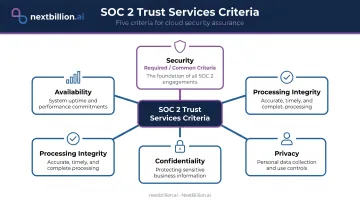
The 5 Trust Services Criteria (TSC)
Unlike compliance frameworks that hand you a checklist, SOC 2 defines five broad risk categories. Your organization designs its own controls to address whichever criteria apply to your services.
Security (Required)
Security is the only mandatory criterion — sometimes called the Common Criteria because its controls underpin every other category. It covers:
- Access controls and identity management
- Network security and firewalls
- Intrusion detection and vulnerability management
- Incident response procedures
Every SOC 2 audit includes Security. The other four are selected based on what your system actually does.
Availability
When customers depend on your systems for ongoing operations, Availability applies. It governs the operational commitments you've already made to customers — and holds you to them. Specific controls include:
- Uptime commitments and SLA monitoring
- Capacity planning and performance thresholds
- Backup procedures and recovery testing
- Disaster recovery plans
For platforms with formal SLAs — like NextBillion.ai's 99.9% monthly availability guarantee — this criterion maps directly to existing contractual obligations.
Processing Integrity
If you process data on behalf of customers — running calculations, analytics, automated workflows, or optimization outputs — Processing Integrity applies. Auditors verify that processing is complete, accurate, timely, and authorized. Controls typically address:
- Input validation and error handling
- Processing monitoring and exception alerts
- Output accuracy checks and audit trails
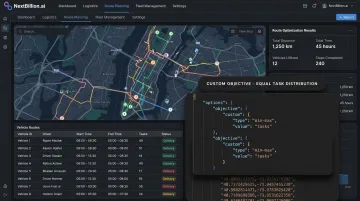
Route optimization platforms like NextBillion.ai fall squarely in scope: every optimized route and dispatched workflow is a processing output that customers rely on for operational decisions.
Confidentiality
When your organization handles sensitive business information — contracts, trade secrets, or proprietary operational data — Confidentiality applies. Controls include:
- Data classification policies
- Encryption at rest and in transit
- Secure data disposal procedures
Privacy
The Privacy criterion applies when your system collects or processes personal information about individuals. It governs consent, purpose limitation, data retention, and deletion rights — and maps closely to GDPR principles. The AICPA published a formal mapping between the 2017 Trust Services Criteria and GDPR requirements, making this criterion especially relevant for platforms that process driver data, customer delivery records, or any personally identifiable information.
SOC 2 Type 1 vs. Type 2: Which One Do You Need?
The choice between Type 1 and Type 2 comes down to one question: do you need to prove your controls exist, or that they actually work over time? For most enterprise sales cycles, only one answer is acceptable.
Type 1: Point-in-Time Assessment
A Type 1 report answers: "Do the right controls exist today?" Auditors evaluate whether your security controls are appropriately designed as of a specific date. They don't test whether those controls have actually been working consistently over time.
Type 1 is faster to obtain and useful as an early credibility milestone — but many enterprise procurement teams have stopped accepting it as sufficient. Overall, SOC 2 compliance is demanding rather than difficult in a technical sense: the challenge is usually organizational, requiring documented policies, consistent enforcement of access and monitoring controls, and evidence collection sustained over the entire observation period rather than a one-time setup effort.
Type 2: Ongoing Operating Effectiveness
A Type 2 report covers a defined observation period — typically 12 months for mature programs, though first-time audits often cover 3, 6, or 9 months. Auditors test whether controls actually operated as intended throughout that period. The extra rigor comes from evidence of consistent operation over time — which is exactly what most enterprise customers require before approving a vendor.
Side-by-Side Comparison
| Type 1 | Type 2 | |
|---|---|---|
| What's evaluated | Control design | Design + operating effectiveness |
| Time period | Single point in time | 3–12 months |
| Typical cost | Lower | Higher |
| Who accepts it | Early-stage vendors, some mid-market buyers | Required by most enterprise customers |
| Time to obtain | Faster (weeks to a few months) | 6 months to over a year (first time) |
Practical Recommendation
Target Type 2. If timeline pressure is real, pursue Type 1 first as an interim proof point while your observation period runs — but plan for Type 2 from the start. In healthcare, financial services, and logistics technology, enterprise procurement teams now routinely require Type 2 before approving a vendor.
On report validity: SOC 2 reports don't technically expire, but industry convention treats reports older than 12 months as stale. Most mature organizations run annual audits to maintain current assurance. If a gap exists between your report period and a customer's review date, a bridge letter can cover a short interim period — typically no more than three months.
Why SOC 2 Compliance Matters for Your Business
It Affects Whether Deals Close
Security questionnaires are now standard in enterprise procurement. According to Drata's 2023 Compliance Trends Report, which surveyed 300 established and enterprise U.S. organizations, 67% believed continuous compliance maturity makes it easier to attract new customers, and 41% said a reactive compliance posture slows the sales cycle.
A current SOC 2 Type 2 report lets sales teams answer security questions proactively — often before a formal questionnaire arrives.
It Strengthens Your Actual Security Posture
Preparing for a SOC 2 audit forces real work: documenting policies that existed only in people's heads, closing access control gaps, building incident response procedures that hold up under scrutiny. The audit outcome matters, but so does the process itself.
Organizations that go through SOC 2 preparation typically emerge with measurably stronger controls — not just a report to share.
Security Documentation as a Competitive Tiebreaker
When two vendors offer comparable functionality, security documentation becomes a tiebreaker. This is especially true in logistics, fleet management, and field service technology — sectors where GPS location records, customer delivery data, and driver information flow through vendor systems at scale.
NextBillion.ai, for example, holds both SOC 2 Type II and ISO/IEC 27001:2013 certifications. The platform processes personal data — location records, sensor data, supply chain data — on behalf of 150+ global customers including DoorDash, AB InBev, and Amentum. Those certifications directly satisfy the security due diligence requirements procurement teams in regulated industries demand.
It Supports Regulatory Alignment
SOC 2 compliance doesn't equal GDPR compliance, HIPAA compliance, or CCPA compliance — full stop. But achieving SOC 2 builds control infrastructure that overlaps substantially with what those regulations require. The AICPA's official GDPR-to-TSC mapping confirms this alignment exists.
In practice, companies that complete SOC 2 typically find their GDPR or HIPAA gap assessments shorter — because the access controls, audit logging, and incident response procedures are already in place.
How to Achieve SOC 2 Compliance: The Audit Process
Key Steps from Scoping to Report
- Define your scope: Which systems are in scope? Which Trust Services Criteria apply to your services?
- Run a gap assessment: Compare your current controls against the criteria requirements. Identify what's missing.
- Implement controls — fill the gaps with access policies, monitoring tools, incident response procedures, and vendor management programs.
- Gather evidence — document control operation throughout your observation period: screenshots, logs, policy acknowledgments.
- Select an auditing firm: Only licensed CPA firms authorized by the AICPA can perform SOC 2 audits.
- Complete the audit. The auditor reviews evidence, tests controls, and issues the report. The audit itself typically takes 2–5 weeks; report delivery adds another 2–6 weeks.
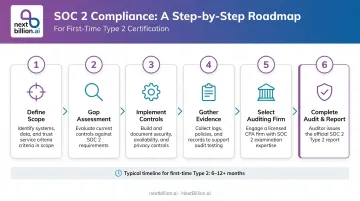
Realistic timeline for first-time Type 2: 6 months to over a year, primarily driven by the observation period.
Who Can Perform the Audit?
Step 5 above has a hard constraint worth emphasizing: only a licensed Certified Public Accountant or AICPA-authorized CPA firm can perform the audit. Compliance automation vendors, consultants, and security firms cannot issue a SOC 2 report. The auditor must also be independent of your organization.
What Does It Cost?
According to Linford & Co., a CPA firm specializing in SOC audits, costs typically range from $20,000 to $150,000, with a median around $30,000. Big Four firms start in the low six figures.
Key cost drivers:
- Number of Trust Services Criteria included (Privacy adds significant cost)
- Complexity and number of in-scope systems
- Organization size and number of locations
- Choice of auditing firm (specialized CPA firm vs. Big Four)
- Use of compliance automation tooling to streamline evidence collection
Type 2 audits cost more than Type 1 because auditors must review evidence across the full observation period, not just a point in time.
Frequently Asked Questions
Is SOC 2 compliance mandatory?
SOC 2 is not legally required the way HIPAA or GDPR are. However, enterprise customers in healthcare, financial services, and government contracting frequently require a current SOC 2 report as a contractual condition of vendor approval, which makes it effectively mandatory for companies selling into those markets.
What does SOC 2 compliance mean?
It means your organization has undergone an independent audit by a licensed CPA and demonstrated that your controls meet the AICPA's Trust Services Criteria for protecting customer data. The result is a formal attestation report, not a certificate, badge, or public listing. For companies like NextBillion.ai handling location and fleet data for enterprise customers, that report is often the baseline a procurement or security team asks for before a contract moves forward.
What are the 5 criteria of SOC 2 compliance?
The five Trust Services Criteria are Security (required for all audits), Availability, Processing Integrity, Confidentiality, and Privacy. Organizations select the additional criteria based on what their systems do and what commitments they've made to customers.
Is SOC 2 the same as ISO 27001?
No. ISO 27001 is an international standard for establishing an Information Security Management System and produces a certification. SOC 2 is a U.S.-originated audit framework that produces an attestation report. They're complementary. Many mature organizations, including NextBillion.ai, hold both simultaneously.
What is the difference between SOC 2 Type 1 and Type 2?
Type 1 evaluates whether controls are appropriately designed at a single point in time. Type 2 evaluates whether those controls operated effectively over a defined observation period of 3–12 months. Type 2 is more rigorous and is what most enterprise customers require before vendor approval.
Who can perform a SOC 2 audit?
Only a licensed Certified Public Accountant (CPA) or an AICPA-authorized CPA firm. The auditor must be independent of the organization being audited and have expertise in the SOC framework and Trust Services Criteria. Consultants, security vendors, and compliance platforms cannot issue a SOC 2 report on their own. Those platforms can help track evidence and readiness, but the final attestation always has to come from the CPA firm itself, not the tool vendor.
How hard is SOC 2 compliance?
Difficulty depends on how mature your security program already is. Companies with documented access controls, change management, and incident response tend to move through readiness faster. Organizations starting from scratch typically need to build policies, implement monitoring, and run those controls consistently before an auditor will even begin fieldwork. The Type 2 observation period adds time since controls must operate reliably, not just exist on paper.
What is SOC 1 and SOC 2 and SOC 3?
SOC 1 covers controls relevant to a customer's financial reporting, commonly used by payroll or billing service providers. SOC 2 covers security and related Trust Services Criteria and is the standard enterprise buyers ask for from technology vendors. SOC 3 is a shorter, general-use version of a SOC 2 report meant for public distribution, without the detailed control testing information.