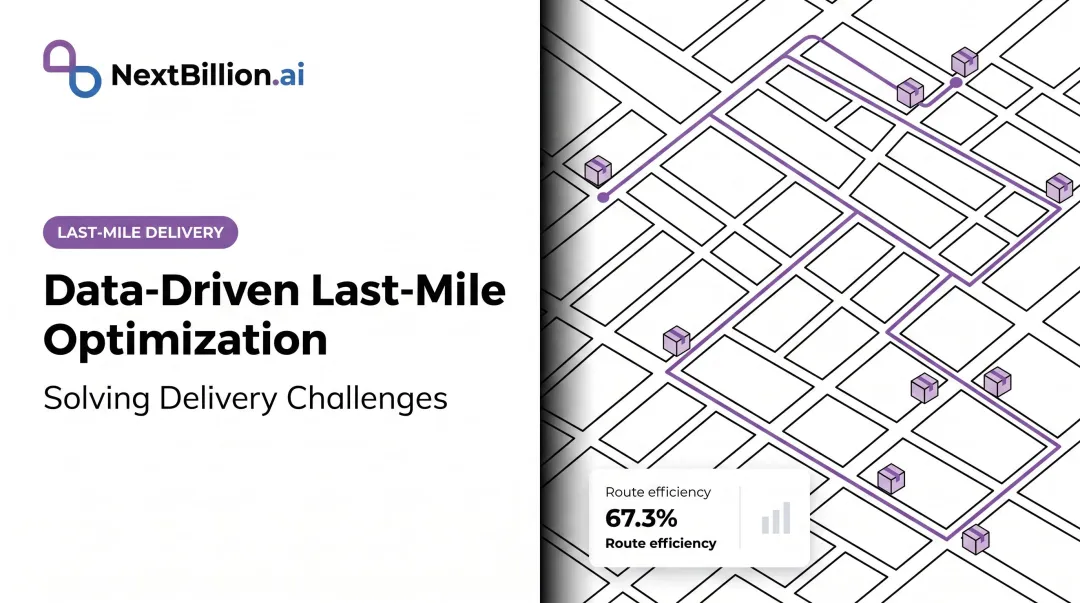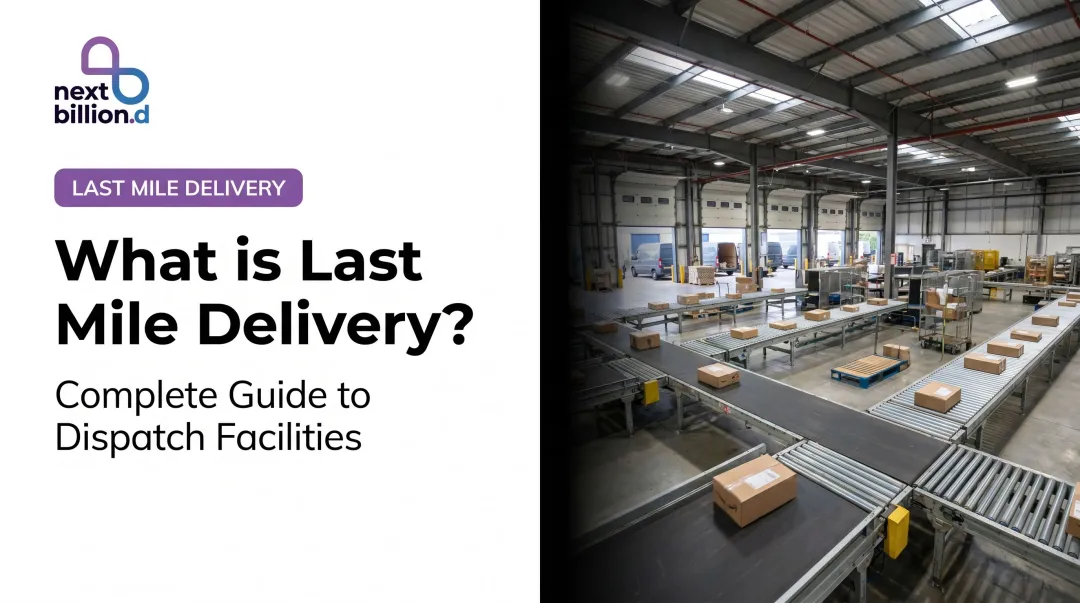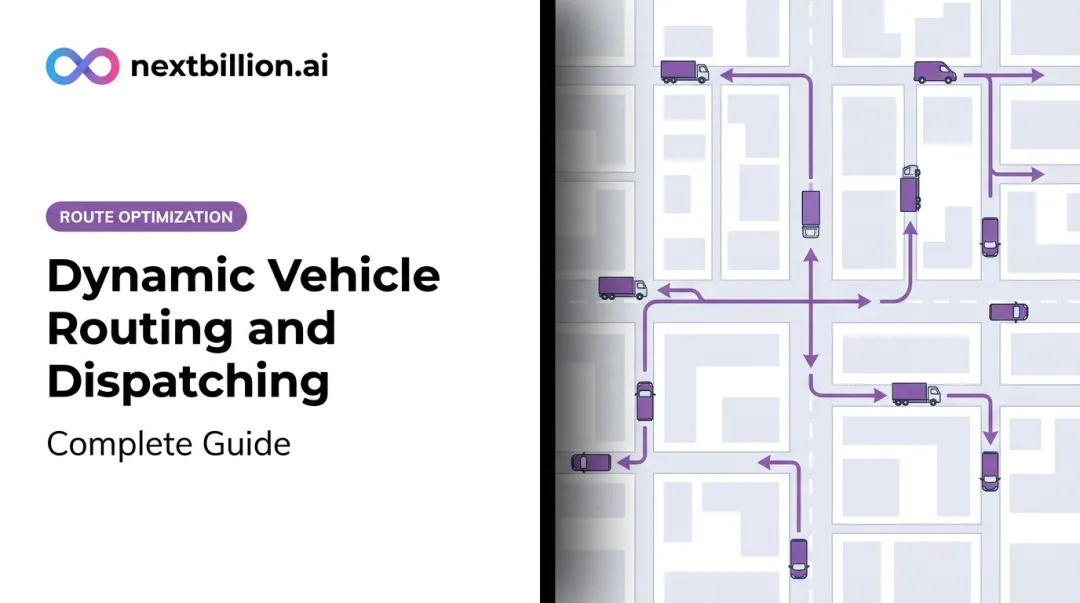
An AI agent for reliable final-mile delivery is an autonomous system that continuously perceives delivery conditions, reasons across competing constraints, and takes corrective action on its own — rather than waiting for a dispatcher to notice a problem. An AI agent for reliable final-mile delivery is an autonomous system that continuously perceives delivery conditions, reasons across competing constraints, and takes corrective action on its own — rather than waiting for a dispatcher to notice a problem. The traditional response — better route planning software, more dispatchers, tighter SLAs — addresses the wrong problem. Last-mile delivery doesn't fail because the morning plan was bad. It fails because conditions change after the plan is made, and most tools have no mechanism to respond. That's the gap AI agents are built to close. That's the gap AI agents are built to close.
AI agents are a different approach. Not smarter dashboards. Not faster planners. Autonomous software systems that continuously perceive delivery conditions, reason across competing constraints, and take corrective action — without waiting for a dispatcher to notice the problem first.
This guide explains what AI agents for last-mile delivery actually are, how they work operationally, what they optimize, how they handle exceptions, and what deployment actually requires.
Key Takeaways
- AI agents are autonomous systems that sense, decide, and act continuously — not one-time route planners
- They re-optimize in real time as traffic shifts, deliveries fail, drivers deviate, and customers reschedule
- Core optimization areas: dynamic routing, predictive ETAs, intelligent dispatch, load sequencing, and customer communication
- Data readiness and integration quality drive deployment success — not the AI model alone
- Key performance metrics: cost per delivery, first-attempt success rate, fuel consumption, stops per hour
What Are AI Agents for Last-Mile Delivery?
An AI agent, as defined by Russell and Norvig's foundational work on intelligent systems, is anything that perceives its environment through sensors and acts upon that environment — choosing actions expected to maximize its performance based on what it observes. The OECD's updated AI definition adds that AI systems have varying levels of autonomy and may adapt after deployment.
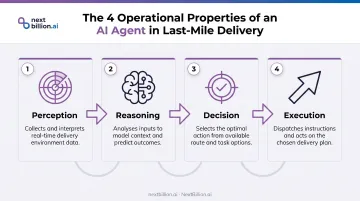
In last-mile delivery, that translates to four operational properties:
- Perception — ingesting live data from GPS, traffic feeds, order systems, and customer signals
- Reasoning — evaluating trade-offs across constraints like time windows, vehicle capacity, and driver hours
- Decision — selecting the optimal action given current conditions
- Execution — pushing that decision to driver apps, dispatch systems, or customer notifications
This is different from a rule-based dispatch tool or a static optimization engine, which produce a fixed plan and stop there. An AI agent manages that plan continuously throughout the day, adjusting as conditions change.
Why Last-Mile Specifically
Every logistics segment deals with variability. But last-mile has the highest variability per stop — customer unavailability, access restrictions, parking constraints, address errors — and the most customer-facing touchpoints. A 15-minute delay at stop 8 can cascade into five missed time windows before noon.
Linehaul and warehouse operations deal with disruptions too, but their failure modes are more contained. In last-mile, one bad stop propagates through every stop that follows.
Single-Agent vs. Multi-Agent Systems
Two architectures are relevant at scale:
- Single-agent systems — one optimization engine coordinating the full fleet, best suited for centralized operations with clear depot structures
- Multi-agent systems — individual agents representing vehicles, zones, or warehouses that coordinate collectively, better suited for distributed networks or dynamic on-demand environments
A single-agent system optimizes globally but becomes computationally expensive as fleet size grows. Multi-agent approaches trade some global optimality for speed and resilience — a worthwhile exchange once you're running hundreds of concurrent routes.
How AI Agents Work in Last-Mile Delivery
AI agents operate through a continuous cycle — perception feeds decision-making, decisions trigger execution, execution generates feedback that updates perception. Each stage depends on the quality of the previous one.
Perception: Reading Conditions in Real Time
The agent continuously ingests:
- GPS and telematics data from vehicles
- Live traffic and weather signals
- Order management system updates (new orders, cancellations, rescheduling)
- Customer availability signals
- Historical delivery outcomes at the stop level
Data quality directly limits everything the agent can do. Loqate's research found that 71% of businesses identify inaccurate address data as a major cause of failed deliveries, and when address information is incomplete, 39% of deliveries fail entirely and 41% are delayed.
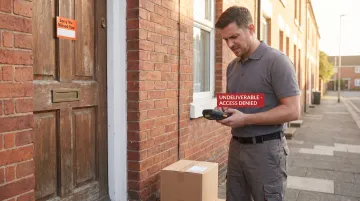
Common perception-layer failures in practice:
- Delayed telematics feeds that show vehicle positions minutes behind actual location
- Incomplete address records that generate impossible routing instructions
- Siloed WMS and TMS systems that don't share order status in real time
- Customer preference data that lives in a CRM the routing layer never touches
These gaps must be resolved before deployment. An agent working from stale or incomplete data makes confident decisions based on conditions that no longer exist.
Decision-Making: Routing, Scheduling, and Dispatching Logic
The reasoning layer processes live inputs against a defined set of operational constraints — delivery time windows, vehicle capacity, driver hours-of-service, access restrictions, load sequencing requirements — and evaluates possible actions.
The computational scale is substantial. Operations research benchmarks at SINTEF include Vehicle Routing Problem with Time Windows (VRPTW) instances covering 1,000 customers, minimizing both vehicle count and total distance simultaneously. UPS's ORION system, at full deployment, was planned to cover 55,000 drivers averaging 160 customers per day. Problems at that scale require purpose-built solvers, not spreadsheet logic.
Machine learning layers trained on historical data improve decision accuracy over time. Specifically, they learn to:
- Predict stop-level service times based on location type, order size, and time of day
- Identify stops with elevated first-attempt failure risk
- Match drivers to route types where their historical performance is strongest
NextBillion.ai's routing engine supports 50+ hard and soft constraints, covering time windows, vehicle capacity dimensions, driver shift limits, priority ordering, and skill-based assignments. Routes generate in seconds, even for high-volume operations. Soft constraints add flexibility: rather than treating every parameter as absolute, the system allows minor deviations where the trade-off improves overall route completion rates.
Execution and Feedback: Closing the Loop
When the agent makes a decision, it pushes updates to driver apps, dispatch systems, and customer notification platforms simultaneously. Then it immediately starts receiving feedback: actual delivery times, driver deviations from planned routes, failed attempt outcomes.
That feedback re-enters the perception layer. The next decision the agent makes incorporates what just happened — not just what was planned. That's the gap between AI agents and static optimization tools: the system doesn't plan once and hope conditions hold. It learns from every delivery outcome and adjusts continuously.
What AI Agents Optimize in Last-Mile Delivery
Dynamic Route Optimization
Static route planning produces a single optimal sequence at the start of the day. AI agents recalculate continuously as conditions evolve — traffic incidents, new order insertions, completed stops running long.
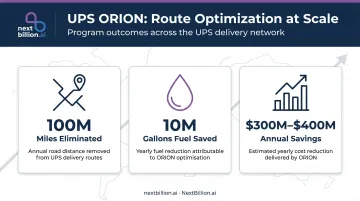
UPS's ORION program illustrates the scale of what's at stake. At projected full deployment, ORION was expected to eliminate 100 million miles annually, cut fuel consumption by 10 million gallons, and deliver $300M–$400M in annual savings — according to INFORMS. Those figures cover ORION's broader optimization program, but they establish the magnitude of value that routing decisions carry.
Real-time re-optimization is where that value is captured or lost. NextBillion.ai's route optimization engine handles exactly this — inserting new orders into ongoing routes with minimal disruption, adjusting for mid-route changes, and pushing updated sequences directly to driver apps through integrations with Samsara, Geotab, and Motive.
Predictive ETAs and Delivery Window Management
AI agents generate probabilistic ETA estimates that update throughout the day as actual route progress deviates from plan. When a stop runs 8 minutes long, every downstream window compresses. The agent recalculates, flags at-risk stops, and either re-sequences or notifies affected customers before the window breaks.
Customer expectations here are unforgiving. Loqate found that 57% of shoppers are reluctant to return to a retailer after a fulfillment failure. Accurate, updating ETAs cut the two biggest drivers of failed first attempts: customers not being home and customers making alternative plans because the window was too wide.
NextBillion.ai's predictive ETA modeling achieves 95% accuracy by combining historical stop-duration patterns with real-time traffic data — a meaningful improvement over static time estimates that assume idealized conditions.
Intelligent Dispatch and Driver-Load Matching
Rather than assigning stops based on static shift schedules, AI agents match drivers to tasks using real-time variables:
- Current vehicle location and remaining capacity
- Driver hours-of-service remaining
- Historical stop performance on similar route types
- Skill or certification requirements for specific deliveries
NextBillion.ai's Driver Assignment API evaluates these parameters with sub-second latency, enabling smart reassignment when drivers call in sick, vehicles break down, or order volumes spike mid-shift — without requiring dispatcher intervention for each change.
Load and Stop Sequencing
Physical loading sequence directly affects on-road efficiency. When packages are loaded in reverse delivery order, drivers avoid mid-route rearrangement at each stop. AI agents optimize the loading plan alongside the route plan — accounting for delivery order, compartment constraints (temperature zones, fragile cargo), and access-restriction-based sequencing at specific stops.
Automated Customer Communication
AI agents trigger proactive outbound updates based on live route progress: narrowing delivery windows as the driver approaches, alerting customers to delays before they become missed deliveries, and confirming ETAs with accuracy that static systems can't match.
This reduces inbound support volume significantly. Fewer surprises for customers means fewer calls to your support team — and fewer failed delivery attempts to re-route the following day.
How AI Agents Respond to Disruptions and Exceptions
Autonomous Exception Handling
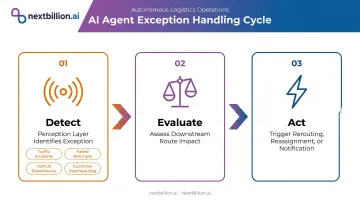
The classes of exceptions AI agents handle without dispatcher intervention:
- Traffic incidents that shift ETAs beyond window tolerances
- Failed delivery attempts (wrong address, customer unavailable)
- Vehicle breakdowns requiring load reassignment
- Customer-initiated rescheduling after dispatch
For each exception, the agent detects the event through its perception layer, evaluates downstream impact on the full route, and triggers a corrective action — rerouting, driver reassignment, or customer notification — automatically.
Proactive Anomaly Detection
Catching exceptions before they become missed deliveries is where anomaly detection earns its keep. These models continuously monitor for deviations from predicted behavior:
- A driver stopped significantly longer than the predicted service time at a location
- ETA drift that will push arrival beyond the delivery window
- Route deviation suggesting navigation error or access problem
Flagging these signals early shifts operations from reactive firefighting to preemptive management. That's the practical value of NextBillion.ai's Live Tracking API: configurable route-deviation alerts, geofence-based notifications, and ETA monitoring give dispatchers an accurate, real-time picture — so intervention happens before a missed window, not after.
The Human Oversight Layer
AI agents are not designed to replace human judgment entirely. Complex situations — major vehicle failures, safety events, customer disputes, regulatory issues — escalate to dispatchers. The agent handles routine exceptions autonomously, freeing operations teams to focus on situations that actually require judgment.
Override capabilities are non-negotiable for driver trust. Drivers who can flag a bad routing decision — and see that feedback reflected in future suggestions — build confidence in the system. That trust translates directly into higher compliance rates and fewer manual workarounds on the road.
Deploying AI Agents for Last-Mile Delivery: Practical Considerations
Data and Systems Readiness
The most common deployment failure isn't a bad AI model — it's fragmented data. An agent that can't see accurate vehicle locations, current order status, and real-time traffic simultaneously cannot make good decisions, no matter how capable the model.
Data unification across TMS, WMS, fleet telematics, and order management systems is the prerequisite that everything else depends on. NextBillion.ai's API-first architecture addresses this directly — integrating with platforms including:
- Samsara, Geotab, and Motive for fleet telematics and vehicle location
- AWS, GCP, and Azure for cloud-based deployment
- On-premise Kubernetes environments for organizations with data residency requirements
This gives the routing and dispatch layer a single, reliable location intelligence source to act on.
Phased Deployment Approach
Start with one high-impact, contained use case before scaling. Route optimization in a single region or depot is the most common entry point — it generates training data, surfaces integration gaps, and produces measurable results that justify broader rollout.
NextBillion.ai offers a 21-day free evaluation where their solutions team runs actual customer data and constraints through the API before any commitment. Most customers reach production-ready routing within a few weeks to a couple of months. Model quality continues improving as more live delivery data accumulates.
Change Management and Driver Adoption
A phased rollout gets the technology in place. Whether it actually improves operations comes down to driver acceptance and dispatcher trust.
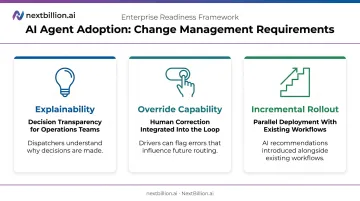
Three things matter most here:
- Explainability — dispatchers need to understand why the system made a particular routing decision, not just what it recommended
- Override capability — drivers must be able to flag routing errors, and those flags need to visibly influence future decisions
- Incremental rollout — introducing AI recommendations alongside existing workflows before replacing them entirely reduces resistance and surfaces issues before they become operational problems
Frequently Asked Questions
How much does AI agent software for last-mile delivery cost?
Pricing varies by model: per-vehicle, per-order, or fixed monthly fee. Per-order pricing tends to be most predictable for high-volume operations, since re-optimization within the same day still counts as one order. Cost drivers include fleet size, constraint complexity, and whether on-premise deployment is required.
How does an AI agent integrate with existing WMS and TMS systems?
Integration happens via REST APIs and data pipelines connecting to TMS, WMS, ERP, fleet telematics, and driver apps. This integration layer — not the AI model itself — is typically the most complex and time-consuming part of deployment. NextBillion.ai supports integrations with major platforms including Samsara, Geotab, SAP, Oracle, and Microsoft Dynamics. Data quality and consistent identifiers across systems matter more than the number of connections, since mismatched order or stop IDs are the most common cause of integration delays. Data quality and consistent identifiers across systems matter more than the number of connections, since mismatched order or stop IDs are the most common cause of integration delays.
How long does deployment take?
Initial deployment of a focused use case like route optimization typically takes 2–8 weeks when data foundations are in place. Full production maturity, where the model improves stop-time predictions from live data, requires an additional 3–6 months of operational history.
What performance improvements can I expect?
UPS's ORION program is the most documented benchmark: projected elimination of 100 million route miles and 10 million gallons of fuel annually. Per-operation results depend on baseline efficiency and data quality, and they compound as the system accumulates more delivery history. Expect gains across route miles, fuel use, on-time percentage, and stops per driver hour rather than a single fixed number, since fleet size, geography, and order density all shape outcomes. Expect gains across route miles, fuel use, on-time percentage, and stops per driver hour rather than a single fixed number, since fleet size, geography, and order density all shape outcomes.
How does the AI handle exceptions like traffic and failed deliveries?
The agent detects exceptions through real-time anomaly monitoring, evaluates impact on the full route, and autonomously triggers rerouting, reassignment, or customer notification. Proactive detection (flagging likely issues before they become missed deliveries) is where the operational difference is most pronounced. Complex situations escalate to dispatchers with context attached, such as affected stops and suggested alternatives, so the human decision is faster rather than starting from scratch.
How do you measure ROI after implementing an AI last-mile agent?
Track these KPIs against a pre-deployment baseline: cost per delivery, first-attempt delivery rate, on-time delivery percentage, fuel consumption per route, and driver stops per hour. A controlled comparison period post-deployment — same routes, same fleet, different system — gives the clearest measurement. ROI compounds over time as the model improves on accumulated delivery data.
Is there an AI for route planning specifically for last-mile delivery?
Yes. AI-based route planning tools ingest live traffic, delivery windows, vehicle capacity, and driver constraints to generate and continuously re-optimize routes, rather than producing a static plan at the start of the day. This differs from traditional route planning software, which typically calculates once and does not adjust automatically as conditions change during execution. NextBillion.ai's route optimization API is built for this continuous-adjustment model.
How can AI improve last-mile delivery specifically for US fleets?
AI agents help US fleets stay within FMCSA hours-of-service limits by factoring driver availability into route plans, reduce fuel and mileage costs relevant to IFTA reporting, and adapt routes in real time for traffic, weather, and delivery windows. The result is fewer missed delivery attempts and better use of driver hours, rather than a general efficiency claim disconnected from operational compliance realities.