What makes NextBillion.ai's dispatch software suitable for heavy equipment fleets specifically?
Unlike general-purpose fleet tools, NextBillion.ai's platform is built with truck-aware routing at its core. It accepts vehicle-specific parameters — height, weight, axle load, cargo type — to generate routes that avoid low-clearance bridges, weight-restricted roads, and HGV-prohibited streets. This matters for heavy equipment fleets moving oversized or overweight machinery between job sites, where a single wrong turn onto a restricted road can mean fines, detours, or infrastructure damage. Dispatch decisions reflect what your actual vehicles can legally and safely travel, not car-routing assumptions, and can be adjusted per vehicle as your equipment mix changes.
How does the route optimization handle complex constraints like time windows and driver shift limits?
The Route Optimization engine supports 50+ hard and soft constraints simultaneously, including delivery time windows, driver shift start and end times, maximum route duration and distance, vehicle load capacity, break requirements, and hazardous material restrictions. Optimized, dispatch-ready routes are generated in seconds even for large fleets with hundreds of stops and multiple depots.
Can the platform integrate with our existing fleet management or telematics systems?
Yes. NextBillion.ai integrates natively with leading telematics and fleet management platforms including Samsara, Geotab, Motive, and Netradyne, as well as enterprise systems like SAP, Microsoft Dynamics 365, and Salesforce. This matters for heavy equipment operators who already track machine hours, maintenance schedules, or utilization through a telematics provider — dispatch and routing data can layer on top of that existing setup instead of replacing it. The API-first architecture also supports integration into custom TMS, ERP, or dispatch consoles, with dedicated solutions engineering support during onboarding.
How does real-time dynamic reassignment work when a driver or vehicle becomes unavailable mid-shift?
The Route Dispatch API supports real-time route updates and task reassignment. When a driver calls in sick, a vehicle breaks down, or a new urgent job is added, the system pushes revised route instructions to affected drivers instantly. Combined with the Driver Assignment API for intelligent replacement selection and the Route Optimization API for re-optimization, operational continuity is maintained without manual dispatcher intervention.
What compliance documentation does the platform support for commercial trucking operations?
The Route Reconstruction API rebuilds complete, road-snapped trip records from raw GPS data — producing time-stamped, legally defensible journey histories with road segment identifiers and distance data. These records support HOS compliance documentation, mileage audit trails, fuel surcharge verification, and incident reconstruction for insurance and regulatory purposes in commercial freight operations.
How does the pricing model work, and will costs spike during high-volume periods?
NextBillion.ai offers per-vehicle and per-order pricing rather than per-API-call billing. This means seasonal demand spikes, high-frequency re-optimization cycles, and large batch planning runs do not translate into unpredictable cost overruns. Operations teams get predictable monthly costs aligned to fleet size or order throughput — a critical advantage for heavy equipment fleets managing variable workloads.
Can we define restricted zones or custom road rules specific to our operational environment?
Yes. The Road Editor App is a no-code interface that lets operations teams inject custom road attributes — road closures, turn restrictions, no-parking zones, custom speed limits, theft-prone corridors, and plying permissions — directly into the routing engine. These edits apply immediately to all route calculations, ETAs, and navigation instructions without requiring developer involvement or map provider support tickets.
What deployment options are available for organizations with strict data security requirements?
NextBillion.ai supports cloud deployment on AWS, Google Cloud, and Microsoft Azure, as well as full on-premise deployment within a customer's own Kubernetes environment or private data center. The platform is SOC 2 Type II certified and ISO/IEC 27001:2013 certified, making it suitable for enterprises with GDPR, CCPA, or strict government data residency mandates.
Does the platform help with DOT and permitting requirements for moving heavy equipment on public roads?
The platform's truck-aware routing incorporates road restrictions relevant to heavy vehicles, including weight limits, bridge clearances, and roads where large or heavy vehicles are prohibited, helping dispatchers avoid routes that would violate state or local permitting rules. It does not generate or file DOT permits itself, but the Route Reconstruction API's trip records can support documentation needed for compliance audits and permit verification.
How does the platform handle tracking for idle or underutilized heavy equipment across job sites?
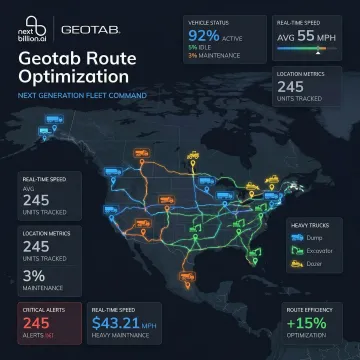
Real-time asset tracking gives dispatchers visibility into where each machine is and whether it is active, idle, or in transit across job sites. This visibility feeds into dispatch decisions, allowing operators to reassign underused equipment to nearby jobs instead of mobilizing another machine, and to identify idle time patterns that may point to scheduling or job-site bottlenecks.