Introduction
Embeddable deployment through private cloud or on-premise infrastructure lets enterprise B2B SaaS buyers keep the ease of cloud-delivered software while meeting the data control, regulatory compliance, and performance guarantees that shared multi-tenant environments can't reliably provide. Private cloud deployment is how enterprises resolve this.
This article is written for enterprise IT leaders, CTOs, and operations architects in logistics, healthcare transport, field service, and regulated industries — specifically those evaluating SaaS platforms that process sensitive location, routing, or operational data. The deployment model you choose isn't a secondary IT decision. For regulated organizations, it's a procurement requirement.
What follows covers the full picture: what private cloud deployment actually is, how it differs from shared SaaS and true on-premises, how it works in practice, and when it may not be the right fit.
KPMG's 2023 Cloud Transformation Survey found that 87% of organizations had auditors or regulators flag at least two compliance issues in the prior year. Infrastructure choices are rarely just technical — for regulated businesses, they're audit territory.
Key Takeaways
- Private cloud gives enterprises dedicated, single-tenant infrastructure — without the risks of shared infrastructure
- Most commonly chosen for data sovereignty, regulatory compliance, security isolation, and low-latency operational workloads
- Deployment options span vendor-managed dedicated instances, BYOC (bring your own cloud), and true on-premises environments
- Key success factors include infrastructure provider, IT maturity, certification scope, update cadence, and network design
- Shared SaaS remains faster, cheaper, and simpler for organizations without strict compliance or data control requirements
What Is Private Cloud Deployment for Enterprise SaaS?
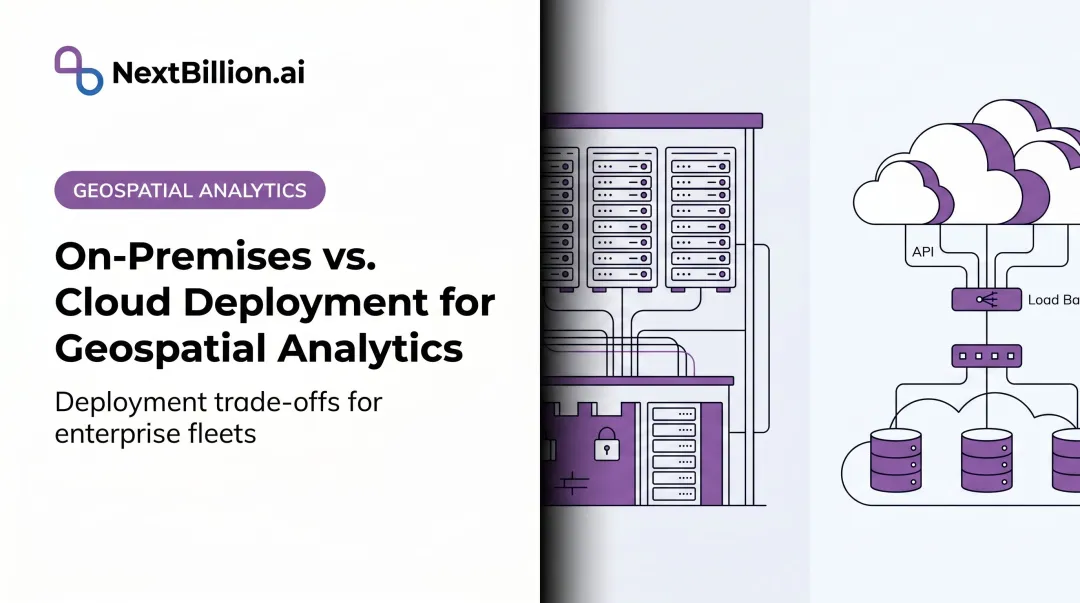
NIST defines private cloud as cloud infrastructure provisioned for the exclusive use of a single organization — owned, managed, and operated by the organization, a third party, or both, and existing on or off premises. For enterprise SaaS, that means dedicated, single-tenant infrastructure for one customer — not a shared environment where compute, storage, and network resources are split among many. On-premises deployment, specifically, means the software runs on servers inside the customer's own facility or data center, under the customer's direct physical and network control, rather than on infrastructure owned or operated by a cloud provider.
The Private Cloud Spectrum
"Private cloud" isn't a single architecture — it covers three distinct options:
- Vendor-managed dedicated instance — vendor hosts the application on dedicated infrastructure in their own environment, fully isolated from other customers
- BYOC (Bring Your Own Cloud) — vendor deploys and operates the application inside the customer's own cloud account (AWS VPC, Azure subscription, GCP project); the customer owns the infrastructure, the vendor manages the software
- True on-premises — application runs in the customer's own data center or private servers, behind their firewall
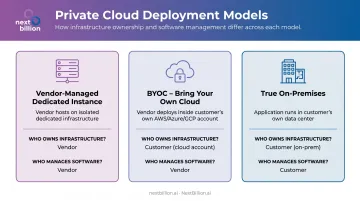
Most modern private cloud deployments run in isolated cloud environments on AWS, Azure, or GCP — not in physical data centers. True on-premises is one option within the spectrum, not its definition.
What Makes It Different
The defining characteristic is exclusive, single-tenant use of dedicated infrastructure — regardless of where that infrastructure physically sits. A well-configured private VPC on AWS with no shared resources qualifies, and so does a physical server in a colocation facility. A multi-tenant SaaS instance with enhanced logging and stricter access controls does not — no matter how locked down it appears.
Why Enterprises Choose Private Cloud Deployment
Data Sovereignty and Regulatory Compliance
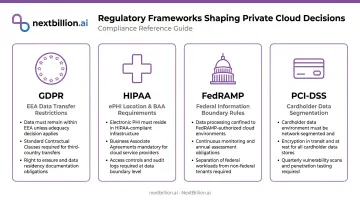
Industries including healthcare, transportation, regulated logistics, government contracting, and financial services operate under frameworks — GDPR, HIPAA, CCPA, FedRAMP, PCI-DSS — that require knowing exactly where data is stored and processed.
In shared SaaS, data may traverse or reside in regions that violate these requirements. Private cloud eliminates that ambiguity, since embeddable private cloud or on-premise deployment keeps data within a defined, auditable boundary rather than a pooled multi-tenant infrastructure. Key regulatory constraints:
- GDPR restricts transfers of personal data outside the EEA unless adequacy decisions, standard contractual clauses, or binding corporate rules apply
- HIPAA requires a Business Associate Agreement with any cloud service provider that creates, receives, maintains, or transmits ePHI — and location must factor into the risk analysis
- FedRAMP defines a boundary around all services and infrastructure handling federal information, prohibiting reuse of federal data for shared purposes like ML training without explicit opt-in
- PCI-DSS scopes systems storing, processing, or transmitting cardholder data, with segmentation as a primary scope-reduction mechanism
The pressure is real: Gartner projects that more than 75% of enterprises outside the US will have a digital sovereignty strategy by 2030, and 61% of Western European CIOs already plan to increase reliance on local cloud providers.
Security Isolation and Access Control
In a dedicated private cloud environment, enterprises can:
- Enforce their own security policies rather than inheriting the vendor's shared posture
- Integrate with internal SIEM tools and identity providers (SSO, JWT, API keys)
- Write their own access control rules and maintain complete audit logs
- Isolate their environment from other tenants completely
ENISA identifies isolation failure — across storage, memory, routing, and reputation — as a core risk in shared multi-tenant environments. Private cloud is not automatically more secure than shared SaaS, though. A poorly patched or misconfigured private instance can present more risk than a well-audited multi-tenant platform. The advantage is control, not guaranteed security.
Performance for Operational Workloads
Shared cloud environments introduce the "noisy neighbor" problem: one tenant's resource consumption degrades another's response times, producing failed requests or elevated latency. For latency-sensitive workloads — real-time route optimization, GPS fleet tracking, dispatch sequencing — this variability is operationally costly.
Dedicated infrastructure removes that contention. NextBillion.ai's on-premises deployment delivers 20x higher throughput and 3x lower latency compared to typical cloud deployments, with large-scale routing requests processed in milliseconds. For last-mile delivery and field service dispatch where sub-second response times determine operational throughput, that difference is material.
Deep Customization and Enterprise Integration
Private cloud instances support:
- Direct connections to enterprise ERP, TMS, WMS, and fleet management systems through private network links
- Custom Kubernetes configurations, including namespace isolation, horizontal pod autoscaling, and multi-cluster setups
- Bespoke data handling policies not possible in shared SaaS
- Modular deployment — selecting only the application components relevant to the use case
NextBillion.ai's on-premises and private cloud deployment is built on Kubernetes with Helm chart support and the open-source k10s utility. This architecture gives logistics and field service operators the enterprise control that shared SaaS platforms can't replicate.
How Private Cloud Deployment Works
Step 1: Infrastructure Provisioning and Environment Isolation
The enterprise or vendor selects and provisions dedicated infrastructure — choosing cloud provider, geographic region, and isolation mechanism (dedicated VPC, private cluster, or bare-metal servers). For true on-premises, this means configuring Kubernetes or VM infrastructure in the enterprise's own data center.
This step is where data residency decisions are locked in. The geographic region and infrastructure provider determine which jurisdiction governs data storage and processing — a compliance decision, not just a technical one.
Step 2: Application Deployment and Configuration
The SaaS application is deployed as containerized workloads using Kubernetes operators, Helm charts, or Docker Compose. Configuration at this stage includes:
- Connection to enterprise identity providers and internal databases
- Security policies, role-based access controls, and encryption settings
- Network egress rules and firewall configurations
- API integration with operational systems
This configuration layer is what makes a private deployment meaningfully different from spinning up a standard SaaS account. The same application, differently configured, behaves as an entirely different security and compliance posture.
Step 3: Ongoing Operations — Updates, Monitoring, and Support
Once that configured environment is live, the operational model shifts. Unlike shared SaaS — where the vendor pushes updates to all customers simultaneously — private cloud deployments require a coordinated update process.
The tradeoff is real:
| Factor | Shared SaaS | Private Cloud |
|---|---|---|
| Update timing | Vendor-controlled | Enterprise-controlled |
| Version management | Automatic | Manual/scheduled |
| Operational disruption | No coordination needed | Requires change management |
| Security patch speed | Immediate | Dependent on enterprise schedule |
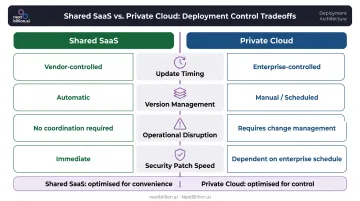
Organizations that don't actively manage their update calendar frequently fall multiple versions behind, accumulating security debt. NIST SP 800-40 Rev. 4 frames patch management as preventive maintenance — not an optional housekeeping task.
Before deployment, nail down contractual terms covering:
- Patch windows and update scheduling
- Supported version timelines and end-of-life policies
- Emergency fix procedures for critical vulnerabilities
Key Factors That Affect Private Cloud Deployment Success
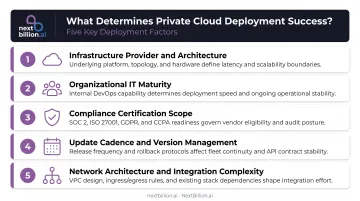
Five factors consistently determine whether a private cloud deployment succeeds — or stalls.
Infrastructure Provider and Architecture
Your choice of cloud provider (AWS, Azure, GCP) or on-premises hardware directly shapes compliance certification availability, network connectivity options, and how data sovereignty requirements can be met. Kubernetes-based deployments offer greater portability and standardized management across providers compared to VM-only approaches.
Organizational IT Maturity
Even vendor-managed private cloud deployments require the enterprise to engage with infrastructure decisions, network design, and security policy definition. Organizations without dedicated platform engineering or DevOps capability face significant operational burden unless the vendor provides a fully managed offering.
For organizations earlier in their platform engineering maturity, NextBillion.ai covers technical support for initial setup, with ongoing support included under the Enterprise plan — which meaningfully reduces that burden.
Compliance Certification Scope
Verify that the SaaS vendor's certifications (SOC 2 Type II, ISO/IEC 27001, HIPAA BAA, FedRAMP) explicitly cover the private or on-premises deployment model — not only the shared SaaS environment. Many vendors hold certifications for their public SaaS only.
In HIPAA contexts, compliance responsibilities are split between the customer and the cloud service provider, with each party accountable for their respective controls. Confirm in writing which party owns which obligations before signing.
Update Cadence and Version Management
Establish contractual terms before deployment for update obligations, security patch windows, and supported version timelines. Enterprises that treat this as a post-launch conversation routinely find themselves running unsupported versions within 12–18 months.
Network Architecture and Integration Complexity
Network boundary design is the leading cause of private cloud deployment delays. Key elements that must be scoped and documented before deployment begins — not retrofitted after go-live — include:
- Firewall rules and ingress/egress policies
- VPN or private link connectivity to enterprise systems
- Identity federation and access control configuration
When Private Cloud Deployment May Not Be the Right Fit
Private cloud is not universally necessary. Three situations where shared SaaS is the better choice:
When compliance requirements are limited Organizations in non-regulated industries — handling no sensitive personal data and facing no cross-border data residency obligations — rarely need private cloud. A well-certified shared SaaS platform covers the compliance surface without the added cost and operational overhead.
When internal IT capacity cannot sustain the model Private cloud deployments require active enterprise participation across:
- Security policy definition
- Network architecture decisions
- Integration maintenance
- Update approvals and change management
Organizations without platform engineering or DevOps resources should evaluate whether they have the internal capacity to sustain these demands before committing.
When deployment speed is the primary constraint Private cloud setup is measured in weeks to months, not hours. The process spans infrastructure provisioning, security review, network configuration, and compliance validation before a single user logs in. Organizations under time-to-market pressure should start with shared SaaS, establish usage patterns, and plan a migration to private cloud when compliance or operational scale makes it necessary.
Frequently Asked Questions
Can a private cloud be deployed on-premise?
Yes. Private cloud can be deployed on-premise in a customer's own data center or private server infrastructure, which is often the preferred model for enterprises with strict data residency, compliance, or air-gapped network requirements. Modern on-premises private cloud deployments commonly use Kubernetes clusters to standardize deployment, scaling, and vendor-managed updates — NextBillion.ai's on-premises option deploys on any Kubernetes cluster using Helm charts and the k10s utility, letting internal IT teams manage infrastructure directly.
What are the three types of cloud deployment?
There are three deployment types:
- Public cloud: Shared, multi-tenant infrastructure managed by a provider (AWS, Azure, GCP)
- Private cloud: Dedicated, single-tenant infrastructure — either vendor-managed or customer-managed
- Hybrid cloud: A combination of public and private cloud, sometimes including on-premises infrastructure, working together
What are the main types of cloud services?
The three core service types are IaaS (infrastructure on demand), PaaS (managed development environments), and SaaS (fully managed applications). Private cloud is a deployment model choice that applies across all three — it describes where and how the service runs, not what it delivers.
What is the difference between a private cloud and a public cloud?
A public cloud is shared, multi-tenant infrastructure managed by a provider (AWS, Azure, GCP) accessible to many organizations. A private cloud is dedicated, single-tenant infrastructure used exclusively by one organization — giving it full control over security configuration, data residency, and access policies. For enterprises handling regulated logistics or fleet data, this distinction often determines whether a deployment can meet internal audit or compliance requirements without relying on a shared vendor environment.
What are the security benefits of private cloud deployment for enterprise SaaS?
The primary benefits are tenant isolation (no shared resources with other organizations), the ability to enforce enterprise-specific security policies and integrate with internal SIEM and IAM tools, full control over audit logs and access rights, and independence from the vendor's shared security posture. The advantage is control, not automatic security — a private cloud still requires the customer's own security team to configure, patch, and monitor it correctly.
What is BYOC and how does it differ from private cloud deployment?
BYOC (Bring Your Own Cloud) is a specific form of private cloud deployment where the SaaS vendor deploys and manages the application inside the customer's own cloud account (AWS, Azure, GCP). The customer retains infrastructure ownership and data control while the vendor continues to manage software operations — combining SaaS operational convenience with private cloud data sovereignty.
What does "on-premises deployment" mean?
On-premises deployment means the software runs on infrastructure physically located in the customer's own data center or facility, rather than in a vendor-hosted or public cloud environment. The customer's IT team manages the servers, networking, and often the operating system layer, while the vendor supplies the application and update packages. This model is common in enterprises with strict data residency, air-gapped, or regulatory requirements.
What deployment model combines both public and private cloud services?
Hybrid cloud combines public and private cloud services, allowing workloads to move between them based on cost, performance, or compliance needs. In enterprise B2B SaaS, this often means running core application logic in a private cloud or on-premises environment for data control, while using public cloud resources for less sensitive workloads such as analytics or scaling during peak demand.