HIPAA-compliant NEMT scheduling software is software that handles encrypted PHI, maintains a signed Business Associate Agreement (BAA), enforces role-based access controls, and still supports the real-time route dispatch a transport operation needs to run. Patient transport scheduling sits at a unique intersection: it's simultaneously a healthcare compliance function and a logistics operation. The software must handle encrypted PHI, signed Business Associate Agreements (BAAs), role-based access controls, AND real-time route dispatch. That's a combination most general scheduling tools simply can't deliver.
The stakes are real. According to IBM's 2025 Cost of a Data Breach Report, healthcare data breaches cost an average of $7.42 million — the highest of any industry. Meanwhile, the NEMT market is projected to reach $18.93 billion by 2031, growing at 8.23% CAGR, according to Mordor Intelligence. That growth creates compliance pressure at every layer of the scheduling stack.
This article covers what makes patient transport scheduling software HIPAA-compliant, reviews the top five purpose-built platforms for 2026, and outlines the must-have features that separate compliant tools from compliance liabilities.
Key Takeaways
- HIPAA-compliant patient transport software requires a signed BAA, PHI encryption in transit and at rest, role-based access controls, and audit logging — all four are required for legal compliance
- The leading platforms for 2026 are MediRoutes, RouteGenie, TripMaster, Ecolane, and CTS Software, all purpose-built for NEMT and paratransit
- Key differentiators: Medicaid/insurance billing integration, real-time GPS dispatch, will-call trip management, and route optimization
- General tools (Google Calendar, Acuity, Doodle) are not substitutes: they lack transport-specific workflows and can't execute a BAA covering transport PHI
What Is HIPAA-Compliant Patient Transport Scheduling Software?
Patient transport scheduling software manages the end-to-end workflow of booking, dispatching, tracking, and billing non-emergency medical transportation (NEMT) trips. It's distinct from clinical appointment scheduling — it handles vehicle routing, driver assignment, and trip manifests, all of which contain PHI tied to a patient's medical condition or care visit.
What Makes It HIPAA-Compliant
Under the HIPAA Security Rule (45 CFR 164.312), compliant transport scheduling software must meet four core requirements:
- Signed BAA — the vendor must contractually commit to PHI protection before data flows
- End-to-end encryption — data encrypted in transit (SSL/TLS) and at rest (AES-256 or equivalent)
- Role-based access controls — drivers see only their manifests; billing staff access financial records; dispatchers manage routing
- Audit logging — every data access and modification event logged with timestamps and user IDs
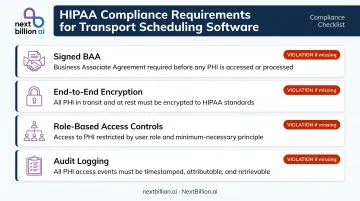
Missing any one of these creates a HIPAA violation. Missing a signed BAA alone is itself a HIPAA violation, regardless of how technically secure the system otherwise is. OCR has enforced this directly, including a $750,000 settlement against Raleigh Orthopaedic for failing to execute a BAA.
Why Generic Scheduling Tools Fall Short
Google Calendar, Acuity, and consumer booking apps weren't built for NEMT operations. The gaps show up fast:
- Missing NEMT-specific data fields: mobility level, required vehicle type, trip authorization codes
- No support for Medicaid billing, eligibility verification, or broker network integration
- Unable to execute a BAA that covers transport-specific PHI workflows at the required scope
Google Workspace does offer a HIPAA-eligible configuration, but it requires specific enterprise setup and places full compliance responsibility on the customer. That's a significant liability for any organization handling transport-related PHI.
Best HIPAA-Compliant Patient Transport Scheduling Software in 2026
These five platforms were selected because they're purpose-built for NEMT and paratransit operations, have documented HIPAA compliance postures, and address the full scheduling-to-billing workflow. Verify current BAA availability, pricing, and certification status directly with each vendor before procurement.
MediRoutes
MediRoutes is a Phoenix-based NEMT platform with over 18 years in operation, serving new and established providers, PACE programs, and brokers. The platform reports 150M+ trips processed and 60,000+ trips dispatched daily across 1,000+ clients.
Its three-pillar structure covers Trip Booking/Planning/Monitoring, Fleet Visibility/Route Execution, and Service Validation/Clean Claims. Medicaid-ready billing is the core differentiator here, particularly for compliance-heavy operations navigating multi-payer environments.
| Category | Details |
|---|---|
| HIPAA/Compliance | HIPAA compliance support and cloud security documented on official pages; BAA availability, encryption standard, and audit-log specifics require direct vendor inquiry |
| Scheduling & Dispatch | Trip intake workflows, live dispatch, real-time fleet tracking, will-call and standing-order management; MAS API integration for trip import and real-time status |
| Broker Integrations | ModivCare (formerly LogistiCare), MTM, MAS, and others via API |
| Pricing | Not publicly listed; contact vendor directly |
RouteGenie
RouteGenie is a Buffalo, NY-based NEMT software platform serving transportation providers and brokers across the US. Its modular product suite includes DispatchGenie, BillingGenie, DriverGenie, ImportGenie, FleetGenie, and HRGenie.
Broker network integrations are where RouteGenie stands out: direct connections with MTM, ModivCare, Veyo, MAS, MART, and GATRA, with automated trip import and export that simplifies multi-payer billing workflows. BillingGenie supports electronic 837P and CMS-1500 claim formats.
| Category | Details |
|---|---|
| HIPAA/Compliance | Official documentation covers unique user IDs, identity verification, password protection, automatic logoff, patient confidentiality, and encrypted data transfer; no public SOC 2 confirmation found |
| Scheduling & Dispatch | Automated trip assignment, driver mobile app, GPS tracking, recurring trip management |
| Broker Integrations | MTM, ModivCare, Veyo, MAS, MART, GATRA |
| Pricing | Starts at $50/month per FAQ; additional plan tiers require direct contact |
TripMaster (by CTS Software)
TripMaster is the flagship product of CTS Software, headquartered in Wilmington, NC. CTS Software began as CTS Management Company in 1982, giving TripMaster one of the longest track records in Medicaid transportation and paratransit software.
Key differentiators include AVL (Automated Vehicle Location) integration for real-time fleet tracking and IVR-based trip reminders. CTS Software's own data shows TripReminder cut no-shows from 13% to 1% at Big Bend Transit, a result that matters for any operator running high trip volumes.
| Category | Details |
|---|---|
| HIPAA/Compliance | HIPAA-compliant billing language and patient confidentiality documented; Event Tracking covers dispatcher/admin/driver actions; explicit BAA terms and encryption standards require procurement inquiry |
| Scheduling & Dispatch | Trip scheduling automation, manifest generation, AVL real-time tracking, IVR passenger notifications |
| Broker Integrations | ModivCare, Alivi, OneCall (API/batch invoice); LogistiCare, MTM, Access2Care (broker import) |
| Pricing | SaaS month-to-month, modular pricing; initial training fee applies; exact figures not public |
Ecolane
Ecolane is a Wayne, PA-based demand-responsive transit and paratransit scheduling platform, part of the National Express family. It serves 300+ agencies and mobility providers and is among the few NEMT platforms to publicly state both SOC 2-compliant data protection and HIPAA BAA handling.
Its AI-driven scheduling engine performs dynamic, real-time trip optimization rather than static route planning, reducing dead miles and improving on-time performance for high-volume paratransit operations. Ecolane reports a 44% average operational efficiency gain across its 16,000+ powered vehicles.
| Category | Details |
|---|---|
| HIPAA/Compliance | Publicly states SOC 2-compliant data protection and HIPAA BAA handling; privacy policy confirms PHI processed under a BAA; strongest public compliance posture of the five platforms |
| Scheduling & Dispatch | Dynamic real-time scheduling algorithm, ADA paratransit compliance features (ADA/WCAG 2.1 AA VPAT), real-time route adjustment, CAD/AVL integration, eligibility verification |
| Pricing | Enterprise contract model; NCPA cooperative purchasing contract available; no public figures |
CTS Software
CTS Software, distinct from its TripMaster product covered above, also offers a platform focused specifically on NEMT and human services transportation. Its emphasis is Medicaid transportation management for social service agencies and state programs.
The platform supports multi-funding-source billing, statewide Medicaid reporting, and exportable reports and manifests. These capabilities make it a practical fit for agencies managing complex state Medicaid and program-compliance requirements.
| Category | Details |
|---|---|
| HIPAA/Compliance | HIPAA-compliant billing and patient confidentiality documented; audit trail capabilities via Event Tracking; volunteer driver coordination and MMIS integration not publicly confirmed — request procurement materials |
| Scheduling & Dispatch | Trip intake and eligibility tools, driver scheduling, automated rider notifications, exportable program compliance reports |
| Pricing | Modular SaaS pricing; scales by functionality tier; exact figures require vendor contact |
Must-Have Features in HIPAA-Compliant Patient Transport Scheduling Software
BAA and Legal Compliance Infrastructure
A signed Business Associate Agreement is a non-negotiable starting point. It defines the vendor's specific obligations for PHI protection under HIPAA and must be executed before any patient data flows through the system.
Operators often skip this step — OCR enforcement confirms it's a real and costly mistake. The $31,000 settlement against CCDH for missing BAA execution is a low-end example; penalties for willful neglect can reach $2.19 million per violation category under current HITECH Act inflation adjustments.
Always request the BAA before signing any platform contract. Review the specific PHI scope it covers, retention terms, and breach notification obligations.
End-to-End Encryption and Role-Based Access
PHI must be protected at every point in the data lifecycle:
- In transit: SSL/TLS encryption on all data transmitted between users, servers, and driver apps
- At rest: AES-256 or equivalent encryption on stored trip records, manifests, and billing data
- Access controls: Role-segmented permissions — drivers see only their assigned manifests, dispatchers manage routing, billing staff access financial records
Over-permissioned access ranks among the most cited compliance failures in NEMT audits. Verify that the platform enforces automatic logoff, unique user IDs per staff member, and that access permissions are configurable at the role level.
Medicaid Billing and Payer Integration
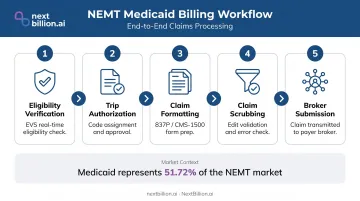
For NEMT operators, billing and scheduling are inseparable. The platform must support:
- 837P and CMS-1500 claim formats (electronic and paper/hybrid)
- Real-time Medicaid eligibility verification (EVS) before trips are confirmed
- Payer-specific authorization codes tied to each trip record
- Automated claim scrubbing and denial resubmission workflows
- Direct connectivity to ModivCare (formerly LogistiCare), MTM, Veyo, and state brokers
Medicaid accounts for an estimated 51.72% of the NEMT market. Payer integration isn't a secondary feature — it's the operational foundation the rest of the platform depends on.
Real-Time GPS Dispatch and Route Optimization
Strong compliance features protect your data, but route optimization determines whether the platform can actually run your operation. Purpose-built NEMT scheduling platforms must handle constraints that generic mapping tools can't model:
- Wheelchair accessibility requirements and vehicle type matching
- Appointment time windows with hard start/end constraints
- Multi-stop sequencing across shared rides
- Will-call pickups where discharge times are unpredictable
- Maximum time-in-vehicle thresholds for patient comfort
Under HIPAA's audit control requirement (45 CFR 164.312(b)), all data access and modification events must be logged with timestamps and user identifiers — and those logs are the primary evidence in any breach investigation. Platforms without granular logging leave providers exposed to maximum HITECH Act penalties, with no documentation trail to demonstrate compliance.
When evaluating platforms, verify:
- Logs capture every access event, not just modifications
- Logs are tamper-resistant and exportable
- Retention period meets your state's compliance requirements
- Incident response procedures are documented in the BAA or security exhibit
How We Evaluated These Solutions
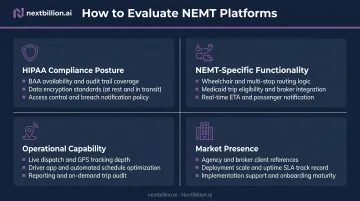
Platforms were assessed against four criteria:
- Documented HIPAA compliance posture: BAA availability, encryption standards, and audit logging
- NEMT-specific functionality — built for transport dispatch, not repurposed from general scheduling tools
- Operational capability: dispatch, GPS tracking, billing integration, and broker network connectivity
- Market presence — verified adoption among NEMT providers and paratransit agencies, not just healthcare scheduling users
One common mistake operators make: choosing general healthcare scheduling tools that aren't built for transport, or assuming HIPAA compliance is a feature the vendor has already handled. HIPAA compliance is a legal agreement, not a checkbox. Always request and review the BAA before signing any contract.
That context matters for what follows. This list covers patient transport scheduling — NEMT, paratransit, medical transport — not clinical appointment scheduling for therapists or clinics. Many "HIPAA scheduling software" listicles conflate the two, but the workflows don't overlap: a therapist's booking tool won't handle wheelchair manifests, Medicaid billing codes, or multi-leg trip coordination.
Conclusion
Selecting HIPAA-compliant patient transport scheduling software isn't a single-feature decision. It requires evaluating the full compliance stack — BAA, encryption, audit logs, role-based access — alongside the operational capabilities that determine whether the platform improves dispatch efficiency, reduces cost-per-trip, and handles Medicaid billing correctly.
Before committing to any platform:
- Request BAA documentation and review it before any PHI flows
- Ask for a compliance-focused demo that walks through encryption, access controls, and audit logging
- Validate payer integrations against your actual broker network and state Medicaid requirements
- Factor scalability and total cost of ownership alongside compliance certification
For teams that need to embed routing directly into their own scheduling infrastructure — rather than adopt an off-the-shelf NEMT platform — the routing layer itself becomes the decision.
NextBillion.ai's API-first platform offers per-vehicle pricing, 50+ routing constraints, and on-premise deployment options, giving NEMT operators and software development teams the building blocks for medical transport logistics without building a custom routing engine from scratch.
Frequently Asked Questions
What scheduling software is HIPAA compliant for patient transport?
For patient transport specifically, HIPAA-compliant options include purpose-built NEMT platforms: MediRoutes, RouteGenie, TripMaster, Ecolane, and CTS Software. All offer BAA agreements and transport-specific PHI handling. General scheduling tools like Google Calendar are not adequate substitutes.
What makes patient transport scheduling software HIPAA compliant?
All four requirements must be present: a signed BAA with the vendor, PHI encryption in transit and at rest, role-based access controls limiting data visibility by staff role, and audit logging of all data access events. Any single gap creates a compliance liability.
Do NEMT providers need HIPAA-compliant scheduling software?
Yes. NEMT providers handle PHI in every trip record — patient names, diagnoses, appointment details, and pickup addresses all qualify. This makes NEMT operators either covered entities or business associates under HIPAA, with a legal obligation to use compliant systems. That obligation extends to routing and dispatch tools, not just the scheduling front end, since trip data typically flows through both.
What is a Business Associate Agreement in medical transportation?
A BAA is a legal contract between a healthcare organization and a software vendor that defines the vendor's obligations to protect PHI. Under HIPAA, it must be signed before the vendor processes any patient data.
Can NEMT scheduling software integrate with Medicaid billing systems?
Leading NEMT platforms support electronic claim submission (837P, CMS-1500), real-time eligibility verification (EVS), and direct integration with Medicaid Transportation Management brokers like ModivCare, MTM, and Veyo. This integration matters for HIPAA compliance too, since claims and eligibility data contain PHI and must move through encrypted, access-controlled channels covered by the same BAA as the scheduling platform.
Is Google Calendar sufficient for patient transport scheduling?
No. Generic tools lack NEMT-specific workflows, Medicaid billing integration, transport data fields like vehicle type and mobility classification, and typically cannot execute a BAA at the scope required for transport PHI.
Is Calendly or Acuity Scheduling HIPAA compliant for patient transport?
Calendly and Acuity Scheduling offer HIPAA-compliant tiers for general appointment booking, but neither is built for patient transport. They lack NEMT-specific fields like mobility classification, vehicle type, and trip legs, and cannot connect to Medicaid billing or broker systems. A signed BAA alone does not make a tool fit for transport scheduling workflows.
What is the best type of scheduling software for transportation operations?
For transportation operations handling PHI, purpose-built NEMT scheduling platforms are the right fit over general calendar apps. The best option depends on fleet size, Medicaid broker relationships, and billing needs, but it must include a BAA, encryption, role-based access, audit logging, and transport-specific data fields like vehicle type and mobility level.