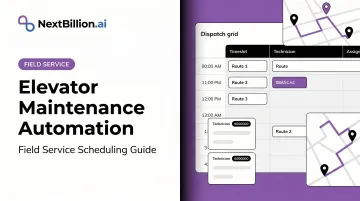
Elevator route optimization means moving away from reactive, manual scheduling toward automation that handles three things at once: tracking regulatory due dates, monitoring condition signals from IoT-connected equipment, and dispatching technicians efficiently. The root cause in most operations is the same: reactive, manual scheduling. Spreadsheets, phone reminders, and paper logbooks don't scale. They can't simultaneously track regulatory due dates across multiple jurisdictions, monitor condition signals from IoT-connected equipment, and optimize technician dispatch across a multi-site portfolio. Skill-based, location-aware dispatch that clusters visits geographically is what actually cuts deadhead time and wasted travel across a multi-site portfolio.
This guide covers when and how to automate elevator maintenance scheduling — the trigger categories that should drive service visits, the signs your current process is failing, and the dispatch best practices that separate high-performing field service operations from ones that are constantly in catch-up mode.
Key Takeaways
- Elevator maintenance scheduling should move from reactive to proactive to cut downtime, compliance risk, and wasted technician travel
- Four trigger categories drive scheduling: usage patterns, condition-based signals, regulatory requirements, and AMC contract cycles
- Reactive maintenance costs 3–4× more than preventive — the cost case for automation is straightforward
- Skill-based, location-aware dispatch is the most under-leveraged efficiency lever in elevator maintenance operations
- The best scheduling systems unify preventive calendars, real-time condition alerts, and smart technician routing in a single automated workflow
Why Scheduling Automation Matters for Elevator Maintenance
Elevators are safety-critical systems operating under strict regulatory frameworks. ASME A17.1 is the accepted North American baseline covering inspection, testing, maintenance, and repair — but actual inspection cycles are set by state and local rules, creating a compliance matrix that manual tracking simply can't handle reliably at scale.
The compliance failure rate is measurable. A New York State Comptroller audit found 8,807 annual elevator inspections missed in a single year — 13% of the required total. Another audit found nearly one-fifth of sampled elevators weren't inspected in a prior review period. These aren't edge cases; they're predictable outcomes of manual scheduling under portfolio pressure.
The Cost of Reactive Maintenance
The financial argument for automation is equally direct. According to IFMA's Knowledge Library, reactive maintenance typically costs 3 to 4 times more than preventive maintenance. Emergency callouts carry premium labor rates. Parts sourced urgently cost more, and extended downtime compounds both figures.
IFMA's Europe benchmarking data sharpens the picture: 69% of facilities management organizations still track maintenance costs and activities using Excel or manual spreadsheets. That's the baseline most elevator service teams are working from — which helps explain why missed inspections remain so common.
The Dispatch Efficiency Problem
The US has more than 1 million elevators served by approximately 24,200 elevator installers and repairers — a specialized labor pool with about 2,000 projected openings per year. With that constraint on skilled technician availability, wasted travel time and mismatched dispatch assignments aren't just operational inefficiencies — they're a capacity problem. Every misdirected technician represents a visit that doesn't happen.
Scheduling automation addresses this directly:
- Compliance tracking: Calendar-based alerts prevent missed inspections before they become violations
- Smarter dispatch: Assigns the closest, appropriately certified technician rather than the first available
- Reduced deadhead time: Clusters visits geographically to cut unproductive travel between jobs
- Audit trails: Logs visit completion automatically, replacing manual spreadsheet updates
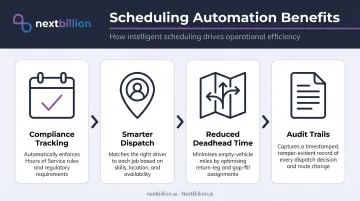
The sections below break down how each of these capabilities translates into a working scheduling system for elevator maintenance teams.
When to Schedule Elevator Maintenance: Scenario-Based Triggers
The right scheduling cadence isn't one number. It depends on the type of maintenance required, the regulatory jurisdiction, the elevator's usage intensity, and the terms of the service contract. A well-automated system recognizes multiple trigger categories simultaneously.
Based on Usage Patterns
High-traffic elevators in commercial buildings, hospitals, or transit hubs accumulate wear significantly faster than low-use residential units. Calendar-only scheduling misses this entirely.
Automated systems can set thresholds — door cycles, motor run hours, trip counts — that trigger maintenance work orders based on actual operational data rather than elapsed time. Service frequency adjusts dynamically from there:
- Tighten intervals during building occupancy peaks or post-renovation restarts
- Extend them safely during confirmed low-use periods
Based on Condition and Performance Signals
Modern IoT-connected elevators can flag anomalies before they become failures. Door misalignment, motor vibration changes, and unusual braking patterns are all detectable signals that should immediately generate a service order — regardless of where the calendar sits.
According to Elevator World's sensor-fusion research, door systems are the primary driver of unplanned elevator downtime, with the majority of lift faults originating there. Specific failure modes — door cycling (multiple close attempts before the cabin moves), interlock misalignment, worn rollers, debris in door gibs — are all trackable signals that condition-based scheduling can act on.
The distinction matters:
- Preventive scheduling follows fixed calendar or usage-cycle intervals regardless of current condition
- Predictive scheduling uses real-time sensor data to schedule service when performance thresholds indicate an imminent issue
- Automation makes predictive scheduling feasible at scale — manually reviewing sensor data across a 50-unit portfolio isn't practical
Based on Regulatory and Seasonal Factors
Scheduling calendars need to account for mandatory inspection deadlines, certificate renewal windows, and filing deadlines — not just service dates. The penalty structure for getting this wrong is significant:
- NYC: Failure-to-file penalties range from $1,000 (residential CAT1) to $5,000 (non-residential CAT5); late filing adds $50–$250 per month per device
- California: Unresolved Preliminary Orders can trigger an Order Prohibiting Use; unpaid invoices past 60 days incur a 100% penalty
- Illinois: Violations under the Elevator Safety and Regulation Act carry fines up to $1,500 per day per violation
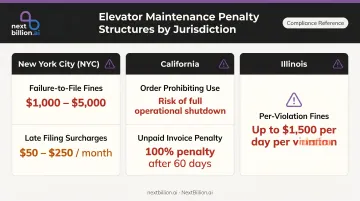
Automated systems should schedule pre-inspection preparation visits in advance of compliance due dates — not just reminders on the due date itself.
Based on AMC and Contract Cycles
Compliance scheduling and contract obligations often overlap — but contract terms carry their own distinct consequences. Annual Maintenance Contracts define service frequency obligations and financial penalties for non-performance.
New York OGS contract templates, for example, apply:
- Liquidated damages of 80% of the monthly maintenance rate for failure to complete monthly PM tasks
- 20% deductions for entrapment response failures exceeding one hour
Automated scheduling tied directly to contract data ensures SLA adherence, prevents missed visits that could void agreements, and flags upcoming renewals before they lapse.
Signs Your Elevator Maintenance Scheduling Needs Automation
Not every operation needs to overhaul its processes immediately — but certain patterns indicate the current approach is already failing:
Operational red flags:
- Preventive visits discovered missed only after a breakdown occurs
- Dispatchers spending most of their time on phone-based coordination rather than exception management
- Technicians arriving on site without the correct parts because no pre-visit work order was generated
- Callback rates climbing without a clear root cause analysis process
Compliance warning signs:
- Overdue inspection certificates discovered during renewal, not proactively
- Inability to produce clean service history logs during audits
- Inconsistent maintenance intervals across buildings in the same portfolio
Scale indicators:
- Managing more than 20–30 elevator units across multiple sites
- Operating in more than one regulatory jurisdiction simultaneously
- Emergency callouts representing more than 20–25% of total service volume
Fleet size alone isn't the deciding factor. If any combination of the above patterns is present — especially rising emergency call share or dispatcher time spent on phone coordination — that's when manual scheduling starts costing more than automation would.
Best Practices for Automating Elevator Maintenance Field Service Scheduling
Build Multi-Tiered Scheduling Logic
A single calendar reminder isn't a scheduling system. Effective automation operates three layers simultaneously:
- Calendar-based preventive visits — tied to regulatory intervals by jurisdiction and equipment type (monthly PM where contracts require it, semiannual inspections, annual and multi-year Category tests)
- Condition-triggered alerts — from IoT sensors or technician-reported anomalies, generating work orders independent of the calendar
- Contract-cycle reminders — tied to AMC terms, SLA deadlines, and renewal dates
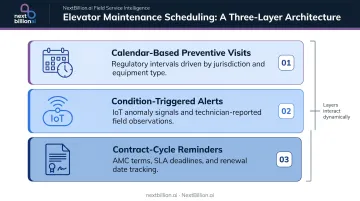
These layers interact. A condition alert mid-cycle shouldn't reset the preventive calendar — it should be logged and addressed separately while the scheduled visit proceeds on its original timeline.
Automate Work Order Generation and Pre-Visit Checklists
The scheduling system should automatically create a work order before a technician is dispatched — not after. That work order should include:
- Site history and previous findings
- Required tools and parts for the visit type
- Inventory check to confirm parts availability
- Any active compliance flags or upcoming deadlines for that asset
This pre-visit intelligence is the primary driver of first-time fix rates. Salesforce's Field Service research documents a 31% increase in first-time fix rate and 26% fewer truck rolls when FSM automation is fully implemented — outcomes that translate directly to elevator maintenance operations.
Implement Skill-Based, Location-Aware Technician Assignment
Availability alone is not a valid dispatch criterion. Elevator maintenance requires jurisdiction-specific qualifications, and sending an uncertified technician to a compliance-critical job doesn't just fail the customer — it creates direct regulatory exposure.
Effective automated dispatch matches jobs based on:
- Technician certifications — hydraulic systems, electrical, Category test authorization
- Proximity to site — minimizing travel time across a multi-site portfolio
- Current workload — balancing utilization across the team, not just filling the first open slot
- Time window requirements — compliance-sensitive visits have mandatory completion windows that route sequencing must respect
Route optimization is where this becomes concrete. NextBillion.ai's field service routing engine supports over 50 hard and soft constraints — including technician skills and certifications, time windows, geographic territory zones, vehicle capacity for parts and tools, and priority weighting for compliance-critical jobs.
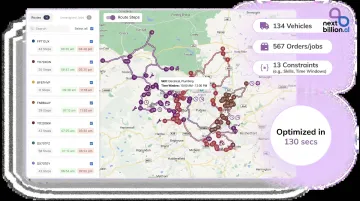
For elevator maintenance operators managing multi-site portfolios, this means every dispatch decision is made against actual job requirements rather than ad hoc by a dispatcher working from a phone list.
The platform also supports real-time re-dispatch. When a condition-based alert generates an emergency work order mid-day, the routing engine recalculates existing technician routes to accommodate the new job with minimal disruption to the rest of the schedule.
Build in Compliance Monitoring and Escalation Triggers
Configure the system to:
- Flag work orders overdue past their scheduled window
- Generate escalation alerts if a confirmed visit isn't logged within a set timeframe
- Automatically produce service history reports formatted for audit review
- Track filing deadlines for regulatory reports separately from service dates (NYC CAT1 reports must be filed within 21 days of the test; periodic inspection reports within 14 days)
Track Scheduling Performance with the Right KPIs
The data the system generates should feed back into scheduling logic. Key metrics to monitor:
| KPI | Why It Matters |
|---|---|
| First-time fix rate | Measures whether technicians arrive with the right skills and parts |
| Emergency callout frequency | Indicates how often preventive scheduling is failing |
| Schedule adherence rate | Tracks whether visits are completed within planned windows |
| Technician utilization | Reveals routing inefficiency and workload imbalance |
| Mean time between failures | Guides whether PM intervals need tightening |
Use this data continuously. Scheduling intervals that worked for a building at 60% occupancy may need adjustment when occupancy reaches 95%.
Conclusion
There's no universal maintenance cadence for elevator portfolios. The right schedule depends on usage intensity, condition signals, regulatory jurisdiction, and contract obligations — and the only practical way to monitor all four simultaneously is through automated scheduling logic.
The shift from reactive to automated scheduling is fundamentally an operational risk management decision. Companies that automate reduce compliance exposure, lower maintenance costs, and improve technician productivity in ways that are measurable within the first year.
What makes the difference between a scheduling system that looks good on paper and one that performs in the field is the quality of dispatch intelligence. Work order creation handles the planning side — but execution depends on getting a certified technician to the right site within the right service window, every time. Field service teams managing multi-site elevator portfolios should evaluate whether their current FSM platform handles that routing and constraint logic natively. If it doesn't, pairing it with a dedicated route optimization layer like NextBillion.ai's Driver Assignment and Route Optimization APIs gives dispatch the constraint-aware intelligence needed to make automated scheduling work in the field, not just on paper.
Frequently Asked Questions
What is the best field service software to automate elevator maintenance scheduling?
Platforms like ServiceTitan, LiftKeeper, Fieldy, and SafetyCulture serve different needs — enterprise operators typically prioritize scheduling automation and compliance tracking within their FSM. Teams managing large multi-site portfolios often pair their FSM with a dedicated route optimization layer, like NextBillion.ai, to handle technician dispatch across complex geographic territories. The right choice depends on portfolio size and whether compliance tracking or route efficiency across many sites is the bigger operational bottleneck.
How often should elevator maintenance be scheduled?
Frequency depends on jurisdiction, elevator type, and usage intensity. Most regulatory bodies require at least annual inspections, though high-traffic commercial elevators typically need preventive visits every 1–3 months. Statutory inspection and Category test cycles are scheduled separately from routine PM visits.
What is the difference between preventive and predictive elevator maintenance scheduling?
Preventive maintenance follows fixed calendar or usage-cycle intervals regardless of current condition. Predictive maintenance uses real-time sensor data — particularly from door systems, which cause the majority of elevator faults — to schedule service when specific performance thresholds indicate an issue is developing, reducing unnecessary visits while preventing failures. Scheduling and dispatch systems need to support both models at once, since most portfolios run mixed fleets with sensor-equipped units alongside older elevators still on fixed cycles.
How does automated scheduling reduce elevator downtime?
Automation ensures no maintenance visit is missed, triggers work orders before failures occur, pre-stages required parts through pre-visit checklists, and dispatches the right certified technician faster. It also recalculates routes in real time when a call comes in mid-shift, so an open technician nearby is assigned instead of the job sitting in a queue until someone finishes their scheduled stops.
What are the most common scheduling mistakes in elevator maintenance operations?
The top errors: relying on calendar reminders instead of usage-based and condition-based triggers, dispatching without verifying technician certifications or proximity, not scheduling pre-inspection preparation visits ahead of compliance deadlines, and failing to maintain complete service history logs for regulatory audits.
How do you optimize technician routing for multiple elevator service calls?
Route optimization tools assign technicians based on real-time location, skill certification match, job priority, and time window requirements simultaneously. This cuts total drive time, increases jobs completed per day, and keeps compliance-sensitive visits sequenced within mandatory completion windows.
What is the elevator scheduling algorithm?
In field service operations, an elevator scheduling algorithm refers to the logic that assigns technicians to maintenance and repair jobs based on location, certification, job priority, and compliance deadlines. It differs from the classic elevator-car dispatch algorithm used inside buildings. Modern field service platforms run optimization engines that continuously re-sequence technician routes as new work orders, cancellations, or urgent breakdown calls come in.
What is the best software for field service management?
There is no single best option — the right software depends on fleet size, compliance requirements, and dispatch complexity. Smaller operators often manage with an FSM's built-in scheduling. Larger portfolios spanning multiple states or metros typically add a dedicated routing and optimization layer, such as NextBillion.ai, on top of their FSM to handle real-time dispatch across dense, multi-site territories.