G2 reviewers have noted their OptimoRoute costs "doubled with no warning," and Capterra users flag difficulty updating routes mid-workday without resetting entirely. For operations hitting these walls, the question isn't whether to look elsewhere — it's which alternative fits their specific stage.
This post evaluates five proven alternatives across route optimization quality, pricing model, field service fit, and scalability.
Key Takeaways
- OptimoRoute's per-driver pricing and 1,000-order planning cap create real friction as fleet size or delivery volume grows
- NextBillion.ai is the strongest choice for enterprises and developers needing API-first control, 50+ routing constraints, and predictable fixed-fee pricing
- Routific suits small-to-mid delivery businesses that want fast route generation with per-order pricing
- Onfleet fits on-demand and courier operations needing automated dispatch and real-time customer communication
- Route4Me works well for field service and territory-based teams that need modular, add-on-driven routing
- eLogii is a solid mid-market option for growing delivery fleets that have outgrown basic route planning tools
Why Businesses Look for OptimoRoute Alternatives
OptimoRoute is a capable route planning tool. It supports driver skill assignments, configurable work hours, flexible start/end locations, and live breadcrumb tracking — enough for many small delivery operations and straightforward field service scenarios. For US-based fleets, that also means routing has to work around Hours-of-Service limits, IFTA fuel-tax reporting across state lines, and CDL-specific truck restrictions — areas where a routing tool's constraint depth starts to matter more than its interface.
The friction appears at four specific points:
- Per-driver pricing that compounds with fleet size — at $44.10/driver/month on Pro, a 50-driver fleet costs over $2,200/month before any add-ons
- The 1,000-order planning cap on Pro — mid-sized operations processing higher daily volumes need to step up to Custom pricing
- Limited mid-route re-optimization — Capterra reviewers note that updating routes during live delivery runs often requires resetting the entire route
- API designed for internal use, not embedding — OptimoRoute does have a public API, but it's rate-limited to 5 concurrent requests and too constrained for developers who need to embed routing directly into their own logistics platforms
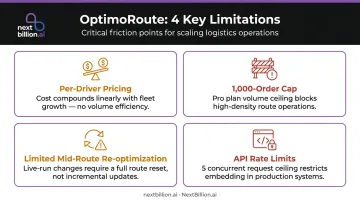
The alternatives below address each of these gaps — covering last-mile delivery, on-demand dispatch, field service, and enterprise or developer needs.
Best OptimoRoute Alternatives for Delivery & Field Service
Each tool below was evaluated across five dimensions:
- Route optimization quality — constraint flexibility and algorithm performance
- Pricing model — predictability and scalability as order/fleet volume grows
- Integration depth — telematics, APIs, and third-party connectivity
- Dispatch and execution features — POD, tracking, driver communication
- Scalability — from SMB to enterprise use cases
NextBillion.ai
NextBillion.ai is an API-first route optimization and mapping platform built for enterprise fleets, logistics software developers, and field service operators that need deep customization without per-call pricing surprises. The platform was built by the founding team behind Grab's Geo team — the same infrastructure that powered one of Southeast Asia's largest logistics and mobility networks. For US operators, that includes routing logic that can account for state-by-state commercial vehicle restrictions and hazmat road rules rather than treating the country as a single flat road network.
The platform has optimized 10.9M+ deliveries, generated $11M+ in documented cost savings, and serves 150+ businesses including DoorDash, Zepto, Meesho, Hawx Pest Control, and AB InBev.
Where it pulls ahead of OptimoRoute:
- 50+ hard and soft routing constraints — time windows, multi-compartment vehicle load, driver skills, priority tiers, service time, HAZMAT routing, task sequencing, and more
- Distance matrix up to 5,000×5,000 — vs. the 25×25 limit on standard APIs, supporting large-scale optimization in a single call
- Truck-compliant routing — accounts for vehicle height, weight, axle load, hazmat rules, and low-clearance bridges at the route calculation level
- Custom map editing — operators can mark road closures, set turn restrictions, apply custom speed limits, and configure no-parking zones via a no-code Road Editor interface
- On-premise deployment with Kubernetes support for organizations with strict data sovereignty requirements
- Native telematics integrations with Samsara, Geotab, Motive, and Netradyne — bidirectional data flow, not just CSV import
- SOC 2 Type II and ISO/IEC 27001:2013 certified
For field service specifically, NextBillion.ai supports:
- Technician skill matching for specialized job assignments
- Appointment-based scheduling and recurring service routes
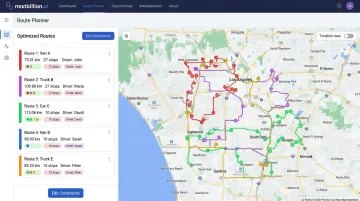
- Dynamic mid-shift re-optimization with sub-second driver-task matching latency
| Category | Details |
|---|---|
| Key Features | 50+ routing constraints, custom maps, truck routing, 5,000×5,000 distance matrix, GPS tracking integrations (Samsara, Geotab, Motive), SOC 2 Type II & ISO/IEC 27001:2013 certified |
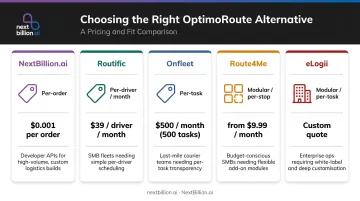
| Pricing Model | Fixed-fee monthly pricing (per vehicle or per order); Starter from $199/month for up to 1,000 orders annually; enterprise pricing custom |
| Best For | Enterprises, logistics software developers, field service operators, and last-mile fleets needing API-first customization and cost-predictable scaling |
Routific
Routific is a route optimization platform widely used by small-to-mid delivery businesses. Its clean dispatcher interface, fast route generation, and per-order pricing model make it particularly well-suited for operations that want predictable costs as order volume grows — without paying per driver. For US small businesses running seasonal delivery volume — grocery, meal-kit, or regional parcel operations — that per-order structure avoids paying for idle driver seats during slow months.
Routific switched from per-vehicle to per-order pricing in mid-2024, which directly addresses one of OptimoRoute's main pain points.
What works well:
- First 100 orders/month free; $150/month up to 1,000 orders; per-stop charges above that (scaling down to $0.03/order at 20,000–50,000 orders/month)
- In-house ML-based routing algorithm
- Customer notification tools, live GPS tracking, and proof of delivery
- Barcode scanning supported via mobile app
- Routing API available on all plans (1,000 free daily API calls included)
Limitations to know: No in-app driver-dispatcher chat, no multi-day route planning across days in a single session, and G2 reviewers note occasional inefficient routing outputs ("spaghetti routes") on complex stop sets.
| Category | Details |
|---|---|
| Key Features | AI route optimization, customer notifications, live tracking, POD, barcode scanning, mobile apps (iOS/Android), routing API |
| Pricing Model | First 100 orders/month free; $150/month up to 1,000 orders; per-stop pricing above that |
| Best For | Small-to-mid delivery businesses with predictable, scheduled routes and growing order volumes |
Onfleet
Onfleet is a delivery management platform built around on-demand and courier-style operations. Its strengths are in automated driver assignment, real-time dispatch, and the communication layer between dispatchers, drivers, and customers. It's a common fit for US courier and last-mile operations running gig or 1099 driver pools, where real-time customer tracking links and dispatcher chat reduce the support-call volume that comes with on-demand delivery windows.
What works well:
- Automated dispatch for on-demand deliveries
- In-app driver-dispatcher chat and driver-to-customer messaging
- Real-time tracking links for customers
- Strong driver analytics and performance reporting
- Barcode scanning available on Scale and Enterprise plans
Limitations to note: Route optimization is capped at 2,000 tasks per request. The Route Optimization API endpoint is Enterprise-only. At $619/month for the Launch plan (2,500 tasks), Onfleet prices out many smaller operations. G2 reviewers have flagged mileage tracking accuracy issues.
| Category | Details |
|---|---|
| Key Features | Automated dispatch, in-app chat, customer tracking links, driver analytics, barcode scanning (Scale+), POD collection |
| Pricing Model | Task-based: $619/month (2,500 tasks), $1,349/month (5,000 tasks), $3,099/month Enterprise (10,000+ tasks) |
| Best For | Courier businesses, on-demand delivery, and mid-size operations needing automated driver assignment and customer self-service |
Route4Me
Route4Me is one of the original route planning platforms, built around a modular marketplace model. It lets field service, field sales, and delivery teams mix and match features rather than pay for a fixed bundle — making it practical for territory-based operations with diverse routing needs across teams. This modularity tends to suit US field service companies that operate across multiple states and need different rule sets — for example, commercial vehicle routing in one region and simple stop-sequencing in another — without paying for capabilities they don't use everywhere.
What works well:
- Territory management and zone carving
- Modular add-ons: time windows, commercial vehicle routing, field service routing, turn-restriction avoidance
- Multi-depot planning
- Broad coverage across field sales, inspection, and delivery use cases
Limitations to note: Published tier pricing starts at $199/month for Route Optimization, $299/month for Business Optimization, and $349/month for Enterprise — but many standard features require paid add-ons billed separately. G2 users flag that in-app navigation accuracy "still needs improvement." Capterra users have noted a desire for better multi-day planning.
| Category | Details |
|---|---|
| Key Features | Territory management, modular add-ons, multi-depot planning, field service routing module, GPS tracking, POD |
| Pricing Model | $199–$349/month base tiers; add-ons billed separately (per-feature pricing) |
| Best For | Field service, field sales, and inspection teams needing territory-based routing and flexible module configuration |
eLogii
eLogii sits between pure routing tools and full enterprise orchestration platforms. It targets growing delivery operations that need more than basic routing — structured failed-delivery workflows, multiple POD types, driver skill matching — without the cost or complexity of a full enterprise TMS.
What works well:
- Multiple POD types: e-signatures, photos, numeric codes, barcode scanning, cash-on-delivery confirmation
- Structured failed-delivery workflows with custom fail reasons and re-delivery instructions
- Traffic-aware ETA management
- Vehicle load optimization across weight, volume, and pallets
- Driver skill assignment for specialized deliveries
- Unlimited vehicles/drivers on all plans — pricing scales with tasks, not fleet size

Limitations to note: Starter pricing is $575/month for 2,500 tasks per Capterra's 2026 data (eLogii's site directs to custom pricing). G2 review volume is limited, so independent user feedback is thinner than for other tools on this list.
| Category | Details |
|---|---|
| Key Features | Multi-type POD, failed delivery workflows, traffic-aware ETA, driver skill matching, dynamic rerouting, multi-language support |
| Pricing Model | Task-based; Starter ~$575/month (per Capterra) for 2,500 tasks across unlimited vehicles |
| Best For | Growing delivery operations needing more than basic routing, without moving to a full enterprise TMS |
How We Chose These Alternatives
Evaluation criteria:
- Route optimization quality — algorithm depth, constraint support, ETA accuracy
- Pricing model transparency — how costs change as fleet or order volume grows
- Field service vs. delivery fit — technician scheduling, skill-based dispatch, multi-stop service routes
- API and integration depth — for businesses embedding routing into their own platforms
- Real-world user feedback — drawn from Gartner's last-mile delivery technology criteria, G2, and Capterra
Common selection mistakes to avoid:
- Pricing at baseline only — run the numbers at 2x your current fleet size and peak seasonal volume, not just today's baseline
- Delivery vs. field service fit — technician scheduling, skill-based dispatch, and appointment management work differently than parcel delivery optimization
- Integration cost blindspot — the real deployment cost is usually connecting the routing tool to your existing telematics, WMS, or CRM — not the subscription fee itself
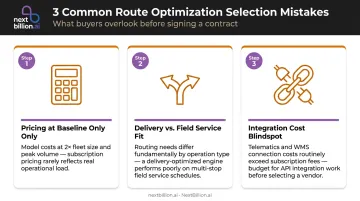
These criteria reflect what actually separates tools that look similar on a feature checklist. McKinsey research shows that combining real-time visibility with AI-based workflow automation can reduce direct logistics costs by 35–40% — but only when the tool fits how your operation actually runs.
Conclusion
The right OptimoRoute alternative depends on where your operation sits right now:
- SMBs with stable, scheduled routes — Routific or eLogii offer the clearest per-order pricing and clean operational workflows
- On-demand and courier operations — Onfleet's automated dispatch and communication layer is purpose-built for that model
- Field service and territory-based teams — Route4Me's modular structure and territory management tools align with how those operations are organized
- Enterprises and logistics software developers — teams that have outgrown per-driver pricing and need 50+ routing constraints, custom map control, truck-compliant routing, and API-level flexibility belong on a platform built for that depth
Before committing to any platform, validate your shortlist with real operational data. Run a route simulation using your actual stop counts and fleet constraints, then model pricing at both peak and off-peak volumes. Check specifically how each tool handles failure scenarios: missed deliveries, mid-day re-optimization, multi-depot returns, and time-window conflicts.
If that evaluation reveals your needs outpace what per-driver SaaS tools can handle, NextBillion.ai offers a hands-on pilot where solution engineers help configure and validate the platform against your actual fleet data. Contact the team to get started.
Frequently Asked Questions
What are the most common reasons businesses switch from OptimoRoute?
The main triggers are per-driver pricing that compounds quickly with fleet growth, the Pro plan's 1,000-order planning cap, and difficulty updating routes during live delivery runs without resetting. Businesses building routing into their own logistics platforms also find the API rate limits (5 concurrent requests) too restrictive for embedded use cases.
Is OptimoRoute suitable for field service businesses?
OptimoRoute supports field service through driver profiles, skill assignments, and flexible start/end locations. It lacks native integration with field service management tools and structured workflows for appointment-based scheduling or technician billing, making dedicated FSM platforms or API-first alternatives more practical for complex operations. Fleets that must document driver hours for FMCSA hours-of-service compliance also need to check whether route plans can be adjusted to reflect those limits, since OptimoRoute does not build HOS rules into its planning logic.
Which OptimoRoute alternative has the best pricing for growing fleets?
It depends on fleet structure. Per-order pricing (Routific, Onfleet, eLogii) scales more smoothly than per-driver pricing as fleet size grows. API-first platforms like NextBillion.ai offer fixed-fee monthly pricing that eliminates per-call costs entirely — more cost-predictable at scale, particularly for high-volume or developer-led deployments.
Does OptimoRoute offer a route optimization API?
OptimoRoute has a public API using JSON over HTTPS, but accounts are limited to 5 concurrent requests. That ceiling makes it a poor fit for embedding routing logic directly into your own platform — API-first alternatives are better suited for that use case. Teams building customer-facing tracking pages, dispatch consoles, or driver apps on top of routing data typically need higher concurrency and more direct control over request volume than a fixed-limit API allows.
What is the best OptimoRoute alternative for large enterprise fleets?
NextBillion.ai is the strongest fit for enterprise fleets needing 50+ routing constraints, custom map editing, truck-compliant routing, and on-premise deployment. For execution-focused high-volume delivery operations, eLogii and Onfleet both serve enterprise-tier needs — though each with different strengths in dispatch vs. delivery management. Enterprise trucking fleets should also weigh whether a platform supports truck-specific restrictions like height, weight, and hazmat routing, since these directly affect DOT and PHMSA compliance during route planning.
Can I switch from OptimoRoute without disrupting live delivery operations?
Running both platforms in parallel during a pilot period is the standard approach — migrate fleet data in a test environment, then validate ETA accuracy against real operational data before full cutover. Most vendors, including NextBillion.ai, assign solution engineers to manage this transition.
What is the best routing software for trucking?
The best fit depends on fleet type. Trucking operations need truck-specific routing that accounts for height, weight, and hazmat restrictions, along with support for IFTA mileage reporting and driver hours tied to FMCSA hours-of-service rules. General delivery routing tools like OptimoRoute are not built around these constraints, so trucking fleets typically need platforms with dedicated truck routing profiles or API-level customization for compliance-driven planning.
How much does OptimoRoute cost?
OptimoRoute prices per driver per month, with plan tiers that also cap the number of orders you can plan (for example, the Pro plan has a 1,000-order limit). Costs scale directly with fleet headcount rather than order volume, which can compound quickly for growing fleets. Businesses comparing alternatives should check whether a platform prices per driver, per order, or on a fixed monthly fee.