Introduction
Every morning, field service dispatchers face the same problem: a dozen technicians, forty jobs, overlapping appointment windows, and a spreadsheet that can't account for traffic, skills, or last-minute cancellations. The result? Missed service windows, wasted drive time, and frustrated customers.
According to Salesforce research involving 6,500 service professionals, 47% of field service appointments don't go as planned. That's a structural problem — and smarter route planning is the most direct fix available.
The field service management software market is on track to reach $9.17 billion by 2030, growing at 12.5% CAGR — and route optimization is the feature most directly tied to measurable gains in on-time rates and fuel costs.
This guide covers five route planning tools purpose-built for field service fleets — what each does well, where each falls short, and how to choose based on your actual operational requirements. For US fleets, that also means checking how each tool handles FMCSA hours-of-service limits, IFTA mileage tracking across state lines, and driver qualification records tied to CDL requirements — constraints that consumer mapping apps simply ignore.
Key Takeaways
- Field service route planning handles appointment windows, skill matching, multi-vehicle workloads, and service time buffers — not just GPS directions
- Tools reviewed: NextBillion.ai, OptimoRoute, Route4Me, WorkWave Route Manager, and Badger Maps
- Key selection criteria: constraint depth, integration compatibility, pricing model at scale, and real-time adaptability
- The right tool means more jobs completed per day, less fuel burned, and better on-time arrival rates
What Makes Field Service Route Planning Different
Most people picture route planning as "find the fastest path between stops." That works fine for a single driver making drop-offs. It breaks down immediately in field service.
Field Service vs. Basic GPS: A Direct Comparison
| Capability | Consumer GPS | Field Service Route Optimization |
|---|---|---|
| Multi-vehicle scheduling | ❌ | ✅ |
| Appointment time windows | ❌ | ✅ |
| Technician skill matching | ❌ | ✅ |
| Job duration / service time | ❌ | ✅ |
| Real-time rerouting | Partial | ✅ |
| CRM / FSM integration | ❌ | ✅ |
| Territory zone management | ❌ | ✅ |
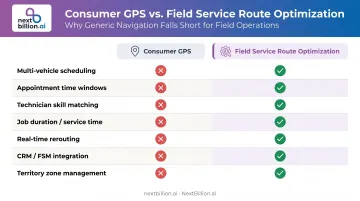
Gartner breaks field service planning into four simultaneous functions: skills-based workload balancing, shift forecasting, schedule optimization, and routing — each running in parallel across a distributed workforce.
A typical dispatcher must assign a certified technician to a job, hit the customer's time window, avoid overtime, and cover a territory spanning dozens of zip codes — all at once. No navigation app handles that. A purpose-built optimization engine does. In the US, overtime rules under the Fair Labor Standards Act add another layer: dispatchers scheduling technicians across zip codes need to track hours worked, not just miles driven, to avoid unplanned overtime liability.
The route optimization software market is now valued at $8.98 billion and growing at 13.32% CAGR — driven by businesses moving past manual scheduling and basic GPS.
Top Route Planning Tools for Field Service Fleets
These tools were selected based on constraint depth, integration capabilities, pricing model transparency, field-service-specific functionality, and verified user feedback.
NextBillion.ai
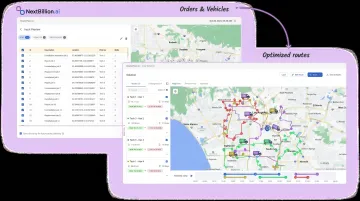
NextBillion.ai is an API-first route optimization and mapping platform built for enterprises and FSM software providers that need flexible, constraint-rich routing without unpredictable per-API-call pricing. The platform powers 10.9+ million deliveries and field tasks globally and integrates natively with telematics providers including Samsara, Geotab, and Motive.
What sets it apart for field service:
- 50+ routing constraints — appointment time windows, technician skill matching, territory zones, vehicle type restrictions, shift hours, priority jobs, and service duration buffers
- Road Editor App lets operations teams mark closures, set speed limits, restrict vehicle types, and apply time-of-day routing rules — changes feed instantly into optimization and navigation APIs
- FSM platforms like Service Autopilot (by Xplor Technologies) have embedded NextBillion.ai's routing directly into their scheduling workflows via its API-first architecture
- Per-vehicle or per-order flat-fee pricing replaces unpredictable per-call costs; the Grow Plan starts at $499/month for up to 5,000 orders, with unlimited dispatchers and vehicles
- On-premise deployment available for enterprises with strict compliance requirements (SOC 2 Type II, ISO 27001 certified)
Customer example: Hawx Smart Pest Control, one of the largest US pest control providers, reduced scheduling time by 40% after implementing NextBillion.ai's Route Optimization and Distance Matrix APIs — enabling same-day schedule updates and deeper technician utilization. Hawx operates across multiple US states, which makes multi-region routing and territory-aware constraint handling — rather than single-region optimization — a practical requirement for fleets of similar scale.
| Category | Details |
|---|---|
| Key Features | 50+ routing constraints, real-time GPS tracking integration, Road Editor App, distance matrix (up to 5,000×5,000), truck-compliant routing, Driver Assignment API, on-premise deployment |
| Best For | Enterprises, FSM software providers, and field service fleets needing API-first, customizable route optimization without per-call pricing |
| Pricing | Grow Plan from $499/month (up to 5,000 orders); Enterprise custom pricing; Driver App add-on at $19/month per driver |
OptimoRoute
OptimoRoute is a cloud-based route planning and scheduling platform widely used by field service and delivery businesses. It earns strong marks for appointment time window support, driver analytics, and per-driver pricing that fits smaller teams well.
OptimoRoute earns a 4.8/5 on G2 (53 reviews) and 4.6/5 on Capterra (259 reviews), reflecting consistent satisfaction among SMB users.
The tradeoff: multi-region scalability and deep API customization are limited compared to enterprise-grade platforms. Teams running operations across multiple territories or embedding routing into their own software will hit its ceiling. US fleets operating in a single state or metro area tend to fit well; those managing crews across multiple states, with different service-area rules or drive-time regulations to track, typically need a platform with deeper constraint and API support.
| Category | Details |
|---|---|
| Key Features | Multi-stop route planning, live driver tracking, ETAs, proof of delivery, analytics dashboard, bulk order import |
| Best For | Small-to-mid-sized field service businesses (single-region) in healthcare, pest control, HVAC, and similar industries |
| Pricing | Lite from $35.10/driver/month; Pro from $44.10/driver/month (billed annually) |
Route4Me
Route4Me is a widely adopted multi-stop route optimization platform with a marketplace of add-on modules. It supports GPS fleet tracking, customer notifications, proof of delivery, and integrations with e-commerce and CRM systems.
The key differentiator: a modular feature marketplace lets businesses add capabilities incrementally — customer notifications, business rules, priority routing, and more. Route4Me earns a 4.7/5 on G2 (129 reviews) and 4.5/5 on Capterra (409 reviews).
The tradeoff: per-vehicle costs can escalate quickly as fleets grow, and the optimization engine is less sophisticated than enterprise-grade platforms for complex constraint combinations. Exact per-vehicle pricing is not published publicly — verify current rates directly at route4me.com.
| Category | Details |
|---|---|
| Key Features | Multi-stop optimization, real-time GPS tracking, automated email/SMS customer notifications, proof of delivery, modular add-ons |
| Best For | Mid-sized field service and logistics businesses needing a flexible, add-on-friendly routing platform |
| Pricing | Route Optimization, Business Optimization, and Enterprise plans available — verify current pricing at route4me.com |
WorkWave Route Manager
WorkWave Route Manager is a routing and dispatch platform purpose-built for field service and last-mile delivery operations. It combines automated multi-stop route planning, GPS driver tracking, customer notifications, and reporting in a single system.
Route simulation lets dispatchers test scenarios before publishing — a practical feature for teams managing tight appointment windows. Strong email/SMS notifications reduce missed appointments, and fast onboarding suits teams without dedicated technical resources. WorkWave claims up to 30% operational efficiency gains — treat that as a vendor benchmark, not an independently verified figure.
The tradeoff: limited AI-driven rerouting and no multi-region orchestration for large enterprise fleets. Minimum four vehicles required.
| Category | Details |
|---|---|
| Key Features | Route planning and dispatch, Driver Mobile App, smartphone GPS tracking, email/SMS customer alerts, route simulations, Route Performance Dashboard |
| Best For | SMB and mid-market field service and distribution teams prioritizing fast setup and customer communication |
| Pricing | From $54/month per vehicle; minimum 4 vehicles required — verify current tiers at workwave.com |
Badger Maps
Badger Maps is a route planning and territory management app designed for field sales and field service teams. It maps customer data visually, optimizes multi-stop routes with up to 120 stops, and integrates directly with Salesforce, HubSpot, and Microsoft Dynamics via two-way sync.
Its CRM-native approach stands out: field reps and technicians can see customer data on an interactive map, prioritize visits geographically, and update CRM records from a mobile device. Badger Maps holds a 4.7/5 on G2.
The tradeoff: better suited for field sales and light service use cases than for complex fleet dispatch with strict SLA constraints and multi-technician workload balancing.
| Category | Details |
|---|---|
| Key Features | Two-way CRM integration (Salesforce, HubSpot, Dynamics), map visualization, multi-stop route optimization (120 stops), mobile app (iOS and Android) |
| Best For | Field sales reps and service technicians managing customer visit routes with CRM data; smaller teams with moderate scheduling complexity |
| Pricing | Business: $58/user/month (annual) or $69/month; Enterprise: $95/user/month (annual) or $109/month |
How to Choose the Right Route Planning Tool
Evaluation Criteria That Actually Matter
Most buyers make one mistake: they compare tools on price per vehicle before confirming the platform can actually handle their constraint set — appointment windows, technician certifications, service-area boundaries, and multi-state compliance tracking where applicable. Get the fit wrong and the monthly savings on a cheaper plan disappear the first week a route has to be rebuilt by hand. consistent mistake: they evaluate route planning tools using delivery-focused criteria and miss the field-service-specific requirements that determine whether a tool actually works in practice.
Non-negotiable for field service:
- Appointment time window enforcement (hard and soft)
- Service time per job (the 45-minute HVAC visit needs to be in the model)
- Technician skill or certification matching
- Integration with existing telematics or FSM platforms
- Mobile app for drivers with job status updates
Pricing model considerations:
- Per-driver/month pricing (OptimoRoute, Badger Maps) works well for stable, smaller teams
- Per-vehicle/month pricing (WorkWave) is predictable for fixed fleets
- Per-API-call pricing becomes costly when usage spikes seasonally or during growth; flat-fee per-vehicle or per-order models (like NextBillion.ai's) cap that exposure regardless of volume
Once you've confirmed a tool meets your field service requirements, narrow the shortlist by fleet profile.
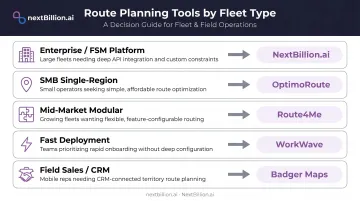
Matching Tools to Fleet Profile
| Fleet Profile | Recommended Tool |
|---|---|
| Enterprise or FSM platform embedding routing | NextBillion.ai |
| SMB field service, single region | OptimoRoute |
| Mid-market with modular feature needs | Route4Me |
| Fast deployment, strong customer comms | WorkWave Route Manager |
| Field sales / light service with CRM priority | Badger Maps |
Before committing to any platform, test the connection with your existing telematics system. A failed integration surfaces late and delays go-live. NextBillion.ai, for instance, has documented native integrations with Samsara, Geotab, and Motive that support bidirectional data flow. Tools without native connectors will require middleware or a custom build.
Conclusion
The right route planning tool for a field service fleet is the one that fits your operational reality — not just the one with the longest feature list. Technician count, territory complexity, appointment window strictness, integration stack, and per-unit pricing all shape whether a platform actually performs in production.
Before committing, test any shortlisted tool against your real constraints: Can it enforce the time windows your service contracts require? Does it match technicians to jobs by skill? Will it connect cleanly with your existing FSM or telematics platform?
For teams building field service software or running enterprise fleets that need API-first, constraint-rich route optimization with predictable pricing, NextBillion.ai is built for that use case. Request a demo or review the Route Optimization API documentation to evaluate it against your specific requirements.
Frequently Asked Questions
How much does route planning software cost?
Pricing varies by model. Per-driver plans typically run $35–$70/month (OptimoRoute, Badger Maps), per-vehicle plans start around $54/month (WorkWave), and API-first platforms like NextBillion.ai offer per-order flat-fee models starting at $499/month for up to 5,000 orders. Verify current pricing directly with each vendor before purchasing.
What is the best route planning software for field service fleets?
It depends on fleet size and complexity. NextBillion.ai suits enterprises and FSM platforms needing deep constraint customization. OptimoRoute fits small-to-mid service teams well. WorkWave is strong for teams that prioritize fast deployment and proactive customer notifications.
What is the difference between route planning and route optimization?
Route planning sequences stops along a path. Route optimization goes further — using algorithms to find the most efficient multi-stop assignments across your entire technician team at once, accounting for:
- Appointment time windows and service duration
- Technician skills and working hours
- Real-time traffic conditions
Optimization also respects hard constraints like FMCSA hours-of-service limits for drivers operating commercial vehicles, so routes stay compliant, not just efficient on paper.
Can route planning tools integrate with existing fleet management software?
Most enterprise-grade platforms do. NextBillion.ai integrates natively with Samsara, Geotab, and Motive with bidirectional data flow. SMB tools like WorkWave and OptimoRoute offer API access, though deeper integrations may require additional configuration or middleware. Before committing, confirm whether the integration syncs job status, ETAs, and driver location in both directions, or only pushes route data one way, since one-way sync limits dispatcher visibility during the day.
What features should I look for in route planning software for field technicians?
Look for these non-negotiables:
- Appointment time window enforcement and per-stop service time
- Technician skill and certification matching
- Real-time rerouting when conditions change
- Driver mobile app with navigation and job status updates
- Integration with your CRM or FSM system
How does route optimization reduce costs for field service businesses?
Optimized routing reduces fuel costs by eliminating unnecessary mileage and increases daily job capacity by cutting windshield time. Scheduling within working hours also limits overtime, which helps with FLSA compliance for hourly technicians. Beyond those savings, it reduces costly reschedules from missed appointment windows — a problem affecting nearly half of all field service appointments according to Salesforce research.
What is the best routing software for fleets?
There is no single best option — it depends on fleet type and scale. Commercial fleets subject to DOT and IFTA reporting need routing tied to compliant mileage and fuel-tax data. Field service teams with tight appointment windows need strong time-window and technician-matching logic. API-first platforms like NextBillion.ai suit teams building custom logic into an existing FSM or dispatch system rather than using an off-the-shelf app.
What is the best software for field service management?
Field service management software and route planning software solve different problems. FSM platforms handle scheduling, invoicing, and customer communication; routing tools optimize technician sequencing and drive time. The best setup often combines both — an FSM system for the full job lifecycle, connected via API to a dedicated routing engine like NextBillion.ai when stop volume or constraint complexity outgrows the FSM's built-in scheduler.