Introduction
Sales territory mapping is the process of dividing a market into defined zones and assigning them to reps based on more than just geography — workload, account potential, and rep strengths all factor in. Most sales organizations divide territories the same way they always have: draw lines on a map, assign ZIP codes, and call it done. Geography alone tells you nothing about workload balance, account potential, or whether a rep has the right relationships to succeed in a given area.
The result? Territories that look balanced on paper but perform completely differently in the field.
Research from the Sales Management Association and Xactly found that 64% of organizations were ineffective or only somewhat effective at territory design. That same study found effective territory design correlated with 14% higher sales objective achievement, while ineffective design dragged performance 15% below average.
This guide breaks down what sales territory mapping actually is, how to build one that holds up in the field, and where most designs quietly fail before a rep ever makes a call.
Key Takeaways
- Sales territory mapping segments a total addressable market into defined zones assigned to specific reps, based on geography, customer type, industry, or revenue potential
- Effective mapping balances workloads, eliminates rep overlap, and ensures no profitable segment goes uncovered
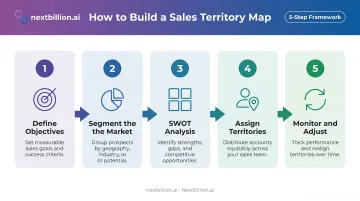
- Building a territory map follows five steps: define objectives, segment the market, run a SWOT analysis, assign territories, and monitor continuously
- Common failure points include stale data, ignoring rep strengths, and treating territory maps as one-time projects
- Territory strategy only pays off when paired with efficient field execution: route optimization and real-time intelligence are what close the gap
What Is Sales Territory Mapping?
Sales territory mapping is the process of segmenting a total addressable market into discrete geographic or account-based zones, each assigned to a specific sales rep or team. The goal is straightforward: maximize market coverage, minimize rep overlap, and align sales effort to actual opportunity. In practice, this means answering how to map out a sales territory in a way that holds up once reps are working accounts in the field, not just on a planning spreadsheet.
The older version of this process involved a spreadsheet, a pin map, and the assumption that geography was the right organizing principle. That worked when field sales meant driving the same county roads to the same accounts every week. It holds up less well when you're managing enterprise accounts, SMB prospects, and specialist verticals spread across the same metro area — where modern territory design treats geography as one input among many, not the whole answer.
Types of Sales Territory Divisions
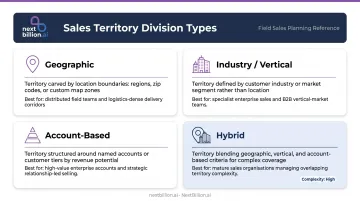
The four most common territory structures each serve a different purpose:
| Type | How It's Defined | Best For |
|---|---|---|
| Geographic | Regions, states, ZIP codes | Field reps with physical travel requirements |
| Industry/Vertical | Sector-based (healthcare, logistics, retail) | Specialist reps or inside sales with deep domain knowledge |
| Account-based | Named accounts or tiers (enterprise vs. SMB) | High-touch sales with long cycles and complex relationships |
| Hybrid | Combination of geography + account attributes | Businesses managing both high-volume small accounts and strategic large accounts in the same region |
According to Alexander Group, hybrid alignment is the most complex of the three primary methods—but also the most adaptable for go-to-market models that don't fit neatly into one category. The SMA/Xactly data confirms that 76% of companies still assign territories primarily by geography, which helps explain why so many territory designs underperform: they're applying a simple structure to a complex selling environment.
Territory Mapping vs. Territory Management
These two terms get used interchangeably, but they describe different activities:
- Territory mapping is the design process—defining boundaries, segmenting markets, and assigning reps
- Territory management is the ongoing operational practice—monitoring performance, handling rep changes, and adjusting assignments as conditions shift
Both are necessary. They require different tools and different cadences. Treating them as the same thing is how organizations end up with maps that were accurate at launch and ignored six months later — which is exactly the problem the rest of this guide covers. Mapping software can support both stages, but the tool is only as good as the segmentation logic and update cadence behind it; software alone does not substitute for the design work described above.
Key Benefits of Effective Sales Territory Mapping
Well-designed territories produce measurable outcomes—not just cleaner org charts.
Balanced Workloads and Rep Performance
When territories are built around opportunity rather than convenience, reps get assignments that are actually achievable. The reverse is also true: territories that pile too many accounts on one rep while leaving another sitting on a thin patch fuel attrition and inconsistent forecasting.
Alexander Group notes that failing to distribute opportunities equitably leads to missed quotas and declining seller motivation. SMA/Xactly data quantifies the upside: organizations effective at territory design achieved 14% higher sales objectives than average.
Full Market Coverage Without Internal Conflict
Undefined or overlapping boundaries are expensive. Reps fight over account ownership. Customers get contacted by two people from the same company. Profitable segments go unserved because everyone assumes someone else is covering them.
Clear territory design with explicit rules of engagement eliminates these conflicts before they start—and ensures every segment of the market has a rep accountable for it.
Data-Driven Performance Tracking
Well-defined territories make performance measurement meaningful. When you can isolate results by zone and compare rep performance against actual opportunity in that zone, you can:
- Identify underperforming territories vs. underperforming reps
- Set more accurate quotas based on real market potential
- Spot coverage gaps before they become revenue gaps
None of this is possible when territory boundaries are fuzzy, contested, or constantly shifting.
How to Create a Sales Territory Map: Step by Step
Step 1: Define Objectives and Business Priorities
Before drawing any boundary, establish what the territory map needs to accomplish. Revenue expansion into a new vertical requires a different design than protecting an existing customer base or rolling out a new product line.
Forrester's territory-design framework puts it simply: "Structure follows strategy." Territory assignments built on historical habit rather than current business goals will reinforce the past, not support the future.
Step 2: Segment and Analyze the Market
Break down your total addressable market by factors that actually predict opportunity:
- Industry and company size
- Geographic density and account clustering
- Purchase history and product fit
- Growth potential and competitive presence
Forrester recommends collecting historical sales performance data by rep, territory, and account for at least one year—up to three years—to identify patterns that aren't visible in a single snapshot. That analysis separates high-density opportunity clusters from territories that only look large on a map.
Step 3: Conduct a SWOT Analysis of Each Territory
Evaluate each proposed territory against four dimensions before finalizing assignments:
- Strengths: Which reps have existing relationships or domain expertise in this area?
- Weaknesses: Where are coverage gaps or capacity constraints most likely?
- Opportunities: Which verticals or geographies are underserved relative to demand?
- Threats: Where is competitor presence strongest, or regulatory risk highest?
This step prevents the common failure mode of assigning territories arbitrarily based on headcount rather than fit.
Step 4: Assign Territories Based on Rep Strengths and Balance
Your segmentation and SWOT outputs now do the heavy lifting. Match reps to territories where their skills, relationships, and experience give them the best realistic chance of success—then check the result against workload balance.
Two things to balance:
- Opportunity potential — account count, revenue size, growth trajectory
- Rep capacity — current book of business, travel requirements, time to service existing accounts
A territory that looks strong on paper becomes a liability if the rep assigned to it can't physically cover it.
Step 5: Monitor, Review, and Adjust Continuously
Most companies treat territory planning as an annual event. SMA/Xactly data puts that number at 76%—but reviewing once a year is a minimum cadence, not a complete strategy.
Key metrics to track on an ongoing basis:
- Sales growth by territory vs. target
- Rep performance relative to territory potential (not just quota)
- Territory cost, including travel time and coverage frequency
- Coverage gaps flagged by customer complaints or competitive losses
At minimum, run a formal review annually tied to business planning cycles. Trigger an immediate reassessment when reps turn over, new products launch, or market conditions shift materially.
Common Challenges in Sales Territory Mapping
Unequal Opportunity Distribution
The most common design flaw isn't intentional—it's the result of building territories on historical assignments rather than current data. Some reps end up managing more accounts than they can realistically cover. Others sit on underperforming patches with little upside.
The downstream effects compound quickly:
- Reps on heavy territories burn out or miss accounts entirely
- Reps on thin territories hit quota ceilings they can't break through
- Forecasting becomes unreliable when you can't separate rep performance from territory potential
Stale or Inaccurate Data
The SMA/Xactly study found that less than 40% of companies could effectively measure the key data inputs required for territory design—and organizations that could measure those inputs achieved 8% higher sales objectives than average.
Territories built on outdated customer lists, old demographic data, or historical revenue figures drift out of alignment with market reality quickly. The most common culprit: 83% of respondents used spreadsheets moderately or frequently for territory design. Spreadsheets don't update themselves.
Data inputs that need regular refreshing:
- Account lists with current addresses and firmographics
- Customer purchase history and engagement signals
- Market potential estimates by zone
- Competitive activity and win/loss data
Territory Overlap and Internal Competition
Overlapping boundaries produce predictable problems:
- Reps competing over the same accounts damage customer relationships
- Credit disputes consume management time and erode team trust
- Customers receive inconsistent outreach from multiple people representing the same company
The fix requires clear rules of engagement: explicit definitions of who owns what, under what conditions, and how conflicts get resolved — backed by technology guardrails that surface violations before they damage relationships.
Resistance to Change
Even well-designed territory changes fail if reps feel blindsided. A rep who loses a key account to a territory redesign—without understanding why—is unlikely to embrace the new assignment with full effort.
Transparent communication is what separates rollouts that stick from ones that stall:
- Explain the rationale behind the redesign, not just the outcome
- Show each rep how their specific assignment was determined
- Give reps a channel to raise concerns before the new structure goes live
From Territory Design to Field Execution
A territory map defines where reps should focus. It doesn't tell them how to sequence visits efficiently, avoid redundant travel, or prioritize high-value accounts within a given day.
This is the gap where most territory strategies lose their ROI. McKinsey's field-operations research found that technology-enabled field operations can reduce travel time by 5–30% and improve jobs completed per FTE per day by 20–30%. The design work creates the opportunity; execution tools determine whether that opportunity gets captured.
How Route Optimization Bridges the Gap
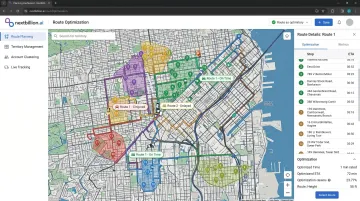
Route optimization platforms translate territory boundaries into executable daily plans. For field sales and field service teams, that means:
- Multi-stop sequencing that minimizes drive time across an entire day's visits
- Account priority constraints that ensure high-value or time-sensitive accounts get covered first
- Time-window support that matches appointment requirements to route sequencing
- Real-time re-routing when schedules change mid-day—new priority accounts, cancellations, or traffic disruptions
NextBillion.ai's Route Optimization API handles up to 10,000 stops per request with 50+ hard and soft constraints, adapting routes dynamically as conditions change. Its Clustering API groups accounts geographically before optimization runs—useful for building balanced beats and non-overlapping territories. Live tracking and real-time job status give managers visibility into whether reps are executing efficiently within their assigned zones.
What to Look for in Territory Execution Tools
When evaluating tools that connect territory design to field execution, prioritize:
- Native sync with CRM and dispatch systems (Salesforce, SAP, Dynamics 365) so account data feeds routing workflows directly
- Mobile delivery of routes and real-time updates so reps aren't relying on static plans
- Multi-stop planning that respects time windows, account priority, and vehicle type simultaneously
- Territory boundary enforcement built into the routing engine itself—not just displayed on a map
- Live tracking and coverage reporting for manager oversight at the zone level
Territory design sets the ceiling on what's possible. Execution tools determine how close reps actually get to it—and the gap between those two numbers is where most field sales ROI is either captured or lost.
Frequently Asked Questions
What is the difference between sales territory mapping and sales territory management?
Territory mapping is the design process: defining boundaries, segmenting markets, and assigning reps. Territory management is the ongoing operational practice of monitoring performance, handling rep changes, and adjusting assignments over time.
How often should sales territories be redesigned?
A formal annual review tied to business planning cycles is the standard baseline. But significant triggers—rep turnover, new product lines, competitive shifts, or rapid headcount growth—should prompt an immediate reassessment rather than waiting for the scheduled review.
What data do you need to create a sales territory map?
Four essential inputs drive a reliable territory map:
- Account list with geographic data (addresses, ZIP codes)
- Historical sales performance by territory and rep
- Customer firmographics (company size, industry, purchase history)
- Market potential estimates to balance territories by opportunity, not just account count
What are the most common types of sales territory divisions?
The four main types are geographic, industry/vertical, account-based, and hybrid. Geographic territories group accounts by region or drive-time radius, industry territories group by vertical expertise, account-based territories assign named accounts regardless of location, and hybrid models combine these. Most modern sales organizations blend approaches, with pure geographic-only models giving way to structures that also weigh account potential and rep specialization.
How do you know when your current territories need realignment?
Key warning signs include significant variance in rep quota attainment across territories, frequent complaints about workload imbalance, visible coverage gaps or customer overlap issues, and any major change in team size, product portfolio, or business strategy.
Can sales territory mapping software integrate with route planning tools?
Yes. Most modern platforms support this integration. Connecting territory boundaries with route optimization tools lets field teams execute visits as efficiently as possible, reducing drive time and increasing the number of accounts reached per day. Look for platforms that expose routing and mapping APIs directly, so territory boundaries feed into route planning without manual exports between separate tools.
How do you map out a sales territory step by step?
Start by pulling account and customer data with location details, then set territory goals (balanced revenue potential, workload, or account count). Segment accounts by geography, industry, or size, then draw draft boundaries and stress-test them against rep capacity and drive-time realities. Assign reps, document the rationale, and review the map against actual performance data after a full sales cycle before adjusting.
What should you look for in sales territory mapping software?
Look for accurate geographic data and boundary drawing tools, the ability to segment by account attributes beyond location (industry, size, potential), integration with your CRM so assignments sync automatically, and route or mapping APIs that connect territory design to field execution. Reporting on territory balance and rep workload matters too, so you can spot imbalance without manual spreadsheet work.