Introduction
The best last-mile delivery analytics solutions give retailers real-time visibility into delivery operations instead of relying on manual dispatch or end-of-day reports. Last-mile delivery consumes 41% of total logistics supply-chain costs, according to Capgemini's research — yet it's where most retailers have the least data visibility. Manual dispatch, end-of-day reports, and reactive tracking leave operators flying blind while customers expect Amazon-level transparency. This guide compares five platforms built for retail, evaluating their capabilities and differentiators to help retailers close the data visibility gap that leads to cart abandonment and rising costs.
The stakes are real. DHL's 2024 survey of 12,000 online shoppers found that 48% frequently abandon carts when their preferred delivery option is unavailable, and 41% abandon when delivery is too expensive. Both problems trace back to the same root cause: insufficient visibility into delivery operations before the customer experience breaks down.
In 2026, the retailers closing the gap on Amazon's delivery performance are doing it with data. This guide compares five last-mile delivery analytics platforms built for retail operations, with a consistent breakdown of capabilities, differentiators, and fit.
Key Takeaways
- Last-mile analytics captures data from dispatch to doorstep — helping retailers cut costs, improve on-time rates, and scale fulfillment without guesswork.
- The strongest platforms go beyond dashboards — they unify route optimization, real-time tracking, and demand forecasting so ops teams can act, not just report.
- Key metrics: On-Time Delivery Rate, First Attempt Delivery Rate, Cost Per Delivery, Vehicle Utilization, and Predictive ETA Accuracy.
- Top platforms covered: NextBillion.ai, Locus, OneRail, Bringg, and FarEye.
- Choosing the right platform means matching your fleet scale, integration requirements, and pricing model — not just feature lists.
What Is Last-Mile Delivery Analytics — and Why Does It Matter in 2026?
Last-mile delivery analytics is the collection, measurement, and interpretation of data across the final delivery leg — from dispatch through proof of delivery. That includes GPS traces, dwell times, exception rates, route deviation alerts, and customer feedback.
The business case is straightforward: if last-mile delivery represents 41% of your logistics costs and customers are abandoning purchases over delivery failures, then data blind spots in this leg translate directly to margin loss and lost revenue.
Why 2026 Raises the Stakes
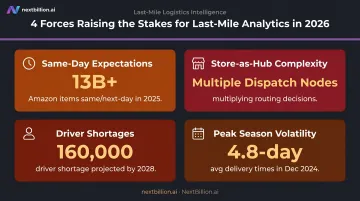
Four specific pressures are forcing retailers to take analytics seriously right now:
- Same-day expectations — Amazon delivered over 13 billion items same-day or next-day in 2025, with a 70% year-over-year increase in same-day volume. That's the benchmark consumers carry into every retail interaction.
- Store-as-hub complexity — Retailers like Target now use stores as mini fulfillment centers, multiplying the number of dispatch nodes and routing decisions that need coordination.
- Driver shortages — The ATA projected a shortage of up to 160,000 drivers by 2028. Route efficiency and stop density have shifted from optimization targets to basic operational requirements.
- Peak season volatility — Project44 reported average U.S. delivery times of 4.8 days in December 2024, with on-time performance slipping into the upper-70% range as promised ETAs became more aggressive.
Manual dispatch and spreadsheet reporting simply can't process this volume of signals fast enough. The platforms covered below are built specifically to close that gap — turning raw delivery data into decisions operators can act on.
Best Last-Mile Delivery Analytics Platforms for Retailers in 2026
These platforms were evaluated on analytics depth, retail-specific capabilities, AI maturity, integration flexibility with WMS/OMS/TMS systems, and documented business outcomes — not just feature lists.
NextBillion.ai
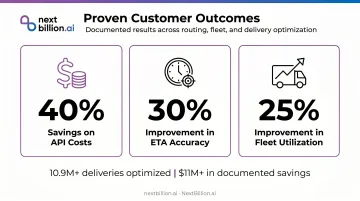
Founded in 2020 by former Grab Geo team engineers, NextBillion.ai is an AI-powered route optimization and delivery analytics platform now part of Velocitor Solutions. It has optimized over 10.9 million deliveries and generated $11M+ in documented customer savings across logistics and field service operations.
What sets it apart for retailers: a 5,000×5,000 distance matrix (vs. the industry-standard 25×25 cap), 50+ hard and soft routing constraints, and per-vehicle or per-order pricing that eliminates the runaway API costs that plague high-volume delivery operations. Native integrations with Samsara, Geotab, and Motive bring telematics data directly into route optimization workflows.
A transportation management system customer documented 40% savings on API costs and a 30% improvement in ETA accuracy after switching to NextBillion.ai. Logistics services customers reported a 25% improvement in delivery fleet utilization.
| Category | Detail |
|---|---|
| Key Analytics Features | Real-time GPS tracking (1-meter accuracy), route deviation alerts, speed and geofence-based notifications, snap-to-road trip reconstruction for audit-grade proof of delivery, and distance matrix computation at enterprise scale |
| Retail-Specific Capabilities | Multi-stop optimization with time-window constraints, truck-compliant routing for large-format retail, multi-depot and store-as-hub dispatch support, order batching, and integration with SAP, Oracle, and Microsoft Dynamics |
| Pricing Model | Per-vehicle or per-order fixed pricing; on-premise (unlimited API calls at fixed price) or cloud-agnostic deployment on AWS, GCP, or Azure; no per-API-call billing |
Locus
Acquired by Ingka Group (IKEA's parent company) in October 2025, Locus is an enterprise-grade AI logistics platform serving high-volume retail and e-commerce operations globally. Its routing engine weighs hundreds of real-world variables simultaneously — driver certifications, vehicle type, and customer delivery preferences among them.
Locus's Control Tower provides cross-facility real-time KPI visibility, and its continuous learning architecture improves routing accuracy with each completed delivery. Case study outcomes include $1.2M payback for Siam Makro and $14M+ in unused capacity uncovered for a Fortune 50 parcel operator (vendor-sourced figures).
| Category | Detail |
|---|---|
| Key Analytics Features | Control Tower multi-DC visibility, on-time delivery rate tracking, driver productivity analytics, predictive delay alerts |
| Retail-Specific Capabilities | Routing variables including vehicle type (refrigerated, lift-gate), driver certifications, and customer preferences; integrates with SAP and Oracle WMS |
| Pricing Model | Enterprise SaaS; pricing based on order volume and deployment scope — contact Locus directly for current rates |
OneRail
Retailers running hybrid fleet and carrier models often end up with fragmented visibility across internal drivers and third-party carriers — OneRail is built to close that gap. Its unified analytics layer consolidates internal fleet performance and third-party carrier data in a single dashboard — enabling retailers to benchmark delivery quality across every carrier in their network.
Its differentiator is the 24/7 Exceptions Assist team: USA-based human escalation that complements analytics with live intervention on active delivery exceptions. OneRail connects enterprise shippers to 12M+ drivers and documented $2.1M in annual cost savings for ATD across a 90-minute delivery model (vendor-sourced).
| Category | Detail |
|---|---|
| Key Analytics Features | Cross-fleet delivery performance dashboards, exception rate tracking, cost-per-drop analysis, SLA compliance reporting across carriers |
| Retail-Specific Capabilities | Mode-agnostic orchestration for same-day, store-fulfilled, and parcel deliveries; carrier performance scorecards |
| Pricing Model | Subscription-based SaaS; pricing varies by delivery volume and carrier network access — request a quote from OneRail |
Bringg
Bringg covers the full delivery lifecycle — from dispatch planning through post-delivery customer feedback — making it a fit for retailers who need analytics across owned fleets, crowdsourced drivers, and 3PL carriers in one view. It's particularly strong for omnichannel retail operations managing crowdsourced, owned fleet, and 3PL carriers simultaneously.
Bringg's Delivery Hub connects to 300+ delivery providers and lets retailers track provider performance across cost, quality, and availability in one view. Walmart and McDonald's are among its documented customers (per TechCrunch); Bringg raised $30M in 2020 to scale its delivery management technology.
| Category | Detail |
|---|---|
| Key Analytics Features | Provider performance measurement across cost, quality, and availability; first-attempt delivery rate tracking; real-time driver and order visibility; post-delivery customer feedback integration |
| Retail-Specific Capabilities | Supports BOPIS, ship-from-store, and scheduled delivery windows; analytics for crowdsourced and 3PL carrier performance |
| Pricing Model | Enterprise SaaS; modular pricing by platform components — confirm current pricing with Bringg |
FarEye
Where most platforms measure delivery performance after the fact, FarEye is built around prediction — delivery promise accuracy and carrier performance management at enterprise scale. Its predictive ETA engine uses historical delivery patterns and real-time data to set and manage delivery promises at checkout — with documented 97% ETA accuracy improvement for a leading furniture retailer (vendor-sourced).
FarEye's own research found that 84% of retailers lack control of their outsourced delivery networks — the exact problem its carrier analytics suite addresses through benchmarking against SLAs. Sustainability reporting for ESG-aligned delivery operations is included as a module.
| Category | Detail |
|---|---|
| Key Analytics Features | Predictive ETA accuracy scoring, carrier performance benchmarking, exception analytics with root-cause tagging, consumer notification performance tracking |
| Retail-Specific Capabilities | Checkout-integrated delivery promise tools, multi-carrier analytics for retail networks, sustainability/ESG reporting |
| Pricing Model | Enterprise SaaS; pricing based on shipment volume and modules deployed — get current pricing from FarEye |
How We Chose These Platforms
Evaluation Criteria
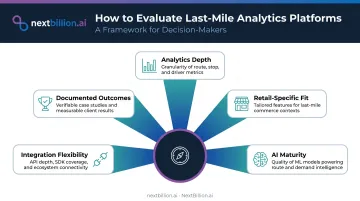
Each platform was assessed across five dimensions:
- Analytics depth — breadth of KPIs tracked and how actionable the insights are
- Retail-specific fit — store-as-hub support, omnichannel fulfillment, peak season scalability
- AI maturity — predictive and prescriptive capabilities vs. purely descriptive reporting
- Integration flexibility — compatibility with WMS, OMS, TMS, and telematics platforms
- Documented outcomes — evidence of operational improvements for retail customers
Common Selection Mistakes to Avoid
Retailers frequently choose the wrong platform for the wrong reasons:
- Prioritizing brand recognition over analytics depth — a well-known name doesn't guarantee retail-specific coverage
- Evaluating platforms in isolation from your existing WMS or OMS, which creates more data silos, not fewer
- Underestimating total cost of ownership — per-API-call pricing looks affordable in demos but scales poorly at high delivery volumes, where per-vehicle pricing can be significantly cheaper
What separates the platforms worth shortlisting is this: they don't just report what happened — they trigger what should happen next, from rerouting a delayed driver to flagging tomorrow's volume surge before it creates a staffing gap.
Conclusion
Last-mile delivery analytics has shifted from a reporting function to an operational advantage. Retailers who instrument every delivery touchpoint and act on that data in real time are outcompeting those still relying on end-of-day summaries and manual dispatch.
The right platform depends on your operational complexity. A 50-store regional retailer managing an owned fleet has different needs than a national omnichannel brand running store-based fulfillment across hundreds of nodes with multiple 3PL carriers. Match the tool to the complexity.
If you're managing high delivery volumes and need route optimization analytics without unpredictable per-call API costs, NextBillion.ai is purpose-built for that scale. Key capabilities include per-vehicle pricing, a 5,000×5,000 distance matrix, 50+ routing constraints, and 24/7 engineering support.
Request a demo or connect with the NextBillion.ai team to see how it fits your operations.
Frequently Asked Questions
What is last-mile delivery analytics and why do retailers need it?
Last-mile delivery analytics captures and interprets data from dispatch through proof of delivery. It gives retailers the visibility to reduce costs, improve on-time rates, and meet rising consumer expectations. In 2026, with same-day norms, store-based fulfillment, and driver shortages converging, it's what makes these demands operationally manageable.
What are the most important last-mile delivery metrics retailers should track?
The five core metrics are: On-Time Delivery Rate, First Attempt Delivery Rate, Cost Per Delivery, Vehicle Capacity Utilization, and Predictive ETA Accuracy. Each ties directly to retail profitability or customer retention — failed first attempts alone cost U.S. retailers $17.20–$17.78 per package (per Locus analysis).
How much can last-mile analytics reduce delivery costs for retailers?
Cost reduction is case-dependent, not a universal average. The primary levers are route optimization (reducing fuel and labor), improved first-attempt rates (eliminating redelivery costs), and better capacity utilization (reducing fleet overhead). McKinsey analysis estimates 13–19% of logistics costs can stem from inefficient handovers alone.
What features should retailers specifically look for in a last-mile analytics platform?
Retail-specific must-haves include: multi-carrier and fleet unified visibility, store-as-hub dispatch support, WMS/OMS integration, predictive demand and ETA forecasting, and exception management automation. These differ from features that matter primarily for pure logistics providers, such as long-haul freight analytics. Also check for API-based routing and mapping so the platform fits into existing dispatch and tracking workflows rather than requiring a rip-and-replace of your tech stack.
How does AI improve last-mile delivery analytics for retailers?
AI shifts analytics from descriptive (what happened) to predictive and prescriptive (what to do next). In practice: dynamic rerouting, demand-based staffing recommendations, proactive customer notifications, and routing models that improve continuously as they accumulate delivery history from your specific network. This also supports compliance-aware routing, factoring in driver hours-of-service limits and delivery windows tied to local traffic and access restrictions, without requiring manual replanning by dispatchers.
How long does it take to see ROI from a last-mile delivery analytics platform?
ROI timing is operation-dependent. Route optimization and visibility improvements typically show measurable results early in deployment, while predictive analytics models improve in accuracy over 6–12 months as they accumulate delivery history specific to your network, markets, and fulfillment model.
What is the best software for last mile delivery management?
There is no single best platform for every retailer; the right choice depends on fleet size, delivery model (store-based, DC-based, or hybrid), and integration needs. Look for software that combines route optimization, real-time tracking, proof of delivery, and analytics in one system, with APIs that connect to your existing OMS and WMS rather than forcing a separate, siloed workflow for delivery operations.
How to optimize last mile delivery?
Optimization starts with accurate address and geocoding data, then layers in dynamic route planning that accounts for traffic, delivery windows, and vehicle capacity. Retailers should also track first-attempt delivery rates, automate exception handling for failed deliveries, and use predictive ETAs to set realistic customer expectations. Continuous improvement comes from feeding actual delivery outcomes back into routing models rather than relying on static, one-time route plans.