Introduction
NEMT scheduling software with transparent pricing typically runs $50–$200+ per vehicle per month, billed flat-rate or with per-trip add-ons disclosed upfront rather than buried in a sales quote. Running an NEMT operation means managing dozens — sometimes hundreds — of recurring trips daily for passengers who can't afford a missed ride. A scheduling error isn't just an operational inconvenience. It can mean a dialysis patient misses treatment, or a compliance gap that triggers a Medicaid audit.
The documentation stakes are real. A 2022 HHS OIG audit found New York improperly claimed $84.3 million in federal Medicaid reimbursements for NEMT payments that didn't meet requirements — with another $112 million flagged as potentially non-compliant. Manual processes and missing trip documentation drove much of that exposure.
The right scheduling software reduces no-shows, cuts dispatcher hours, and keeps your trip documentation audit-ready. Choosing the wrong platform — or staying on manual processes — leaves you exposed to exactly that kind of claims scrutiny.
This guide breaks down the top 5 NEMT scheduling platforms in 2026 — their pricing, features, and who each one is actually built for.
Key Takeaways
- NEMT scheduling software automates trip booking, driver assignment, recurring appointments, and compliance documentation — replacing spreadsheets and phone dispatch
- Pricing runs $50–$200+ per vehicle/month, with setup fees and add-ons that raise first-year totals
- The right fit depends on your fleet size, payer mix, and recurring trip complexity
- Top 5 in 2026: TobiCloud, RouteGenie, TripMaster, Bambi, MediRoutes
- Teams building proprietary NEMT platforms can use NextBillion.ai's route optimization APIs for constraint-heavy scheduling off-the-shelf tools can't handle
What Is NEMT Scheduling Software and Why It Matters
NEMT scheduling software is a purpose-built platform that manages trip booking, recurring appointment scheduling, driver-vehicle matching, GPS verification, and compliance documentation. Unlike generic fleet management tools, it's built around Medicaid billing logic, broker API integrations, and EVV documentation as core functions — not add-ons.
Without it, the operational drag is significant. Transportation barriers cause foregone or delayed medical care for approximately 3.6 million people annually, and no-shows compound the problem. Indiana's Medicaid review found 10.4% of NEMT requests canceled in advance and 10.1% needed but not completed — a real cost for any fleet managing high daily volume.
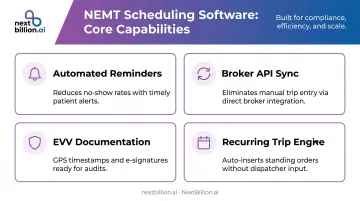
Specialized software addresses this through:
- Automated reminders that reduce no-show rates
- Broker API sync that eliminates manual trip entry from broker portals
- EVV-grade documentation with GPS timestamps and electronic signatures that survive audits
- Recurring trip engines that auto-insert standing orders without dispatcher touchpoints
The five platforms below were selected based on pricing transparency, scheduling automation depth, compliance features, and real-world user feedback.
Best NEMT Scheduling Software in 2026
Each platform below was evaluated on five criteria: scheduling automation depth, pricing transparency, Medicaid/broker compliance, mobile app quality, and scalability.
Selection criteria: scheduling automation depth, pricing transparency, Medicaid/broker compliance, mobile app quality, and scalability.
TobiCloud
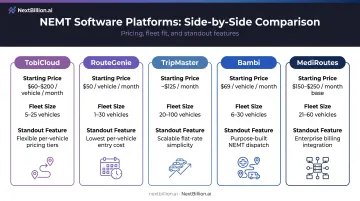
TobiCloud is a cloud-native platform targeting small-to-mid-sized providers. It's known for transparent flat-rate pricing, an offline-capable driver app, and built-in accounting features that reduce the need for third-party billing tools.
The open API supports direct broker integrations with ModivCare, MTM, and Veyo, and the pricing model lets operators configure custom rules by vehicle type or time of day — useful for mixed fleets with different rate structures.
| Attribute | Details |
|---|---|
| Key Features | Multi-fleet management, automated trip attestation, electronic signatures, AI-based trip assignment, open API broker integrations, built-in accounting and invoicing |
| Pricing | Bronze: $60/vehicle/month; Silver: $90/vehicle/month; Gold: $200/vehicle/month; $0.10/trip charge on all plans; custom enterprise pricing available. This tiered structure is a useful benchmark for what NEMT scheduling software costs overall, since it publishes per-vehicle rates plus the per-trip charge rather than folding both into an opaque quote. |
| Best For | Small-to-mid fleets (5–25 vehicles) heavily reliant on broker trips that need transparent pricing and a reliable offline driver app |
RouteGenie
RouteGenie has been in the NEMT market for over a decade. Its core differentiator is a route optimization engine that reduces deadhead miles — and a flat per-vehicle pricing model with no trip fees, which matters a lot once daily volume climbs.
The "BillingGenie" module handles pre-submission claim scrubbing and denial prevention, which pairs well with its broker integrations (ModivCare, MTM, Veyo, regional brokers).
| Attribute | Details |
|---|---|
| Key Features | Advanced route optimization, dynamic trip routing, real-time GPS tracking, driver behavior monitoring, fleet utilization analytics, broker API integrations, automated scheduling engine |
| Pricing | Growth Plan: $50/vehicle/month (month-to-month, no setup fee on base software); Pro Plan: $750/month base includes 15 vehicles; add-ons priced separately |
| Best For | Startups and established fleets (1–30 vehicles) prioritizing route efficiency and predictable flat-rate pricing; strong fit for operators managing high daily trip volume |
TripMaster
TripMaster serves providers managing paratransit, demand-response, and NEMT within a single system — a distinction that matters for transit agencies or larger operators running mixed service types. It holds one of the highest customer support ratings in the space.
Its recurring-trip scheduling engine handles standing orders (dialysis three times weekly, weekly therapy) automatically, and the IVR-based passenger reminder system reduces no-shows without dispatcher involvement.
| Attribute | Details |
|---|---|
| Key Features | Automated scheduling for recurring trips, IVR passenger reminder system, real-time GPS tracking, billing and reporting with ModivCare integration, CMS templates and audit logs, batch invoicing |
| Pricing | Custom pricing starting around $125/month; request a quote based on fleet size and service mix; free trial available |
| Best For | Transit agencies and larger providers (20–100 vehicles) mixing paratransit with NEMT; operators who prioritize scheduling complexity and support quality |
Bambi
Bambi is the newest platform on this list, launched post-2022 with an AI-first architecture and the most modern UI in the NEMT category. Its "Run Bambi Run" one-click dispatch feature uses AI to assign trips, optimize routes, and predict arrival times — cutting the time dispatchers spend on manual assignments.
HIPAA compliance is built into the platform architecture rather than added as a module. No long-term contracts are required.
| Attribute | Details |
|---|---|
| Key Features | AI-driven predictive dispatch, automated trip assignment and ETA prediction, unified scheduling-to-billing workflow, real-time claim status visibility, major broker integrations, HIPAA-compliant platform |
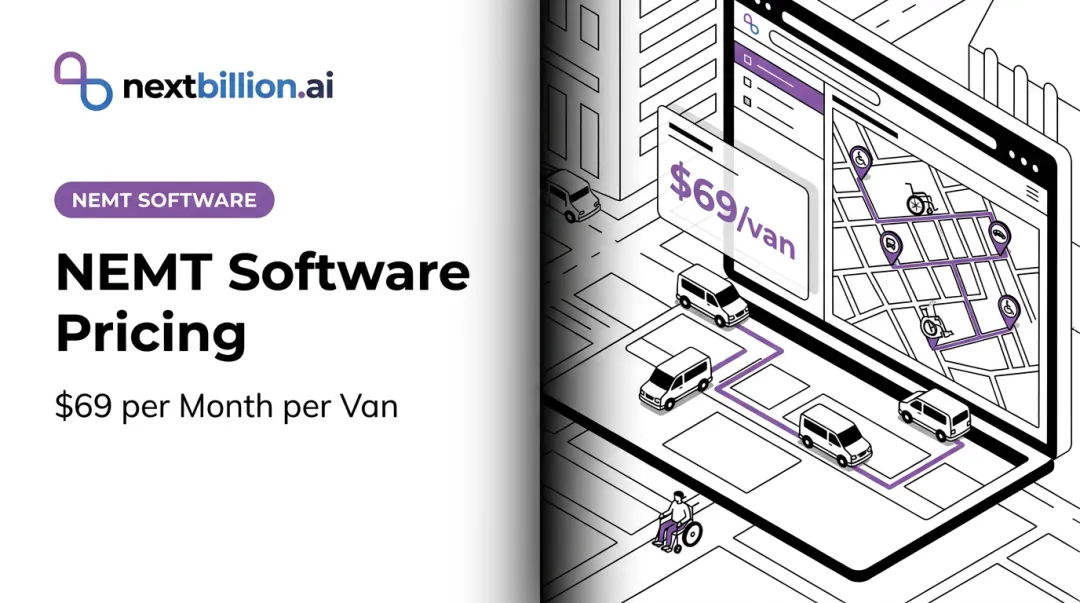
| Pricing | $69/vehicle/month; no onboarding fees, no hidden charges, no contract lock-in; verify current pricing directly with vendor. That flat per-vehicle rate is the clearest answer to what Bambi software costs, though fleets should confirm it against current vendor quotes before budgeting, since published rates can change. |
| Best For | Growing mid-sized fleets (6–30 vehicles) where dispatch workload is the primary bottleneck; operators who want modern UX and automation over deep billing customization |
MediRoutes
MediRoutes is built for enterprise-scale operations managing complex multi-payer, multi-state scheduling and billing. With over 15 years in the market, it covers advanced denial management, comprehensive HCPCS code mapping, and a GPS-enabled mobile app for iOS and Android.
Broker integration depth sets it apart — the platform connects directly to ModivCare full API, MTM Link synchronization, and a range of regional and specialty brokers.
| Attribute | Details |
|---|---|
| Key Features | Real-time dispatching and scheduling, GPS-enabled driver mobile app (iOS/Android), multi-payer billing compliance, advanced denial management, multiple export formats and API integrations, driver logs and reporting |
| Pricing | Base: $150/month + $0.50/managed trip; Premium: $250/month + $0.50/managed trip; no extra onboarding fee; contact vendor for enterprise configurations |
| Best For | Large fleets (21–60 vehicles) requiring sophisticated multi-payer billing, multi-state compliance, and scalable scheduling infrastructure |
Key Features to Evaluate Before You Buy
Not every NEMT platform handles these equally — and the gaps show up in billing errors and compliance exposure, not in demos.
Automated Recurring Trip Scheduling
For providers managing dialysis or chemotherapy patients, the ability to auto-insert standing orders — without a dispatcher touching each booking — is the difference between a manageable workday and constant manual re-entry. Look specifically for:
- Calendar conflict resolution that flags vehicle-type mismatches before they become dispatch problems
- The ability to handle exceptions (canceled sessions, schedule changes) without rebuilding the entire week's schedule
- Time-window enforcement that respects clinic hours, not just patient preferences
If your patient mix is heavily recurring-appointment-based, this feature should carry significant weight in your evaluation.
Compliance and EVV Documentation
Under the 21st Century Cures Act, CMS mandates Electronic Visit Verification for Medicaid-funded personal care and home health services — requiring documentation of service type, individual receiving service, provider, date, location, and start/end times. State Medicaid programs and broker contracts often layer additional requirements on top of that federal baseline.
Before purchasing any platform, confirm it covers your specific state's approved EVV requirements. Requirements vary by state and payer. A platform that satisfies Colorado's NEMT billing rules (which includes specific HCPCS codes like A0100, A0130, and EDI 837P submission with diagnosis code R68.89) may require additional configuration for another state's program.
Broker API Integrations and Billing Connectivity
Direct API connections to ModivCare, MTM, Veyo, and your state Medicaid portals are essential. Manual trip entry from broker portals introduces the data-entry errors that drive claim denials. ModivCare's Integration Hub, launched in May 2024, specifically enables channel partners to connect programmatically for NEMT trip management.
For operators or developers building proprietary platforms that need more than off-the-shelf tools can deliver, API-based routing engines like NextBillion.ai can power more sophisticated scheduling logic. NextBillion.ai's Route Optimization API supports NEMT-specific constraints including:
- Wheelchair-accessible vehicle matching
- Multi-dimensional time windows
- Skill-based driver assignment
- Recurring trip automation
Ride Care, a NEMT provider, reduced route planning from half a night to under two hours after integrating NextBillion.ai with their existing dispatch workflow.
How We Chose the Best NEMT Scheduling Software
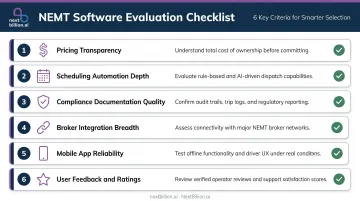
Platforms were evaluated on six criteria:
- Pricing transparency: whether vendors publish rates or hide behind "contact us"
- Scheduling automation depth, covering recurring trips, conflict resolution, and vehicle matching
- Compliance documentation quality — EVV support, audit logs, and claim scrubbing
- Broker integration breadth, including which brokers are supported natively versus through workarounds
- Mobile app reliability — especially offline functionality for drivers in low-connectivity areas
- User feedback from review platforms (TripMaster: 4.5/5 on Capterra across 93 reviews; RouteGenie: 4.7 for value-for-money on GetApp)
Watch out for two common mistakes when buying: picking a platform based on UI alone without testing the billing workflow, and choosing an enterprise system that adds overhead a 5-vehicle fleet will never use.
Total Cost of Ownership
The advertised monthly rate is never the full cost. Factor in:
- Setup and integration fees: Bambi and RouteGenie Growth publish $0 setup costs; others won't tell you until the contract stage
- Per-trip charges — TobiCloud's $0.10/trip adds up fast at volume; MediRoutes charges $0.50 per managed trip
- Add-ons like broker integrations, auto-dispatch modules, and passenger portals, which are frequently priced separately
- Annual price increases — build these into your year-two projections, not just year-one
Before signing, run the numbers against your actual daily trip volume. A platform priced at $299/month can easily reach $600+ once per-trip fees and add-ons are included.
Conclusion
The best NEMT scheduling software in 2026 is the one that fits your fleet size, payer mix, and scheduling complexity — not the one with the longest feature list. A platform built for 50-vehicle enterprise operations creates unnecessary overhead for a 5-vehicle startup.
Before committing: request demos that walk through actual scheduling and billing workflows, not just the dispatch interface. Verify broker API compatibility against your specific payer mix. Calculate total first-year cost including setup, integrations, and training.
For NEMT operators and software teams that need to exceed the routing capabilities of off-the-shelf platforms — particularly those building or scaling proprietary dispatch systems — NextBillion.ai's route optimization APIs handle 50+ scheduling constraints, deliver sub-second routing response times, and support on-premise deployment via Kubernetes for complex medical transportation operations. Learn more at NextBillion.ai's NEMT routing capabilities.
Frequently Asked Questions
How much does NEMT scheduling software cost?
Entry-level plans start around $50/vehicle/month (RouteGenie Growth). Mid-tier platforms run $69–$125/vehicle/month (Bambi, TobiCloud Silver, TripMaster). Enterprise solutions like TobiCloud Gold and MediRoutes can exceed $200/vehicle/month when per-trip charges are factored in. Budget separately for setup fees, broker integration modules, and annual rate increases when calculating total first-year cost.
What is the difference between NEMT scheduling software and NEMT dispatch software?
Scheduling software manages trip intake, recurring appointments, capacity planning, and route batching in advance. Dispatch software handles real-time driver assignment, GPS tracking, and live route adjustments during operations, including re-optimizing routes when a trip is cancelled or a vehicle breaks down. Most modern NEMT platforms combine both functions, though depth varies — some excel at pre-planned scheduling while offering only basic dispatch capabilities, so ask vendors to demo live re-routing, not just the intake screen.
Does NEMT scheduling software integrate with Medicaid billing?
Most leading platforms include Medicaid billing integration — HCPCS coding, EDI 837P submission, and claim scrubbing — though some generate complete claims automatically while others require a separate billing system. Always confirm your specific broker connections (ModivCare, MTM, Veyo) are natively supported before purchasing. Also verify EVV data flows directly into the claim record, since mismatched pickup/drop-off timestamps are a common cause of Medicaid claim denials and audit flags.
What features should I look for in NEMT scheduling software?
Core requirements include:
- Automated recurring trip scheduling
- EVV-compliant GPS documentation
- Direct broker API integrations
- Electronic patient signatures
- Mobile driver app with offline/low-connectivity support
- Denial management tools and HIPAA compliance certification
Is there free NEMT scheduling software?
Free tools exist but aren't viable for Medicaid billing — they lack GPS verification, broker API connections, and claim scrubbing. Missing documentation is what generates audit exposure and denied claims. Paid options starting at $50/vehicle/month are a far better investment for any Medicaid-dependent operation. Free trip-planning apps can work for a small private-pay fleet with no broker contracts, but once you bill Medicaid, EVV and audit requirements make paid software effectively mandatory.
How long does it take to implement NEMT scheduling software?
Most small-to-mid-fleet implementations take 1–4 weeks, covering setup, driver training, broker certification, and workflow refinement. Enterprise platforms like MediRoutes or TripMaster typically need 4–6 weeks, especially when multi-state billing configuration is involved.
How much do NEMT brokers charge or reimburse per trip?
NEMT brokers like ModivCare, MTM, and Veyo don't publish a fixed public rate card — reimbursement varies by state Medicaid program, trip mileage, vehicle type (ambulatory vs. wheelchair), and negotiated contract terms. Rates are typically set per trip or per mile through a contracted agreement rather than a flat fee. Confirm current reimbursement structures directly with each broker and your state Medicaid office rather than relying on third-party estimates.
What is the best NEMT scheduling software?
There is no single best option — the right choice depends on fleet size, state Medicaid requirements, and which brokers you contract with. Small fleets often prioritize low per-vehicle cost and fast setup, while multi-state operations need robust broker API integrations and multi-jurisdiction billing support. Evaluate platforms against your specific EVV mandate, broker list, and claim volume rather than generic feature lists or rankings.