Introduction
Last-mile delivery solutions for the e-commerce market combine route optimization software, multi-carrier networks, real-time tracking, and dispatch systems to move packages from a local hub to the customer's door faster and at lower cost. Here's a logistics paradox worth sitting with: the shortest leg of the entire supply chain consistently eats the largest share of the budget. Last-mile delivery now accounts for 53% of total shipping costs worldwide, up from 41% in 2018 — and that gap keeps widening as order volumes climb.
Cost pressure is only part of the problem. According to an OnTrac/Hanover Research survey of 5,000 consumers, 86% define "fast delivery" as two days or less, and 60% say they won't purchase from a retailer again after a slow delivery experience. Speed is now table stakes, not a selling point.
This article covers what's actually driving last-mile complexity, the strategies that reduce cost without sacrificing service, and how technology — route optimization, real-time dispatch, and live tracking — determines which operations scale profitably and which ones don't.
Key Takeaways
- Last-mile delivery represents 53% of total shipping costs — the largest and most complex fulfillment stage
- Core challenges: high labor and fuel costs, failed deliveries at $17.20 per attempt, rising customer expectations, and siloed technology
- Top strategies: AI-powered route optimization, micro-fulfillment positioning, multi-carrier diversification, and proactive tracking
- Constraint depth, matrix capacity, and pricing model are the three criteria that separate routing APIs delivering real cost savings from those that don't
- EV fleets, autonomous delivery pilots, and predictive capacity planning are setting the operational baseline heading into 2026
What Is Last-Mile Delivery in E-Commerce?
Last-mile delivery is the final movement of a package from a local distribution hub or carrier facility to the customer's door. It's the only stage of the supply chain the customer actually experiences — which makes it both the most visible and the hardest to get wrong. Choosing the right delivery partner for e-commerce generally comes down to matching carrier network coverage, routing technology, and pricing structure to order volume and delivery radius, rather than defaulting to a single national carrier for every lane.
The Three-Stage Logistics Journey
| Stage | Movement | Characteristics |
|---|---|---|
| First Mile | Manufacturer → Warehouse | Bulk shipments, consolidated loads |
| Middle Mile | Warehouse → Regional Hub | High-volume, optimized freight lanes |
| Last Mile | Hub → Customer's Door | Individual packages, dispersed addresses |
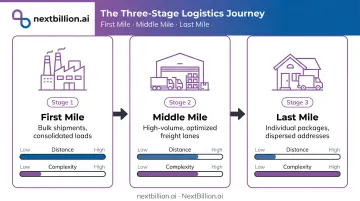
The last mile covers the least distance but involves the most stops, the most variability, and the least efficiency. A truck carrying 40 pallets to a distribution center operates very differently from a driver making 80 individual home deliveries across a city grid.
Why Delivery Execution Shapes Business Outcomes
What happens in that final window directly affects whether customers come back. An Ipsos study found 85% of online shoppers say a poor delivery experience would prevent them from ordering from that retailer again. That window closes fast — and the failures that trigger it are specific:
- Failed first-attempt delivery from missed time windows or inaccurate address data
- Zero real-time visibility, leaving customers unable to track or intercept a package
- No proof of delivery, creating disputes that cost time and credibility
Each of these is an operational problem before it becomes a customer experience problem. Fixing them requires more than driver discipline — it requires systems that plan smarter routes, surface exceptions in real time, and document every stop.
Key Challenges in Last-Mile E-Commerce Delivery
Ballooning Costs and Thin Delivery Margins
Last-mile operations carry a structural cost problem. Labor (driver wages) is the dominant expense, with fuel and vehicle maintenance compounding on top. Unlike bulk middle-mile freight, where a single driver moves thousands of units in one trip, every last-mile stop requires a vehicle, a driver, and fuel for potentially one lightweight package.
That unit economics problem scales poorly. More orders means more stops and more drivers — without proportional efficiency gains unless routing intelligence keeps pace.
Where the budget leaks most:
- Driver wages and overtime
- Fuel costs, particularly on inefficient or backtracked routes
- Vehicle wear and maintenance on high-stop urban routes
- Failed delivery redelivery costs (covered below)
Failed Deliveries and Address Inaccuracy
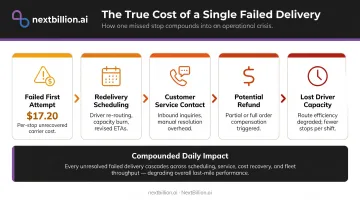
Failed deliveries are among the highest-ROI optimization targets in last-mile logistics. A Loqate/GBG study found that 8% of domestic first-time deliveries fail, costing retailers $17.20 per order and roughly $197,730 per year for the average retailer in the study.
The same research tied address problems directly to outcomes: inaccurate or incomplete addresses cause 41% of delayed deliveries and 39% of outright failures.
Each failure isn't a single-cost event. It triggers redelivery scheduling, customer service contacts, potential refunds, and driver time that could have gone to successful stops. For an operation running hundreds of deliveries daily, that redelivery overhead can consume more margin than the original order generated.
Rising and Shifting Customer Expectations
63% of consumers now expect delivery within two days — and same-day delivery influences the purchase decisions of 67% of shoppers, per the OnTrac/Hanover Research data. These aren't edge-case demands; they're the new baseline across most product categories.
The stakes extend beyond the delivery event itself. McKinsey research found 90% of consumers are likely to abandon carts that feature high shipping costs. Separately, Baymard's 2025 benchmark reports 21% of shoppers abandon checkout specifically because delivery is too slow. The last mile directly affects conversion, not just fulfillment cost.
Urban and Rural Delivery Complexity
Urban and rural environments create mirror-image problems — each environment undermines efficiency in opposite ways:
Urban challenges:
- Traffic congestion adding unpredictable time to every route
- Parking restrictions forcing drivers to walk longer distances
- Building access issues in dense residential or commercial zones
- Low-emission zone regulations forcing route changes mid-shift
Rural challenges:
- Long distances between dispersed stops
- Poor road infrastructure limiting vehicle options
- Low delivery density making each stop disproportionately expensive
- Rural parcel delivery costs run roughly 70% higher than in metropolitan centers
Urban density helps with stop clustering but creates friction at each one. Rural areas eliminate that friction entirely — and replace it with distance costs that no clustering can fix.
Technology Fragmentation and Integration Gaps
Most e-commerce operations run on siloed platforms (separate systems for order management, inventory, carrier coordination, and tracking) that don't share data in real time. The result is an operation that's chronically reactive.
How fragmentation shows up operationally:
- Drivers can't be dynamically rerouted when conditions change
- Customers receive outdated ETAs that erode trust
- Exception handling is manual and slow
- Capacity planning for peak seasons relies on historical guesswork rather than forward-looking data
Proven Strategies to Overcome Last-Mile Delivery Challenges
AI-Powered Route Optimization
Route optimization is the foundational cost-reduction lever — and that means genuine constraint-based planning, not basic navigation. A 2025 study published in Scientific Reports found dynamic algorithmic routing achieved a 24.3% reduction in total operational costs versus static baseline methods, while on-time delivery improved from 68.1% to 92.8%. In practice, optimizing last-mile delivery means pairing this kind of routing engine with real-time dispatch and live tracking so drivers can be rerouted mid-shift and customers get accurate ETAs instead of static estimates set at pickup.
The difference between "shortest path" and real optimization is how many constraints the engine can process simultaneously. Meaningful route optimization incorporates:
- Vehicle type, capacity, and load restrictions
- Customer delivery time windows (including multiple windows per stop)
- Driver shift limits and break requirements
- Road access rules and turn restrictions
- Real-time traffic and congestion data
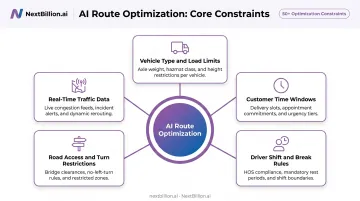
NextBillion.ai's Route Optimization API supports 50+ hard and soft constraints in a single planning pass, handling up to 10,000 stops per routing problem. This constraint depth is what separates dispatch-ready routes from routes that require significant manual correction before a driver ever leaves the depot.
Strategic Inventory Positioning and Micro-Fulfillment
Shorter distances mean faster, cheaper delivery. Multi-node fulfillment networks and urban micro-fulfillment hubs reduce the last-mile radius for high-demand zones, enabling same-day and two-hour delivery windows that would be impossible from a regional distribution center 40 miles out.
The micro-fulfillment market reflects this shift: Grand View Research projects the sector will reach $37.74 billion by 2030, growing at a 34.8% CAGR. Higher urban delivery density from hub proximity also means more stops per driver per hour, a direct cost-per-delivery improvement that requires no changes to the routing algorithm.
Multi-Carrier Strategy and Carrier Diversification
No single carrier is optimal for every parcel weight, destination type, or service level. A diversified carrier mix, intelligently applied at the order level, reduces per-package cost and protects operations from carrier-specific capacity failures during peak periods.
Intelligent carrier selection depends on:
- Rate-shopping tools that normalize base rates, fuel surcharges, and accessorial fees
- Real-time carrier performance data by zone and service level
- Flexibility to switch carriers at the order level, not just the contract level
- Transporter scorecards tracking on-time delivery and SLA compliance
Real-Time Tracking and Proactive Customer Communication
Carrier resilience solves the operational side. Customer visibility solves the experience side — and the stakes are just as high. About 50% of US consumers actively track their orders, per McKinsey data. When visibility gaps appear, they generate support contacts: WISMO ("Where Is My Order?") inquiries account for 25–35% of retail contact center volume, spiking to 50% during peak periods.
Proactive communication addresses both cost and retention:
- Automated ETA updates reduce inbound support volume
- Delivery window narrowing as vehicles approach cuts customer anxiety
- Exception alerts catch problems before customers notice them
- Photo proof of delivery eliminates disputes
Each of these touchpoints reduces the cost of a delivery while improving the customer's experience of it — a rare combination in logistics operations.
Flexible Delivery Options and Address Validation
Customer-controlled flexibility reduces failed first attempts (the single most expensive per-incident cost in last-mile logistics). Options worth building:
- Scheduled delivery windows chosen at checkout
- BOPIS (Buy Online, Pick Up In Store)
- Parcel locker networks in high-density areas
- Easy rescheduling via SMS or app without requiring a customer service call
Address validation at checkout catches errors before they become $17.20 problems. Combined with flexible pickup alternatives, these measures reduce the per-incident cost of failed attempts.
How Technology Powers Smarter Last-Mile Delivery
The technology stack is now the primary differentiator between operations that scale profitably and those stuck reacting to problems. Four layers matter most: routing intelligence, geocoding accuracy, real-time tracking, and delivery analytics.
Route Optimization APIs: Choosing the Right Engine
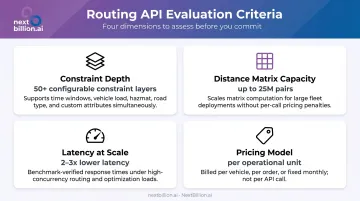
When evaluating a routing API for last-mile operations at scale, four criteria determine whether it will actually perform:
1. Constraint depth: Real operations require vehicle type, load restrictions, time windows, and road access rules handled simultaneously. Surface-level routing tools support only a fraction of what a production environment demands.
2. Distance matrix capacity: Legacy tools cap at 25×25 stops. NextBillion.ai's Distance Matrix API handles up to 5,000×5,000 elements (25 million pairs) in a single call. That 200x increase eliminates the need to break large planning problems into smaller, slower batches.
3. Latency at scale: High-volume dynamic dispatching requires fast response times. NextBillion.ai documents 2–3x lower latency than competitors with 10–20x higher throughput — the response times on-demand and same-day delivery actually require.
4. Pricing model: Per-API-call pricing becomes prohibitive as volume grows. NextBillion.ai aligns pricing with operational units — orders completed or vehicles in fleet — with usage alerts at 50%, 75%, and 90% thresholds to prevent billing surprises.
The platform integrates natively with Samsara, Geotab, and Motive, and connects via API with Salesforce, SAP, and Microsoft Dynamics 365, fitting into existing logistics stacks without requiring a rip-and-replace.
Geocoding and Address Accuracy
Routing intelligence only works as well as the address data feeding it. Poor geocoding sends drivers to wrong coordinates, packages go undelivered, and the $17.20 cost-per-failure compounds across every shift.
NextBillion.ai's Road Editor App addresses this at the operational layer — enabling teams to mark custom road closures, turn restrictions, no-entry zones, vehicle-specific access permissions, and custom speed limits. Changes feed directly into the Directions, Distance Matrix, Route Optimization, and Navigation APIs with no lag. For operations in geographies where standard map data is incomplete or stale, this editing capability is the difference between routing that works in theory and routing that works on the ground.
Delivery Analytics and Continuous Improvement
Route optimization isn't a one-time configuration. Ongoing improvement requires consistent data across four dimensions:
- Carrier performance by zone and delivery window
- Failed delivery patterns by address type and time slot
- Route efficiency trends over time
- Driver behavior metrics: route deviation and dwell time
NextBillion.ai's tracking layer surfaces this data in real time — turning a static routing configuration into a system that improves with every route cycle.
Emerging Trends Shaping Last-Mile E-Commerce in 2025 and Beyond
Sustainable delivery and EV fleet adoption are accelerating in parallel. McKinsey found over 35% of US consumers would pay $1–$2 extra for sustainable shipping, a figure that rises to 55% among 18–34 year-olds. On the fleet side, IEA reports global electric light commercial vehicle sales hit 430,000 units in 2025, up 45% year over year.
NextBillion.ai supports EV-specific routing constraints — range limits, charging station stops, and low-emission zone compliance — so fleets can model EV corridors before committing to wholesale vehicle replacement.
Autonomous delivery is moving from pilot to limited commercial deployment. Wing and Walmart expanded drone delivery to millions of customers across Dallas-Fort Worth in 2024, while the FAA authorized Zipline for beyond-line-of-sight commercial operations around Salt Lake City. Meanwhile, IoT-enabled telematics are improving exception handling on conventional fleets through:
- Temperature sensors flagging cold-chain deviations in transit
- Door alerts detecting unauthorized access or missed handoffs
- Real-time location feeds enabling faster rerouting around delays
That operational data feeds directly into the next frontier: predictive analytics and AI-driven capacity planning. Leading operations now use demand forecasting to pre-position inventory, pre-assign carrier capacity, and pre-optimize routes weeks before peak season volume arrives. The result is fewer missed SLAs and less overtime cost when surges hit.
Frequently Asked Questions
Is last-mile delivery profitable?
It can be, but it requires deliberate optimization. Last-mile accounts for 53% of total shipping costs, so profitability depends heavily on delivery density, route efficiency, and reducing failed delivery rates. Operations with strong routing, validated addresses, and smart carrier selection can achieve healthy unit economics — those without them rarely do. In practice, this means auditing route plans against real stop data, tightening delivery windows, and cutting the manual dispatch work that erodes margin on every order.
What percentage of total shipping costs does last-mile delivery account for?
Last-mile delivery accounts for approximately 53% of total shipping costs worldwide as of 2023, up from 41% in 2018, according to Statista citing Cascadia. That disproportionate share reflects individual stop routing rather than consolidated bulk transport.
What are the biggest challenges in last-mile e-commerce delivery?
The top challenges include:
- High labor and fuel costs compressing margins on every stop
- Failed delivery attempts averaging $17.20 per incident
- Rising consumer expectations for two-day or same-day windows
- Fragmented technology that blocks real-time visibility and dynamic rerouting
How does route optimization reduce last-mile delivery costs?
Route optimization increases delivery density, cuts fuel consumption, and reduces failed attempts through accurate address matching. AI-powered systems that factor in real-time traffic, vehicle constraints, and time windows deliver the most impact — research models show up to 24.3% cost reduction versus static routing.
What is the difference between last-mile and final-mile delivery?
They're the same thing. Last-mile and final-mile are interchangeable terms for the final stage of delivery from a local hub to the customer's address. The terminology varies by region or company preference, but the operations, cost structure, and optimization strategies are identical. For US e-commerce operators, this stage is where delivery windows, address accuracy, and driver routing decisions have the most direct impact on customer satisfaction and cost per stop.
What technologies are transforming last-mile e-commerce delivery?
The key categories shaping last-mile delivery today:
- AI-powered route optimization APIs with deep constraint support
- Real-time GPS tracking and proactive customer notification platforms
- Geocoding and address validation tools
- Delivery analytics dashboards and IoT fleet telematics
- Emerging autonomous systems, including delivery drones and ground robots
For most US e-commerce operations, the practical starting point is combining route optimization APIs with address validation, since these two directly reduce failed delivery attempts and fuel costs before adding more advanced tracking or telematics layers.
How do you optimize last-mile delivery for e-commerce?
Optimization starts with route planning software that accounts for real-time traffic, delivery windows, and vehicle capacity rather than static routes. Pair this with address validation to cut failed deliveries, live tracking so customers get accurate ETAs, and driver dispatch tools that adjust routes dynamically as new orders come in. The goal is fewer miles per stop, fewer failed attempts, and tighter delivery windows without adding headcount.
What should e-commerce businesses look for in a last-mile delivery partner?
Look for route optimization that handles real delivery constraints (time windows, vehicle types, driver breaks), reliable address validation to cut failed attempts, and real-time tracking with customer notifications. API-based platforms that integrate with existing order management and fleet systems let you build a solution around your operation rather than forcing a rigid one-size-fits-all workflow. Flexibility to scale as order volume grows matters more than any single feature.