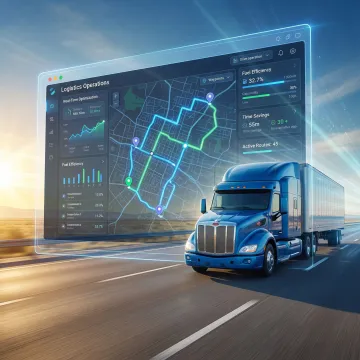
How does the Route Optimization API handle truck-specific routing restrictions?
The API accepts precise vehicle parameters — height, width, weight, axle load, and cargo type including hazardous materials — and generates routes that avoid low-clearance bridges, weight-restricted roads, and truck-prohibited streets. This vehicle-dimension awareness is built into the core routing engine, not applied as a post-calculation filter, ensuring every route is compliant before it reaches the driver.
Can the API handle Hours of Service (HOS) compliance requirements for commercial drivers?
Yes. The Route Optimization API supports driver break requirements, maximum shift durations, and route time constraints that align with HOS regulations. Combined with the Route Reconstruction API's audit-ready trip documentation and the Live Tracking API's real-time monitoring, the platform supports a complete HOS compliance workflow from pre-trip planning through post-trip record generation.
What is the maximum scale supported for distance matrix calculations?
The Distance Matrix API supports matrices up to 5,000×5,000 — processing up to 25 million distance and ETA pairs in a single API call. For carriers running large-scale network planning, this means depot-to-destination pairs across an entire regional or national fleet can be calculated in one request rather than split into batches, which reduces latency, developer overhead, and the inconsistencies that batching introduces when planning multi-stop truckloads across weight-sensitive corridors.
How does pricing work, and how does it differ from Google Maps or HERE?
NextBillion.ai offers per-vehicle and per-order pricing models instead of per-API-call billing. This means re-optimization cycles, seasonal demand spikes, and high-frequency ETA recalculations don't generate proportionally larger invoices. Costs stay aligned to your actual fleet size or order throughput — not to the underlying computational activity of your routing engine, unlike Google Maps or HERE's consumption-based pricing.
How quickly can we integrate the API into our existing TMS or logistics platform?
Integration typically goes live within one week, including trial onboarding, data testing, and production integration support. The API integrates with TMS, ERP, logistics SaaS, and telematics platforms including Samsara and Geotab, and is deployable on AWS, Google Cloud, and Microsoft Azure. Dedicated solutions engineers provide hands-on support throughout the integration process.
Does NextBillion.ai support on-premise deployment for data-sensitive freight operations?
Yes. On-premise deployment is available via Kubernetes for organizations with data residency requirements, private cloud mandates, or strict data sovereignty policies. This includes the full routing and mapping infrastructure stack, ensuring no external data transmission for operations handling sensitive cargo, government contracts, or regulated freight classifications.
How does the Road Editor App help trucking operations that standard map data doesn't cover?
The Road Editor App lets operations teams inject custom road attributes — including unofficial height restrictions, theft-prone corridors to avoid, approved overnight parking locations, and municipal plying permissions — directly into the routing engine without engineering changes. These edits apply immediately to all route calculations, navigation, and ETA estimates, eliminating the gap between what dispatchers know and what the routing system actually uses.
Can the platform support multi-depot trucking operations with simultaneous dispatch?
Yes. The Route Optimization API and Route Dispatch API together support multi-depot coordination — generating optimized routes from multiple depot locations simultaneously and pushing dispatch-ready route instructions directly to driver apps and fleet management systems in real time. This matters for carriers running regional distribution networks with more than one origin point, where routes and driver assignments need to be calculated and dispatched together rather than depot by depot, keeping fleet-wide load balancing and drive-time constraints consistent across the whole network.
What is the best route optimization software for trucking fleets?
The right choice depends on whether the software accounts for truck-specific constraints — vehicle dimensions, axle load, hazmat rules, and bridge or road restrictions — rather than treating trucks like passenger vehicles. General-purpose consumer mapping tools are not built for this. NextBillion.ai's Route Optimization API is designed specifically for commercial freight, with HGV-compliant routing built into the core engine and pricing structured around fleet size rather than per-call consumption.
Can AI do route optimization for trucking operations?
Yes. AI-driven optimization can process multiple constraints simultaneously — vehicle dimensions, hazmat restrictions, delivery windows, driver hours, and road-specific limitations — to generate routes that a manual or rules-based system would struggle to calculate at scale. NextBillion.ai's Route Optimization API applies this to commercial freight, factoring in HGV compliance and bridge or weight restrictions directly into route generation rather than as an afterthought.