Introduction
Predictive behavioral routing is a contact center technology that uses machine learning to match callers with agents based on personality, communication style, and behavioral history, rather than relying only on availability, language, or queue position. Most contact center calls are routed based on who's available, what language the caller speaks, or which queue they fall into. Personality, communication style, and emotional state rarely factor in — and according to SQM Group research, most agents aren't trained to identify or adapt to customer communication styles at all.
When a data-driven caller gets a relationship-focused agent, or an emotionally distressed customer reaches someone optimized for transactional speed, friction builds — regardless of the agent's technical competence. That mismatch is the gap PBR targets.
Predictive Behavioral Routing (PBR) is the technology designed to close that gap. This guide covers:
- What PBR is and the foundational insight behind it
- How the technical pipeline works end-to-end
- The six behavioral profiles used in matching
- Measurable benefits backed by vendor data
- How PBR compares to other routing methods
- How predictive routing logic extends into logistics and field service
Key Takeaways
- PBR uses machine learning to match callers with agents based on personality, communication style, and interaction history
- Six behavioral profiles (Doer, Organizer, Connector, Advisor, Dreamer, Original) form the matching framework
- Vendor data shows up to 18% reduction in talk time and 10–25% improvements in first-call resolution
- PBR works alongside skills-based and IVR routing — it adds a behavioral layer, not a replacement
- The same matching logic extends to logistics — pairing drivers or technicians to jobs using behavioral history and real-time signals
What is Predictive Behavioral Routing?
DMG Consulting defines predictive behavioral routing as matching customers with agents based on personality, communication style, emotional state, previous interactions, and behavioral data. People communicate differently, and those differences predict outcomes. This is the practical answer to whether AI can predict customer behavior in a contact center setting: it doesn't forecast what a caller will buy, it predicts how a caller prefers to communicate, then routes accordingly.
Some callers want facts and logical structure. Others need empathy before they'll engage with a solution. Still others are time-pressed and will disengage the moment they sense inefficiency. When caller and agent communication styles are misaligned, even a knowledgeable agent struggles to build rapport or resolve issues efficiently.
Origins and Evolution
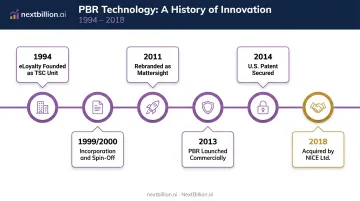
PBR traces back to eLoyalty Corporation, originally a Technology Solutions Company business unit. The technology went through several ownership and branding changes before reaching its current form:
- 1994 — eLoyalty established as a TSC business unit
- 1999 — Incorporated in Delaware; spun off in 2000
- 2011 — Rebranded as Mattersight Corporation after divesting its Integrated Contact Solutions business
- 2013 — Mattersight launches PBR commercially
- 2014 — Secures U.S. Patent No. 8,718,262 for automatic routing based on analytic attributes from prior interactions
- August 20, 2018 — Acquired by NICE Ltd.
Today, NICE CXone offers PBR as a named product, and Genesys Cloud provides a comparable predictive routing capability.
What PBR Is Not
It helps to be clear about what PBR doesn't replace:
| Routing Type | How It Works |
|---|---|
| Skills-based routing | Assigns calls based on declared agent competencies |
| IVR routing | Sorts callers by menu selections |
| Priority-based routing | Routes by customer tier or account value |
| PBR | Adds a behavioral intelligence layer on top of these |
PBR doesn't eliminate the others — it enhances the final agent-selection step with personality and behavioral compatibility data.
Four Core System Components
- Data analyzer — queries CRM records, interaction history, and behavioral annotations
- Learning program — ML model that improves matching accuracy over time
- Language/sentiment understander — NLP that interprets tone, intent, and emotional state
- Matching engine — scores caller-agent compatibility and routes in real time
How Predictive Behavioral Routing Works: The Technical Pipeline
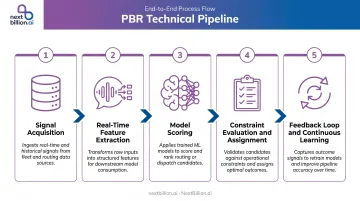
Stage 1 — Signal Acquisition
When a call arrives, the system queries the caller's phone number (ANI) against the CRM. It pulls interaction history, account tier, past resolution data, and any behavioral annotations logged from previous calls. This forms the baseline profile for the routing decision.
Stage 2 — Real-Time Feature Extraction
For callers with limited history, platforms supplement CRM data with real-time speech analytics during the IVR interaction — extracting acoustic signals like speaking rate, pitch variance, and pause patterns to infer emotional state or urgency before the call reaches an agent.
Stage 3 — Model Scoring
The combined data profile runs through a trained ML model that generates a compatibility score between the caller and each available agent. Genesys Cloud, for example, ranks agents by how well each is predicted to handle the specific interaction and optimize a target KPI — such as first-call resolution, conversion rate, or churn prevention.
That scoring only kicks in once sufficient agent data exists: Genesys requires profiles for more than 50% of agents on a predictive-routing-enabled queue before agent-profile data can influence routing decisions.
Stage 4 — Constraint Evaluation and Assignment
Before executing the match, the engine applies hard constraints:
- Agent availability and shift status
- Language requirements
- Compliance rules (regulatory, geographic)
Once constraints clear, the call is routed and a pre-populated context screen is pushed to the receiving agent — so they're prepared before picking up.
Stage 5 — Feedback Loop and Continuous Learning
Unlike the previous four stages, which operate within a single call's lifespan, Stage 5 works across the aggregate of completed interactions. Post-call outcomes feed back into the model as labeled training data:
- Resolution status
- Handle time
- CSAT score
The system retrains on rolling interaction windows, which means older data gradually loses weight as recent call patterns take precedence — keeping the model calibrated to current agent performance and shifting customer behavior.
Genesys recommends running predictive routing in a 50/50 comparison test (alternating hourly between predictive routing and an alternative method) for at least two weeks to generate statistically significant performance data before committing to full rollout.
The Six Behavioral Profiles in Predictive Behavioral Routing
PBR systems classify both callers and agents into behavioral profiles based on dominant communication patterns detected through language and speech analytics. According to NICE's 2020 documentation, these profiles draw on the Process Communication Model (PCM), a language-based typology adapted by Mattersight and now embedded in NICE's CXone platform.
The Six Profiles
| Profile | Communication Style | Best Matched With |
|---|---|---|
| Doer | Charming, persuasive, action-oriented | Direct agents who match their energy |
| Organizer | Logical, factual, methodical, structured | Systematic agents who lead with data |
| Connector | Warm, conversational, relationship-focused | Empathetic agents who prioritize rapport |
| Advisor | Observant, conscientious, thoughtful | Patient agents who listen before responding |
| Dreamer | Quiet, reflective, calm, detached | Agents comfortable with deliberate pacing |
| Original | Spontaneous, unconventional, unpredictable | Flexible agents who can shift register quickly |
Matching in Practice
Here's how the matching logic plays out in real scenarios:
High-urgency caller — The system detects fast speech rate and clipped responses during IVR. An Organizer-type agent who leads with direct facts and a clear action plan is selected.
Emotionally distressed caller — Prior interaction notes and real-time tone signals flag emotional distress. A Connector-type agent skilled in empathy and rapport-building receives the call.
Repeat caller with known style — A returning caller's behavioral annotations show a preference for conversational interactions. The system routes to an agent whose past interaction data shows alignment with that style.
Key Benefits of Predictive Behavioral Routing
Reduced Handle Time
When communication styles align, callers and agents spend less time on clarification. Mattersight reported an 18% reduction in talk time for one unnamed HMO and a 1-minute reduction in talk time for a second unnamed HMO in a 2015 vendor update. These are vendor-reported figures from unnamed customers, but they represent the type of efficiency gain PBR implementations target.
Improved First-Call Resolution and CSAT
Mattersight's 2014 patent release cited 10% to 25% improvements in first-call resolution and sales performance across implementations. NICE's documentation links personality-based matching to higher CSAT scores and fewer repeat callbacks — though no named-company CSAT figure has been independently verified.
Mattersight also reported a 14% sales conversion increase for an unnamed retail client. That figure shows PBR's impact extends beyond service metrics into revenue outcomes.
Better Agent Performance and Retention
Agents matched to compatible callers experience less emotional friction. NICE's materials note that personality-based matching correlates with greater agent job satisfaction and lower turnover. No specific retention figure has been independently verified, though the connection is direct: fewer adversarial calls means less daily burnout for agents handling high volumes.
Across all three areas, the reported gains point to the same underlying driver:
- Shorter calls when communication friction drops
- Higher resolution rates when agents and callers are better matched
- Lower attrition when agents face fewer draining interactions
PBR vs. Other Call Routing Methods
Comparison Overview
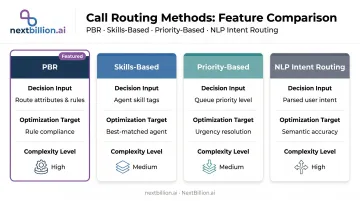
| Routing Method | Decision Input | Optimization Target | Complexity |
|---|---|---|---|
| PBR | Behavioral profiles + ML scoring | Outcome prediction (FCR, CSAT, conversion) | High |
| Skills-based | Declared agent competencies | Competency match | Medium |
| Priority-based | Customer tier or account value | Service-level fairness | Low |
| NLP intent routing | Spoken intent during IVR | Department/queue selection | Medium |
How PBR Fits With Existing Systems
PBR works alongside these methods — not instead of them. Skills-based routing narrows the agent pool to those qualified to handle the call type. Priority routing ensures high-value customers don't wait. NLP routing sends the call to the right queue. PBR then applies within that qualified, appropriately prioritized pool to select the most behaviorally compatible agent available.
Honest Tradeoffs
PBR carries operational costs that simpler routing doesn't:
- Data requirements — Sufficient labeled interaction history is needed before the model reliably beats static routing
- Model maintenance — Agent turnover and shifting customer behavior require periodic retraining to keep predictions accurate
- Fairness risk — Training data that reflects historical service inequities can entrench those patterns; ongoing auditing is required
- Implementation complexity — KPI selection, testing design, and threshold management add layers absent from rule-based systems
Smaller contact centers with limited historical data will likely get better results from skills-based routing until enough labeled outcomes have built up to train a reliable model.
Predictive Behavioral Routing Beyond Contact Centers: Applications in Logistics and Field Service
The logic at the heart of PBR — using historical behavioral data and real-time signals to match a resource to a job for the best predicted outcome — isn't unique to contact centers. It maps directly onto logistics and field service dispatch.
The Parallel Data Structure
In contact center PBR, the system scores caller-agent compatibility using interaction history, behavioral profiles, and real-time signals. In logistics and field service, the equivalent inputs are:
- Worker profiles built from past job outcomes, completion times, customer feedback, and route history
- Real-time signals including location, traffic conditions, current workload, and active order queue
- Job-level variables covering complexity, urgency, required skills, and customer history
The IDC 2025 MarketScape for AI-Enabled Field Service confirms this direction is maturing: leading platforms now use AI/ML scheduling engines that assign jobs based on real-time traffic, crew expertise, weather, and SLA requirements — not just proximity.
How NextBillion.ai Applies This Logic
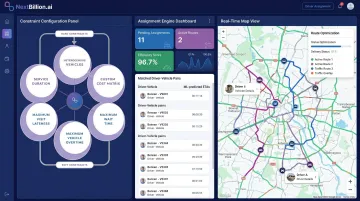
NextBillion.ai's route optimization and driver assignment platform brings predictive matching to physical operations through a combination of ML-driven routing and a highly configurable assignment engine.
Key capabilities that mirror PBR logic:
- Driver Assignment API matches drivers to orders using location, skills and certifications, shift timings, vehicle capacity, location familiarity, performance history, and customer preferences — with decisions executing in under one second.
- 50+ configurable constraints cover skill-based technician matching, attribute-based assignment, priority orders, and job-type compatibility rules
- ML-driven routing learns from each customer's historical fleet data — incorporating actual driver completion times at specific addresses, observed traffic patterns, fueling-stop preferences, and deviation patterns to sharpen predictions over time
These capabilities translate directly to measurable outcomes. Hawx Smart Pest Control documented one result: by incorporating technician skills and drive time into job allocation, the company improved its Net Promoter Score — a customer satisfaction signal, not just an efficiency metric.
The platform has optimized 10.9+ million deliveries and field tasks across 150+ businesses, navigating 557+ million miles. That volume feeds the same continuous learning dynamic that makes PBR effective in contact centers: the system gets more accurate as operational history accumulates.
Frequently Asked Questions
What is predictive behavioral routing?
Predictive behavioral routing is an AI-powered contact center technology that matches inbound callers with agents based on personality type, communication style, emotional state, and interaction history. Unlike availability-based routing, PBR uses machine learning to predict which agent is most likely to produce a successful outcome for each specific caller.
How is predictive behavioral routing different from skills-based routing?
Skills-based routing assigns calls based on pre-declared agent competencies — language, product knowledge, or certification. PBR uses ML to dynamically score behavioral compatibility between a caller and available agents based on communication style profiles and predicted outcome data, adding a personality layer on top of skills matching.
What are the six behavioral profiles used in predictive behavioral routing?
The six profiles (Doer, Organizer, Connector, Advisor, Dreamer, and Original) come from the Process Communication Model as adapted by Mattersight and NICE. Both callers and agents are classified into these profiles, enabling compatibility-based matching rather than purely competency-based assignment.
What data does predictive behavioral routing use to route calls?
PBR uses CRM interaction history, account data, agent performance metrics, and post-call outcome labels (resolution status, CSAT, handle time) to train and refine its ML model. Some platforms supplement this with real-time speech analytics during IVR to infer emotional state for callers with limited history. In logistics contexts, the equivalent inputs are driver history, delivery outcomes, customer feedback, and live signals like traffic, ETA accuracy, and vehicle telemetry, which feed similar matching models for dispatch decisions.
What are the main benefits of implementing predictive behavioral routing?
The primary documented benefits are reduced average handle time, improved first-call resolution rates, and reduced agent burnout from better caller-agent compatibility. Mattersight's vendor data cites talk-time reductions of up to 18% and FCR improvements of 10–25% across implementations. In field service and delivery operations, the same compatibility logic can reduce repeat visits, improve customer satisfaction scores, and cut dispatcher time spent manually reassigning jobs when the wrong resource is sent.
Can predictive behavioral routing principles be applied outside of call centers?
Yes. The core logic applies directly to logistics and field service: use historical behavioral data and real-time signals to match the right resource to the right job. Platforms like NextBillion.ai use driver performance history, skill profiles, and live operational data to assign drivers or technicians to jobs, optimizing for on-time delivery and customer satisfaction.
What does AI routing mean for fleet and delivery operations?
AI routing in logistics means using machine learning to decide not just the fastest path between points, but which driver or vehicle should handle which stop, based on historical performance, real-time traffic, and delivery constraints such as time windows or hours-of-service limits. It goes beyond static route optimization by continuously adjusting assignments as conditions change, similar to how predictive behavioral routing adjusts agent-caller matches in a contact center.
Can AI predict driver or customer behavior for routing decisions?
AI can identify patterns in historical data, such as which drivers consistently meet delivery windows on certain routes or which customers require extra time at drop-off, and use those patterns to inform future assignments. This is prediction based on statistical correlation, not certainty. In regulated freight, any behavioral prediction still has to operate within fixed constraints like FMCSA hours-of-service and DOT rules, which limit how much routing can be optimized around behavior alone.