How does the Route Optimization API handle strict time windows for medical equipment deliveries?
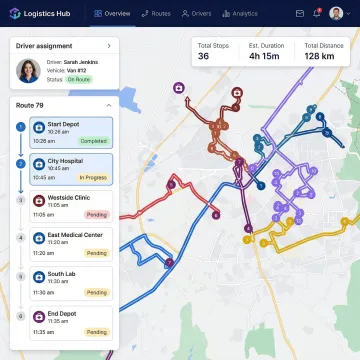
The API supports hard time window constraints for every stop, ensuring routes are sequenced so drivers arrive within the specified delivery window at each hospital, clinic, or care facility. If a time window cannot be met due to traffic or scheduling conflicts, the optimizer flags the violation before dispatch so adjustments can be made proactively—never after the fact.
Can the API manage priority deliveries for critical or urgent medical equipment?
Yes. The Route Optimization API supports priority stop ordering as one of its 50+ configurable constraints. Critical equipment deliveries—such as ventilators, surgical instruments, or time-sensitive diagnostics—can be designated as high-priority stops that the optimizer sequences first, regardless of geographic efficiency, ensuring your most urgent shipments are never deprioritized.
Does the API support compliance documentation for pharmaceutical and medical delivery regulations?
Yes. The Route Reconstruction API generates complete, road-snapped trip records with timestamps, distances, and road segment data that serve as verifiable proof-of-service documentation. Combined with geofence-triggered arrival logging, these records support the kind of audit trail needed for pharmaceutical custody chains, cold chain delivery documentation, and NEMT proof-of-service reporting under FMCSA and PHMSA-adjacent recordkeeping expectations. Note that final compliance determination rests with your legal and regulatory teams.
How does real-time dynamic reassignment work if a driver is unavailable mid-shift?
The Route Dispatch API and Driver Assignment API work together to handle mid-shift disruptions automatically. When a driver becomes unavailable, the system identifies the best replacement driver based on location, shift status, and remaining capacity, then re-optimizes the affected portion of the route plan and pushes updated instructions to the reassigned driver instantly—without manual dispatcher intervention.
What vehicle types and constraints does the API support for medical logistics fleets?
The API supports cars, vans, motorcycles, and heavy goods vehicles with configurable dimensions including height, weight, axle load, and length. For medical delivery fleets, operators can set compartment-specific capacity constraints, cargo type restrictions, temperature zone requirements, and truck-compliant routing rules to avoid low-clearance bridges or weight-restricted roads relevant to medical transport vehicles.
How does pricing work—is it based on the number of API calls?
NextBillion.ai uses per-vehicle or per-order pricing models rather than per-API-call billing. This is particularly important for medical delivery operations that run frequent re-optimization cycles, respond to urgent add-on orders, or process large batch planning runs. Your costs scale with your fleet size and order throughput—not with the underlying computational activity of the routing engine.
How quickly can the Route Optimization API be integrated into an existing healthcare logistics platform?
The API can be live in production within one week. NextBillion.ai provides dedicated solutions engineering support throughout trial onboarding, data testing, and integration. The REST API integrates with TMS, ERP, and logistics SaaS platforms and is deployable on AWS, Google Cloud, Microsoft Azure, or on-premise for organizations with healthcare data residency or HIPAA-adjacent compliance requirements.
Is on-premise deployment available for healthcare organizations with data privacy requirements?
Yes. NextBillion.ai offers full on-premise deployment using Kubernetes, allowing healthcare logistics operators, pharmaceutical distributors, and hospital supply chain teams to run the complete routing and mapping infrastructure within their own private cloud or data center. This gives organizations subject to HIPAA-adjacent data handling expectations direct control over where patient-linked delivery and location data is stored and processed, without relying on a shared multi-tenant cloud environment.
Can the API account for state-specific permitting or road restrictions affecting medical delivery vehicles?
Yes. Truck-compliant routing accounts for vehicle dimensions, weight, and axle load against road and bridge restrictions, which vary by state and locality. For medical delivery fleets using larger vehicles, this helps avoid routes that violate state DOT weight limits or low-clearance restrictions, reducing the risk of fines, delays, or unsafe detours during time-critical deliveries.