Introduction
Platforms for predictive traffic patterns route optimization combine machine learning forecasts with constraint-based routing engines to reroute fleets around congestion before it forms, rather than after drivers are already stuck in it. Traffic congestion isn't just an inconvenience for commercial fleets — it's a direct hit to the bottom line. According to ATRI's 2024 analysis of trucking congestion, U.S. highway congestion cost the trucking industry $108.8 billion in 2022 alone, wasting more than 6.4 billion gallons of diesel and adding $7,588 in average costs per registered combination truck.
Standard navigation apps reroute drivers once congestion appears on the map — by that point, the delay has already begun. AI predictive traffic optimization works differently: it forecasts where and when congestion will develop, so fleets can plan routes around the problem before drivers leave the depot.
What follows is a practical guide for fleet operators, logistics managers, and last-mile delivery teams — covering how the technology works, the business outcomes it drives, and where it's heading next.
Key Takeaways
- U.S. trucking congestion costs $108.8 billion annually — predictive routing directly attacks this expense
- AI forecasts traffic conditions up to 30 minutes ahead using historical patterns, GPS telemetry, and incident feeds
- Enterprise route optimization handles 50+ operational constraints simultaneously — well beyond what consumer navigation tools support
- Last-mile delivery accounts for 53% of total shipping costs — the single largest driver of per-delivery expense
- 5G, V2X communication, and reinforcement learning are the next wave — cutting response times and enabling systems that optimize themselves with every route run
What Is AI Predictive Traffic Optimization?
AI predictive traffic optimization uses machine learning, predictive analytics, and real-time data fusion to forecast traffic conditions before they occur. The goal is to inform route decisions ahead of congestion — not scramble to reroute after it's already slowing your fleet down. When fleet managers ask what the best route optimization software or traffic prediction app is, the answer depends on whether the platform can apply these forecasts inside a constraint-based engine — handling delivery windows, vehicle capacity, and driver hours — rather than simply displaying live traffic like a consumer navigation app.
How It Differs from Consumer Navigation
Consumer GPS apps like Google Maps show current traffic and adjust routes reactively — which works fine for a single driver, but falls short for fleet operations with hard constraints and dozens of vehicles to coordinate.
Enterprise fleets have constraints consumer tools simply don't account for:
- Fleet-wide coordination across dozens of vehicles simultaneously
- Delivery time windows with hard customer commitments
- Vehicle load limits and multi-dimensional capacity rules
- Multi-stop sequencing optimized across hundreds of stops per driver
- Truck-specific restrictions — weight limits, height clearances, hazmat routing, loading dock access
UPS's purpose-built navigation system, for example, directs drivers to specific loading docks and preferred pickup areas that standard mapping apps can't even display. Their drivers average 125 stops per day — a routing problem consumer apps aren't designed to solve.
Prediction vs. Reaction
The core distinction is timing. U.S. DOT research describes predictive traffic management as using historical and real-time data — including probe vehicle speeds, weather feeds, GPS-based smartphone data, and incident reports — to forecast nonrecurrent traffic conditions up to 30 minutes before the earliest incident report.
That 30-minute window changes the dispatch calculus entirely. A fleet dispatcher can assign alternate corridors, adjust departure times, or resequence stops before a slowdown compounds — rather than reacting to delays that have already burned fuel and missed windows.
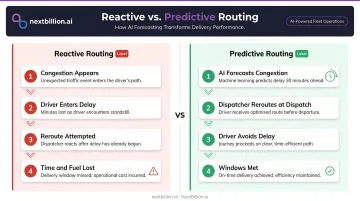
How AI Predicts Traffic and Optimizes Routes
The Data Foundation
AI traffic models are trained on large, layered datasets. For each road segment, the system builds a "traffic fingerprint" that captures how conditions evolve across different times, days, and circumstances.
Key data inputs include:
- Historical traffic flow and speed profiles
- Real-time GPS telemetry from connected vehicles
- Time-of-day and day-of-week patterns
- Weather conditions and forecasts
- Incident reports and road closure feeds
- IoT sensor data from infrastructure
Platforms like NextBillion.ai go a step further — ingesting historical operational data from your own fleet, including driver behavior, preferred routes, and service duration patterns. Routes calibrated to how your drivers actually perform are meaningfully more accurate than generic traffic models.
Machine Learning Models: Why LSTM Matters
Not all ML models handle traffic well. Traffic prediction requires understanding how conditions evolve over time, not just what they look like at any given moment. This is also why software built specifically for traffic simulation and forecasting outperforms generic analytics tools — it is trained to model sequences of change across a road network, not just isolated snapshots.
Long Short-Term Memory (LSTM) networks are particularly effective here. Research published in Scientific Reports confirms that BiLSTM architectures capture both short-term and long-term temporal dependencies in traffic flow. In practice, this means the model understands not just current speed on a corridor, but how that corridor typically behaves over the next 30–60 minutes given current conditions — enabling the engine to route around congestion before drivers reach it.
Route Optimization: The Graph Layer
Once traffic forecasts are generated, they feed into a route optimization layer. Road networks are modeled as graphs — intersections as nodes, road segments as edges. The key difference from static routing: edge weights are dynamically updated with predicted travel time, not just distance.
Academic work adapting Dijkstra's algorithm with traffic prediction demonstrates this directly — using forecasted travel time as the dynamic weight in the adjacency matrix means the engine finds the fastest path based on where congestion will be, not where it is at query time.
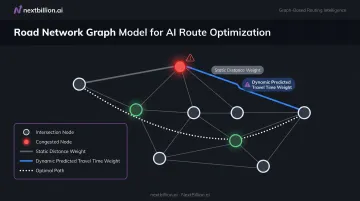
Real-Time Adaptation Mid-Journey
Prediction isn't perfect. Accidents happen. Roads close. The system doesn't just plan once at departure — it continuously monitors live conditions and re-optimizes affected routes.
NextBillion.ai's platform supports dynamic rerouting when traffic conditions, order cancellations, or urgent deliveries require it. New stops can be inserted into active routes with minimal re-optimization impact, and the system processes large-scale routing adjustments in milliseconds.
The Enterprise Constraint Layer
Speed and adaptability matter — but for commercial fleets, traffic handling alone doesn't get the job done. Purpose-built platforms go further, applying 50+ operational constraints simultaneously within the same optimization pass:
- Vehicle type, dimensions, and payload capacity
- Driver shift hours and overtime limits
- Hard and soft delivery time windows
- Skill-based job assignment
- Multi-stop sequencing and task precedence
- Hazmat routing and regulatory compliance
- Customer priority rules and depot preferences
NextBillion.ai's Route Optimization API, for instance, supports constraints including multi-dimensional capacity planning, custom cost matrices, and HAZMAT routing with axle load restrictions — all within a single optimization pass.
Business Benefits of AI Predictive Traffic Optimization
Fuel and Cost Savings
Avoiding congestion cuts more than time. Stop-and-go driving and unnecessary idling burn fuel at rates that multiply across a fleet quickly.
The UPS ORION case is the clearest documented example. According to INFORMS, ORION cost approximately $250 million to develop, saved $320 million by late 2015, and was projected to save $300–$400 million annually at full deployment — while reducing fuel consumption by 10 million gallons per year and cutting CO₂ by 100,000 metric tons annually.
Customers on NextBillion.ai's platform have recorded similar results: Xpress Global Systems cut operating costs by 35% and reduced miles driven by 13% per month after implementing optimized routing.
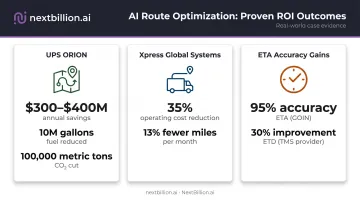
On-Time Delivery and ETA Accuracy
Predictive routing changes the ETA conversation. Instead of "your driver is stuck in traffic" notifications sent after a delay begins, dispatchers can issue accurate arrival windows at the moment of dispatch.
Two NextBillion.ai customers illustrate what that shift looks like in practice:
- GOIN, an NEMT provider, achieved 95% ETA accuracy through predictive modeling incorporating historical patterns and real-time traffic data
- A leading TMS provider on the same platform recorded a 30% improvement in ETA and ETD accuracy
When customers can rely on arrival windows at dispatch rather than scrambling after a delay hits, failed delivery rates drop and repeat business follows.
Reduced Planning Time and Dispatcher Workload
Manual route planning for a 50-vehicle fleet with tight delivery windows and mixed load types can consume hours of a dispatcher's day. AI handles that in seconds.
Results from NextBillion.ai customers show how significant that shift can be:
- Ride Care, an NEMT operator, cut planning time from half a night to two hours — now handling 4,000–6,000 transports monthly
- A field service operator on the same platform reduced scheduling time by 40%
Scalability During Demand Surges
When order volumes spike or a driver drops out mid-shift, manual replanning can't keep pace. AI systems re-optimize entire fleet route plans in near real-time.
NextBillion.ai's platform dynamically adjusts for:
- Last-minute order additions and cancellations
- Driver unavailability requiring task reassignment
- Sudden road closures requiring fleet-wide rerouting
- Peak volume periods that would overwhelm manual planning
Environmental Impact
Optimized routes mean fewer miles driven per delivery. According to the WEF's 2024 urban logistics report, last-mile logistics account for 53% of total shipping costs — so every mile removed from a route has measurable financial and environmental impact.
NextBillion.ai's platform tracks CO₂ reduction as a distinct ROI metric, giving fleet operators a direct line between routing decisions and corporate sustainability targets.
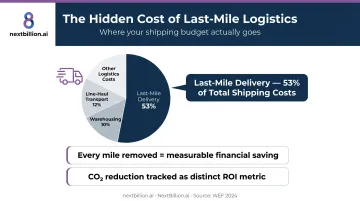
Industry Applications Across Logistics and Fleet Operations
Last-Mile and On-Demand Delivery
Last-mile is where AI traffic optimization creates the most immediate impact. Dense urban environments combine dozens of stops, hard delivery windows, and highly variable congestion into routing problems that change by the hour.
NextBillion.ai supports last-mile operations for customers including DoorDash, Zepto, and Meesho — with capabilities covering intelligent order batching, proximity-based clustering, mixed fleet routing across bikes, vans, EVs, and refrigerated trucks, and real-time dispatch optimization for ultra-fast grocery delivery. One US food delivery platform documented 40% savings on mapping costs alongside improved customer experience.
Field Service and Long-Haul Trucking
Field service adds layers that last-mile routing doesn't face: skill-based job assignments, sequential service windows, and territory planning for technicians who can't easily swap jobs mid-route.
NextBillion.ai serves Hawx Pest Control with skill-based route planning and scheduling, and OK Ride Care for NEMT operations with advanced patient journey optimization and task sequencing.
For long-haul trucking, the routing constraints are different but equally demanding:
- Height and weight restrictions on bridges and tunnels (vehicles over 13 ft 6 in are prohibited at certain facilities)
- HAZMAT routing requirements under 49 CFR Part 397
- Axle load compliance across state and municipal jurisdictions
Generic navigation tools don't enforce these rules. Non-compliance creates both safety exposure and regulatory liability — consequences no dispatcher wants to explain after the fact.
Emergency Services and Public Transit
A 2025 ambulance routing study using deep neural network architecture reported 99.15% real-time route-adjustment accuracy with 720ms processing time — a result that illustrates how much faster real-time AI can respond compared to pre-calculated routes.
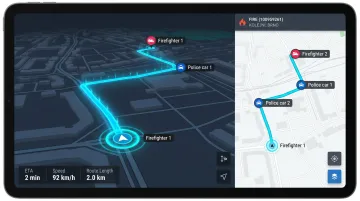
Transit operators apply the same underlying data feeds differently: instead of emergency response, the goal is holding schedules steady against variable urban congestion, stop by stop.
Challenges and What to Look for in a Solution
Data Quality and Coverage Gaps
AI models are only as reliable as the data feeding them. GPS noise, sparse sensor coverage in rural areas, and outdated road network data all degrade prediction accuracy.
NextBillion.ai addresses this through quarterly map data updates, a Map Data Management Service (MDaaS) that merges private map data with OpenStreetMap, and custom Road Editor tools for correcting route permissions in remote or industrial areas. For regions where standard data is insufficient, the platform supports private map overlays and off-road navigation configurations.
Integration with Existing Fleet Systems
A routing platform that can't connect to your telematics stack adds friction rather than removing it. The right solution integrates without forcing you to replace existing infrastructure.
NextBillion.ai integrates bidirectionally with Geotab, Samsara, and Motive — syncing data in, optimizing routes, and pushing dispatch directly to native driver apps. Deployment follows a structured path:
- Start with a trial API key
- Tune configurations with solutions engineering support
- Complete full integration — production deployment achievable within one week
Pricing Model Transparency
High-volume fleets generating thousands of optimization requests daily face real cost exposure under per-API-call pricing — every mid-day re-optimization becomes a line item.
NextBillion.ai offers per-vehicle and per-order pricing as alternatives: fixed monthly structures where re-optimizing a route mid-day doesn't generate an additional billing event. Volume-based tiers reduce per-unit costs as usage scales, and usage alerts trigger at 50%, 75%, and 90% of allocated credits to prevent surprises.
Future Trends in AI Traffic Optimization
5G and Edge Computing
Faster recalculation starts with faster data. A DHS 2024 report identifies 5G's lower latency and enhanced connectivity as key enablers of advanced vehicle automation and smarter highway infrastructure — directly supporting the high-frequency route updates that dense urban delivery and emergency dispatch require. Edge computing pushes that processing closer to the vehicle, cutting the round-trip time between data ingestion and a new route appearing on the driver's screen.
V2X Communication
V2X (vehicle-to-everything) communication goes a step further by connecting routing systems directly to traffic signals, road infrastructure, and other vehicles — not just to the driver. U.S. DOT ITS resources define V2X as enabling communication across vehicles, road users, infrastructure, and networks. In practice, that means a route could update based on a signal phase change or a stopped vehicle ahead before that slowdown ever appears in historical traffic data.
Reinforcement Learning
Reinforcement learning takes a fundamentally different approach to route optimization. Rather than static ML models trained on periodic data exports, RL systems learn from every completed route — rewarding paths that beat predicted travel times and penalizing underperforming choices. A NeurIPS 2018 paper demonstrated an end-to-end RL framework for vehicle routing that generates solutions as action sequences trained on reward signals, without retraining for each new problem instance.
The practical implication for fleet operators: enterprise platforms using RL gradually calibrate to a specific fleet's real-world patterns, improving accuracy on the routes that actually matter to that business.
Frequently Asked Questions
What is the difference between real-time traffic data and predictive traffic optimization?
Real-time data shows what traffic looks like right now. Predictive optimization uses historical patterns, machine learning models, and live feeds to forecast where congestion will develop — letting dispatchers make route decisions before problems occur rather than after vehicles are already stuck.
How does AI predictive traffic optimization reduce fuel costs for fleets?
By routing vehicles around predicted congestion, AI eliminates idle time and unnecessary stop-and-go mileage. UPS's ORION system cut fuel consumption by 10 million gallons annually — a direct result of shorter, more efficient routes rather than reactive detours. Fewer stop-start cycles also reduce brake and engine wear, and predictive routing helps fleets stay within FMCSA hours-of-service limits by avoiding unplanned delays that force drivers into costly extended shifts.
Can AI route optimization handle last-minute order changes or disruptions?
Enterprise platforms monitor live conditions continuously and re-optimize affected routes in seconds when new stops are added, a driver becomes unavailable, or a road closes. NextBillion.ai, for example, handles live re-sequencing and dynamic task reassignment while keeping the rest of the route intact.
What data sources does AI use to predict traffic congestion?
The main inputs are historical traffic flow, GPS and telematics data from connected vehicles, weather feeds, incident reports, IoT sensor data, and time-of-day patterns. Enterprise platforms also incorporate first-party fleet data — driver behavior, service durations, and historical route performance — to sharpen accuracy. Some platforms let fleets layer in their own operational constraints, such as delivery windows or vehicle restrictions, so predictions reflect the fleet's actual operating conditions rather than generic traffic averages.
How is AI-powered route optimization different from Google Maps for business fleets?
Consumer tools optimize a single vehicle's route reactively and lack enterprise capabilities like fleet-wide coordination, hard delivery time windows, vehicle load constraints, multi-stop sequencing, and regulatory compliance routing. Enterprise platforms handle all of these simultaneously at fleet scale. They also expose APIs so route logic can integrate directly into dispatch, telematics, or warehouse systems, and support predictive traffic modeling rather than only current-condition routing, which matters most for multi-stop commercial operations planned hours or days in advance.
What are the key future trends shaping AI traffic optimization?
Several converging technologies are reshaping how AI handles route planning:
- 5G connectivity reduces data latency, enabling faster real-time route updates
- V2X communication lets infrastructure feed route changes directly to vehicles
- Reinforcement learning allows systems to improve continuously from completed route outcomes, instead of relying on periodically updated static models
What is the best route optimization software for predicting traffic patterns?
There is no single best platform for every fleet; the right choice depends on fleet size, delivery complexity, and integration needs. Look for platforms that combine predictive traffic modeling with fleet-specific constraints such as time windows, vehicle capacity, and driver hours. Enterprise platforms like NextBillion.ai focus on configurable, API-based routing that fleets can adapt to their own operational rules rather than a fixed consumer navigation experience.
What is the best software for traffic simulation in fleet routing?
Traffic simulation software models how vehicles would move under different congestion, weather, or road-closure scenarios before routes are finalized. For fleets, the more useful question is whether a platform can simulate route outcomes against real operational constraints, such as delivery windows and driver hours, rather than just modeling traffic in isolation. This lets planners test route plans and staffing decisions before committing vehicles to the road.