How does the Route Optimization API enforce HAZMAT-specific road restrictions?
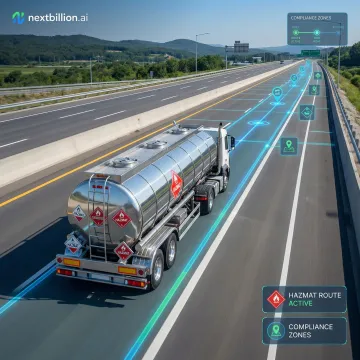
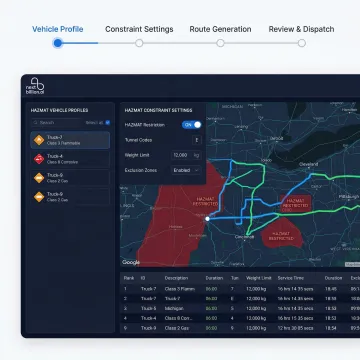
The API accepts vehicle parameters including cargo classification, vehicle weight, axle load, height, and width. These inputs are matched against road-level restriction data—bridge weight limits, tunnel restriction codes, truck-prohibited streets, and HAZMAT exclusion zones—before route calculation, so every generated route is compliant by construction, not by post-processing review.
Which HAZMAT cargo classifications does the API support?
The API supports vehicle and cargo type parameterization that maps to standard regulated goods classifications used in commercial trucking, covering the general categories of hazardous materials recognized under DOT hazmat classification, such as flammables, corrosives, explosives, and toxic substances. Operators specify hazardous material indicators as part of the vehicle profile, triggering the correct road restriction filters during optimization. Contact the solutions engineering team to validate specific classification requirements for your operation.
Can the API handle HAZMAT routing restrictions that vary by time of day or day of week?
Yes. Using the Road Editor App, operators can configure time-of-day and day-of-week scoped road restrictions—for example, applying a HAZMAT exclusion on a city-centre corridor only during peak hours. These custom rules feed directly into every route calculation without requiring API changes or developer intervention.
How does the API produce compliance documentation for HAZMAT audits?
The Route Reconstruction API processes raw GPS breadcrumb data from each trip and rebuilds a complete, road-snapped journey record with timestamps, road segment identifiers, and distance data. This output provides the verifiable, time-stamped trip history required for HAZMAT regulatory audits, incident investigations, and customer SLA verification.
What happens if a HAZMAT vehicle deviates from its optimized route?
The Live Tracking API monitors vehicle location against the planned route in real time and fires configurable deviation alerts when a vehicle strays from the approved corridor. This matters for HAZMAT loads because an unplanned detour can put a vehicle onto a road with weight, tunnel, or exclusion restrictions it is not cleared for. Combined with dynamic re-optimization through the Route Optimization API, a revised compliant route is recalculated and pushed to the driver instantly via the Route Dispatch API, keeping the trip auditable end to end.
Does the API support large HAZMAT fleets with hundreds of vehicles?
Yes. The Route Optimization API is engineered for large-scale fleet operations and handles complex multi-vehicle routing problems with 50+ constraints per vehicle. The Distance Matrix API supports matrices up to 5,000×5,000, enabling pre-processing of large fleets without batching overhead or calculation inconsistencies across requests.
What pricing model applies to HAZMAT route optimization, and how does it scale?
NextBillion.ai offers per-vehicle and per-order pricing rather than per-API-call billing. This means re-optimization cycles, deviation recalculations, and batch planning runs during seasonal demand spikes do not generate proportional cost increases. Monthly costs stay aligned to your fleet size or throughput, not to underlying computational activity.
How quickly can the HAZMAT Route Optimization API be integrated into an existing TMS or fleet system?
The API is deployable via REST and goes live within approximately one week, including trial onboarding, data testing, and production integration. NextBillion.ai's solutions engineering team provides dedicated support throughout the process. The platform integrates natively with leading TMS, ERP, and telematics platforms including Samsara and Geotab.
What are the classes of hazardous materials the API can route around?
US hazmat regulation groups hazardous materials into nine general classes, covering explosives, gases, flammable and combustible liquids, flammable solids, oxidizers, toxic and infectious substances, radioactive material, corrosives, and miscellaneous dangerous goods. The Route Optimization API does not classify cargo itself; instead it accepts these classification flags as vehicle parameters and applies the corresponding road restriction rules during route calculation.
Does the API distinguish between hazmat-only trucking and mixed-cargo operations?
Yes. Vehicle profiles are configured per vehicle or per trip, so a fleet running both hazmat and non-hazmat loads can apply hazmat-specific restriction rules only to the vehicles or trips carrying regulated cargo. Non-hazmat vehicles route without those exclusion zones and weight-based restrictions applied, avoiding unnecessary detours for loads that do not require them.