Introduction
The US ride-hailing market hit $21.0 billion in 2025, growing at a 24.7% CAGR according to IBISWorld — and Uber and Lyft still control the lion's share, with Uber alone accounting for 76% of observed US rideshare spending as of March 2024. But that dominance tells an incomplete story.
Niche operators are building profitable businesses in the gaps — in markets Uber and Lyft have little interest in serving:
- NEMT: Projected to reach $13.43 billion by 2031
- Airport shuttles: A $13.9 billion global segment
- Corporate and chauffeured fleets: Another $11.5 billion domestically
These aren't afterthoughts — they're real, underserved markets.
The catch? Building cab booking software from scratch costs anywhere from $50,000 to $500,000 and takes 6–18 months. For most entrepreneurs, that timeline kills the opportunity before it starts.
This guide covers what cab booking software actually is, the top platforms available to US operators today, and a practical framework for choosing the right one.
Key Takeaways
- Cab booking software is a pre-built platform — rider app, driver app, admin panel, and dispatch tools — deployable in weeks.
- The US market rewards operators who move fast and target underserved niches: readymade software is the fastest path there.
- Top platforms covered: Onde, VivoCabs, Jugnoo, TaxiMobility, and Cabsoluit — each suited to different business models.
- Key selection criteria: white-label depth, dispatch capability, scalability, pricing model, and routing technology.
- NextBillion.ai offers enterprise-grade route optimization APIs that integrate directly into any cab software stack.
What Is Cab Booking Software?
Cab booking software — also called ride-hailing software — is a pre-built, fully functional digital platform that gives operators everything needed to run a ride-hailing business without writing code from scratch. Instead of spending $50,000 to $500,000 and 6–18 months building rider apps, driver apps, and dispatch tools independently, operators license or subscribe to a ready-made platform and launch in weeks. This makes it the practical route for niche operators — NEMT, airport shuttle, and corporate fleet services — who need to serve underserved markets fast rather than compete on Uber and Lyft's timeline.
The Four Core Components
| Component | What It Does |
|---|---|
| Rider App (iOS & Android) | Booking, real-time tracking, payment, trip history |
| Driver App (iOS & Android) | Trip requests, navigation, earnings, status management |
| Admin Dashboard | Fleet management, user management, fare configuration, reports |
| Dispatcher Panel | Manual and auto-assignment, live trip monitoring, driver communication |
Three Deployment Models
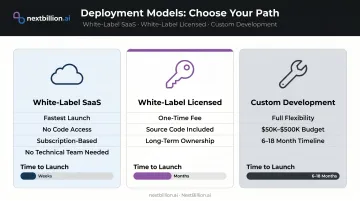
White-label SaaS: Hosted by the vendor, subscription-based, no code access. Fastest to launch and least customizable — the right fit if you want to go live quickly without a technical team.
White-label licensed: One-time fee with source code included. More upfront cost, but you own the codebase long-term. Choose this if you plan to customize heavily or want independence from a single vendor.
Custom development: Built from scratch to your exact specifications. Full flexibility, but industry benchmarks from GoodFirms put complex app timelines at 3–18+ months — and a taxi platform with rider app, driver app, and admin panel sits firmly at the complex end. Budget $50,000–$500,000 and 6–18 months of runway.
Readymade solutions have become the default entry point for US entrepreneurs for exactly this reason: they eliminate that cost and timeline risk, delivering proven, production-ready codebases with reliability already established in the market.
Top Cab Booking Software in the USA
These platforms were selected based on feature completeness, scalability, customization depth, support quality, and verified deployments in real markets. Each one targets a different operator profile — from no-code SaaS launches to full source-code ownership to multi-modal fleet management. The right fit depends on your fleet size, technical resources, and how much control you need over the underlying software.
Onde
Onde is a cloud-based SaaS white-label platform built for founders who want to launch without in-house developers. With 700+ apps deployed across 70+ countries over 10+ years, its deployment history is one of the more verifiable in this category. The platform also offers app store optimization support and launch assistance — useful for operators without a marketing team.
| Key Features | White-label rider and driver apps (iOS & Android), smart dispatch, real-time tracking, multi-language and multi-payment gateway support, promo and referral tools |
| Pricing Model | One-time setup fee plus monthly revenue share; no driver or trip limits across plans |
| Uptime Claim | 99.98% over the past year (per Onde's technology page) |
| Best For | Entrepreneurs and small-to-mid fleet operators wanting a fast, developer-free launch |
VivoCabs
VivoCabs is developed by FATbit Technologies and stands out for one reason most platforms can't match: full source code access. For a one-time payment of $9,999, operators get a lifetime license with no recurring subscription charges — plus Android and iOS apps, admin dashboard, and a codebase they can modify without vendor permission.
| Key Features | 100% white-label branding, native iOS and Android apps, source code included, admin dashboard, customizable fare engine, multiple payment gateways (PayPal, Stripe, Braintree), real-time GPS tracking |
| Pricing Model | One-time license fee of $9,999; no recurring subscription after purchase |
| Compliance | PCI compliant, SSL encryption, two-factor authentication, GDPR compliant |
| Best For | Operators who want full ownership, source code control, and long-term customization flexibility |
Jugnoo
Jugnoo positions itself as a Mobility as a Service Platform — and backs that up with feature breadth. The platform supports taxis, bike taxis, carpooling, shared mobility, micromobility, car rental, and airport taxi within a single system. Operators running more than one transportation type — or planning to expand into new segments — don't need to stitch together separate tools.
| Key Features | Multi-vehicle and ride-type support, iOS and Android apps, real-time tracking, in-app chat, referral program, smart analytics, admin banner and promo management |
| Pricing Model | Bundle plans with included rides: Startup Suite pricing available on request (14-day free trial available), with $0.10/additional ride; Enterprise Suite includes 24/7 support |
| Deployment Scale | 50M+ rides, 75+ countries, 350+ clients |
| Best For | Operators targeting diverse or multi-modal transportation markets |
TaxiMobility
TaxiMobility is built for operators transitioning from traditional dispatch to digital ride-booking — think independent taxi companies or regional cab operators who currently run manual or phone-based dispatch. Its pricing structure reflects that focus: Professional at $14/driver (up to 50 drivers) and Enterprise at $16/driver (unlimited drivers), plus a one-time Standalone license option.
| Key Features | Passenger and driver mobile apps, manual and automatic dispatch, split fare, SOS emergency button, street pickup support, driver referral, real-time trip monitoring |
| Pricing Model | Professional: $14/driver (up to 50 drivers); Enterprise: $16/driver (unlimited); Standalone: flexible one-time fee |
| Best For | Traditional taxi operators digitalizing their dispatch and booking operations |
Cabsoluit
Cabsoluit is a cloud-based dispatch platform with one distinctive angle: physical booking terminal integration. It supports kiosk-based bookings at hotels, airports, and malls alongside mobile apps and a web booking plugin — making it multi-channel in a way most platforms aren't. It operates on a pay-as-you-go model with no long-term contracts and a 14-day free trial.
| Key Features | White-label apps, centralized dispatcher dashboard, kiosk integration, web booking plugin, MID-approved taximeter support, fleet analytics, driver productivity tracking |
| Pricing Model | Pay-as-you-go; no long-term contracts; 14-day free trial |
| Primary Market | Originally built for UK taxi and private-hire companies; the kiosk and multi-channel booking model translates well for US airport transfer and hotel fleet operators |
| Best For | Fleet operators running airport transfers, hotel pickups, or corporate accounts requiring multi-channel booking |
How to Choose the Right Cab Booking Software
The most common mistake operators make is optimizing for the lowest upfront cost. Total cost of ownership tells a different story once you factor in support fees, per-driver charges, update costs, and re-platforming expenses if you outgrow your initial choice.
The Evaluation Framework
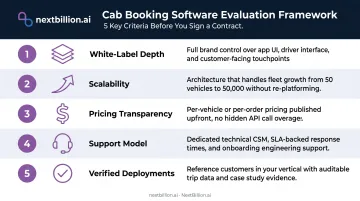
Before requesting demos, assess each platform against these criteria:
- White-label depth — Can you fully rebrand, or are vendor watermarks baked in?
- Scalability — Does it handle 500 drivers as gracefully as 10? Ask vendors for client references at your target fleet size.
- Pricing transparency — Understand all fee layers: setup, subscription, per-driver, per-trip, and year-two support costs.
- Support model — Ticket-based reactive support vs. hands-on onboarding matters most during launch week, when operational issues surface fastest.
- Verified deployments — Any vendor can claim global reach. Ask for specific case studies in your market segment.
Why Dispatch and Routing Technology Deserves More Scrutiny
Most operators spend their evaluation time on the rider app and admin dashboard, then sign a contract without examining the dispatch engine underneath. That's where the real operational risk lives. The routing layer directly determines driver assignment speed, ETA accuracy, and fuel costs across your entire fleet.
Off-the-shelf platforms use varying levels of routing sophistication. Operators who need more control — whether building a custom solution or enhancing an existing platform — can integrate specialized routing APIs as a dedicated layer. NextBillion.ai's ride-hailing route optimization APIs are built specifically for this use case:
- Driver Assignment API — Real-time 1:1 driver-to-rider matching with sub-second latency
- Distance Matrix API — Supports matrices up to 5,000×5,000 (no 25×25 cap)
- Route Optimization API — Applies 50+ constraints (time windows, vehicle capacity, shift hours, skills) to generate dispatch-ready assignments
For niche operators — airport shuttles managing multi-terminal pickups, NEMT providers matching wheelchair-accessible vehicles to patients, or corporate fleets handling fixed-schedule runs — that constraint depth makes a measurable difference. GOIN, a paratransit and NEMT operator, achieved a 40% cost reduction and 95% accurate ETAs after integrating NextBillion.ai's routing layer into their dispatch operations.
Scalability Is a Business-Critical Decision
Operators often start with 10 drivers and plan for 500. The platforms on this list handle growth differently:
- Onde and Jugnoo are cloud-hosted SaaS products — scaling is primarily a pricing conversation, not a technical one.
- VivoCabs gives you the codebase to scale on your own infrastructure, but infrastructure management becomes your responsibility.
- TaxiMobility's per-driver pricing model means costs scale predictably with fleet size.
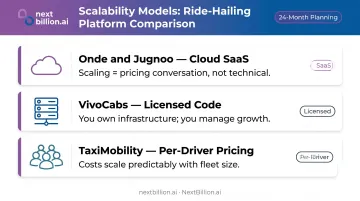
The right answer depends on your 24-month projection — not your current driver count.
Conclusion
The US market doesn't reward operators who spend 18 months building software — it rewards operators who launch, learn, and iterate. The right cab booking platform handles the infrastructure, so you compete on market focus and service quality instead.
Start by shortlisting 2–3 platforms from this guide based on your fleet size, vehicle types, and revenue model. Request demos, ask for client references at your expected scale, and stress-test the support model before committing.
For operators who want to go beyond what any off-the-shelf dispatch engine provides — whether integrating production-grade routing APIs into an existing platform or building a custom solution entirely in-house — NextBillion.ai's route optimization and mapping APIs are built for transportation businesses that need flexibility, predictable pricing, and production-grade reliability.
Frequently Asked Questions
What is the best taxi software?
There's no single best platform — the right choice depends on business size, fleet type, and customization needs. Onde suits fast-launch SaaS deployments, VivoCabs suits operators wanting full source code control, and TaxiMobility is the most practical choice for traditional taxi operations transitioning to digital dispatch.
How much does cab booking software cost in the USA?
Custom builds typically range from $50,000 to $500,000. White-label options vary widely — VivoCabs starts at a one-time $9,999 license, Onde uses a setup fee plus revenue share, and TaxiMobility charges per driver monthly. Factor in support, updates, and per-trip fees when comparing total cost of ownership.
What is the difference between white-label and custom cab booking software?
White-label software is a pre-built, rebrandable platform that gets you to market in weeks at a fraction of custom development cost. Custom development gives you full technical control but requires significant time and budget — most US operators start white-label and add customization as the business scales.
What features should I look for in cab booking software?
Must-haves include real-time GPS dispatch, native rider and driver apps, surge pricing, multiple payment gateways, and fleet management dashboards. Don't overlook routing quality and dispatch automation — the driver-assignment engine directly determines ETA accuracy and how efficiently your fleet runs. For US operators, check that the routing engine handles local road restrictions and traffic patterns, and that dispatch logic accounts for driver hours-of-service limits where applicable.
How long does it take to launch a cab booking platform in the USA?
White-label SaaS platforms like Onde can go live in a few weeks. Licensed solutions with customization typically take 4–8 weeks. Both are far faster than custom development, which runs 6–18 months for a production-ready platform.
Can small operators compete with Uber and Lyft using these software solutions?
Direct national competition with Uber or Lyft is impractical. But niche operators — airport shuttles, corporate fleets, NEMT providers, suburban cab companies — regularly build profitable businesses by serving segments the large platforms underserve. The right software gives them the operational infrastructure to do so without building technology from scratch. A web and kiosk booking option also matters here, since many of these riders — hospital patients, elderly passengers, hotel guests — don't default to a mobile app.
What is the best software for taxi dispatch?
The best dispatch software depends on fleet size and workflow, not a single universal winner. Look for automated driver assignment based on proximity and availability, live GPS tracking, and dispatcher override controls for manual intervention. For US fleets, dispatch software should also support call-in bookings, web bookings, and kiosk bookings alongside the mobile app, since a meaningful share of riders never book through an app.
What is the most used taxi app?
Uber and Lyft dominate app-based ride-hailing usage nationally, but 'most used' isn't the right benchmark for traditional taxi and fleet operators. Local and regional taxi companies typically run their own branded apps alongside web and kiosk booking channels, since many of their riders — seniors, hospital and hotel guests, corporate accounts — prefer booking by phone, web, or a physical kiosk over installing an app.