What is a Delivery Management System API and what does it do?
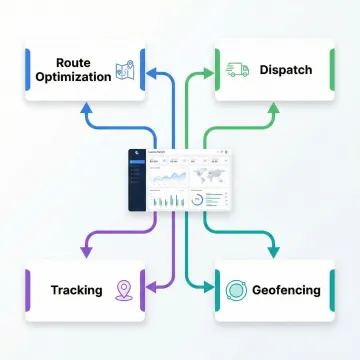
A Delivery Management System API is a programmatic interface that connects route planning, driver dispatch, live tracking, geofencing, and delivery execution into a single integrated workflow. NextBillion.ai's DMS API suite automates the end-to-end delivery lifecycle — from computing optimized multi-stop routes and assigning drivers to pushing dispatch instructions and monitoring on-road execution — without manual handoffs between systems.
How long does it take to integrate NextBillion.ai's Delivery Management APIs?
Integration typically goes live within one week, including trial onboarding, data testing, and production deployment, consistent with the platform's broader goal of getting customers live in days rather than months. NextBillion.ai's solutions engineering team provides dedicated, hands-on support throughout this process — from initial API setup through first production run — validating edge cases, data formats, and constraint configurations, including vehicle profiles and geofence definitions, before go-live.
What deployment options are available for the Delivery Management System APIs?
NextBillion.ai supports cloud deployment on AWS, Google Cloud, and Microsoft Azure, as well as on-premise deployment using Kubernetes for organizations with data residency, GDPR, CCPA, or private cloud requirements. The platform is cloud-agnostic, meaning you are not locked into a specific cloud provider and can deploy in the environment that meets your infrastructure and compliance standards.
How does NextBillion.ai's pricing model differ from per-API-call pricing?
Instead of charging per API call — a model that scales cost exponentially with re-optimization frequency and order volume — NextBillion.ai offers per-vehicle and per-order pricing alternatives. This means seasonal demand spikes, batch planning runs, and real-time re-optimization cycles don't generate variable cost overruns. Monthly costs are predictable and aligned to fleet size or order throughput, not to underlying computational activity.
Which fleet management and telematics platforms does the API integrate with?
NextBillion.ai integrates natively with Samsara, Geotab, Motive, and Netradyne for telematics, and with Salesforce, SAP, and Microsoft Dynamics 365 for CRM and ERP workflows. The Route Dispatch API and Live Tracking SDK also support custom driver app integrations built on Android, iOS, and Flutter, ensuring dispatched routes and live data flow through the tools drivers and dispatchers already use.
Can the route optimization handle truck-specific routing and regulatory compliance?
Yes. The Route Optimization and Navigation APIs are built with commercial vehicle compliance at their core. You can specify vehicle dimensions — height, weight, axle load, length — and cargo type to generate routes that avoid low-clearance bridges, weight-restricted roads, truck-prohibited streets, and hazardous material routing restrictions. This eliminates car-routing assumptions that create on-road compliance failures for heavy goods vehicles.
What is the maximum matrix size supported by the Distance Matrix API?
NextBillion.ai's Distance Matrix API supports matrices up to 5,000×5,000 — processing up to 25 million distance and ETA pairs in a single API call. This eliminates the costly and error-prone practice of batching large datasets into multiple smaller requests. Both a real-time Fast variant and a Flexible variant with truck-specific routing and departure-time-based calculations are available.
Is there an uptime SLA, and what support is provided after integration?
NextBillion.ai provides a 99.9% uptime SLA backed by contract across its core API infrastructure. Post-integration, customers receive 24/7 hands-on support from solutions engineers rather than a generic ticketing queue. This includes support for configuration changes, troubleshooting edge cases in routing or dispatch logic, and guidance as your integration scales to new vehicle types, regions, or order volumes over time.
What is a delivery management system?
A delivery management system is the software layer that coordinates the full lifecycle of a delivery operation: planning routes, assigning drivers or vehicles, dispatching jobs, tracking progress in real time, and confirming completion. Rather than a single tool, it is typically a set of connected capabilities — route optimization, dispatch, tracking, and geofencing — that work together so dispatchers and fleet managers can run deliveries from one operational view instead of juggling separate systems.
API management refers to how an organization exposes, secures, monitors, and maintains the APIs that power its software integrations — covering things like authentication, versioning, rate limits, and uptime monitoring. For a Delivery Management System API suite, this means the route optimization, dispatch, tracking, and geofencing endpoints are documented, versioned, and supported consistently, so integration teams can build against a stable interface as their delivery operations scale.