This isn't hypothetical. It's how HIPAA violations start in NEMT — not through cyberattacks, but through ordinary tools that were never built for healthcare data.
HIPAA is widely assumed to govern only hospitals and insurers. NEMT providers handle patient names, Medicaid IDs, appointment destinations, and GPS logs daily — all of which qualify as Protected Health Information — yet many operate on generic logistics software whose vendors won't sign a Business Associate Agreement and can't document a single encryption standard.
This guide covers why HIPAA applies to NEMT, what data triggers compliance obligations, where violations typically occur, what compliant software must include, and a checklist for evaluating vendors.
Key Takeaways
- NEMT providers are business associates under HIPAA when they handle PHI on behalf of covered entities, which means the same federal rules that govern hospitals apply to them
- Civil penalties range from $100 to $50,000 per violation, with an annual cap of $1.5 million for identical violations
- The most common compliance failures: non-healthcare dispatch apps, shared logins, unencrypted data, and missing Business Associate Agreements
- Compliant software requires encryption in transit and at rest, role-based access, tamper-proof audit logs, and a signed BAA from every vendor
- Generic logistics or routing tools almost never meet these standards; routing and GPS components face the same HIPAA requirements as dispatch software
Why HIPAA Applies to NEMT Providers
The Business Associate Designation
HIPAA doesn't stop at clinic doors. Under federal rules, any organization that performs functions involving the use or disclosure of PHI on behalf of a covered entity is classified as a business associate — and becomes directly liable for HIPAA compliance. HIPAA itself does not require a SOC 2 report, but a SOC 2 Type II audit gives covered entities and NEMT brokers independent evidence that a platform's access controls, encryption, and monitoring hold up over time, which is why many Medicaid managed care organizations ask for one alongside a signed BAA.
NEMT providers meet this threshold whenever they receive, process, or transmit patient trip data for a hospital, Medicaid managed care organization, dialysis center, or NEMT broker. That covers nearly every scheduled medical transport.
According to HHS, covered entities must obtain satisfactory assurances — typically through a signed Business Associate Agreement — that any BA will safeguard PHI. Without a BAA in place before data is exchanged, the provider may already be in violation before the first trip completes.
HHS has drawn a clear line here: entities acting purely as data conduits — like a postal carrier transporting sealed records — are not business associates. NEMT coordination doesn't qualify for that exemption. Dispatchers receive eligibility data, appointment details, insurance identifiers, and diagnosis-linked scheduling notes. That's PHI processing, not mere transport.
Four Rules That Govern NEMT Operations
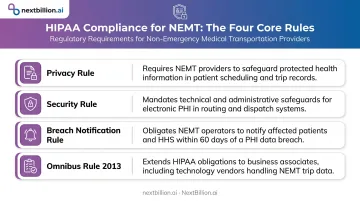
| HIPAA Rule | What It Requires for NEMT |
|---|---|
| Privacy Rule | Restricts unauthorized disclosure of PHI; applies to trip manifests, scheduling records, billing data |
| Security Rule | Requires administrative, physical, and technical safeguards for electronic PHI |
| Breach Notification Rule | Mandates notification within 60 days of discovering a breach (45 CFR 164.410(b) for business associates) |
| Omnibus Rule (2013) | Extended compliance obligations directly to business associates and their subcontractors |
Audit Exposure Is Real
State Medicaid agencies and CMS auditors don't limit their reviews to clinical providers. A 2021 OIG audit found at least $14,142,730 in improper Medicaid NEMT payments in Massachusetts alone. A 2022 OIG review questioned $196 million in New York NEMT reimbursements. Transportation vendors' trip logs, dispatch records, and billing software are all within scope.
Non-compliance by a single NEMT vendor puts healthcare partners at risk too. If your data handling exposes patient manifests, the hospital or Medicaid plan that contracted you shares accountability. That's why covered entities increasingly require documented compliance from every transportation subcontractor before signing. Medicaid reimbursement rates for NEMT trips vary by state program and trip type, set through each state's Medicaid agency or managed care contracts rather than a single federal rate, which is one more reason vendors need clean, auditable trip records to support billing claims.
What Counts as PHI in NEMT Operations
Standard Trip Records Are Loaded With PHI
The 18 identifiers listed in 45 CFR 164.514(b)(2)(i) define what must be protected. NEMT trip records routinely contain several of them:
- Patient names — in every trip request and manifest
- Home addresses and pickup locations — geographic subdivisions below state level
- Appointment dates and pickup times — specific dates that identify healthcare interactions
- Medicaid IDs and MCO member numbers — health plan beneficiary identifiers
- Phone numbers — for riders, caregivers, and facility contacts
- Vehicle and device identifiers — when linked to patient trip records
A standard trip manifest hits six or more identifiers before a dispatcher confirms the first pickup.
Destinations Reveal Diagnoses
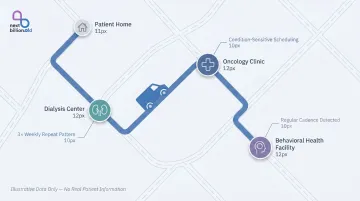
This is where NEMT's PHI exposure gets underappreciated. A schedule showing a patient traveling to a dialysis center three times weekly, or recurring trips to an oncology clinic or behavioral health facility, indirectly discloses a medical condition. The trip record as a whole is PHI — not just the name field.
GPS Logs and Route History
Patient-linked GPS logs, route histories, and real-time tracking records carry PHI risk under the same framework. HHS's online tracking guidance, updated June 2024, confirms that geographic location data connected to healthcare context — including device IDs, IP addresses, and location information tied to a regulated entity's systems — qualifies as individually identifiable health information.
That makes routing APIs and fleet tracking tools subject to the same compliance requirements as dispatch software. Providers should verify that any mapping or GPS platform operates under a signed BAA or is architected to prevent identifiable PHI exposure.
Platforms that offer on-premise deployment and hold SOC 2 Type II and ISO/IEC 27001:2013 certifications — NextBillion.ai among them — are better positioned to meet these requirements than off-the-shelf consumer mapping APIs not designed for healthcare data environments.
Common HIPAA Risks in NEMT Software and Operations
Non-Healthcare Software Is the Biggest Gap
Many NEMT operators run on generic taxi dispatch apps, free productivity tools, or standard logistics platforms. These tools were never designed for healthcare. They lack healthcare-grade encryption, role-based access, and audit trails — and their vendors won't sign BAAs. The provider absorbs all liability for any breach.
Shared Logins and Weak Access Controls
When dispatchers, drivers, and billing staff share a single login, there is no way to trace who accessed or changed a patient record — a direct violation of HIPAA's accountability requirements under 45 CFR 164.312(b).
The "minimum necessary" principle compounds this problem. Drivers who can view the full patient roster — rather than only their assigned trips — exceed the access their role requires. OCR auditors flag this routinely.
Unencrypted Data in Common Use
- Sending trip schedules via standard email
- Storing patient manifests in shared cloud folders without access restrictions
- Keeping route histories on servers without documented encryption
Catholic Health Care Services of the Archdiocese of Philadelphia — a HIPAA business associate — paid $650,000 in a 2016 OCR settlement after failing to safeguard ePHI on mobile devices, including encryption failures. Each item above has been cited in enforcement actions like this one.
Mobile Workforce Exposure
NEMT's field-based model creates PHI risks that stationary healthcare offices don't face:
- Printed trip manifests left in vehicles accessible to anyone who opens a door
- Driver apps displaying full patient details without authentication
- Paper rosters visible during vehicle checks or stops
Subcontractor Liability
When NEMT providers share trip data with sub-haulers, partner fleets, or scheduling brokers without confirming signed BAAs and compliant systems, they create downstream compliance liability. The Omnibus Rule extended those obligations to subcontractors, meaning ignorance of a partner's non-compliance does not insulate the covered entity from enforcement.
Key Features of HIPAA-Compliant NEMT Software
Encryption and Secure Data Handling
Compliant platforms must protect PHI at every stage:
- In transit: TLS encryption (per NIST SP 800-52 guidance) to secure data moving between systems
- At rest: Disk encryption aligned with NIST standards — HIPAA requires risk-based safeguards and recognizes strong encryption as a safe-harbor method
- Documented: Vendors must be able to produce written evidence of encryption methods for audit review
This applies across the entire stack — dispatch, scheduling, billing, and any routing or GPS components. NextBillion.ai, for example, uses HTTPS/TLS for data in transit and supports disk encryption, with SOC 2 Type II certification providing independent third-party validation of those controls.
Role-Based Access Control and Audit Trails
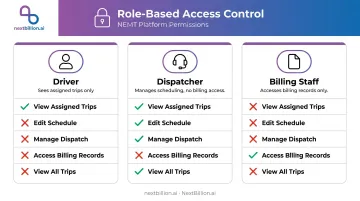
RBAC ensures each user role sees only the data their function requires:
- Drivers see only their assigned trips — not the full roster
- Dispatchers manage scheduling without accessing billing records
- Every action is tied to a unique login with a timestamp
Tamper-proof audit logs that record every access and modification are what HIPAA auditors look for under 45 CFR 164.312(b). These logs must be exportable and structured to satisfy Medicaid audit requirements without manual reconstruction.
The same standard applies to routing and GPS components. NextBillion.ai's Route Reconstruction API produces audit-defensible trip records built for regulated industries that require verifiable trip history — including NEMT proof-of-service documentation.
Signed BAAs and HIPAA-Compliant Cloud Hosting
Software must be hosted on infrastructure with a signed BAA from the cloud provider. AWS, Microsoft Azure, and Google Cloud all offer HIPAA-eligible services and BAA arrangements. The same requirement extends to every integrated tool — routing APIs, EHR connectors, payment processors.
If a vendor refuses to sign a BAA, that tool cannot legally process PHI — and that applies to every integrated component in your stack, without exception.
The True Cost of HIPAA Non-Compliance
Financial Penalties
Civil penalties under 45 CFR 160.404 scale with culpability:
| Violation Type | Per-Violation Range | Annual Cap |
|---|---|---|
| Unknowing | $100 – $50,000 | $1.5 million |
| Reasonable cause | $1,000 – $50,000 | $1.5 million |
| Corrected willful neglect | $10,000 – $50,000 | $1.5 million |
| Uncorrected willful neglect | $50,000+ | $1.5 million |
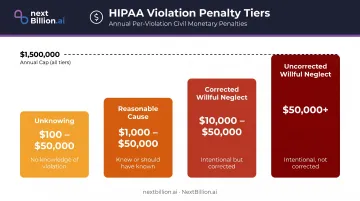
HHS adjusts these amounts for inflation, so current assessments may exceed the base statutory figures. In 2020, CHSPSC LLC — a business associate — paid $2.3 million to settle a Security Rule investigation following a cyberattack. Business associates are not sheltered from enforcement.
Contract and Revenue Loss
Medicaid agencies and managed care organizations include compliance clauses allowing immediate contract suspension when HIPAA violations are discovered. Losing a Medicaid contract cuts revenue immediately, but the longer damage is reputational. Hospitals, dialysis centers, and other referral partners take notice — and rebuilding that trust is slow work.
Ongoing Regulatory Costs
Beyond the initial fine, cited providers face ongoing monitoring that consumes significant administrative resources. A documented breach triggers costs that extend well past the penalty:
- Incident response and forensic investigation
- Legal fees and regulatory counsel
- Staff time diverted to compliance reporting
- Corrective action plan implementation and audits
HIPAA Compliance Checklist for Evaluating NEMT Software Vendors
Use this checklist when vetting any NEMT software vendor. A vendor that can't answer "yes" to most of these items — with documentation to back it up — is a compliance liability, not a partner.
Data Security and Vendor Accountability
- Does the vendor encrypt PHI in transit (TLS) and at rest, with written documentation of the standards used?
- Will the vendor sign a Business Associate Agreement?
- Has the vendor undergone independent security validation — SOC 2 Type II, HITRUST, or equivalent?
- Do these requirements extend to any routing, mapping, or GPS sub-processors integrated into the platform?
Access Control and Audit Capability
- Does the platform support distinct role-based permissions — drivers see only assigned trips, dispatchers don't access billing data?
- Is every user action tied to a unique login?
- Are audit logs tamper-proof, exportable, and structured for Medicaid and CMS audit requirements?
Infrastructure and Ongoing Compliance
- Is the platform hosted on a HIPAA-eligible cloud environment (AWS, Azure, or Google Cloud) with a signed BAA from the cloud provider?
- Is on-premise deployment available for providers requiring full data control behind their own firewall?
- Does the vendor release timely updates when Medicaid billing rules or HIPAA requirements change?
- Can the vendor generate compliance documentation on demand during a state Medicaid audit?
A complete checklist is a starting point. Vendors who pass should still provide documentation — signed BAAs, audit reports, and security attestations — before you go live.
Frequently Asked Questions
Are NEMT providers considered covered entities or business associates under HIPAA?
NEMT providers are typically classified as business associates, not covered entities. They handle PHI on behalf of covered entities — hospitals, Medicaid programs, MCOs — which means they must sign BAAs and meet the same HIPAA standards as any other business associate handling patient data.
Does GPS tracking and route history data in NEMT software qualify as PHI?
When GPS logs and route histories are tied to identifiable patients, they qualify as PHI. Pickup and drop-off locations reveal a patient's healthcare interactions. HHS guidance treats patient-linked geographic and device data in healthcare contexts as individually identifiable health information requiring protection.
What is a Business Associate Agreement and does every NEMT software vendor need to sign one?
A BAA is a legally binding contract requiring vendors to protect PHI under HIPAA. Any software vendor — dispatch, billing, routing, or mapping — that processes PHI for an NEMT operator must sign one before deployment. No signed BAA means the tool cannot legally touch PHI.
What are the fines for HIPAA violations in NEMT?
Civil penalties range from $100 to $50,000 per violation and up to $1.5 million annually for identical violations. Violations can also trigger Medicaid contract suspension and public enforcement action by the HHS Office for Civil Rights — risks that can permanently affect an operator's ability to serve Medicaid patients.
Can NEMT providers use standard logistics or routing apps not designed for healthcare?
Using non-healthcare tools creates serious compliance exposure. They typically lack encryption documentation, RBAC, tamper-proof audit trails, and the willingness to sign BAAs. Any tool that processes PHI must meet HIPAA standards regardless of the industry it was originally built for. Before adopting a routing or mapping API, confirm the vendor will execute a BAA and document how location and trip data are stored, transmitted, and purged, not just how routes are calculated.
How frequently should NEMT providers conduct HIPAA compliance audits?
At minimum, annual internal audits plus periodic third-party reviews. Audits should also be triggered by vendor changes, workforce expansion, or state Medicaid rule updates that affect how patient data is collected, stored, or transmitted. Audits should specifically check that every software vendor touching PHI, including routing and dispatch platforms, still has a current signed BAA and that access logs and audit trails remain intact and reviewable.
Does HIPAA require SOC 2?
No. HIPAA and SOC 2 are separate frameworks. HIPAA is a federal law governing PHI, while SOC 2 is a voluntary auditing standard covering security, availability, and confidentiality controls. A vendor can be HIPAA compliant without a SOC 2 report, but a SOC 2 report gives NEMT operators independent, third-party evidence that a vendor's security controls meet the operational rigor HIPAA compliance also depends on.
What is HIPAA and SOC 2?
HIPAA is a US federal law that sets rules for protecting patient health information, requiring covered entities and business associates, including NEMT software vendors, to safeguard PHI through administrative, technical, and physical controls. SOC 2 is an independent audit standard evaluating how a service organization manages data security, availability, and confidentiality. Together they address different but complementary needs: legal obligation versus verified operational security practice.