Introduction
Last-mile delivery is where logistics budgets go to die. According to Capgemini Research, the final leg of delivery consumes 41% of total supply chain costs — averaging $10.10 per delivery while operators charge customers only $8.08. That $2 gap compounds fast across millions of shipments.
The volume pressure isn't letting up. U.S. parcel shipments hit 22.37 billion in 2024, up 3.4% year-over-year. More packages, tighter margins, and rising consumer expectations mean routing decisions now directly determine whether operations turn a profit. For US carriers and regional fleets, that pressure peaks every November and December, when parcel volume spikes and route plans built for average-day demand break down fastest.
This guide covers 10 specific route optimization strategies that reduce cost per delivery, improve on-time rates, and scale fulfillment capacity without proportionally scaling headcount or fleet. Each strategy is routing-specific and tied to measurable operational outcomes.
Key Takeaways
- Last-mile delivery eats 41% of supply chain costs, often more than operators recover from customers
- Route optimization delivers faster ROI than drones, autonomous vehicles, or network redesigns
- Smarter routing decisions — not bigger fleets — cut miles driven, reduce failed deliveries, and lower cost per stop
- Track four core KPIs: cost per delivery, on-time delivery rate, first-attempt success rate, and stops per route
What Is Last-Mile Delivery Route Optimization?
Route optimization and route planning are related but not interchangeable — the gap between them is where most delivery inefficiencies hide.
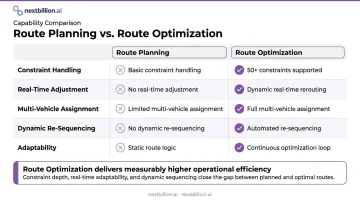
Route planning selects which stops a driver will visit. Route optimization sequences and assigns those stops under dozens of simultaneous constraints — time windows, vehicle capacity, driver hours, traffic conditions, customer preferences — to minimize total cost, distance, or time. The system recalculates dynamically as conditions change mid-route. In the US, driver-hours constraints are not just an operational preference — fleets running commercial vehicles must plan routes that keep drivers within FMCSA hours-of-service limits, which makes constraint-based optimization a compliance tool as much as a cost-saving one.
Planning vs. Optimization
| Capability | Route Planning | Route Optimization |
|---|---|---|
| Stop selection | ✅ | ✅ |
| Constraint handling | Basic | 50+ hard and soft constraints |
| Real-time adjustment | ❌ | ✅ |
| Multi-vehicle assignment | Limited | ✅ |
| Dynamic re-sequencing | ❌ | ✅ |
The scope spans two delivery models:
- Scheduled delivery — all orders known before the day begins; optimization runs once or in batches
- On-demand/hybrid delivery — orders arrive in real time, assignments must be made in seconds without visibility into future orders
Both models benefit from optimization, but on-demand delivery demands faster re-computation and tighter latency requirements.
The Biggest Last-Mile Challenges Route Optimization Solves
Route optimization directly addresses the most expensive failure points in last-mile delivery:
- High cost per stop — fragmented deliveries spread across wide geographies inflate fuel and labor costs per package
- Failed first-attempt deliveries — Loqate found 8% of U.S. deliveries fail on the first attempt, costing $17.20 each — with poor sequencing and missed time windows as the leading causes
- WISMO calls overwhelming dispatch — "Where is my order?" inquiries represent up to 50% of inbound customer service volume, costing roughly $5 per call
- Inability to scale at peak — December 2024 saw FedEx on-time performance drop to 91.8% and USPS to 90.4%, down sharply from prior-year peak performance
Every one of these problems traces back to how routes are planned — which is exactly why the strategies below focus on where the most recoverable costs live.
10 Strategies to Master Last-Mile Delivery Route Optimization
Strategy 1: Apply AI-Powered Multi-Constraint Route Optimization
Basic shortest-path algorithms solve for one variable. Real operations have dozens.
AI-powered optimization engines handle hard constraints (vehicle load limits, driver hours-of-service, time windows) and soft constraints (customer preferences, priority tiers, avoid-zones) simultaneously. The best platforms sequence thousands of stops across hundreds of vehicles in seconds, producing plans that are both feasible and cost-minimized. For US fleets, encoding hours-of-service limits directly into the constraint set means dispatchers no longer have to manually check driver availability against FMCSA limits after the fact — the optimizer builds compliant routes from the start.
The operational gap between basic tools and advanced constraint-based platforms is significant. UPS's ORION system — the most studied large-scale deployment — projected $300–$400 million in annual operating cost reduction, 100 million miles avoided, and 10 million gallons of fuel saved annually.
NextBillion.ai's Route Optimization API supports 50+ hard and soft constraints — including vehicle capacity by weight and volume, incompatible cargo types, driver shift hours, multi-depot dispatch, and customer priority tiers — and processes up to 10,000 orders in a single optimization run.
Strategy 2: Shift from Static to Dynamic Real-Time Rerouting
A route planned at 6 AM is rarely optimal by noon. Traffic incidents, customer cancellations, new orders, and vehicle delays all erode the value of a static plan.
Dynamic rerouting feeds live traffic data, GPS position updates, and new-order events into the active route plan — resequencing stops mid-route and recalculating ETAs without requiring driver intervention.
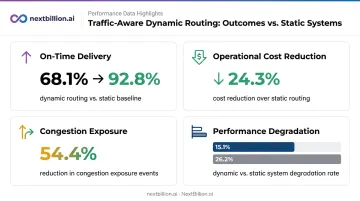
A 2025 study in Scientific Reports tested traffic-aware dynamic routing on a Shanghai urban testbed and found:
- On-time delivery improved from 68.1% to 92.8%
- Total operational cost dropped by 24.3%
- Congestion exposure fell by 54.4%
- Under extreme traffic variability, performance degradation was limited to 15.1% versus 26.2% for static systems
For same-day and on-demand models, dynamic rerouting isn't optional — it's the operational baseline.
Strategy 3: Use Predictive Analytics to Pre-Position Resources
On-demand dispatch has a structural problem: by the time an order arrives, it may already be too late to assign the nearest available driver efficiently.
Analyzing historical delivery data — order volume by time of day, geography, day of week, and season — lets teams forecast where demand will concentrate before it materializes. Teams can pre-build routes and pre-position drivers near high-demand zones. CARTO notes that forecasting demand just 30–60 minutes ahead can prevent assigning drivers away from areas about to generate orders.
The added benefit: pre-positioned resources reduce deadhead miles (empty driving between assignments) and improve first-attempt delivery rates because drivers are already near customers when orders drop.
Strategy 4: Implement Order Clustering and Batch Dispatch
Assigning each incoming order to the nearest available driver looks efficient on paper — but it ignores the next two minutes of incoming orders and drives up total distance.
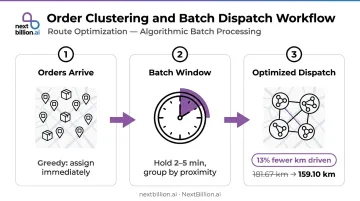
Greedy assignment sends every order immediately to the closest driver. Batch dispatch holds orders for a short window — typically 2–5 minutes — then solves the assignment optimally across the full batch.
CARTO's analysis of a 5-minute on-demand batch window found batch assignment reduced total pickup distance from 181.67 km to 159.10 km — a 13% improvement over greedy assignment.
Order clustering builds on this by grouping stops geographically before route-building. Higher stop density per route means fewer miles between stops and more deliveries per driver hour.
NextBillion.ai's Clustering API groups delivery stops by proximity, ETA, and distance, with configurable constraints for cluster size, depot boundaries, and high-priority stop weighting — then feeds the output directly into route optimization.
Strategy 5: Optimize for Time Windows, Not Just Distance
The shortest route on a map is often not the cheapest route in practice.
When a driver arrives outside a customer's availability window, the delivery fails. That failure costs $17.20 to resolve — far more than any fuel savings from a tighter route. INFORMS research modeling customer availability profiles showed that incorporating time-window success probabilities into routing reduced failed deliveries by ~12% and logistics costs by ~5%.
Time window optimization sequences stops to honor all committed windows while minimizing idle wait time between deliveries. Soft constraint handling — treating some windows as flexible rather than hard cutoffs — allows the engine to maximize task completion when perfect adherence would leave stops unassigned.
A more advanced application: dynamic scheduling tools that steer customers toward time windows that are cheaper to serve, consolidating stops in the same zone on the same day to increase route density.
Strategy 6: Enable Drivers with Mobile-First Execution Tools
Optimization value exists on paper until drivers actually follow the plan.
Mobile driver apps that surface turn-by-turn navigation, stop sequences, delivery instructions, and proof-of-delivery capture in a single interface eliminate improvised rerouting and reduce dwell time at each stop. For US fleets, these apps also generate the timestamped records dispatchers need to reconcile driver hours-of-service logs and resolve delivery disputes, giving operations a paper trail beyond the route plan itself.
The data feedback loop matters just as much: actual stop durations, delivery outcomes, and exception notes captured in real time feed back into the optimization model, making future routes progressively more accurate.
Descartes ePOD case data showed SIG plc increased OTIF deliveries by 10–15% and delivery volume by 25% using their existing fleet — without adding vehicles.
NextBillion.ai's Driver App integrates turn-by-turn navigation, one-click dispatch from the route planner, and live tracking with deviation alerts. Dispatchers receive automatic notifications when drivers deviate from the optimized sequence.
Strategy 7: Automate Real-Time Customer Communication and ETA Updates
"Where is my order?" calls represent up to 50% of inbound retail customer service volume. At roughly $5 per call for self-service resolution — and $13.50 for assisted contacts — the cost accumulates quickly. For US operations running high delivery volumes during peak retail periods, that call volume can overwhelm a dispatch team within days if ETA accuracy lags behind actual route conditions.
Automated SMS and email notifications with live tracking links and dynamic ETAs accomplish two things at once: they keep customers informed so they're present for delivery, and they deflect WISMO calls before they hit the queue.
The ETA accuracy depends entirely on the routing engine continuously recalculating arrival times as the driver progresses. Systems that update customers in real time as ETAs shift prevent the surprise that drives reschedule requests — which are even more expensive than WISMO calls. 69.7% of shoppers are less likely to reorder from a retailer that delays their package without proactive notification.
Strategy 8: Integrate Fleet Telematics for Live Route Adherence
GPS telematics data fed into the route optimization platform gives dispatchers a live view of route adherence versus plan. When a driver falls behind or a delivery zone shows unexpected congestion, dispatchers can intervene before the delay cascades across remaining stops.
Telematics integrations with platforms like Samsara, Geotab, and Motive create a unified dispatch view without manual status checks. Samsara data found Arte Logistik reduced fuel consumption by 0.69 liters per 100 km over 9 million kilometers using connected telematics — saving 64,000 liters annually.
The integration architecture matters here. NextBillion.ai supports native bidirectional API integrations with Samsara, Geotab, and Motive — pulling vehicle and order data automatically, then pushing optimized routes directly back to driver apps on those platforms. This eliminates the manual handoff between routing and fleet visibility that creates lag in exception management.
Strategy 9: Leverage Micro-Fulfillment to Compress the Final Mile
No routing algorithm fully compensates for a fulfillment origin that's 40 miles from your delivery zone.
Positioning inventory in urban micro-fulfillment centers or forward-deployment nodes reduces the geographic radius of every route before optimization begins. McKinsey found that same-day delivery from dark stores runs 23% cheaper than fulfillment from conventional retail locations — and that robotic micro-fulfillment centers pick at 400–500 units per hour, more than 5x manual speed, while halving pick-and-pack cost per order.
Micro-fulfillment changes the inputs to the optimization problem. Shorter base distances and denser delivery zones mean more stops per route with fewer miles traveled. Combined with smart routing, the cost-per-stop reduction multiplies — neither tactic alone delivers what both achieve together.
Strategy 10: Build Continuous Route Performance Improvement Loops
Route optimization isn't a one-time configuration. Operations change, customer bases shift, and stop times that were accurate in Q1 may be wrong by Q4.
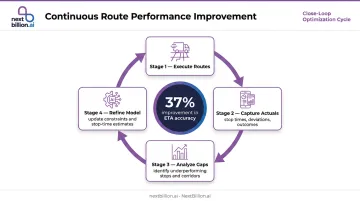
Post-day comparison of planned routes versus actual execution reveals:
- Stops that consistently run longer than estimated
- Drivers routinely skipping the optimized sequence on specific corridors
- Zones where first-attempt delivery rates lag the network average
This data refines stop-time estimates, updates constraint settings, and improves future route templates. NextBillion.ai's AI Route Optimization learns from historical fleet data — incorporating actual driver completion times, observed traffic patterns on regularly-used corridors, and historical deviation patterns — to produce routes that drivers find natural to follow and that deliver predictable on-road performance. One logistics firm saw a 37% improvement in ETA accuracy after the platform was trained on their historical operational data.
Assign a routing competency owner responsible for reviewing analytics, updating parameters, and propagating learnings. Without that ownership, the gap between what your optimizer thinks is true and what's actually happening on the road widens — and ETA accuracy and delivery costs follow.
Measuring Success: KPIs for Last-Mile Route Optimization
Track these five metrics with defined review cadences:
| KPI | Definition | Review Cadence |
|---|---|---|
| Cost per delivery | Total last-mile operating cost ÷ deliveries completed | Weekly |
| On-time delivery rate (OTDR) | Deliveries completed within promised window | Daily |
| First-attempt success rate | Deliveries completed without failed attempt or redelivery | Daily |
| Stops per route / miles per stop | Route density; signals driver time and fuel efficiency | Weekly |
| Route adherence rate | How closely actual execution matched the optimized plan | Monthly |
Those KPIs only mean something when measured against a baseline. December 2024 peak on-time performance hit 96.5% at UPS, 91.8% at FedEx, and 90.4% at USPS — all large carriers running mature optimization programs. If your OTDR sits below 90%, routing logic and time-window calibration are the first places to look.
Structure your review cadence around the metrics that change fastest:
- Daily: OTDR and first-attempt success rate — catch service failures before they compound
- Weekly: Cost per delivery and stop density — spot efficiency trends early
- Monthly: Route adherence and model accuracy — assess whether your optimization engine's predictions match actual outcomes
Conclusion
Last-mile route optimization is a system, not a single purchase. The 10 strategies above work together: fix routing sequencing and real-time visibility first, then layer in predictive analytics, micro-fulfillment, and performance feedback loops as operations mature.
The most productive sequence is usually the same. Start with constraint-based optimization and dynamic rerouting (Strategies 1 and 2), add driver execution tools and customer communication (Strategies 6 and 7), then build the data feedback discipline that makes the whole system improve over time (Strategy 10).
Platforms built specifically for logistics operations — like NextBillion.ai's route optimization and mapping APIs — offer the constraint depth, predictable pricing, and integration flexibility that modern last-mile operators need. Per-vehicle and per-order pricing means route re-optimization during peak demand never becomes a budget emergency. See how NextBillion.ai's route optimization APIs fit into your last-mile stack.
Frequently Asked Questions
What is last-mile delivery optimization?
Last-mile delivery optimization is the process of maximizing efficiency in the final leg of delivery — from a fulfillment origin to the end customer — using routing algorithms, real-time data, and operational constraints to reduce cost, time, and failed deliveries. It covers everything from stop sequencing and vehicle assignment to time window management and exception handling.
What is a last-mile delivery solution?
A last-mile delivery solution is a software platform — or integrated set of tools — that enables businesses to plan, execute, and measure final-leg delivery operations. It typically combines route optimization, real-time tracking, driver apps, and customer notification into a single operational stack. Fleets use it to build dispatch plans that account for vehicle capacity, driver hours, delivery windows, and address-level constraints, then adjust those plans as conditions change during the day.
How do you improve OTIF performance?
OTIF improvement comes down to four levers: accurate route planning with realistic time windows, real-time exception management to catch delays early, proactive customer communication to confirm availability, and consistent KPI tracking to surface chronically underperforming stops or routes.
What is the biggest challenge in last-mile delivery?
The core structural challenge is fragmentation. Unlike bulk freight, last-mile involves dozens of individual stops, which drives up labor, fuel, and vehicle cost per unit. Unpredictable traffic and customer unavailability make execution harder, while rising expectations for fast, free delivery keep raising the bar. Compliance adds another layer: drivers must stay within hours-of-service limits, and dispatchers need visibility into delivery attempts and exceptions to keep routes both efficient and defensible.
How does AI improve last-mile route optimization?
AI enables route engines to evaluate thousands of stop sequences against hard and soft constraints simultaneously, then adjust plans in real time as traffic or orders shift. Over time, the engine learns from historical execution data, making future route plans more accurate and cost-efficient.
How to optimize delivery routes?
Optimizing delivery routes starts with clean data: accurate addresses, real delivery windows, vehicle capacities, and driver constraints. From there, a route optimization engine sequences stops to minimize distance and time while respecting those constraints. The process should not stop at planning — real-time tracking and re-optimization let dispatchers adjust routes when traffic, cancellations, or new orders come in mid-day.
Can AI do route optimization?
Yes. AI-based route optimization engines can process many variables at once — stop order, time windows, vehicle capacity, driver hours, and traffic conditions — and generate routes faster than manual planning or basic mapping tools allow. AI also supports re-optimization, adjusting routes mid-day as conditions change, and can improve future planning by learning from historical delivery patterns rather than relying on static rules alone.