Introduction
Google Maps Platform is where most logistics and fleet software projects start. The APIs are familiar, the documentation is solid, and the first few thousand requests are cheap enough that nobody asks questions.
Then the bills arrive. Per-API-call pricing starts compounding, the Distance Matrix hits its element cap mid-dispatch, and a route optimization feature you assumed existed simply doesn't. The tool that seemed adequate in development is actively working against you in production.
This article evaluates six serious Google Maps alternatives — HERE Maps Platform, Mapbox, TomTom, Azure Maps, OpenRouteService, and NextBillion.ai — through the lens of operational logistics. Not consumer apps, not map tiles. For US fleet operators, that lens also includes whether a routing engine can factor in FMCSA hours-of-service limits, state-by-state truck weight and bridge restrictions, and hazmat routing rules — constraints that consumer-grade mapping tools were never built to handle.
The evaluation criteria: route optimization constraints, matrix size limits, truck routing, pricing predictability, and what actually happens when you need support at 2 a.m.
One option pulled clearly ahead — and it wasn't the one most teams default to.
Key Takeaways
- Google Maps Platform's per-call pricing compounds fast — and native route optimization caps at 25 waypoints
- HERE and TomTom handle truck routing well but use negotiated enterprise contracts that make cost forecasting difficult
- Mapbox and Azure Maps serve specific niches well but aren't purpose-built for dispatch-heavy operations
- OpenRouteService is free but requires heavy engineering to run reliably at scale
- NextBillion.ai is the top pick: per-vehicle/per-order pricing, 50+ constraints, a 5,000×5,000 distance matrix, and truck-compliant routing from day one
Why Businesses Are Reconsidering Google Maps Platform
Google Maps Platform is a suite of developer APIs — Directions, Distance Matrix, Routes, Places — used to embed mapping and routing functionality into business applications. It's developer infrastructure, not a navigation app.
For low-volume use, it works. The problems surface in two specific areas once operations scale: pricing and hard technical limits.
The Pricing Problem
Google Maps Platform uses pay-as-you-go pricing billed by billable event — requests, elements, transactions. Secondary sources reported price increases exceeding 1,400% for some use cases when Google overhauled its pricing structure in 2018. You may not hit that extreme — but every API call costs money, and logistics operations generate a lot of them. For a US-based dispatch team running multiple route recalculations per driver per shift, that per-call model turns predictable operating costs into a variable line item that's hard to budget for month to month.
The Technical Ceiling
Two specific limits cause real operational pain:
- Distance Matrix: The Routes API Compute Route Matrix caps at 625 elements for standard requests (100 for transit or traffic-aware optimal). For fleet dispatch, that's a hard constraint that forces batching, multiplies API calls, and drives costs up simultaneously.
- Route optimization: The legacy Directions API caps at 25 waypoints with TSP-style reordering — and Google's routing documentation lists no native support for truck dimensions, axle weight, or hazmat controls.
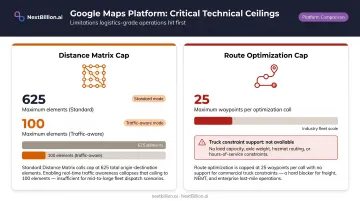
For a company dispatching 20 vehicles with 30+ stops each, this isn't a minor inconvenience. It's a product architecture problem. In the US, where interstate carriers must also account for FMCSA hours-of-service limits and state-specific truck weight and hazmat restrictions, a routing engine that can't natively model those constraints pushes the compliance work onto dispatchers manually — the opposite of what a routing API is supposed to solve.
6 Google Maps Alternatives I Tested
Alternatives were evaluated on: pricing model and scalability, route optimization depth, truck routing support, matrix size, ease of integration, and availability of commercial SLAs.
HERE Maps Platform
HERE is one of the oldest independent mapping data providers, originally developed by Nokia and now backed by Audi, BMW, Mercedes-Benz, Bosch, Intel, and others. It offers Routing, Geocoding, Traffic, and Fleet Telematics APIs with serious enterprise pedigree.
What HERE does well:
- Truck routing with documented support for height, width, length, gross weight, axle count, axle weight, trailer count, hazmat goods, and tunnel categories
- Proprietary traffic data and offline map packages for global operations
- Waypoints Sequence API for stop-order optimization
Where it falls short: HERE's pricing is consumption-based, and enterprise contracts require direct negotiation — making cost predictability harder for mid-market logistics operators. Some advanced routing modes are documented as beta.
The Matrix Routing API supports up to 15 origins × 100 destinations (or 100 origins × 1 destination). Better than Google, but still constraining at dispatch scale.
| HERE Maps Platform | |
|---|---|
| Pricing | Consumption-based; free tier available; enterprise via quote |
| Key strengths | Truck routing, offline maps, proprietary traffic, fleet telematics |
| Best for | Large enterprises with global operations needing automotive-grade reliability |
Mapbox
Mapbox is a developer-first platform known for highly customizable map styling and a broad SDK ecosystem. Consumer apps and startups building branded navigation experiences are its natural home.
What Mapbox does well:
- Map aesthetics and frontend customization set the standard for visual flexibility
- Optimization API v2 solves vehicle routing problems
- Directions API supports up to 25 coordinates with some vehicle dimension parameters
Where it falls short: The Optimization API v2 caps at 50 coordinates per request; v1 caps at 12. Pricing is usage-based per API request, so at logistics scale, cost behavior mirrors Google's. Mapbox is built for frontend experiences — it's not a dispatch engine.
| Mapbox | |
|---|---|
| Pricing | Pay-as-you-go per API request; free tier available |
| Key strengths | Custom map styling, Navigation SDK, consumer-grade UX |
| Best for | Consumer-facing apps and startups that need branded, visually custom maps |
TomTom Maps API
TomTom has been in navigation hardware since 1991 and brings decades of connected vehicle data to its APIs. Its traffic data quality is a genuine differentiator.
What TomTom does well:
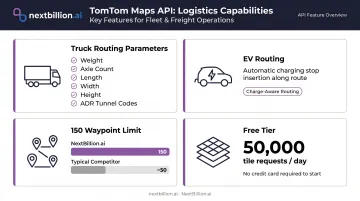
- Truck routing parameters include vehicle weight, axle weight, axle count, length, width, height, commercial flag, load type, and ADR tunnel codes
- Long Distance EV Routing API adds automatic charging stop insertion
- Maximum 150 waypoints in Calculate Route — better than most competitors
- Daily free tier: 50,000 tile requests and 2,500 non-tile requests
Where it falls short: Constraint complexity for large multi-stop operations has limits, and tiered pricing can escalate for dispatch-heavy operations. Enterprise pricing requires a separate conversation.
| TomTom Maps API | |
|---|---|
| Pricing | Freemium with tiered plans; enterprise on request |
| Key strengths | Real-time traffic, truck + EV routing, 150-waypoint limit |
| Best for | Businesses prioritizing traffic accuracy and solid truck-compliant routing |
Azure Maps
Microsoft's Azure Maps is a cloud-native mapping service that integrates directly with the Azure ecosystem, covering routing, geocoding, traffic, and spatial analytics.
What Azure Maps does well:
- Deep integration with Azure infrastructure and Microsoft's compliance certifications
- Route Matrix and Optimization APIs support up to 150 waypoints
- 50,000 free transactions/month for select APIs
- Routing pricing at $0.50 per 1,000 transactions after free tier
Where it falls short: Routing capabilities are basic compared to specialized logistics APIs. No native advanced multi-constraint optimization. Best treated as a supporting service for teams already in the Azure stack — not a routing engine for complex dispatch. For US operators evaluating it as a Google Maps replacement, that means Azure Maps can plug into an existing Microsoft-based dispatch tool, but it won't independently solve truck compliance or multi-stop optimization.
| Azure Maps | |
|---|---|
| Pricing | Transaction-based; 50,000 free/month for select services |
| Key strengths | Azure ecosystem integration, compliance certifications, spatial analytics |
| Best for | Microsoft Azure organizations needing basic mapping within existing cloud infrastructure |
OpenRouteService
OpenRouteService (ORS) is an open-source routing engine developed by the HeiGIT Institute at Heidelberg University, powered by OpenStreetMap data.
What ORS does well:
- Free to use via public API or self-hostable for full control
- Supports distance matrix (up to 3,500 elements), isochrones, and basic optimization (up to 100 locations)
- Multi-modal routing: driving, cycling, walking, and more
Where it falls short: The public API has firm rate limits (40 requests/minute), and exceeding them can trigger temporary blocks. OSM data quality varies significantly by region — including gaps in rural US road and address coverage compared to Google's commercial dataset. No commercial SLA, no dedicated support, and productionizing it for high-volume logistics requires real geospatial engineering investment.
| OpenRouteService | |
|---|---|
| Pricing | Free public API (rate-limited); self-hosted at infrastructure cost |
| Key strengths | Open-source, OSM-based, zero licensing cost, matrix + optimization |
| Best for | Developer projects, startups, or teams with GIS expertise who need a cost baseline |
NextBillion.ai — Top Pick
NextBillion.ai was founded in 2020 by Ajay Bulusu, Gaurav Bubna, and Shaolin Zheng, who built Grab's geo platform from scratch — scaling it from zero to hundreds of engineers while discovering that nearly 60% of Grab's customer support tickets were location or routing issues. They built NextBillion.ai to fill the gap they couldn't solve with off-the-shelf APIs.
What makes it different:
The pricing model alone changes the math for logistics operators. Instead of billing per API call, NextBillion.ai charges per vehicle or per order on a fixed monthly fee. That means a seasonal demand spike or a technical retry loop doesn't generate a surprise invoice.
Customers report savings of 30–60% compared to Google Maps Platform, and one trucking company documented a 30% reduction in API costs after switching. The technical specs back up that value:
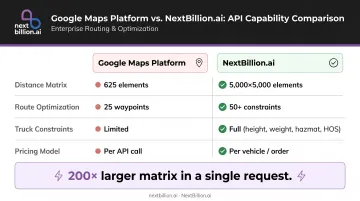
- Distance Matrix: Supports 5,000 × 5,000 elements — compared to Google's 625-element cap, that's a 200-fold difference in a single request
- Route Optimization: 50+ hard and soft constraints including time windows, vehicle capacity, driver shifts, skills matching, priority stops, hazmat routing, and task dependencies
- Truck Routing: Handles height, width, weight, axle load, tunnel restrictions, hazmat classifications, and HOS-compliant routing natively
- Custom Map Editing: The Road Editor App lets operations teams mark warehouse access roads, private industrial routes, no-entry zones, and custom speed limits — no code required, changes apply immediately across all APIs
- On-Premise Deployment: Runs on any Kubernetes cluster (AWS EKS, GCP GKE, Azure AKS, or self-managed), with modular deployment so you only install the components you need
Security and compliance: SOC 2 Type II, ISO/IEC 27001, GDPR, and CCPA certified. Support is 24x7 via dedicated Slack channels with named solution engineers — not a ticketing queue.
The platform currently serves 150+ businesses globally, has optimized over 10.9 million deliveries and tasks, and has delivered more than $11 million in documented cost savings. Customers include DoorDash, AB InBev, Mars, Octopus Energy, and Geotab.
| NextBillion.ai | |
|---|---|
| Pricing | Per-vehicle or per-order fixed monthly fee; no per-API-call charges |
| Key strengths | 50+ optimization constraints, 5,000×5,000 matrix, truck routing, custom map editing, on-premise deployment |
| Best for | Logistics operators, last-mile delivery, field service, fleet software vendors needing enterprise-grade routing without unpredictable billing |
How to Evaluate a Google Maps Alternative Properly
The most common mistake: choosing based on brand familiarity. Picking Mapbox because developers love it, or Azure Maps because you're already on Azure, without stress-testing against actual dispatch volume or stop count.
What actually matters for operational use:
- Confirm whether pricing is per-call or per-vehicle — per-call models from Google, Mapbox, and Azure compound fast at scale.
- Check matrix size limits before committing. Batching a large origin-destination set multiplies API calls and inflates cost.
- Count the constraints your operation actually needs: time windows, vehicle dimensions, driver shifts, and skills matching aren't available in every platform.
- Verify truck routing specifics if you run commercial vehicles — axle weight and hazmat support aren't guaranteed just because a provider advertises truck routing.
- Pressure-test support response times. A 3-day ticketing SLA and a dedicated Slack channel with a named engineer are not the same product.
Running a proof-of-concept against your real data matters more than any feature comparison table. When I tested NextBillion.ai, the team provided a 1–2 week trial against live data with solution engineers available throughout — no credit card required, no sandbox limitations.
Conclusion
Each alternative on this list has a legitimate use case. HERE and TomTom are strong for global truck routing. Mapbox is the right choice for consumer-facing branded maps. ORS is a valid baseline for engineering-led teams. Azure Maps fits naturally into Microsoft-centric procurement.
But for logistics, fleet management, and field service operations — where API call volume is high, constraint requirements are real, and billing unpredictability is a business risk — consumer-grade APIs hit hard limits fast: per-call cost spikes at volume, matrix size caps, and missing constraints that only surface once you're in production.
NextBillion.ai was built specifically for this gap. The per-vehicle pricing model, 50+ optimization constraints, and 5,000×5,000 distance matrix each address a specific failure point the founding team encountered firsthand while scaling routing infrastructure at Grab.
If you're evaluating the switch, request a demo to run a cost comparison against your current Google Maps spend using your actual dispatch volume — not a projected estimate.
Frequently Asked Questions
What is the best free alternative to Google Maps?
For personal use, OsmAnd and Organic Maps are strong offline options built on OpenStreetMap data. For businesses, OpenRouteService provides a free self-hosted routing engine — though it requires engineering resources to run reliably in production and has no commercial SLA.
Are there better free satellite maps than Google Maps?
Mapbox and HERE both offer free tiers with satellite imagery access. For GIS and geospatial research, NASA Earthdata provides high-quality satellite datasets at no charge. Google's imagery coverage remains the most comprehensive globally. "Better" depends on use case: for coverage breadth, Google is hard to beat; for research-grade imagery or routing-focused work, the free tiers above are often sufficient without paying for a full commercial license.
Which Google Maps alternative is best for logistics and fleet management?
NextBillion.ai is purpose-built for logistics, offering multi-constraint route optimization, truck routing, and per-vehicle pricing that scales predictably. Unlike per-API-call models, it doesn't penalize high-volume dispatch operations with escalating costs. It also supports US-specific truck attributes like hazmat restrictions and low-clearance routing, which matter for fleets operating under FMCSA and DOT rules, where a car-based routing engine like Google Maps falls short.
Is Mapbox cheaper than Google Maps API for high-volume enterprise use?
At high volumes, pricing is comparable — both charge per API request, and costs climb steeply with scale. For dispatch-heavy operations, the more meaningful comparison is against per-vehicle or flat-fee models, where call-volume billing stops being the cost driver entirely. Before comparing sticker prices, map your actual call volume per vehicle per day; that number, not the per-call rate, determines which pricing model actually costs less at scale.
Can I use OpenStreetMap data commercially without paying licensing fees?
Yes. OSM data is available under the Open Database License (ODbL), which permits commercial use. Attribution is required, and share-alike terms apply to adapted databases. Consult legal counsel for high-stakes production deployments.
What should businesses look for when switching from Google Maps Platform?
Evaluate these criteria before switching:
- Pricing model: per-call vs. per-vehicle or flat-fee
- Route optimization constraint depth
- Distance matrix size limits
- Truck routing attribute support
- Commercial SLA and uptime guarantees
- Onboarding quality and technical support access
Run a proof-of-concept with real operational data before committing.
Who is Google Maps' biggest competitor for business use?
For consumer navigation, Apple Maps and Waze are the closest competitors. For business and developer use, the field splits by function: Mapbox and HERE compete on general-purpose mapping and APIs, while NextBillion.ai and similar platforms compete specifically on route optimization and fleet routing. There is no single biggest competitor; the right one depends on whether the use case is consumer navigation or operational logistics.
What is the best alternative for Google Maps for US trucking and delivery fleets?
For US trucking and delivery operations, look for platforms that support FMCSA-compliant truck routing (weight, height, hazmat restrictions), multi-stop route optimization, and pricing that doesn't punish high call volumes. NextBillion.ai is built around these needs. Generic mapping APIs like Google Maps or Mapbox can provide base map data but typically require additional engineering to layer in truck-specific routing logic and hours-of-service constraints.