The stakes have risen. Data privacy regulations now cover consumers in 20+ US states, and enforcement actions against companies mishandling location data are accelerating. Meanwhile, usage-based API pricing at logistics scale can produce bills that bear little resemblance to initial estimates — Google Maps Platform's March 2025 billing changes removed the $200 monthly credit that many teams had built into their cost models.
This guide breaks down both deployment models across the dimensions that matter most to enterprise buyers: security, compliance, cost, and operational fit — then provides a practical framework for making the right call.
Key Takeaways
- Self-hosted puts infrastructure, data, and control inside your own environment; cloud puts all of that in the vendor's hands
- Regulated industries — healthcare, financial services, government — typically require self-hosted to meet data residency and audit requirements
- Cloud deployment offers faster time-to-value and lower operational burden, suited for teams without dedicated DevOps capacity
- Per-API-call pricing escalates sharply at logistics scale; per-vehicle or flat-fee models shift the TCO calculation significantly
- Hybrid and BYOC models are now the enterprise default — SaaS convenience without surrendering data residency control
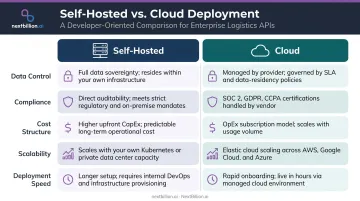
Self-Hosted vs. Cloud Deployment: Quick Comparison
| Dimension | Self-Hosted | Cloud |
|---|---|---|
| Data Control | Complete ownership of where data lives and who accesses it | Data resides in vendor infrastructure under vendor policies |
| Compliance | Full audit control, network isolation, and custom security policies | Relies on vendor certifications and breach response timelines |
| Cost Structure | Upfront infrastructure costs plus ongoing operations labor | Subscription or consumption-based; scales with usage |
| Scalability | Requires internal capacity planning and manual upgrade cycles | Auto-scales; feature updates pushed automatically |
| Deployment Speed | Weeks to months (infrastructure provisioning + testing) | Days to weeks with minimal setup |
What Is Self-Hosted Deployment for Enterprise SaaS?
In self-hosted deployment, the enterprise downloads, installs, and operates the SaaS platform on its own infrastructure — on-premises hardware, a private cloud, or a VPC within AWS, Azure, or GCP. The vendor delivers the software; the enterprise owns and operates the environment. This is what makes the model embeddable: the platform is packaged to drop into an existing private cloud footprint rather than requiring a separate vendor-managed environment, which matters for enterprise B2B SaaS buyers who already standardize on internal infrastructure and security tooling.
Core Advantages
- Routing queries, user data, and logs never leave your environment — full data residency control
- Your platform availability is determined by your own infrastructure, not a vendor's uptime SLA
- Network isolation, firewall rules, and access policies are configured to your exact requirements
- No shared tenancy means no exposure to vendor-side breaches or third-party data handling risk
One common misconception: self-hosted means sacrificing enterprise security standards. It doesn't. NextBillion.ai's on-premise option, deployed via Kubernetes across AWS EKS, GCP GKE, Azure AKS, or bare-metal private data centers, carries SOC 2 Type II and ISO/IEC 27001:2013 certifications. Security rigor and deployment model are separate questions.
Operational Tradeoffs
The enterprise absorbs full operational responsibility: infrastructure provisioning, patching, version upgrades, monitoring, and incident response all fall on internal teams. NextBillion.ai provides Helm charts, comprehensive documentation, and its open-source k10s utility to streamline Kubernetes deployment.
That tooling reduces friction, but it doesn't eliminate it. Internal teams still plan and execute upgrades on their own schedule — which means DevOps maturity is a real prerequisite. Broadcom's 2025 survey of 1,800 senior IT decision-makers found that 30% cite lack of in-house skills as a private cloud barrier — a clear indicator that self-hosted isn't the right fit for every team.
Air-Gapped Deployment
For government, defense, or high-security logistics contexts where data cannot touch any external network, self-hosted is the only viable option. NextBillion.ai explicitly supports fully air-gapped deployments where all routing and mapping operations run behind the customer's firewall with no external data transmission.
Self-Hosted Use Cases
Self-hosted is effectively the required model for:
- Healthcare: HIPAA/PHI obligations require covered entities to control individually identifiable health data
- Financial services: PCI DSS compliance for any entity processing cardholder data
- Government and defense: FedRAMP authorization requirements and air-gapped network mandates
- EU-regulated enterprises: GDPR Article 44 restricts personal data transfers to third countries without adequate protections
For logistics and fleet operations specifically, self-hosted is the safer default when route data, driver telemetry, or delivery addresses fall under regional data sovereignty laws — or when the enterprise operates in geographies that treat location data as PII. IDC's 3Q24 Cloud Pulse Survey found that 50–70% of cloud buyers across regions demand control over where their data and digital infrastructure reside.
What Is Cloud Deployment for Enterprise SaaS?
Cloud deployment means the vendor hosts, operates, and maintains the full platform on its own infrastructure. The enterprise accesses functionality via APIs or a web interface — no server management required. This is the default model for most SaaS today, including most mapping and location intelligence APIs.
Core Benefits
- Zero infrastructure setup — no hardware provisioning, no cluster management
- Automatic security patches and feature updates without internal action
- Vendor-managed SLAs (NextBillion.ai's cloud offering carries a 99.9% uptime guarantee with defined service credits)
- Faster time-to-value — most teams can go live within days to a week of integration
This model suits enterprises without dedicated DevOps capacity or those piloting new capabilities before committing to on-premise infrastructure.
The Compliance Ceiling
Most cloud SaaS vendors carry SOC 2 and ISO 27001 certifications. What they can't offer:
- Direct control over where your data physically resides
- Audit log access on your own schedule
- Incident response timelines that match your internal SLA
For most standard enterprise use cases, vendor certifications are sufficient. For teams under HIPAA, strict GDPR residency requirements, or government procurement rules, they usually aren't.
Broadcom's survey found 66% of senior IT decision-makers are very or extremely concerned about public-cloud compliance — a number that should inform procurement conversations, not just the IT team's internal discussions.
Cloud Deployment Use Cases
Cloud works well for:
- Fast-growing logistics startups and scale-ups that need immediate API access without infrastructure investment
- Enterprises piloting new routing or location capabilities — before committing to on-premise infrastructure
- Organizations with small DevOps teams, where self-hosting would introduce more operational risk than it removes
Self-Hosted vs. Cloud: Which Deployment Model Is Right for Your Enterprise?
No single factor determines this. The answer comes from combining five dimensions. For enterprise B2B SaaS buyers specifically, the private cloud question usually comes down to whether procurement, security, and engineering can agree on where the tradeoffs are acceptable — an embeddable self-hosted option only pays off if internal teams are actually equipped to operate it.
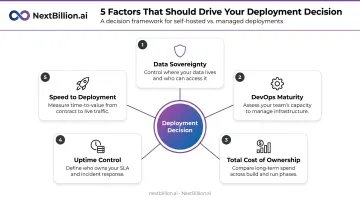
The Five Decision Factors
- Data sovereignty and compliance obligations: what regulations actually apply to your data types and geographies
- Internal DevOps maturity: do you have the Kubernetes expertise and ops staffing to run the platform reliably
- Total cost of ownership at projected scale: not just subscription fees, but API call volumes, egress, support, and platform labor
- Required uptime control: who owns incident response when the platform goes down
- Speed-to-deployment: cloud goes live in days; on-premise typically takes a few weeks to a couple of months
Compliance Mapping
| Regulation | Deployment Implication |
|---|---|
| HIPAA / PHI | Self-hosted strongly preferred |
| GDPR with strict residency requirements | Self-hosted or BYOC required |
| PCI DSS | Self-hosted for cardholder data environments |
| FedRAMP / government | Self-hosted or FedRAMP-authorized cloud |
| Standard SOC 2, no residency mandates | Cloud is viable |
Cisco's 2024 survey of 2,600 security and privacy professionals found 98% said external privacy certifications are important in buying decisions — and 91% believed data is inherently safer stored in their own country or region. Compliance isn't just a legal department concern; it's driving procurement choices at the security team level.
The TCO Reality at Scale
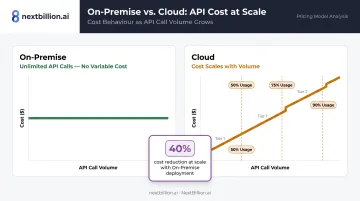
Cloud pricing looks straightforward until usage volumes scale. Flexera found 84% of organizations struggle to manage cloud spend, and per-API-call pricing in location intelligence compounds this problem quickly.
GOIN, a paratransit and NEMT provider processing 2,000 trips per day and 800,000 distance matrix calls per month, achieved a 40% cost reduction by switching to NextBillion.ai's transparent pricing structure — and subsequently scaled to nearly 2 million API calls monthly without a proportional cost increase. Per-call pricing can't offer that — costs simply scale with volume.
NextBillion.ai structures pricing to remove that exposure:
- On-premise: flat subscription fee with unlimited API calls, no variable cost at scale
- Cloud: per-order, per-asset, or per-API-call pricing with volume discounts and automated alerts at 50%, 75%, and 90% of allocated usage
The Middle Path: BYOC and Private Cloud
Bring Your Own Cloud (BYOC) sits between cloud and on-premise: the vendor manages the software, but it runs inside the customer's own cloud account with dedicated infrastructure. IDC found 88% of cloud buyers are already deploying or operating hybrid cloud — hybrid isn't a compromise anymore, it's the enterprise default.
NextBillion.ai's Private Cloud option provides dedicated infrastructure within your chosen cloud provider (AWS, GCP, or Azure), offering more configuration and data control than multi-tenant without the full management burden of on-premise. Both options sit under the Enterprise plan, so the choice between them is operational, not contractual.
Situational Recommendation
Choose self-hosted if:
- Your enterprise handles regulated data (PHI, PCI, federal)
- You operate across multiple jurisdictions with data residency laws
- You need direct infrastructure control for uptime and incident response
- Driver, vehicle, or customer location data is classified as PII under applicable regulations
Choose cloud if:
- Your team lacks Kubernetes/DevOps capacity for ongoing ops
- You're prioritizing rapid deployment and pilot flexibility
- Your compliance framework is satisfied by vendor certifications like SOC 2 and ISO 27001
Location Intelligence: Why Deployment Model Is a Privacy Decision
Geospatial data looks like infrastructure data. Legally, it often isn't.
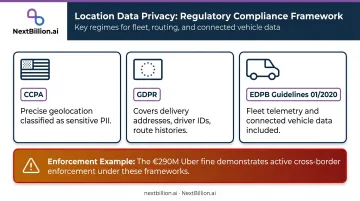
Three regulatory frameworks directly affect how logistics enterprises store and transfer location data:
- CCPA: Classifies precise geolocation (within 1,850 feet) as sensitive personal information
- GDPR: Covers delivery addresses, driver identities, and route histories when linked to identifiable individuals
- EDPB Guidelines 01/2020: Directly addresses personal data processing in connected vehicles and mobility applications — fleet telemetry included, not just consumer apps
The enforcement risk is real. In 2024, the Dutch Data Protection Authority fined Uber €290 million for transferring European drivers' personal data to US servers without adequate protection mechanisms. That case isn't an edge case — it's a preview of the exposure logistics enterprises face when deployment model decisions are treated as IT preferences rather than compliance requirements.
How NextBillion.ai Approaches This
NextBillion.ai serves logistics operators, last-mile delivery companies, NEMT providers, and fleet managers — organizations whose core operational data (route histories, driver telemetry, real-time vehicle positions, delivery addresses) sits squarely in the regulated category under GDPR and multiple US state privacy laws.
The platform supports three deployment models — Multi-Tenant Cloud, Private Cloud, and On-Premise — so compliance-sensitive customers can choose where their data lives without switching vendors or rebuilding integrations. The on-premise option deploys the full routing and mapping stack (Directions API, Distance Matrix API, and Route Optimization API) behind the customer's firewall. On-premise configurations deliver 20x higher throughput and 3x lower latency compared to typical cloud setups.
SOC 2 Type II, ISO/IEC 27001:2013, GDPR, and CCPA certifications apply across the platform. For enterprises evaluating deployment options for location intelligence, NextBillion.ai's team can model which path fits specific compliance and cost requirements.
Deployment model also isn't a permanent commitment. The right vendors support migration between models as compliance requirements or operational scale shift. The decision should match actual risk profile, not default to cloud out of convenience or self-hosted out of assumption.
Frequently Asked Questions
What is the difference between self-hosted and cloud deployment for enterprise SaaS?
Self-hosted means the enterprise installs and runs the software on its own infrastructure; cloud means the vendor hosts and manages everything. The choice determines who controls the data, who responds to incidents, and how costs scale with usage. For US enterprises handling driver, shipment, or customer location data, this also determines which team is accountable during a DOT audit or a security incident, and whether that data ever leaves company-controlled infrastructure.
Which deployment model is better for compliance-heavy industries?
Regulated industries — healthcare, financial services, government — typically require self-hosted deployment to satisfy data residency, audit access, and incident response requirements that cloud vendors cannot fully address through certifications alone.
How does self-hosted deployment affect total cost of ownership compared to cloud SaaS?
Self-hosted carries upfront infrastructure and DevOps labor costs but eliminates per-seat or per-API-call fees that escalate at enterprise scale. For high-volume routing and location intelligence workloads, self-hosted TCO is often lower despite the added operational overhead. Enterprises should also weigh the cost of maintaining in-house expertise for updates, scaling, and uptime, since self-hosted deployments shift responsibility for availability and performance tuning from the vendor to the internal team.
Can enterprises use a hybrid or BYOC approach?
Yes. Bring Your Own Cloud (BYOC) lets the vendor manage the software while it runs in the enterprise's own cloud account, combining operational ease with data residency control. This is the most common enterprise approach today, with 88% of cloud buyers already operating hybrid cloud environments.
How do software updates work in self-hosted vs. cloud deployments?
Cloud platforms push updates automatically with no enterprise action required. Self-hosted deployments give the internal team full control over update timing — vendors supply packages and guidance, but customers decide when to apply them to avoid production disruptions. This matters for fleets running on fixed schedules, since a routing engine update mid-shift can affect dispatch, ETAs, or hours-of-service tracking; self-hosting lets teams stage updates during planned maintenance windows instead.
What should enterprises consider when choosing a deployment model for location intelligence platforms?
Location data — including routes, driver telemetry, and delivery addresses — is subject to privacy regulations in many jurisdictions. Deployment model is a compliance decision that determines where that data lives, who can access it, and what happens if a breach occurs.
Is embeddable self-hosted deployment suitable for a private cloud enterprise B2B SaaS product?
Yes, when the software is packaged to run inside the enterprise's own private cloud or data center rather than as a hosted multi-tenant service. Embeddable self-hosted deployment lets an enterprise integrate routing, mapping, or fleet-optimization APIs directly into its existing infrastructure and network security controls, which is often required for B2B platforms serving regulated customers like logistics, healthcare, or government fleets that cannot send location data outside their own environment.
Does self-hosted deployment help with FMCSA or DOT compliance for fleet operations?
Self-hosted deployment does not itself satisfy FMCSA or DOT requirements, but it gives fleet operators direct control over where routing, ELD-adjacent, and location data is stored and how long it is retained, which supports internal audit and recordkeeping practices. Enterprises subject to hours-of-service or IFTA reporting often prefer self-hosting so their compliance and legal teams retain full visibility into data handling rather than relying on a third-party vendor's infrastructure.