Remote monitoring tools catch these failures quickly. What they can't do is physically replace a failed network card, re-seat a loose cable, or swap out a degraded server. That gap — between remote detection and physical resolution — is exactly where 24/7 field service support earns its place.
This article explains why round-the-clock on-site support is a measurable operational necessity, what specific advantages it delivers, and what happens when organizations try to manage complex infrastructure without it.
Key Takeaways
- 24/7 field service support means qualified technicians available around the clock for on-site IT infrastructure intervention — covering what remote tools cannot fix.
- Core advantages: faster incident recovery through rapid dispatch, less reactive firefighting, and consistent SLA compliance across distributed sites.
- Without it, IT teams face extended outages, escalating incident costs, and an inability to scale support geographically.
- Coverage pays off more when paired with intelligent dispatch, skill-matched technicians, and regular performance reviews.
What Is 24/7 Field Service Support?
24/7 field service support provides round-the-clock access to qualified technicians who respond physically to IT infrastructure issues — hardware replacement, server troubleshooting, cable management, rack and stack work, device installations — that cannot be resolved through remote access alone. Examples of field service work in this context include swapping a failed network switch, replacing degraded drives, running new cabling, installing point-of-sale or kiosk hardware, and performing scheduled preventive checks at remote sites.
It applies across:
- Enterprise IT environments with distributed branch offices
- Data centers and colocation facilities
- Hybrid cloud and edge computing deployments
- Multi-location operations spanning multiple time zones
- Any environment where IT assets are geographically dispersed
Think of it as two distinct roles. Remote monitoring identifies the problem. 24/7 field service support closes the gap between "problem identified" and "problem resolved." For hardware-level incidents, that gap only closes when a trained technician is physically present — no remote session can swap a failed drive or reseat a cable.
Key Advantages of 24/7 Field Service Support for IT Operations
The advantages below are grounded in outcomes IT operations leaders actually track: uptime, response speed, cost of downtime, SLA adherence, and infrastructure resilience. Each one maps to specific KPIs — not abstract benefits.
Advantage 1: Minimized Downtime Through Rapid On-Site Dispatch
Remote IT management has a hard limit. Software diagnostics, configuration changes, and reboots cover a significant share of incidents — but physical hardware failures, failed network equipment, and complex cabling issues require a human to be on-site. No amount of remote tooling changes that.
24/7 field service support addresses this directly. A Field Operations Center (FOC) triages incidents continuously, dispatches the nearest qualified technician with parts pre-staged, and tracks resolution in real time. The window between incident detection and physical fix compresses from hours to under an hour in well-run operations.
ITIC's 2024 report found that average hourly outage costs topped $5M for Banking/Finance, Government, and Healthcare — the verticals with the most demanding uptime requirements and the most distributed infrastructure.
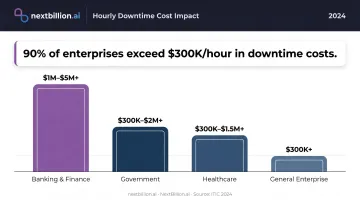
IT leaders who rely solely on remote support are betting that every failure is remotely resolvable. That bet fails — and it tends to fail during the incidents that cost the most.
KPIs impacted:
- Mean Time to Resolution (MTTR)
- Infrastructure uptime percentage
- SLA compliance rate
- Incident escalation rate
When it matters most: Multi-location enterprises, retail and branch environments with limited on-site IT staff, and any organization where a single node failure — a network switch, a router — can take down an entire location.
Advantage 2: Proactive Infrastructure Maintenance Reduces Reactive Firefighting
Break-fix is expensive — financially and operationally. Every emergency dispatch triggered by a preventable failure pulls IT team capacity away from infrastructure improvement, security hardening, and strategic projects. Those diversions compound.
24/7 field service support enables a shift from reactive to proactive. Continuous monitoring detects early warning signals — overheating, degraded hardware performance, connectivity anomalies — which trigger scheduled preventive visits rather than emergency dispatches. The difference is catching a failing drive before it fails versus replacing it at 3 AM during an outage.
Uptime Institute's 2025 outage analysis found that power remains the leading cause of impactful outages, IT and networking issues accounted for 23% of incidents in 2024, and 40% of organizations had a major outage caused by staff not following procedures in the prior three years.
That last figure points directly at something proactive field programs address: trained technician discipline during scheduled maintenance, not just emergency response.
There's a security dimension here too. CISA's guidance on end-of-support edge devices warns that nation-state actors specifically target unsupported firewalls, routers, and VPN gateways at the network perimeter. Physical maintenance visits are the mechanism through which aging hardware gets inventoried, flagged, and replaced — addressing operational and security risk simultaneously.
KPIs impacted:
- Emergency dispatch rate
- Device health scores
- Mean Time Between Failures (MTBF)
- Unplanned downtime incidents per quarter
- IT team capacity utilization
When it matters most: Organizations managing large device fleets, multiple data centers, or edge-heavy environments see disproportionate gains from preventive field programs. The more complex the infrastructure, the more each prevented failure is worth.
Advantage 3: Consistent SLA Compliance and Scalability Across Distributed Operations
For businesses managing IT across multiple locations, regions, or time zones, 24/7 field service support is what makes consistent service delivery achievable — without requiring dedicated internal IT staff at every site. Cost for this kind of coverage typically scales with factors like site count, response-time tier (same-day versus next-business-day), and technician skill requirements, rather than a flat per-visit rate.
The mechanism is straightforward: a network of qualified field technicians with defined response windows (same-day, 4-hour, next-business-day) provides coverage across geographies. A failure in a remote branch office receives the same response quality as one at headquarters. Service agreements can be met reliably because technician coverage exists to meet them.
Intelligent dispatch is a critical enabler of this consistency. Matching a qualified technician to the right job — with the right parts, at the right location — requires real-time routing, skill-based assignment, and parts logistics visibility.
This is where tools like NextBillion.ai's Route Optimization API fit in: reducing technician travel times through optimized routing, skill-based job allocation, and real-time re-routing when conditions change. For geographically spread operations with tight response SLAs, that efficiency difference shows up in the numbers.
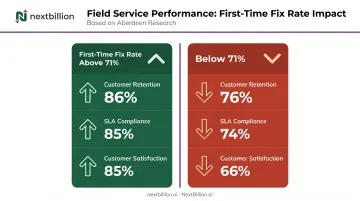
Aberdeen's field service research quantifies what good looks like: organizations with first-time fix rates above 71% reported 86% customer retention, 85% SLA compliance, and 85% customer satisfaction — versus 76%, 74%, and 66% respectively for lower-performing organizations. The gap between those numbers represents real contract risk.
KPIs impacted:
- SLA compliance rate
- Customer satisfaction scores (CSAT)
- First-time fix rate
- Technician utilization across regions
- Cost per support incident
When it matters most: Organizations in geographic expansion mode, those with strict contractual SLA obligations (government, healthcare, financial services), and businesses supporting distributed remote workforces where no single office is the operational center.
What Happens When 24/7 Field Service Support Is Missing
The absence of always-on field support creates a predictable failure pattern. IT teams shift into permanent reactive mode — every outage is an emergency, every emergency consumes capacity that should be going elsewhere, and the root causes of recurring failures never get addressed because there's no system for doing so.
The operational and financial consequences compound over time:
- Extended downtime with no clear resolution path when hardware fails outside business hours
- SLA breaches that trigger financial penalties and erode client trust
- Higher total support costs as emergency dispatch rates increase and deferred maintenance leads to full equipment failure rather than component replacement
- Scaling limitations — headcount grows proportionally with locations instead of coverage growing through a vetted partner network
- Security exposure from aging hardware going uninspected between scheduled reviews, leaving exploitable vulnerabilities at the network perimeter
This gap stays invisible until a major incident exposes it. A single after-hours outage that stretches into the next business day — because no technician is available — can cost more than a full year of structured 24/7 coverage.
Ponemon Institute's research found that core data centers average 2.4 total facility shutdowns per year and nearly 10 rack/server-isolated downtime events annually. Those aren't rare edge cases. They're expected operational frequency. Running that failure frequency through a business-hours-only model doesn't reduce incidents — it just delays resolution and amplifies the cost of each one.
How to Get the Most Value from 24/7 Field Service Support
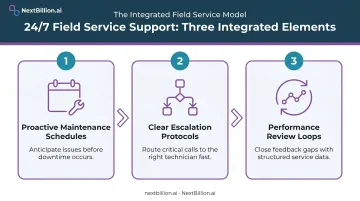
24/7 field service support works best as an integrated system, not an on-demand service. Three elements need to operate together:
- Proactive maintenance schedules — regular inspections that prevent emergency dispatches rather than just responding to them
- Clear escalation protocols — documented paths from remote triage to field dispatch, covering technician skill matching, parts staging, and handoff criteria
- Performance review loops — tracking MTTR, emergency dispatch frequency, first-time fix rates, and SLA compliance to create feedback that improves the system over time
The dispatch intelligence layer is where many operations leave value on the table. Getting the right technician — with the right skills and parts — to the right location in the shortest time is an optimization problem. It benefits from real-time routing, traffic-aware ETAs, and skill-based matching, not just headcount.
NextBillion.ai's Route Optimization API handles this kind of constraint-rich dispatch at scale. The platform manages 30,000+ vehicles and technicians for Service Autopilot by Xplor, using skill-based assignment, real-time re-optimization, and live tracking to cut scheduling time and improve response consistency.
Organizations that pair 24/7 coverage with intelligent dispatch see measurably better MTTR and lower per-incident costs. Staffing hours around the clock is the baseline — routing the right people efficiently is what separates reactive operations from ones that consistently hit SLAs.
Conclusion
Field service operations don't fail because of a single missed dispatch or a bad route. They erode gradually — through slow response times, technician scheduling gaps, and routing decisions made without real-time data. By the time the impact shows up in customer complaints or SLA reports, the operational debt has already accumulated.
24/7 support infrastructure matters because field work doesn't stop at 5 PM. The ability to route, dispatch, and track technicians continuously — with intelligent optimization running in the background — determines whether your team arrives on time or explains why they didn't.
The value scales with operational complexity. A ten-technician team can absorb inefficiency. A fleet of hundreds, spread across regions with varying service windows and job constraints, cannot. That's where always-on routing and dispatch tools shift from a convenience to a core operational requirement.
Treat continuous field service coverage as a measurable operational discipline, not a contingency plan. Organizations that build reliable dispatch and routing infrastructure before they need it don't just avoid failures — they build the capacity to grow without adding proportional overhead.
Frequently Asked Questions
What is 24/7 technical support?
24/7 technical support refers to around-the-clock access to IT assistance — including both remote monitoring and on-site field technician dispatch — ensuring that infrastructure issues can be identified and resolved at any hour, including nights, weekends, and holidays.
How much does outsourced IT field service support cost?
Pricing varies widely based on SLA response tier, geographic coverage, asset complexity, and whether proactive maintenance is included. Organizations should request quotes based on their specific footprint and response window requirements rather than expecting a standard rate card. Dispatch and routing software is a separate line item from labor cost, but it directly affects total spend: better routing reduces windshield time, cuts overtime, and lets fewer technicians cover more service calls per shift.
Can remote IT support replace 24/7 field service technicians?
Remote support handles a significant share of incidents through diagnostics and software-level fixes, but physical hardware failures, cable issues, device replacements, and on-site infrastructure work require a field technician. The two capabilities are complementary — remote tools diagnose, field technicians resolve what can't be fixed remotely. Routing and dispatch software connects the two by automatically assigning the nearest available technician, tracking arrival against SLA windows, and giving dispatchers live visibility into every job in progress.
What industries need 24/7 field service support the most?
Industries with the highest downtime costs and most distributed infrastructure — banking and finance, healthcare, government, logistics, retail, and manufacturing — are typically most dependent on continuous field service coverage. ITIC data shows hourly outage costs exceed $5M in banking, healthcare, and government. Field teams in these sectors also face US-specific operating constraints, such as FMCSA hours-of-service limits for driving technicians and HIPAA handling requirements at healthcare sites, which dispatch software needs to account for when assigning jobs.
What is the difference between 24/7 field service support and a standard service desk?
A service desk handles remote triage, ticket management, and software-level resolution. 24/7 field service support adds the physical dimension — dispatching trained technicians to perform hands-on work that cannot be done remotely, such as hardware replacement, cabling, and rack work.
How do you measure the ROI of 24/7 field service support?
Track these metrics before and after implementation to measure impact:
- Reduction in mean time to repair (MTTR)
- Decrease in emergency dispatch frequency
- SLA compliance rate improvement
- Lower cost per incident over time
- Revenue protected from outages resolved before they cascaded
What does 24/7 customer support mean for field service dispatch?
For field service dispatch, 24/7 customer support means a customer or facility manager can report an issue at any hour and get a response — whether that's remote triage, a scheduled visit, or an emergency dispatch. It also means dispatchers have round-the-clock visibility into technician locations, job status, and SLA timers so no request sits unassigned overnight or over a weekend.
What is the best field service software for dispatch teams?
There is no single best option — it depends on fleet size, service area, and integration needs. Look for software that handles real-time routing and re-routing, technician tracking, ETA accuracy, and SLA monitoring, and that integrates with your existing work order or CRM system. Teams managing distributed technicians across large territories should prioritize platforms built on strong mapping and routing infrastructure rather than generic scheduling tools.