Introduction
The benefits of real-time location tracking in fleets across the USA come down to five things: lower fuel spend, safer drivers, faster dispatch decisions, more accurate ETAs, and cleaner compliance records. Fleet managers today don't face one problem — they face several at once. Fuel costs fluctuate unpredictably, driver shortages pressure existing staff, and compliance requirements keep expanding.
Meanwhile, customers expect live delivery updates. Handling all of this without real visibility into what's happening on the road is where operations start breaking down.
That's why fleet tracking has shifted from a "nice to have" to a core operational tool. According to Berg Insight's 2025 analysis, there were 19.2 million active fleet management systems deployed across North American commercial vehicle fleets as of Q4 2024 — a number forecast to reach 33.2 million by 2029.
The value of fleet tracking shows up in faster decisions, costs that get controlled before they compound, and problems caught before they escalate. This article covers five concrete ways fleet tracking systems change day-to-day operations — with the metrics fleet managers actually use to measure each one.
Key Takeaways
- Fleet tracking systems give operations teams live visibility into vehicle location, speed, driver behavior, and route performance — all in one place.
- The five key benefits: fuel and cost control, driver safety, real-time operational visibility, ETA accuracy, and regulatory compliance.
- Each benefit ties to measurable KPIs — fuel spend per mile, incident rates, on-time delivery, and audit readiness.
- Businesses that act on tracking data see cascading gains: lower insurance premiums, reduced overtime, and higher customer retention.
What Is a Fleet Tracking System?
A fleet tracking system is GPS hardware installed in vehicles, paired with software that collects, transmits, and displays real-time data — vehicle location, speed, engine status, driver behavior, and route history — in a format fleet managers can actually use.
It applies wherever vehicles are a core operational asset:
- Last-mile and e-commerce delivery
- Long-haul trucking and freight
- Field service operations (pest control, HVAC, utilities)
- Non-emergency medical transport (NEMT)
- Construction and pharmaceutical distribution
Fleet tracking doesn't improve operations on its own. Its value lies entirely in the decisions it enables:
- Rerouting a vehicle mid-trip when traffic backs up
- Catching a maintenance issue before it becomes a roadside breakdown
- Knowing a driver has been idling for 40 minutes without a single stop logged
The tracking system is the information layer. What you do with that information determines the outcome.
The 5 Key Business Benefits of a Fleet Tracking System
The five benefits below are ranked by operational impact — starting with what hits the bottom line hardest and ending with what keeps operations legally defensible. If you run a commercial fleet, at least two or three of these are probably already on your radar.
Benefit 1: Fuel Efficiency and Cost Control
Fuel is one of the top three operating costs for any fleet. ATRI's 2025 trucking cost analysis puts fuel at $0.481 per mile — approximately 21.3% of total operating cost when calculated against the $2.260 per mile average. Fleet tracking directly targets this expense through three mechanisms.
How Tracking Reduces Fuel Spend
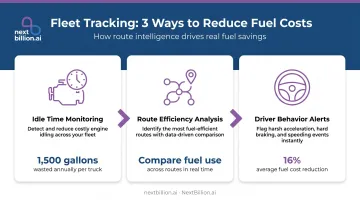
Idle time monitoring: A heavy-duty truck burns roughly 0.8 gallons of diesel per hour at idle. A typical long-haul truck idles approximately 1,800 hours annually — consuming around 1,500 gallons of diesel that generates zero revenue. Fleet tracking surfaces this by vehicle, by driver, and by day.
Route efficiency analysis: Managers can compare fuel consumption across different routes over time, identifying which paths are consistently inefficient — not just one-off delays. This is one of the clearest examples of the role GPS tracking plays in fleet management: it turns route history into a decision tool rather than a static log.
Driver behavior alerts: Harsh acceleration, unnecessary braking, and excessive speeding all increase fuel burn per mile. In-cab alerts notify drivers in the moment rather than at the end of the week.
The aggregate effect is measurable. Verizon Connect's 2025 Fleet Technology Trends Report found GPS fleet tracking users reported an average 16% reduction in fuel costs.
KPIs This Affects
- Fuel cost per mile
- Idle time per vehicle per day
- Average miles per gallon across the fleet
- Total maintenance spend (lower mileage extends vehicle life)
When It Matters Most
Fuel savings have the highest impact in large fleets with high daily mileage, urban delivery operations with frequent stop-and-go traffic, and during periods of fuel price volatility.
Fleet tracking data becomes even more powerful when paired with route optimization. NextBillion.ai's Route Optimization platform integrates directly with Samsara, Geotab, and Motive — pulling live vehicle data and pushing optimized routes back into driver workflows before a single mile is driven inefficiently.
The results are concrete. Xpress Global Systems documented a 35% reduction in operating costs and a 13% reduction in miles driven per month after adding route optimization on top of their tracking stack.
Benefit 2: Driver Safety and Risk Reduction
Fleet tracking captures speeding, harsh braking, rapid acceleration, and tailgating in real time. That visibility changes how managers operate: they coach proactively instead of responding to incidents after the fact.
The Feedback Loop That Changes Behavior
Driver scorecards, real-time in-cab alerts, and post-trip reports create a system where behavior is visible, documented, and addressable. Managers can identify consistently risky drivers, deploy targeted training, and document their safety programs for liability and insurance purposes.
This matters beyond safety culture. When an incident does occur, the tracking system provides incident replay data and driver logs — making it an evidence layer that protects the business in insurance claims and litigation, not just a monitoring tool. This is among the most cited benefits of GPS tracking overall: it converts a disputed incident into a documented, time-stamped record.
Accident Costs and Insurance Impact
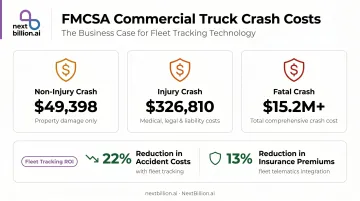
FMCSA's 2025 crash cost methodology puts a non-injury commercial truck crash at $49,398, an injury crash at $326,810, and a fatal crash at over $15.2 million. One prevented serious incident can exceed the cost of an entire fleet tracking deployment.
Verizon Connect's survey data shows GPS fleet tracking users reported an average 22% reduction in accident costs and a 13% reduction in insurance premiums.
KPIs This Affects
- Incident rate per 100,000 miles
- Insurance premium trends year over year
- Driver safety score averages
- Speeding and harsh braking events per driver per week
When It Matters Most
Driver safety monitoring delivers the highest ROI when:
- Turnover is high — new drivers carry statistically greater accident risk
- Routes run through dense urban areas — more stop-and-go exposure means more risk events
- One serious incident could threaten insurability — smaller fleets especially can't absorb that exposure
Benefit 3: Real-Time Visibility and Operational Control
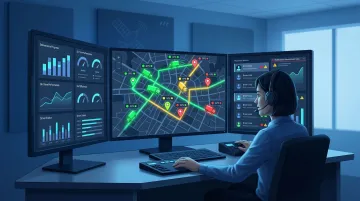
Real-time visibility means knowing where every vehicle is, what its status is, and whether it's on schedule — without a phone call. That shift, from reactive coordination to proactive control, changes how dispatchers and managers spend their time.
What This Looks Like in Practice
- Dispatchers reassign the nearest available vehicle to an urgent job without contacting multiple drivers
- Managers spot schedule deviations as they happen, not at end-of-day review
- Geofence alerts flag unauthorized vehicle use or unexpected stops automatically
- Operations teams handle demand spikes without adding headcount to keep up
The operational efficiency gains are documented. Verizon Connect's survey found 62% of GPS fleet tracking users cited increased efficiency in managing daily operations, with an average 16% reduction in labor costs.
How NextBillion.ai Extends This Capability
For fleets already using Geotab, Samsara, or Motive, NextBillion.ai's Live Tracking API layers additional intelligence on top of existing telematics hardware:
- Configurable speed, idle, geofence, and route-deviation alerts
- Up to 1-meter location accuracy with offline tracking in low-connectivity zones
- Geofencing with time-of-day and day-of-week scheduling, so alerts fire only when operationally relevant
KPIs This Affects
- Dispatcher time per vehicle managed
- Job completion rate per day
- Response time to urgent jobs
- Unauthorized vehicle use incidents
Benefit 4: Customer Service and ETA Accuracy
Fleet tracking enables accurate, live ETAs — not estimates based on scheduled departure times. That distinction matters more than most fleet managers initially expect.
Why ETA Accuracy Is a Revenue Driver
Customer expectations around delivery transparency are high. Research from project44 found 70% of consumers wanted the ability to track shipments and receive progress updates — and 74% said late deliveries hurt their impression of the company responsible. In B2B service contracts, missed time windows can carry direct financial penalties.
Live location data feeds into customer notifications so dispatchers can communicate delays proactively, before customers call in. Proof-of-delivery timestamps give businesses documentation to support SLA claims. Taken together, these capabilities have measurable impact: 51% of Verizon Connect GPS fleet tracking users reported that tracking helped them meet customer demands.
KPIs This Affects
- On-time delivery rate
- Customer complaint volume
- Inbound status inquiry calls per day
- SLA compliance rate
When It Matters Most
ETA accuracy has the highest stakes in time-sensitive deliveries, NEMT operations (where late arrivals affect patient care), and B2B service contracts with defined arrival windows.
For NEMT specifically, NextBillion.ai's integration with Samsara (as used by Ride Care) gave dispatchers more efficient routes and real-time visibility, supporting on-time performance at scale.
Benefit 5: Regulatory Compliance and Audit Readiness
Fleet tracking systems — particularly those integrated with Electronic Logging Devices (ELDs) — automatically generate the records required for Hours of Service compliance, IFTA fuel tax reporting, and DVIR documentation.
What Automated Compliance Actually Changes
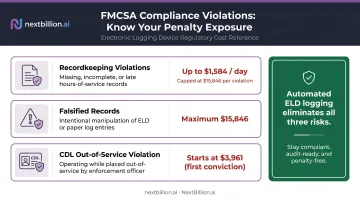
Manual compliance management introduces two risks: records that are incomplete and records that are falsified. Automated logging removes both. Real-time HOS alerts prevent violations before they happen. Historical data is available for audits on demand.
The regulatory stakes are concrete. Under current FMCSA rules, recordkeeping violations can reach $1,584 per day, capped at $15,846. Knowingly falsifying required records carries a maximum penalty of $15,846. CDL out-of-service violations start at $3,961 for a first conviction and scale significantly from there.
KPIs This Affects
- HOS violations per quarter
- IFTA reporting time per period
- Audit preparation time
- DOT violation penalties incurred
When It Matters Most
Compliance benefits are most critical for long-haul trucking, multi-state fleet operations, and any business subject to DOT inspections or government contracts. For fleets running complex multi-day routes, scheduling software adds another layer of protection. NextBillion.ai's Route Optimization API — which integrates with telematics platforms like Geotab and Samsara — factors driver shift limits, required rest breaks, and overnight stops directly into route planning, reducing the dispatcher decisions that can inadvertently create HOS exposure.
What Happens Without Fleet Tracking
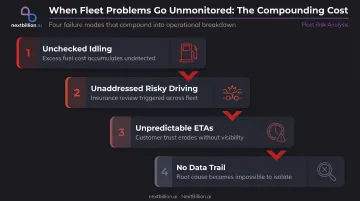
Without fleet tracking, fleet managers operate on incomplete information. Routing decisions rely on assumptions. Driver behavior goes unmonitored until something goes wrong. Maintenance is reactive by default.
Each gap has a compounding cost:
- Unchecked idling adds fuel expense with no service output to show for it
- Unaddressed risky driving accumulates until an incident triggers an insurance review
- Unpredictable ETAs generate inbound inquiry calls and erode customer trust over time
These problems don't disappear when left unmonitored. They surface later — as rising insurance premiums, unplanned breakdowns, or missed SLAs — and by then, the root cause is far harder to isolate without a data trail.
Those downstream costs compound further when fleets grow without visibility in place. Operators running five or ten vehicles often defer tracking until growth forces the issue — but by then, inefficient habits like excessive idle time, undocumented hours, and suboptimal routes are already embedded in daily operations and harder to unwind.
How to Get the Most Value from Your Fleet Tracking System
Deploying a fleet tracking system is step one. The businesses that see the highest ROI are those that act on the data consistently.
Build review cycles into operations:
- Weekly driver scorecard reviews (don't let safety trends accumulate unaddressed)
- Monthly fuel and cost trend analysis by vehicle and route
- Quarterly route efficiency audits comparing planned versus actual performance
Pair tracking with intelligent routing. Tracking shows you what happened — but pairing it with an AI-powered route optimization platform like NextBillion.ai turns that history into better decisions going forward. NextBillion.ai integrates with Geotab, Samsara, and Motive, pulling in vehicle and order data from telematics platforms and pushing optimized routes back out to driver apps. The result: fewer unplanned detours, tighter schedules, and measurable fuel savings across your fleet.
Fleet data compounds over time. Route history, driver behavior trends, and fuel consumption patterns grow more valuable the longer you collect and act on them. A single month gives you a snapshot. A year gives you the baseline to measure real cost reduction.
Conclusion
The five benefits of a fleet tracking system — fuel and cost control, driver safety, operational visibility, customer service, and compliance readiness — don't operate in isolation. They compound on each other. Safer drivers bring down insurance premiums. Optimized routes cut fuel spend. Real-time visibility enables the proactive customer communication that drives retention, and automated compliance logs remove the scramble when audits arrive unexpectedly.
The businesses that get the most from fleet tracking are those that treat it as an ongoing operational practice, not a one-time deployment. Review data regularly. Coach drivers based on what the system surfaces. Refine routes based on what history shows. The technology surfaces what's happening across your fleet. What you do with that visibility — consistently, week over week — is what drives lower costs, faster deliveries, and fewer compliance gaps.
Frequently Asked Questions
What is a fleet tracking system and how does it work?
A fleet tracking system uses GPS devices installed in vehicles to transmit real-time location, speed, and vehicle health data to a central software platform. Fleet managers get continuous visibility into their entire operation — where every vehicle is, what it's doing, and whether it's on schedule. The role of GPS here is to supply the raw positioning data; routing and optimization software then turns that data into actionable dispatch, ETA, and compliance decisions across the fleet.
Why is real-time data important in fleet management?
Real-time data allows fleet managers to make immediate decisions — rerouting vehicles, responding to breakdowns, or addressing unsafe driving — rather than discovering problems after the fact. Catching issues as they happen is almost always cheaper than addressing them after the damage is done.
How does fleet tracking reduce fuel costs?
Fleet tracking reduces fuel costs by identifying excessive idling, flagging inefficient routes, and monitoring driver behaviors like harsh acceleration — each of which directly increases fuel consumption per mile. Verizon Connect's survey data shows GPS fleet tracking users reported an average 16% reduction in fuel costs.
What is the ROI of a fleet tracking system?
ROI varies by fleet size and industry. Verizon Connect's 2025 Fleet Technology Trends Report found 47% of GPS fleet tracking users saw positive ROI in less than one year, with 33% achieving it in under six months — across savings in fuel, maintenance, labor, and insurance.
Can small fleets benefit from fleet tracking as much as large ones?
Per-vehicle savings are similar regardless of fleet size. Smaller fleets often see faster payback because each vehicle represents a larger share of total operating cost — meaning one prevented accident or one optimized route has proportionally greater impact on the bottom line. Small fleets also benefit from tracking's role in simplifying FMCSA hours-of-service and IFTA reporting, since manual mileage and duty-status logs become harder to maintain as volume grows even with few vehicles.
What is the best GPS tracking system for fleets?
There is no single best system — the right choice depends on fleet size, vehicle types, and what you need beyond location, such as routing, ETAs, or fuel and driver behavior monitoring. Look for a platform that integrates GPS data with route optimization and dispatch tools, supports the vehicle types you operate, and fits your compliance needs, including FMCSA hours-of-service and IFTA mileage reporting.
What is the role of GPS tracking in fleet management?
GPS tracking provides the location and movement data that fleet management depends on. On its own, it tells you where a vehicle is and how fast it is moving. Paired with fleet management software, that data drives route optimization, accurate ETAs, driver behavior monitoring, and compliance reporting for hours-of-service and mileage. GPS is the input; the management platform is what turns it into operational decisions.