Introduction
The best field service management software sales pitch examples all start the same way: with a specific operational pain, not a product pitch. Field service sales reps face a specific, frustrating problem: the people they're selling to are running operations that never stop. Dispatchers are managing cancellations in real time. Ops managers are fielding calls about missed appointments. CFOs are staring at fuel bills that don't make sense.
Generic pitches don't land with these buyers. This article gives you a practical framework for closing that gap — what to say, how to say it, and which operational details to name so buyers know you've done your homework. Gong's analysis of 30,000+ prospecting emails found that 87% of buyers say sales emails they receive don't address a relevant organizational challenge — and industry-specific personalization correlated with an 88% lift in reply rates.
You'll find:
- The five components every effective field service pitch needs
- Fill-in-the-blank templates for email, phone, and in-person
- Worked pitch examples for HVAC/pest control, logistics, and utilities
- The three mistakes that stall deals — and how to avoid them
Before a buyer agrees to a demo, they need to believe you understand their operation. The templates and examples below are built around that principle.
Key Takeaways
- Open with a specific operational pain, not a product description
- Use peer proof and documented outcomes — buyers trust results over claims
- Every pitch needs one low-friction next step (drop the vague "let me know")
- Pitch the dispatcher, ops manager, and CFO separately — 82% of B2B software purchases involve multiple stakeholders
- Data-backed pitches outperform narrative pitches with operations buyers
What Makes a Field Service Sales Pitch Effective
Lead With Pain, Not Product
The instinct to open with capabilities ("our platform does X, Y, and Z") is understandable — you know the product well. But field service buyers tune it out immediately. They need to hear that you understand their world first.
Start by naming a specific operational friction:
- "Your team is covering three counties. Most dispatchers your size lose 90+ minutes per day to unoptimized routing between those zones."
- "Every cancellation after 9 AM either kills an appointment slot or costs your dispatcher 20 minutes of manual rerouting."
That specificity earns the next 60 seconds of attention — because it proves you've done the work.
Quantify the Cost of Doing Nothing
Don't just name the pain. Put a number on it. If a technician wastes 90 minutes per day on inefficient routing, that's roughly 375 hours per year per tech. At $35/hour loaded cost, that's $13,000 per technician annually sitting in windshield time.
Help the prospect calculate their version of that number before you introduce any solution. When a CFO sees $13,000 per tech multiplied across a 20-person team, the conversation shifts — you're no longer selling software, you're resolving a $260,000 problem.
Social Proof Carries Disproportionate Weight
Numbers get attention, but they don't close deals alone. Field service buyers have heard vendor claims before — and they discount them. A named reference customer or documented outcome removes that skepticism faster than any feature list.
G2's 2024 survey of 1,900+ B2B software buyers found 31% consulted public product review sites before a purchase decision — up from 23% the year prior. Peer proof isn't a nice-to-have; it's often the deciding factor.
Map Your Stakeholders
Field service purchases are rarely a single signature. The same G2 research found 82% of software selections are consensus-based, with CFOs holding final approval in 79% of cases. Legal teams slow or block purchases in 61% of deals.
Your pitch needs to address three layers:
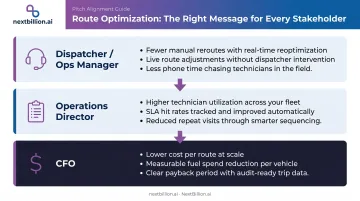
- Dispatcher/Ops Manager: Frame around daily friction — fewer manual reroutes, less time on the phone chasing technicians, routes that actually account for traffic windows
- Operations Director: Lead with utilization and compliance — technician capacity, SLA hit rates, and how often a second visit gets avoided
- CFO: Translate everything into dollars — cost per route, fuel spend reduction, and a clear payback period tied to headcount or overtime
When prospects ask about the best CRM software for field service management or the best field service scheduling software, resist naming a single winner in your pitch. Instead, tie whatever platform you represent back to the specific layer of pain — dispatcher, ops director, or CFO — that the buyer in front of you actually owns.
The Anatomy of a Winning Field Service Sales Pitch
The 5 Core Components
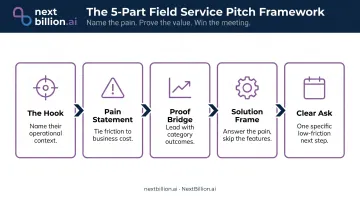
1. The Hook
Open with a specific observation about the prospect's operational context. Not a generic statement about the industry — something that signals you know their situation. This is the same principle behind any good sales pitch example, in field service or otherwise: specificity signals credibility before you've said a word about your product.
Examples:
- "I noticed your service area spans [X counties] — most teams your size are losing 90+ minutes per day to unoptimized routing between those zones."
- "Your reviews mention technicians running behind schedule — that's usually a dispatch sequencing problem, not a staffing one."
2. The Pain Statement
Name the friction and tie it to a business cost. A failed first service visit averages 2.75 total visits and adds about 13 days to resolution, according to Aquant's benchmark of 16.2 million work orders. That's the kind of number that reframes a conversation.
3. The Proof Bridge
Before describing your solution, establish that the category delivers. A Forrester TEI study modeled a 16% field service efficiency gain from intelligent routing and scheduling, with 310% ROI and a 7-month payback for a 200-technician organization. That efficiency gain comes from smarter dispatch sequencing and real-time route reoptimization — the same capability platforms like NextBillion.ai's Route Optimization API are built to deliver. Lead with the outcome, then introduce the mechanism.
4. The Solution Frame
Don't list features. Frame the product as the direct answer to the pain you just named.
- ❌ "Our platform includes real-time dispatch and GPS tracking."
- ✅ "When a cancellation hits at 10 AM, your team can reoptimize the entire day's routes in under 60 seconds — instead of losing that slot entirely."
5. The Clear Ask
Every pitch ends with one specific, low-friction next step. Pick one:
- A 20-minute call to walk through a route efficiency scenario
- A live demo using their actual service area
- A 14-day free trial with solutions engineering support included
A vague close gives the prospect an easy exit. A specific ask — tied to their actual operational context — gives them a reason to say yes.
Field Service Sales Pitch Templates by Channel
Cold Email Pitch Template
Subject line: [CITY/REGION] routing — [COMPANY NAME]
Hi [FIRST NAME],
Most [INDUSTRY] teams your size lose [PAIN POINT — e.g., 60–90 minutes per technician per day] to unoptimized routing. For a [FLEET SIZE]-tech operation, that's roughly [CALCULATED COST] in idle time annually.
[REFERENCE CUSTOMER OR OUTCOME] — a similar [INDUSTRY] team reduced scheduling time by 40% and increased stops per technician by 35% after switching.
Worth a 15-minute call to run through what this looks like for [COMPANY NAME]?
[YOUR NAME]
A note on length: Gong's analysis of 28 million cold emails found the ideal cold email is 100 words or fewer, with 3–4 sentences generating the highest reply rates. Salesloft found 25–50 word emails outperformed average by 65%. Keep it short.
Phone / Voicemail Pitch Script
Voicemail (30 seconds):
"Hi [NAME], this is [YOUR NAME] from [COMPANY]. I work with [INDUSTRY] teams who are losing dispatch time to manual rerouting after cancellations — usually 60 to 90 minutes per day across the fleet. I have a 10-minute route efficiency walkthrough I can tailor to your service area. I'll follow up by email, but feel free to call me back at [NUMBER]."
When they pick up — first 60 seconds:
- Open with a permission ask: "Is this a bad time, or do you have 90 seconds?" Research from Gong shows this opener reduces hang-ups and improves full-conversation rates.
- Hook: "I work with [INDUSTRY] teams who are dealing with [SPECIFIC PAIN]. Is that something you're running into?"
- If yes: "We helped [REFERENCE CUSTOMER TYPE] cut scheduling time by [OUTCOME]. I'd love to show you what that looks like for your team. Do you have [DATE/TIME] open for a quick call?"
In-Person / Demo Pitch Framework
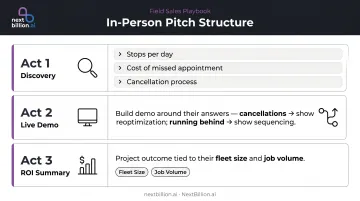
Every in-person pitch works best in three acts:
Act 1 — Discovery (2–3 questions before any demo):
- "How many stops does your average technician complete per day?"
- "What does a missed appointment cost you — in direct revenue and in customer churn?"
- "When a cancellation comes in mid-morning, what's your current process for filling that slot?"
Act 2 — Live Demo tied to their answers: Their answers define the script. Skip the generic product tour and build the demo around what they just told you — if cancellations are the problem, show real-time reoptimization; if technicians are running behind, walk through schedule sequencing.
Act 3 — ROI Summary: Close with a projected outcome specific to their fleet size and job volume. "Based on your [X technicians] and [Y stops per day], here's what a 16% efficiency gain means in recovered hours and direct cost savings."
Pitch Examples by Field Service Vertical
Pest Control ### Pest Control
Context: A pest control company with 12 technicians covering urban and suburban routes.
Here's how this pitch sounds in a real outreach context:
"I noticed you're covering [METRO AREA] — that's dense residential territory, and most pest control teams your size are losing 45–60 minutes per technician per day to inefficient stop sequencing. For 12 techs, that's roughly 500+ hours annually that aren't generating revenue.
Hawx Smart Pest Control — one of the largest pest control providers in the US — described five minutes of unoptimized drive time per technician per day as equivalent to millions of dollars in annual cost. After implementing route optimization, they gained the ability to update schedules multiple times per day, handle same-day cancellations without losing the slot, and improve technician utilization significantly.
The way we address this is by automatically sequencing your stops based on skills, time windows, and geography — so your techs spend more time at customer sites and less time driving. Can we schedule a 15-minute call to run a sample route optimization for your service area?"
Logistics / Last-Mile Delivery
Context: A regional delivery operation managing 20 drivers with on-time SLA commitments.
Here's how to open this conversation:
"Your operation is managing [X] daily stops with SLA commitments — and every failed delivery attempt adds real cost. Loqate's research found failed first-attempt deliveries cost an average of $17.20 each. At even a 5% failure rate across your volume, that's a number that adds up fast.
We've helped logistics operations reduce route variability and fuel cost by optimizing for real-time traffic, driver time windows, and delivery zone density simultaneously. One logistics client reduced operating costs by 35%.
I can show you a live scenario using your delivery zones. Would [DAY] work for a 20-minute walkthrough?"
Utilities / Energy Field Service
Context: A utilities team managing scheduled maintenance windows with certified technicians.
This pitch leads with the compliance angle most tools miss:
"Utilities teams have a specific scheduling problem that most routing tools ignore: you need the technician with the right certification for that specific asset, within a compliance-approved time window, with documentation that closes out automatically. Proximity alone doesn't cut it.
We handle certification matching as a hard constraint, so the system won't assign a job to an uncertified tech even if they're closer. Add scheduled maintenance window optimization and audit-ready trip documentation, and your team handles more cycles per shift without the compliance risk.
Want to walk through how this maps to your current dispatch model? I can set up a 20-minute call with one of our solutions engineers."
Common Mistakes That Sink Field Service Pitches
Mistake 1: Feature-Dumping
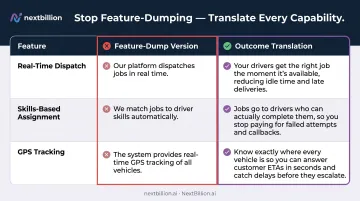
Listing capabilities without anchoring them to outcomes causes buyers to check out. Every feature needs a translation:
| Feature | Feature-Dump Version | Outcome Translation |
|---|---|---|
| Real-time dispatch | "We have real-time dispatch" | "Your team can reroute within 60 seconds of a cancellation instead of losing that slot" |
| Skills-based assignment | "50+ routing constraints" | "The system won't send an uncertified tech to a job — first time, every time" |
| GPS tracking | "Live GPS tracking" | "Customers get accurate ETAs; your dispatcher stops fielding 'where is my tech?' calls" |
Mistake 2: Pitching to the Wrong Stakeholder
Selling only to the dispatcher when the CFO controls budget — or only to the CFO when the dispatcher controls adoption — stalls deals. For software over $20,000, 49% of buyers took four months or more to decide in 2024, up from 41% the year prior.
Build a simple stakeholder map early in the deal:
- Who uses it daily — dispatcher, operations coordinator?
- Who approves the budget — CFO, VP Operations?
- Who can block it — IT security, legal, procurement?
- Who champions it internally — the person most frustrated with the current process?
Then tailor your proof to each layer:
- Dispatchers want fewer manual adjustments and smarter rerouting
- CFOs want ROI projections and a clear payback period
- Legal and IT want SOC 2 certification and data handling documentation
Mistake 3: Skipping Discovery
Launching into a demo before asking two or three qualifying questions signals you don't understand the prospect's operation. Build a two-minute discovery habit before every call or meeting:
- What's your current dispatch process?
- What's your biggest source of scheduling delays right now?
- What does a bad week look like operationally?
The answers don't just improve your pitch — they tell you which proof points to lead with.
Using Route and Operational Data to Strengthen Your Pitch
Operations buyers are analytical. Showing a prospect their estimated drive time versus an optimized route scenario is more persuasive than any feature description. The gap between current state and optimized state is your pitch.
Build a Gap Analysis
Use verified benchmarks to quantify what the prospect is leaving on the table:
- A failed first visit averages 2.75 total visits and adds ~13 days to resolution (Aquant, 2023 — based on 16.2M work orders)
- Intelligent routing and scheduling produced a modeled 16% field service efficiency gain (Forrester TEI study)
- Aquant found field service costs per repair rose 7% year-over-year — buyers are already feeling the pressure
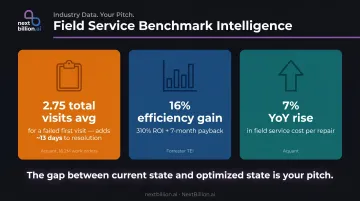
If you have the prospect's fleet size and average daily stops, you can build a rough projection on the spot. "If your 15 technicians each recover 45 minutes per day through better sequencing, that's over 3,000 hours annually — here's what that's worth at your labor rate."
Lead With Documented Outcomes
Benchmarks frame the problem. Named outcomes close the argument. NextBillion.ai's route optimization platform handles 50+ routing constraints and integrates with fleet management systems including Geotab and Samsara — with documented results across 150+ businesses.
Two examples worth citing in field service pitches:
- A health-tech field service operation achieved 35% more visits per technician and 25% cost savings
- Hawx Pest Control reduced developer hours in scheduling and improved technician utilization within the first month
When the CFO enters the conversation, pricing structure becomes as important as outcome data. The per-vehicle or per-order model — rather than per-API-call billing — directly addresses budget predictability, a common sticking point in deals with variable daily volumes.
Frequently Asked Questions
What is a good example of a sales pitch?
A strong pitch opens with a specific operational pain ("your team is losing 60+ minutes per technician daily to manual rerouting"), connects that pain to a measurable cost (idle technician hours, missed SLA penalties), and ends with one clear next step like a 15-minute route efficiency walkthrough. It should never open with product features.
What are some common field service management software features?
Core FSM features include scheduling and dispatch, work order management, GPS tracking, route optimization, mobile technician access, invoicing, and reporting. Effective pitches translate each feature to an operational outcome — route optimization becomes "your techs complete more stops per shift without adding headcount."
What is field management software?
Field management software is a platform that helps businesses coordinate technicians, jobs, scheduling, and customer communication from a centralized system. It replaces manual dispatch processes — and in a sales pitch, it's most compelling when framed around what that replacement actually costs the prospect today. For US fleets, that framing often includes exposure to FMCSA hours-of-service limits and DOT reporting, since manual dispatch makes those harder to track consistently.
How do you personalize a field service sales pitch for different industries?
Personalization starts with understanding the industry's core KPI. For HVAC and pest control, that's first-time fix rate and technician stops per day. For logistics, it's on-time delivery and cost per failed attempt. Build your pain statement around what failure in that specific metric actually costs the business.
What questions should you ask a field service prospect before pitching?
Ask: How many stops does your average technician complete per day? What's your current dispatch method? What's the biggest source of scheduling delays right now? How do you currently track hours of service and vehicle compliance across your fleet? These questions surface the specific operational pain — including compliance exposure — that makes your proof points land and shows the prospect you understand their day-to-day constraints, not just software features.
How do you handle price objections in a field service sales pitch?
Reframe the objection by calculating the cost of the current problem. If the prospect's 10 technicians each lose 45 minutes daily to unoptimized routing, that's roughly $150,000+ in annual idle labor cost — and that number makes the platform's price straightforward to justify.
What are good opening lines for a pitch?
Open with a specific, verifiable operational fact about the prospect's business, not a compliment or a feature claim. For example: "Most field teams your size lose time to manual rerouting when a job runs long or a technician calls in." This works because it names a problem the prospect already recognizes, which earns the next 30 seconds of attention needed to get to a discovery question.
What is the best field service scheduling software?
There is no single "best" scheduling software — the right choice depends on fleet size, job complexity, and whether route optimization or compliance tracking (like hours-of-service limits) matters more to the business. When pitching, avoid naming a universal winner. Instead, ask what the prospect's current scheduling tool fails to do, then position your platform's routing and dispatch capabilities against that specific gap.