For most fleet-dependent operations, the problem isn't one catastrophic decision. It's hundreds of small ones: a 30-stop route sequenced in the order stops were entered, a driver idling at a loading dock for 40 minutes, a time window so loose it forces backtracking across a service zone. Each inefficiency is minor. Across a fleet and a year, they compound into serious margin pressure.
The good news: logistics costs are largely decision-driven, not structurally fixed. Route optimization is one of the highest-leverage places to intervene. This applies as much to waste and recycling collection routes and garbage truck dispatch as it does to freight and last-mile delivery, since fixed collection zones and daily stop volumes make sequencing errors just as costly. This article examines where costs actually build up, what drives them, and which strategies produce the most measurable results.
Key Takeaways
- Logistics cost overruns accumulate through daily routing decisions, not structural overhead alone
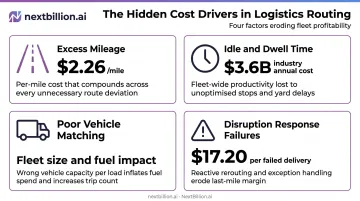
- The four biggest cost drivers are excess mileage, idle/dwell time, poor vehicle-load matching, and inability to adapt to disruptions
- Cost reduction works at three levels: pre-dispatch planning, active route management, and operational structure
- Tools modeling 50+ real-world constraints produce executable routes; distance-only tools generate costly exceptions
- Switching from static to dynamic optimization addresses fuel, overtime, and vehicle wear simultaneously
How Logistics Costs Build Up
Logistics costs are rarely visible as a single line item. They distribute across fuel, driver wages, vehicle wear, failed deliveries, and overtime — often spread across multiple cost centers in ways that obscure the actual source.
The accumulation is gradual. None of these events trigger an alert — they happen, get absorbed, and repeat:
- A dispatcher manually builds routes the same way they did last quarter
- A driver follows a familiar path that adds three miles
- A route gets assigned to the wrong vehicle type and hits a weight-restricted bridge
McKinsey's analysis of mid- and last-mile logistics puts the cost of inefficient handoffs and routing at $95 billion annually in U.S. economic losses — with an estimated 1 to 1.5 hours of avoidable dwell time per day in affected operations.
These costs stay hidden until scale forces a reckoning. A fleet of 10 vehicles can absorb the inefficiency. A fleet of 50 magnifies it — and the same routing habits that seemed manageable at smaller scale become a structural drag on profitability.
The Four Key Cost Drivers in Logistics Routing
Excess Mileage from Stop Sequencing
Stop order matters as much as stop count. A route with 30 deliveries visited in the wrong sequence can drive significantly more miles than the same 30 stops in an optimized sequence — and at $2.336 per mile, those extra miles add up fast.
A peer-reviewed case study from Western Sydney University found that route optimization reduced daily distance by 8% for a municipal fleet — without reducing the number of stops served. At fleet scale, that kind of reduction translates directly into fuel savings and reduced vehicle wear.
Idle and Dwell Time
Time spent not moving still costs money. A driver waiting at a loading dock, sitting in predictable morning traffic on a corridor the route didn't account for, or arriving 25 minutes early for a time window — all of these burn fuel and driver hours without generating output.
ATRI research from 2024 documented that truck driver detention cost the industry $3.6 billion in direct expenses and $11.5 billion in lost productivity in 2023 alone. Without dwell time visibility in your routing system, that exposure stays hidden until it shows up in overtime and missed SLAs.
Poor Vehicle-to-Route Matching
Dispatching an oversized vehicle on a route suited for a smaller one inflates fuel cost per unit delivered and accelerates maintenance cycles. Sending a standard truck onto a road with weight or height restrictions creates mid-route failures that require re-dispatch.
EPA SmartWay case data puts numbers to the gap:
- Associated Food Stores used network optimization to cut fleet size by 38% and eliminate two to three routes daily — without reducing service levels
- Subway consolidated shipments into full truckloads and saved more than 9 million truck miles annually
Inability to Respond to Disruptions
A static route hitting a road closure, accident, or unexpected cancellation has no recovery mechanism. The ripple effect — overtime, missed time windows, failed deliveries — is disproportionately expensive compared to the original disruption.
That ripple lands hardest at the last mile. Industry estimates put the average cost of a failed delivery at $17.20 per attempt, and roughly 8% of deliveries fail on the first try. For a fleet completing hundreds of stops daily, that failure rate is a predictable, recurring line item — and one that better disruption handling directly reduces.
Cost-Reduction Strategies for Logistics Operations
Most logistics cost problems have a fix at one of three points: before a truck leaves the depot, while routes are running, or at the structural level that determines what optimization can realistically achieve. The strategies below address all three.
Strategies That Change Planning Decisions
These interventions reduce cost before a truck leaves the depot.
Rather than assigning stops in the order received, group them by proximity first. NextBillion.ai's Clustering API does this — grouping large stop volumes into proximity-based clusters with configurable parameters before route optimization runs. Geographic consolidation reduces total distance driven per route without changing stop count.
Broad delivery windows like "8am–6pm" force stop sequences that create backtracking. Tighter, strategically placed windows let the optimizer build more logical routes — and often allow more stops per route.
Vehicle matching matters at the planning stage, not after dispatch. NextBillion.ai's optimization engine accounts for truck dimensions, weight limits, height restrictions, cargo type (including hazmat), and road-specific constraints. Routes that ignore these factors create mid-route problems no dispatcher can solve cheaply.
Leaving real-world constraints unmodeled — driver hour limits, load sequencing rules, priority customers, multi-depot assignments — turns those constraints into expensive field exceptions. NextBillion.ai's Route Optimization API supports 50+ hard and soft constraints, from vehicle capacity to skill-based task assignment to order incompatibility rules.
Strategies That Change How Routing Is Managed
Once routes are active, cost management shifts to visibility and responsiveness.
Static routes repeat the same sequence regardless of conditions. Dynamic optimization recalculates based on current traffic, new stops, cancellations, or unexpected delays. This is where AI-based route optimization adds value over manual replanning: algorithms can evaluate thousands of stop-sequence combinations against live conditions in the time it would take a dispatcher to review a handful by hand. NextBillion.ai supports mid-route re-optimization triggered by new orders, last-minute cancellations, or traffic disruptions — and allows the API to be rerun with the same order set within 24 hours at no extra cost.
Route deviations — drivers taking familiar paths instead of optimized ones, avoiding highways, adding stops — cost money that's invisible without tracking. NextBillion.ai's Live Tracking API monitors driver movements to an accuracy of up to 1 meter, with geofence-based alerts when vehicles deviate from designated routes. Dispatchers can intervene before a deviation cascades into overtime.
Without data, fleet managers assume delays are random. In most fleets, a handful of stops or specific time slots account for the bulk of idle cost. The Live Tracking API monitors excessive idling as a tracked metric, and that data feeds back into future planning decisions.
Route planning tools that only minimize distance produce routes that look clean on paper but break down in the field. Xpress Global Systems, using NextBillion.ai's Route Optimization API with soft constraints for driver shift management, achieved a 35% reduction in operating costs and a 13% reduction in monthly miles driven — with overtime minimization built into the optimization logic rather than managed after the fact.
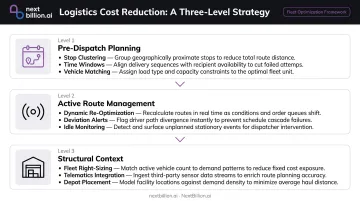
Strategies That Change the Structural Context
Some cost drivers sit upstream of routing entirely. No amount of stop resequencing fixes a misaligned depot, an oversized fleet, or routing software that can't see real vehicle data.
Many operations add trucks when the real solution is fitting more stops into existing vehicles through better sequencing and load planning. A health-tech logistics firm using NextBillion.ai achieved 35% more visits per rider while lowering conveyance expenses by 25% — without expanding the fleet.
Routing decisions made without real vehicle data — location, historical traffic patterns, vehicle availability — are always suboptimal. NextBillion.ai integrates with telematics platforms including Samsara, Geotab, Motive, and Netradyne, enabling bidirectional data flow where historical traffic patterns inform future route builds and optimized routes push directly to driver apps.
In operations that have grown beyond their original geographic footprint, the real cost driver may be where trucks start, not how stops are sequenced. Long initial and return legs that persist across every route sometimes require evaluating depot or hub placement against current service density — a structural fix that route optimization alone can't deliver.
Conclusion
Reducing logistics costs through route optimization means identifying exactly where cost originates — in planning decisions, operational management, or structural context — and applying the right lever at the right stage. Without that diagnosis, interventions tend to shift waste rather than eliminate it.
The operations that sustain results treat optimization as a continuous process. Routing conditions change, fleets scale, and customer expectations rarely stand still. Organizations that embed optimization into daily workflows — rather than treating it as a one-time project — consistently outperform those that don't.
NextBillion.ai's Route Optimization API and Route Planner App are built for exactly that kind of ongoing operation: 50+ configurable constraints, real-time re-routing, and per-vehicle pricing that scales with your fleet rather than your API call volume.
Frequently Asked Questions
What is route optimization software?
Route optimization software uses algorithms to find the most efficient sequence and paths for multi-stop vehicle routes, accounting for constraints like time windows, vehicle capacity, driver hours, and real-time traffic. Unlike basic navigation, it's designed to minimize total fleet costs across complex, real-world conditions — a distinction Gartner's vehicle routing and scheduling category makes explicit.
How much can route optimization reduce logistics costs?
Documented results range from a 25% cut in conveyance expenses at a health-tech logistics firm to a 35% reduction in operating costs at Xpress Global Systems. EPA SmartWay case studies show fleets eliminating millions of annual miles after combining network and route optimization — the higher your baseline inefficiency, the larger the initial gains.
What is the difference between static and dynamic route optimization?
Static routing repeats fixed sequences regardless of conditions. Dynamic optimization recalculates routes based on current traffic, new orders, cancellations, or disruptions in real time. The cost difference between the two grows as fleet size and stop complexity increase — since static routes never self-correct. For waste and recycling fleets, dynamic optimization also adjusts for missed pickups, overflow containers, and same-day route additions without manual re-planning by dispatch.
How does route optimization reduce fuel costs specifically?
Fewer total miles, less idling from dynamic rerouting, and better vehicle-to-route matching all cut fuel burn — and the savings compound. Subway eliminated over 1.6 million gallons of diesel annually after consolidating routes, according to EPA SmartWay data.
What constraints should route optimization software handle?
Effective software handles both hard constraints (vehicle weight limits, road restrictions, driver hours-of-service, time windows) and soft constraints (driver preferences, priority customers, load sequencing). Tools that only minimize distance without modeling real-world constraints produce routes that generate expensive field exceptions. For waste collection specifically, constraints also include container capacity, disposal site hours, low-clearance roads, and residential noise ordinances that restrict early-morning or late-night stops.
How quickly can operations see results after deploying route optimization?
Several NextBillion.ai customers saw measurable cost reductions within the first weeks of deployment. EasyHealth completed integration and went to production within 10 days. Xpress Global Systems documented a 13% reduction in monthly miles driven as one of the earliest measurable indicators — with fuel and overtime savings following directly from that reduction.
What routing software works best for garbage trucks and waste collection fleets?
Garbage truck routing has requirements general delivery routing software does not: container capacity tracking, disposal or transfer station hours, low-clearance and weight-restricted roads, and compaction cycles that affect stop duration. The best fit is software that lets you configure these as constraints rather than forcing routes through a generic multi-stop delivery model built for parcel or last-mile use cases.
Can AI do route optimization for waste and logistics fleets?
Yes. AI-based routing engines use machine learning and optimization algorithms to generate and continuously adjust routes based on live traffic, new stops, and changing constraints, rather than relying on a single fixed plan. For waste logistics, this means routes can adapt to overflow bins, added pickups, or closed disposal sites during the day instead of waiting for the next planning cycle.