Trucking dispatch and fleet management sit at the core of whether a carrier operates profitably or hemorrhages cost at every turn. The two disciplines are deeply connected, yet most operations treat them separately — which is exactly where inefficiency takes root.
This guide covers everything fleet managers and trucking company owners need to know: the difference between dispatch and fleet management, what dispatchers actually do, the software features that matter most, why route optimization is one of the highest-leverage investments available, and how to evaluate tools for your specific operation.
Key Takeaways
- Dispatch is the day-to-day function of assigning loads and managing drivers; fleet management is the broader discipline covering vehicles, compliance, and costs
- A dispatcher's core job spans load assignment, driver communication, real-time tracking, and exception handling
- Effective dispatch software requires GPS tracking, automated scheduling, HOS compliance, and route optimization
- Trucking margins average -2.3% and empty miles run 16.7% — route optimization directly determines whether a fleet runs profitably
- When evaluating software, prioritize integration capability and total cost of ownership over feature count
Trucking Dispatch vs. Fleet Management: What's the Difference?
These two terms get used interchangeably, but they operate at different levels of the business. For private fleets in particular, where the same team often owns both trucks and freight decisions, understanding this distinction is what determines whether a dispatch operations management system gets evaluated against the right criteria in the first place.
Trucking dispatch is tactical and real-time. It covers matching loads to drivers, communicating route details, and tracking delivery progress from departure to confirmation — decisions measured in hours and minutes.
Fleet management spans both tactical and strategic responsibilities:
- Vehicle acquisition and maintenance scheduling
- Driver compliance (HOS, ELD requirements)
- Fuel management and cost tracking
- Safety programs and incident reporting
- Long-term asset utilization planning
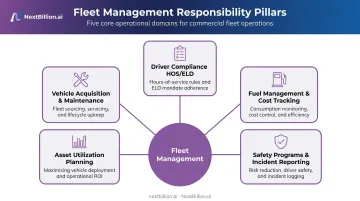
These decisions shape what dispatch can do weeks or months before a load ever moves.
Why Both Break Down Without the Other
The two functions are inseparable. Dispatch feeds real operational data into fleet management — driver hours logged, miles driven, fuel consumed per route. Fleet management constraints — vehicle availability, maintenance status, driver qualifications — directly limit what dispatch can execute on any given day.
When the two aren't connected, both sides operate blind:
- A dispatcher without fleet visibility makes load decisions with incomplete information
- A fleet manager without dispatch data can't schedule maintenance or time asset acquisitions accurately
For most carriers, that integration isn't optional. According to the American Trucking Associations, 91.5% of active motor carriers operate 10 or fewer trucks, and 99.3% operate 100 or fewer. At that scale, running dispatch and fleet management as disconnected systems creates gaps that compound quickly — in missed maintenance windows, driver hours violations, and poorly matched loads.
What Does a Truck Dispatcher Do?
A dispatcher's job has three distinct layers, and each one requires different skills and different data.
Logistics Management
This is the planning function: assigning loads based on driver availability, hours of service remaining, and equipment type. In multi-stop operations, it includes sequencing deliveries to minimize drive time and avoid customer time-window violations. Done manually with spreadsheets, this process burns hours. Done with the right tools, it takes minutes.
Driver Management
On the road, the dispatcher is the driver's primary point of contact. That means relaying route updates, handling permit questions, coordinating with receivers, and managing driver expectations when delays happen. In smaller operations — most carriers run fewer than 10 trucks — one person handles dispatch and driver relations simultaneously.
Exception Handling
This is where dispatchers earn their keep. None of these make it onto the day's plan, but all demand an immediate response:
- Traffic incidents and unexpected road closures
- Mechanical failures mid-route
- Detention time at shipper or receiver facilities
- Load rejections and last-minute customer changes
ATRI's research found that 39.3% of stops involved driver detention in 2023, costing the industry $3.6 billion in direct expenses and $11.5 billion in lost productivity. Detention alone shows why exception handling is the most demanding part of the role.
The quality of a dispatcher's decisions is directly tied to the quality of their data. Without real-time visibility and accurate routing information, even experienced dispatchers operate with blind spots that cost money on every load.
Core Features Every Trucking Dispatch & Fleet Management System Needs
Not all dispatch software is built for trucking. Here's what separates systems that actually work for commercial fleets from those that fall short. For private fleets asking what the best dispatch software or TMS actually looks like, the answer isn't a single feature — it's whether the system unifies dispatch, compliance, and fleet health data in one place rather than forcing dispatchers to reconcile multiple disconnected tools.
Real-Time GPS Tracking and Visibility
A live dispatch map showing each vehicle's location, direction, speed, and HOS status is the operational foundation. It enables proximity-based load assignment, accurate ETA communication to customers, and rapid rerouting when delays occur.
Without it, dispatchers are reduced to calling drivers for location updates. That's where most delays, miscommunications, and missed windows originate.
Automated Scheduling and Load Assignment
Manual load matching is slow and error-prone. Automated dispatch tools match loads to drivers based on:
- Current availability and proximity
- Hours of service remaining
- Equipment type and capacity
- Driver qualifications and certifications
The reduction in back-and-forth communication alone justifies the investment for most mid-size operations. C.H. Robinson's touchless appointment scheduling software, which handles truckload scheduling "without any human intervention," is an early indicator of where automation is taking commercial dispatch. Carriers that haven't evaluated automated scheduling tools are already behind the curve.
HOS and ELD Compliance Integration
HOS compliance is non-negotiable for DOT-regulated carriers. FMCSA requires a 30-minute break after 8 cumulative hours of driving, and failure to maintain proper records can trigger penalties of $1,584 per day, up to $15,846. A driver FMCSR violation can add another $4,812.
Dispatch software that surfaces HOS data alongside load assignments prevents costly violations before they happen — not after the fact.
Driver Communication Hub
In-app messaging, automated status notifications, and document capture (bills of lading, proof of delivery) reduce phone calls and create a documented audit trail. For carriers managing compliance documentation, a centralized communication hub is as much an operational requirement as it is a convenience.
Maintenance Scheduling and Fleet Health Tracking
A truck that's unexpectedly out of service doesn't just cost repair money — it collapses the dispatch plan around it. Systems that track mileage-based maintenance intervals and send proactive alerts keep assets available. Planned downtime is manageable; unplanned breakdowns cascade into missed loads, angry customers, and driver scheduling headaches.
The Role of Route Optimization in Modern Fleet Dispatch
GPS tracking tells you where your trucks are. Route optimization determines the most efficient path forward — and treating them as the same capability is a costly assumption that erodes margins fleet by fleet.
Basic Routing vs. Truck-Specific Optimization
Standard navigation apps calculate routes for passenger vehicles. Commercial trucking operations need something fundamentally different.
Effective truck routing must account for:
- Vehicle dimensions — height clearances, width restrictions, length limits
- Weight restrictions — bridge limits, axle load rules
- Hazmat routing rules — restricted corridors for dangerous goods
- Time windows — customer delivery appointments and facility hours
- Multi-stop sequencing — optimizing stop order across 10, 50, or 500 deliveries
- HOS compliance — driver break requirements built into route structure
- Toll avoidance — controlling variable operating costs
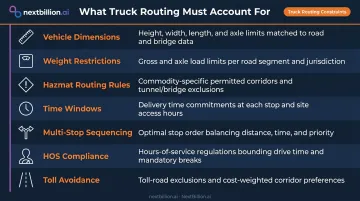
NextBillion.ai's Route Optimization API supports 50+ hard and soft constraints for this type of complex, regulation-compliant truck routing — constraint depth that generic mapping tools don't come close to matching.
The Real Cost of Poor Routing
ATRI's 2025 analysis puts the average operating cost at $2.26 per mile in 2024, with the truckload sector averaging an operating margin of -2.3%. Empty (deadhead) miles averaged 16.7% during the freight recession.
Every unnecessary mile driven at $2.26 in operating cost is profit that doesn't exist. At thin or negative margins, shaving even 3–5% off weekly mileage can mean the difference between a solvent quarter and a loss.
Real-Time Rerouting at the Route Level
Traffic incidents, weather delays, and customer changes don't stop mid-route. A dispatch system with genuine route optimization can recalculate multi-stop sequences dynamically — not just redirect a single driver to an alternate highway.
NextBillion.ai's route optimization engine generates dispatch-ready recalculations in seconds, with real-time traffic integration built in. Dispatchers get specific rerouting recommendations rather than raw GPS data, reducing cognitive load and enabling faster decisions when conditions change.
That speed advantage compounds at scale. NextBillion.ai supports distance matrix computations up to 5,000×5,000 elements (compared to the 25×25 cap common in standard APIs), enabling more accurate pricing, dispatch, and optimization for complex multi-stop trucking operations.
Key Metrics to Measure Dispatch Efficiency
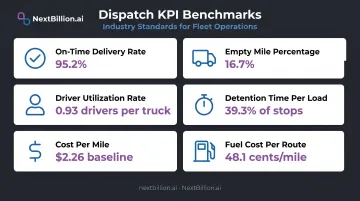
Dispatch decisions that can't be measured can't be improved. These six metrics cover the service and cost dimensions that separate efficient fleets from those leaking margin.
| KPI | Why It Matters |
|---|---|
| On-time delivery rate | Measures customer service reliability and contract compliance |
| Empty mile percentage | Industry average: 16.7%; every point below that is direct margin recovery |
| Driver utilization rate | Tracks productive hours against available hours — ATRI reports drivers per truck fell to 0.93 in 2024 |
| Detention time per load | 39.3% of stops involved detention in 2023; tracking this identifies problem facilities |
| Cost per mile | Baseline is $2.26/mile; route-level tracking identifies which lanes drain profitability |
| Fuel cost per route | Fuel ran 48.1 cents per mile in 2024; route comparisons expose inefficiency |
Building a KPI Feedback Loop
Correlating these metrics — not just tracking them in isolation — is where dispatch analysis pays off.
When dispatch software connects routing choices, driver assignments, and scheduling patterns to actual performance outcomes, managers can identify which lanes, load types, or drivers consistently outperform — and replicate those patterns. Modern fleet management dashboards surface these correlations automatically, cutting the time between identifying a problem lane and acting on it from weeks to days.
How to Choose the Right Trucking Dispatch & Fleet Management Software
Fleet Size and Operational Complexity
A 10-truck regional carrier and a 300-truck enterprise operation have almost nothing in common when it comes to software requirements.
- Small fleets (under 20 trucks): Prioritize mobile access, simplicity, and quick setup. Avoid platforms requiring months of implementation.
- Mid-size fleets (20–100 trucks): Need scalability and solid ELD integration with providers like Samsara, Geotab, or Motive.
- Enterprise fleets (100+ trucks): Require multi-terminal support, deep system integrations, advanced analytics, and often custom configuration.
Integration Ecosystem
No dispatch software operates in isolation. It needs to connect with ELD providers, telematics systems, accounting tools, and route optimization engines without requiring a full platform replacement every time you add a new capability.
NextBillion.ai's API-first architecture integrates directly with Samsara, Geotab, and Motive through plug-and-play connectors. Dispatchers can pull vehicle and order data from existing telematics systems, optimize routes, and push assignments back to driver apps without manual re-entry.
That means fleets can layer advanced route optimization on top of systems that already work, rather than replacing them wholesale.
Pricing Model Transparency
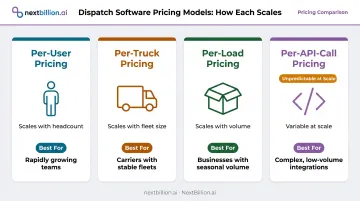
Dispatch software pricing varies widely, and the model matters as much as the number:
- Per-user pricing: Scales with headcount, not fleet size
- Per-truck pricing: Grows with the fleet, which is predictable
- Per-load pricing: Can become expensive for high-volume operations
- Per-API-call pricing: Often unpredictable at scale as re-routing and recalculations multiply
Capterra's fleet management pricing data shows costs ranging from $5 to over $42 per vehicle per month, while Software Advice reports average buyer budgets of $67 to $158 per user per month. Enterprise TMS platforms like McLeod LoadMaster require vendor contact for pricing.
Watch for hidden costs: IFTA add-ons, integration fees, per-seat upgrades, and data migration charges that inflate total cost of ownership well beyond the advertised subscription price.
NextBillion.ai uses per-vehicle or per-order pricing that stays fixed regardless of how many optimization calls are made. For high-volume trucking operations running frequent rerouting requests, that pricing stability is a meaningful operational advantage.
Implementation Speed and Support Quality
Enterprise platforms can require 6–12 month implementations. Cloud-based solutions deploy in days to weeks. When operations are losing money on inefficient routes, a 6-month implementation timeline isn't a minor inconvenience — it's a real cost.
NextBillion.ai's route optimization API can be integrated and tuned in under a week, with solutions engineers available throughout the process, including during pre-purchase evaluation.
Frequently Asked Questions
How much does dispatch software cost?
Basic trucking dispatch tools start around $49.95/month flat rate; fleet management platforms range from $5 to over $42 per vehicle per month; mid-tier tools run $67–$158 per user per month. Enterprise TMS solutions require custom quotes. Whether you're billed per-user, per-truck, or per-load matters significantly as your operation scales.
What is the difference between trucking dispatch and fleet management?
Dispatch is the day-to-day operational function: assigning loads, routing drivers, and monitoring deliveries in real time. Fleet management is the broader discipline covering vehicle maintenance, driver compliance, fuel management, and asset utilization across the entire operation. Dispatch feeds data into fleet management; fleet management constraints shape what dispatch can execute.
What does a truck dispatcher do?
A dispatcher assigns loads based on driver availability, HOS remaining, and equipment type — then tracks shipments in real time and handles exceptions like breakdowns, detention, or load rejections. In small fleets, one person manages all of this at once. A dispatch operations management system supports these tasks with live vehicle location, automated ETA updates, and route recalculation when conditions change, reducing the manual work required to keep loads moving and customers informed.
What features should I look for in trucking dispatch software?
Must-haves include real-time GPS tracking, automated load assignment, HOS/ELD compliance integration, in-app driver communication, truck-specific route optimization, and maintenance scheduling. Small fleets should prioritize simplicity and mobile access; larger operations need scalability and deep system integrations.
How does route optimization improve fleet dispatch?
Route optimization reduces fuel costs, cuts empty miles, improves on-time delivery rates, and allows dispatchers to handle more loads with fewer manual decisions. The key is truck-specific constraints — accounting for weight limits, height clearances, HOS, and time windows — which generic navigation tools don't support. For private fleets, this matters most when routes must be replanned mid-day around delays, driver hours running out, or new pickups, since a dispatch system can re-sequence stops automatically instead of a dispatcher doing it by hand.
Can small trucking companies benefit from dispatch software?
Yes. Even fleets under 10 trucks benefit from eliminating manual scheduling errors, improving customer communication with accurate ETAs, and freeing dispatcher time for higher-value work. The operational complexity per truck is often higher in small fleets, where one person manages everything without specialized support roles. A private fleet running its own trucks (rather than brokering loads) also gains from a system that centralizes route planning, delivery tracking, and driver compliance in one place instead of juggling spreadsheets and phone calls.
What is the best dispatch software for a private trucking fleet?
There is no single best option — the right choice depends on fleet size, whether loads are for-hire or internal delivery, and existing systems like ELD or telematics providers. Private fleets generally need strong route optimization with truck-specific constraints, real-time tracking, and integration with existing compliance tools, rather than broker-focused load-matching features found in carrier dispatch platforms.
What is the difference between a TMS and a dispatch operations management system?
A transportation management system (TMS) typically handles the broader logistics workflow: load planning, carrier selection, freight billing, and documentation. A dispatch operations management system focuses narrower, on real-time driver assignment, routing, and shipment tracking. For private fleets, dispatch functionality is often the core daily tool, while TMS features matter more when managing outside carriers or complex freight billing.