Introduction
The $69/month/van price point published by Bambi is real, transparent, and genuinely one of the more honest numbers in this market. But it's also just the starting point for a budget conversation that most operators don't finish before signing a contract.
NEMT software pricing runs from roughly $50 to $200+ per vehicle per month across publicly listed plans, with enterprise tiers requiring custom quotes that push well beyond that ceiling. The actual amount your fleet pays depends on vehicle count, whether billing is included, broker integration limits, and add-ons that rarely appear in the headline rate.
Here you'll find what each tier actually covers, what pushes costs higher, and how to calculate your true all-in number before signing anything.
Key Takeaways
- Published pricing: $49.99–$200/vehicle/month across verified vendor plans; enterprise tiers require custom quotes
- Claims management is included at entry-level pricing on some platforms — verify before assuming it's an add-on
- True monthly cost runs 40–60% higher than the advertised rate after setup fees, training, and add-ons
- Stronger constraint handling in route optimization cuts deadhead miles and lowers fuel spend — the difference shows up in monthly ops costs
- Spend more when: Denied Medicaid claims and manual billing errors cost more than the software upgrade would
How Much Does NEMT Software Cost?
NEMT software pricing runs from roughly $50 to $200+ per vehicle per month across publicly listed plans, with enterprise tiers requiring custom quotes beyond that ceiling. NEMT software doesn't have a single price — the $69/van/month figure is one real data point, not an industry average. Actual cost varies by vehicle count, pricing model, and feature depth. Your true all-in number depends on whether billing is included, how many broker integrations you need, and which add-ons sit outside the headline rate.
The mistake operators make most often is treating the per-van headline as the total cost. The hidden gaps show up later: billing requires a separate system, broker integrations are tier-limited, or the entry plan won't scale past 10 vehicles without a pricing jump.
Here's how the market breaks down based on publicly verified vendor pricing:
Tier 1 — Entry-Level ($49.99–$80/vehicle/month or flat plans)
Verified examples:
- NEMT Cloud Dispatch: $49.99/month for 1 vehicle; $149.99/month for up to 5 vehicles (all features included)
- RouteGenie: $50/vehicle/month for small fleets, month-to-month
- Tobi Bronze: $60/vehicle/month with 2 broker integrations
What's typically included: Trip scheduling, GPS tracking, driver mobile app, core broker API connections, basic dispatch
Billing note: Contrary to common assumptions, some entry-level plans do include claims management:
- Tobi Bronze includes attestation and claims management
- NEMT Cloud Dispatch includes its full billing engine at every tier
- RouteGenie lists billing in its feature set
Best for: Solo operators and fleets of 1–5 vehicles; operators who've confirmed billing is covered by their chosen platform or a trusted third-party service
Tier 2 — Mid-Range ($69–$150/vehicle/month)
Verified examples:
- Bambi: $69/month/van — all features included, no onboarding fees, no hidden costs, no contracts
- Tobi Silver: $90/vehicle/month with 4 broker integrations and automated client communications
What's typically included: Real-time routing, electronic proof of delivery, driver app with GPS, major broker integrations, scheduling automation
Billing note: At $69/van, Bambi describes NEMT billing as included. Whether a platform at this tier provides full claims management or dispatch-only coverage varies — confirm this directly with the vendor before budgeting.
Best for: Growing fleets of 5–20 vehicles focused on Medicaid compliance and dispatch efficiency
Tier 3 — Enterprise ($150–$200+/vehicle/month or custom)
Verified examples:
- Tobi Gold: $200/vehicle/month with 6 integrations, multi-fleet management
- TripMaster, Ecolane: Quote-required; feature pages describe full billing, auditing, payroll, and multi-payer workflows
What's typically included: Fully integrated billing and claims management, multi-broker workflows, dedicated account management, advanced analytics, route optimization tools
Best for: Fleets of 20+ vehicles or multi-state operations where billing complexity and audit compliance justify the investment
Key Factors That Affect NEMT Software Pricing
Two fleets at the same vehicle count can pay dramatically different amounts. These are the variables that drive the gap.
Pricing Model Structure
Four models are common in this market:
| Model | How It Works | Best For |
|---|---|---|
| Per-vehicle flat | Fixed cost per van (e.g., $69/van/month) | Fleets with consistent trip volumes |
| Tiered subscription | Flat monthly rate by fleet size band | Small-to-mid fleets; cost caps at thresholds |
| Per-trip | Base fee + per-trip charge | Lower-volume or seasonal operations |
| Enterprise custom | Negotiated annually | 50+ vehicle fleets; multi-state ops |
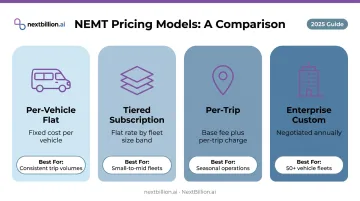
A 10-van fleet paying $69/van = $690/month under per-vehicle pricing. Under NEMT Cloud Dispatch's tiered model, the Growth plan starts at $149.99 + $39.99/additional vehicle, meaning 10 vans costs ~$510/month. The model that's cheaper today may flip at different scale points.
Fleet Size and Scale
Per-vehicle pricing scales linearly. Tiered plans cap costs at fleet size thresholds. Very small fleets — 1 to 3 vehicles — often overpay on per-vehicle plans compared to entry-level flat-rate subscriptions.
Run the math at your current fleet size and your projected size in 12 months before choosing a model.
Feature Depth and Integration Requirements
Broker API integrations are a major variable. Tobi caps integrations by tier: 2 integrations at Bronze, 4 at Silver, 6 at Gold. NEMT Cloud Dispatch includes all integrations at every tier. RouteGenie lists ModivCare, MTM, Veyo, MAS, Alivi, SafeRide Health, and others — but pricing treatment for specific brokers isn't always public.
Route optimization quality also separates tiers. Basic dispatch tools handle point-to-point routing. Higher-tier platforms handle multi-stop sequencing, wheelchair-accessible vehicle assignment, and real-time re-routing.
That real-time re-routing capability comes with a hidden cost risk: per-API-call billing that spikes with re-optimization frequency. GOIN, a paratransit and NEMT provider processing ~2,000 trips per day, switched to NextBillion.ai's route optimization API and achieved a 40% cost reduction compared to their previous per-call model. Trip volume simultaneously scaled from 800,000 to nearly 2 million API calls monthly. NextBillion.ai's per-vehicle and per-order pricing keeps costs aligned to fleet size or trip volume rather than computational activity.
Compliance and Support Level
HIPAA-compliant infrastructure and Business Associate Agreements are baseline requirements. What varies is support depth:
- Email-only support: typically included at lower tiers
- Phone or chat support: common at mid-range
- Dedicated implementation engineers and SLA commitments: enterprise tiers only
RouteGenie charges $250/hour for individual training sessions beyond the included group training. Budget for this if you have high dispatcher turnover.
Full Cost Breakdown: What You're Really Paying Per Van
The per-van subscription is one line item. Here's the full picture for a 10-van fleet using a mid-range platform at $69/van:
| Cost Item | Type | Estimated Range |
|---|---|---|
| Base subscription | Recurring | $690/month (10 × $69) |
| Setup and onboarding | One-time | Often waived at entry/mid tiers |
| Individual training | One-time/periodic | $0–$250/hour depending on platform |
| Custom development | As needed | ~$95/hour |
| Clearinghouse/EDI fees | Recurring | ~$44.95/month per Tax ID (Office Ally) |
| Add-on modules | Recurring | 20–30% above base rate |
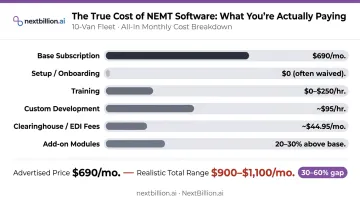
Notes: Bambi and NEMT Cloud Dispatch confirm no setup fees. RouteGenie charges $250/hour for individual training; most others include it. NEMT Cloud Dispatch publishes a $95/hour custom development rate.
Realistic all-in estimate for 10 vans: A $690/month base rate can realistically reach $900–$1,100/month once clearinghouse fees, any add-ons, and periodic training costs are included — roughly 30–60% more than the advertised figure.
Hardware costs are worth factoring in here too. The major platforms reviewed — Bambi, NEMT Cloud Dispatch, Tobi, and RouteGenie — all support standard iOS and Android devices for driver apps and GPS. None appeared to require proprietary hardware based on their official pages. That matters because platforms that lock you into their own devices make future transitions considerably harder.
What Most NEMT Operators Miss When Evaluating Software Costs
The Gap Between Advertised and Actual Cost
The $69/van number doesn't automatically include setup, EDI clearinghouse fees, individual training, or advanced add-ons. Operators who budget only the headline figure regularly find their actual monthly bill is noticeably higher by month three.
Build a full-cost model before committing. Map out every line item, confirm what's included versus billed separately, and calculate at your 12-month projected fleet size — not just today's.
The Cost of Not Switching
A 2022 HHS-OIG audit of New York City NEMT payments found that only 17 of 100 sampled payments complied with Medicaid documentation requirements, with over $196 million — more than 72% of the audited amount — identified as improperly claimed or potentially non-compliant. Documentation gaps are a direct contributor, and manual or disconnected systems make those gaps harder to catch before submission.
Operators running dispatch and billing in separate systems — or on spreadsheets — introduce re-entry errors that compound into denied claims. At some fleet size, the monthly cost of those errors outweighs the cost of a better platform. The calculation is worth doing before the next audit cycle.
Over-Specifying or Under-Specifying
- A 3-van solo operator paying enterprise rates for multi-state billing workflows they won't use for two years is overpaying
- A 12-van fleet on a dispatch-only plan while billing errors compound monthly is underpaying for the wrong thing
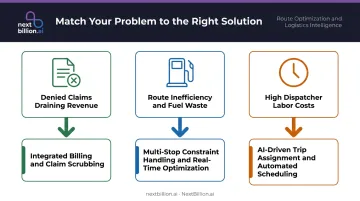
Match the platform to your current bottleneck. If route inefficiency and fuel costs are the problem, prioritize constraint-aware optimization. If denied claims are the problem, billing integration is the priority. If dispatcher labor hours are the problem, AI-driven automation is the lever.
How to Estimate the Right NEMT Software Budget
NEMT software pricing varies enough that the wrong choice can cost more than it saves. Three questions help you find the right range before you start comparing vendors:
1. What's your fleet size and trip volume? Calculate monthly cost under per-vehicle pricing and under tiered pricing at your current and 12-month projected fleet size. The cheaper model today may reverse at scale. If trip volume varies significantly by season, per-trip pricing may be more economical than per-vehicle.
2. What's your payer mix? Medicaid-heavy fleets need strong billing integration or a credible third-party billing service in the budget. Primarily private-pay fleets may get adequate value from dispatch-only tools at lower price points.
3. What's your biggest operational cost driver?
- Budget for platforms with integrated billing and claim scrubbing if denied claims are draining revenue
- Prioritize multi-stop constraint handling, wheelchair-accessible vehicle routing, and real-time optimization if route inefficiency and fuel waste are the main cost driver
- For dispatch platforms that embed routing, choose API-based solutions with per-vehicle or per-order pricing — per-call models inflate unpredictably at scale
- Prioritize platforms with AI-driven trip assignment and automated scheduling workflows if dispatcher labor costs are the primary concern
Frequently Asked Questions
How much does NEMT software cost?
Published pricing runs from $49.99/month for a single vehicle to $200/vehicle/month at the high end of publicly listed plans, with enterprise tiers requiring custom quotes. All-in-one platforms with billing cost more than dispatch-only tools. The true monthly cost — including clearinghouse fees, training, and add-ons — typically runs 40–60% higher than the advertised base rate.
How much does transportation management software cost?
General logistics TMS products are priced differently and don't include Medicaid billing workflows, broker API integrations, or NEMT-specific dispatch features. NEMT software pricing reflects specialized compliance requirements — 837P EDI claim submission, CMS 1500 forms, payer-specific documentation — that standard TMS products don't address.
What is the best NEMT software?
There's no single best platform. The right choice depends on fleet size, payer mix, and whether billing is handled in-house or through a third-party service. Evaluate platforms on billing integration depth, broker API coverage, integration limits by tier, and total cost of ownership — not headline price alone. Also weigh routing quality: dispatch that accounts for wheelchair-accessible vehicle assignment, will-call trips, and multi-loading directly affects on-time performance and driver hours under FLSA and hours-of-service planning.
What is included in NEMT software at $69 per month per van?
At Bambi's published $69/van/month rate, all features are included — no onboarding fees, no hidden costs, no contracts. At other platforms in this range, coverage varies significantly; confirm whether billing, broker integrations, and route optimization are included before budgeting.
Is per-vehicle pricing better than per-trip pricing for NEMT fleets?
Per-vehicle pricing works best for fleets with consistent, high trip volumes since cost is fixed regardless of trips completed. Per-trip pricing suits smaller or seasonal operations with variable monthly volumes — though the base fee and per-trip rate combined determine actual cost at your specific volume. Model both against your actual dispatch logs before committing: a fleet running near capacity most days will usually find per-vehicle pricing cheaper, while one with irregular Medicaid broker assignments may come out ahead on per-trip terms.
How much do NEMT brokers charge?
NEMT brokers typically negotiate rates directly with state Medicaid programs or managed care organizations, then pay contracted transportation providers a per-trip or per-mile rate that's often lower than direct-pay rates. Broker rates vary by region, trip type (ambulatory vs. wheelchair vs. stretcher), and mileage, and are not standardized nationally. Providers should request the broker's rate card and reconcile it against actual operating costs, including fuel, driver time, and vehicle maintenance, before signing a contract.