Introduction
Secure storage options for hybrid on-premises and cloud deployments combine on-site infrastructure with cloud platforms under a shared encryption, access-control, and compliance framework, so data stays protected whether it sits behind the corporate firewall or in a cloud tier. Distributing sensitive operational data across on-premises infrastructure and cloud environments creates real security exposure — not just theoretical risk. According to IBM's 2024 Cost of a Data Breach report, 40% of breaches involved data stored across multiple environments, and those multi-environment breaches averaged more than $5 million in damages — taking 283 days to identify and contain.
The core problem isn't hybrid architecture itself. It's that most organizations adopt cloud storage first and bolt on security second, leaving encryption gaps, inconsistent access policies, and unprotected data in transit between tiers.
This guide breaks down the five leading secure storage solutions built for hybrid and on-premises deployments: what each one does, where it performs best, and the specific questions to ask before committing.
Key Takeaways
- Multi-environment data breaches cost more than $5M on average — the right storage architecture directly reduces this risk
- Top solutions: NetApp Cloud Volumes ONTAP, Pure Storage FlashArray, Dell EMC PowerStore, Nutanix Unified Storage, Cohesity Data Cloud
- Require AES-256 encryption, TLS 1.2+, immutable snapshots, RBAC, and customer-managed encryption keys
- Compliance certifications (SOC 2 Type II, ISO 27001, FIPS 140-2) must be verified at the product level, not just the company level
What Is Secure Storage in Hybrid Cloud & On-Premises Environments?
Hybrid cloud storage is a unified architecture spanning on-premises infrastructure and cloud services, letting data move, replicate, and be managed across both through a common control layer. A hybrid storage system typically falls into one of three cloud storage service types — object, file, or block storage — each mapped to on-premises equivalents so workloads can move between tiers without changing how applications read or write data.
"Secure" is the operative word because hybrid environments introduce risk at the integration layer. Unlike pure cloud deployments, hybrid setups create three specific vulnerability points:
- Data in transit between on-prem and cloud tiers, where encryption enforcement is often inconsistent
- Fragmented access policies that apply differently across environments
- Mismatched compliance coverage, where cloud-side controls are strong but on-premises equivalents are left to manual configuration
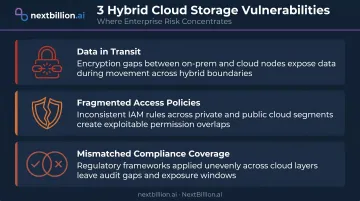
These vulnerabilities are most acute for industries handling regulated or location-sensitive data — logistics, healthcare, financial services, field operations, and government — where on-premises storage for controlled data must coexist with cloud elasticity for variable workloads.
That's exactly the architecture NextBillion.ai's Kubernetes-native on-premise deployment is built for: routing queries, user information, and logs stay behind the customer's firewall, with the platform certified under SOC 2 Type II and ISO/IEC 27001:2013 to satisfy compliance requirements across these environments.
The options below address each layer of that architecture — from encryption in transit to access control and compliance boundary management.
Key Security Features to Look for in Hybrid Storage Solutions
Most hybrid storage breaches trace back to the same root cause: security enforced in one tier but not the other. Four capabilities determine whether a solution holds up across both on-premises and cloud environments. These four capabilities — encryption, immutability, identity and access control, and compliance auditing — map directly to the four types of cloud security controls organizations are expected to maintain, and the most secure cloud storage providers are the ones that enforce all four consistently rather than treating them as separate add-ons.
Encryption Standards
Enterprise hybrid storage must enforce NIST-approved AES-256 encryption at rest and TLS 1.2 or higher in transit (TLS 1.3 preferred where supported). The more important differentiator is key management: solutions offering BYOK (bring your own key) or HSM (hardware security module) integration let you hold encryption keys outside the provider's control — meaning the cloud vendor cannot access your data even if their infrastructure is compromised.
Immutability and Ransomware Protection
Encryption controls who can read your data — but it won't stop ransomware from destroying it. Close to 70% of organizations were still under cyberattack despite improved defenses, according to Veeam's 2025 research, and attackers increasingly target backup repositories rather than production data precisely because that's where recovery depends. Immutable snapshots (WORM policies, locked backup copies) prevent ransomware from encrypting or deleting recovery data. The most resilient implementations enforce immutability at the hardware level, not just through software policy that an admin could modify.
RBAC and Zero-Trust Access
Fragmented identity management — one policy on-premises, another in the cloud — is how lateral movement happens after a credential compromise. Look for:
- Role-based access control (RBAC) enforced uniformly on-prem and in cloud
- Multi-factor authentication on management planes
- Least-privilege principles that prevent lateral movement if credentials are compromised
Compliance Certifications and Audit Trails
Verify certifications at the product level, not just the company. A vendor's company-level SOC 2 report may not cover the specific storage product you're deploying. Immutable audit logs for access and change events are mandatory under most regulated frameworks — HIPAA, SOX, and PCI DSS all require tamper-evident records of who accessed what and when.
Top Secure Storage Options for Hybrid Cloud & On-Premises Deployments
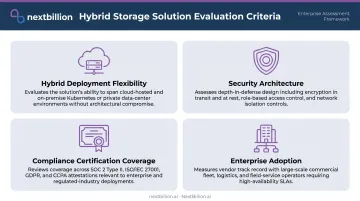
These five solutions were evaluated against four criteria:
- Hybrid deployment flexibility — native support for on-premises and cloud environments
- Security architecture — encryption, immutability, and access control depth
- Compliance certification coverage — verified certifications for regulated industries
- Enterprise adoption — production use in healthcare, finance, and federal environments
NetApp Cloud Volumes ONTAP
NetApp is a storage infrastructure leader with decades of enterprise data management experience. Cloud Volumes ONTAP extends its on-premises ONTAP storage OS to AWS, Azure, and Google Cloud, providing a unified data plane across hybrid environments.
Key differentiator: NetApp's SnapLock immutability creates tamperproof WORM snapshots at the volume level. Combined with NetApp Volume Encryption, external key manager integration via KMIP, and the SnapCenter management console, security teams get consistent policy enforcement across on-prem arrays and cloud volumes from a single interface.
| Category | Details |
|---|---|
| Deployment Options | On-premises ONTAP arrays, AWS, Azure, GCP, and hybrid via Cloud Volumes ONTAP |
| Key Security Features | AES-256 encryption (NVE/NAE), SnapLock WORM, RBAC, multi-admin verification, external key management (KMIP) |
| Compliance Programs | NetApp's trust center lists SOC 2 and ISO 27001 for in-scope services; FedRAMP evidence is specific to Azure NetApp Files — confirm Cloud Volumes ONTAP product-level scope directly with NetApp |
Pure Storage FlashArray with SafeMode
Pure Storage is an all-flash storage vendor known for high-performance NVMe-based arrays — and its SafeMode Snapshots feature has become a benchmark for ransomware-resistant enterprise storage.
Key differentiator: SafeMode enforces an immutable, vendor-managed retention policy on snapshots that cannot be deleted or modified — even by storage administrators. This eliminates insider-threat and credential-compromise risk entirely. Pure1 cloud management provides unified visibility across on-prem and cloud-connected arrays.
| Category | Details |
|---|---|
| Deployment Options | On-premises FlashArray, hybrid via Portworx (Kubernetes-native storage), cloud-connected via Pure Cloud Block Store on AWS/Azure |
| Key Security Features | SafeMode immutable snapshots (ineradicable by design), always-on encryption with no performance penalty, RBAC, MFA on Pure1 management plane |
| Compliance Programs | Common Criteria certification and ISO 27001 evidence confirmed for FlashArray; check SOC 2 Type II and HIPAA product scope with Pure's trust center before procurement |
Dell EMC PowerStore
Dell Technologies' PowerStore is a midrange-to-enterprise all-flash array designed for modern hybrid environments. It supports VMware, Kubernetes, and bare-metal workloads across on-premises and cloud infrastructure.
Key differentiator: PowerStore's Cyber Recovery Vault integration creates an isolated, air-gapped copy of critical data with automated integrity scanning. Its REST API-first architecture lets security policies be enforced programmatically, which is critical in hybrid environments where manual configuration creates compliance drift.
| Category | Details |
|---|---|
| Deployment Options | On-premises PowerStore arrays, hybrid integration via Dell's multicloud storage portfolio and cloud services |
| Key Security Features | AES-256 encryption with FIPS 140-2 validated self-encrypting drives, Secure Snapshots, Cyber Recovery Vault (air-gap), RBAC, external key management (KMIP) |
| Compliance Programs | FIPS 140-2 encryption validation confirmed; request product-specific SOC 2, ISO 27001, and HIPAA documentation from Dell before procurement |
Nutanix Unified Storage
Nutanix is a hyper-converged infrastructure leader whose Unified Storage offering combines block, file, and object storage in a single software-defined platform spanning on-premises clusters and Nutanix Cloud Clusters (NC2) on AWS and Azure.
Key differentiator: Nutanix's WORM bucket policies in Objects prevent anyone — including administrators — from modifying or deleting data while the policy is active. Flow Network Security adds micro-segmentation at the storage network layer, creating software-based firewall boundaries around critical data even within the same cluster.
| Category | Details |
|---|---|
| Deployment Options | On-premises NX/HX clusters, hybrid via Nutanix Cloud Clusters (NC2) on AWS/Azure |
| Key Security Features | FIPS 140-2 data-at-rest encryption, WORM buckets (Objects), RBAC, Flow micro-segmentation, audit logging |
| Compliance Programs | SOC 2 Type II and ISO 27001 confirmed for specific cloud services including NC2; validate HIPAA and PCI DSS coverage at the exact product scope with Nutanix |
Cohesity Data Cloud
Cohesity is a data security and management platform built specifically for hybrid environments. Its Data Cloud unifies backup, archival, file services, and object storage into a single scale-out platform spanning on-premises hardware and major cloud providers.
Key differentiator: Cohesity's DataHawk module performs ML-based anomaly detection on stored data to identify ransomware indicators before exfiltration occurs. FortKnox provides a Cohesity-managed, air-gapped cloud vault as a defense-in-depth layer. For federal and regulated workloads, the FedRAMP Moderate authorization at the product level (FR2306445868) is independently verifiable — a level of specificity most vendors don't publish upfront.
| Category | Details |
|---|---|
| Deployment Options | On-premises (Cohesity appliances or software-defined), hybrid via SmartFiles and CloudArchive to AWS, Azure, GCP, and S3-compatible targets |
| Key Security Features | AES-256 encryption, DataLock immutable snapshots (WORM), DataHawk AI threat detection, FortKnox air-gap vault, RBAC with MFA |
| Compliance Programs | SOC 2 Type II confirmed for Cohesity Helios SaaS; FedRAMP Authorized at Moderate level for Cohesity Cloud Services for Government (FR2306445868) — confirm scope for specific deployment configurations |
How We Chose the Best Secure Storage Solutions
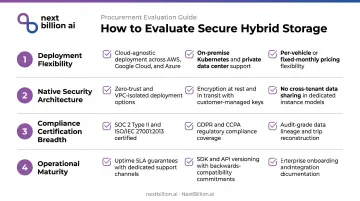
Solutions were assessed across four dimensions:
- Deployment flexibility — genuine on-premises plus cloud hybrid support, not cloud-only with a gateway
- Native security architecture — encryption key ownership, immutability at hardware vs. software level, access control granularity
- Compliance certification breadth — SOC 2 Type II and ISO 27001 as enterprise baselines, with FIPS 140-2, HIPAA, PCI DSS, and FedRAMP as supplemental requirements by industry
- Operational maturity — enterprise support SLAs, integration ecosystems, and documented incident response posture
Enterprises often select storage based on familiarity with a primary cloud provider rather than evaluating whether the solution enforces consistent security across both tiers. A platform that's locked down in the cloud but leaves on-premises controls to the customer creates a compliance gap that auditors will find — and attackers will exploit first.
The safest procurement approach is controls-based. Before shortlisting any vendor, require evidence of:
- AES-256 encryption and TLS 1.2+ in transit
- BYOK or HSM key management
- Immutable/WORM retention and isolated recovery capability
- Explicit hybrid deployment support
Then require the vendor's current SOC 2 Type II report, ISO certificate scope, HIPAA BAA, and FedRAMP Marketplace listing where applicable — verified at the product level, not just the company level.
Conclusion
Choosing secure storage for a hybrid deployment isn't a one-size-fits-all decision. It depends on where your most sensitive data lives, what compliance frameworks govern your industry, and whether your storage platform enforces uniform security policy across both tiers without requiring manual intervention to close the gap.
That evaluation shouldn't stop at the storage layer. The applications writing data to that storage must meet the same security and deployment standards. For enterprises running location intelligence or route optimization at scale — logistics, healthcare, field service, and government operations where data residency and regulatory compliance shape architecture decisions — a vulnerable platform layer can undermine even the most hardened storage.
NextBillion.ai's Kubernetes-native on-premise deployment keeps all routing queries, user data, and logs behind your firewall. SOC 2 Type II and ISO/IEC 27001:2013 certifications provide independently audited evidence of that control — the kind of documentation your security and compliance teams can actually use.
Frequently Asked Questions
What is the safest cloud-based storage option for hybrid on-premises and cloud deployments?
The right choice depends on workload sensitivity and compliance requirements. For regulated industries, the enterprise baseline is a solution that enforces immutable snapshots, customer-managed encryption keys, and consistent access controls across both environments — NetApp Cloud Volumes ONTAP and Pure Storage with SafeMode both meet that bar. For fleet operators subject to FMCSA hours-of-service or DOT recordkeeping rules, the same principle applies: driver logs and location history should sit behind access controls and encryption regardless of whether they are stored locally or in the cloud, so audit trails remain intact under either deployment model.
What is an example of hybrid cloud storage?
A hybrid storage system combines on-premises infrastructure with cloud storage under a single management layer, letting data move between the two based on cost, performance, or compliance needs. NetApp Cloud Volumes ONTAP is a common example — on-premises ONTAP arrays can be tiered, replicated, or backed up to AWS or Azure, with unified management and consistent encryption across both environments. Microsoft Azure Stack serves the same role for organizations standardized on the Microsoft ecosystem. For fleet and mapping platforms handling location data, this model keeps sensitive dispatch records local while cloud resources handle elastic workloads like route computation.
What are the 4 types of cloud storage?
The four types are block storage (for databases and VMs), file storage (for shared file systems), object storage (for unstructured data like backups and media), and archival/cold storage (for long-term retention at low cost). Hybrid storage solutions like Nutanix Unified Storage and Cohesity Data Cloud often support multiple types within a single platform.
What is the difference between on-premises storage and hybrid cloud storage?
On-premises storage is fully owned and managed within the organization's own facilities with no cloud dependency. Hybrid cloud storage connects those on-premises systems to cloud storage through a management layer, enabling data portability, cloud bursting, and off-site replication — while retaining local control over sensitive or regulated data.
What security certifications should I look for in a hybrid cloud storage solution?
The enterprise baseline is SOC 2 Type II (operational security controls) and ISO/IEC 27001 (information security management). For regulated industries, add HIPAA (healthcare), PCI DSS (payment data), and FIPS 140-2 (encryption module validation). FedRAMP is required for U.S. federal workloads — verify authorization status directly on the FedRAMP Marketplace.
How do I decide between on-premises and hybrid cloud storage for my enterprise?
Weigh four factors: data sensitivity (regulated or PII-heavy data typically stays on-premises), workload variability (elastic workloads benefit from cloud bursting), compliance jurisdiction (data residency laws may mandate local storage), and total cost of ownership. On-premises carries higher upfront costs but lower per-TB costs for stable, predictable workloads.
What are the four types of cloud security relevant to hybrid deployments?
The four common categories are identity and access management (controlling who can reach data and systems), data encryption (protecting data at rest and in transit), network security (firewalls, segmentation, and VPNs between on-premises and cloud environments), and monitoring/logging (detecting anomalies and supporting audit trails). In a hybrid deployment, each layer must be consistent across both environments, otherwise the weaker side becomes the point of exposure for regulated data like driver or shipment records.