Introduction
Fleet conditions at 6 AM rarely match what you're dealing with by noon. New orders arrive, a driver calls out, traffic backs up on your best corridor, and suddenly the plan you built the night before is working against you.
Dynamic vehicle routing and dispatching solves this by combining real-time data with algorithmic decision-making, continuously adjusting routes and driver assignments as conditions change rather than locking in a plan before the day begins. For US fleets, this also means accounting for operational constraints unique to domestic trucking and delivery operations — hours-of-service limits, state-level weight and access restrictions, and service commitments tied to specific delivery windows.
This guide is written for fleet managers, dispatch operators, logistics planners, and transportation technology buyers who need to understand how it actually works in practice. We'll cover what dynamic routing is, how it differs from static planning, the end-to-end process, where it's applied, and what separates systems that perform from those that don't.
Key Takeaways
- Dynamic routing continuously recalculates and reassigns routes mid-operation based on live inputs — unlike static routing, which is fixed before the shift starts
- Dispatching in a dynamic system is algorithmic, not manual — the system assigns jobs to the best-fit vehicle in real time
- Core inputs driving the system: live vehicle telemetry, incoming order signals, and real-time road conditions
- Key outcomes: lower cost per delivery, higher on-time rates, and demand spike absorption without rebuilding routes from scratch
- Not all routing software supports true dynamic re-optimization; solver speed and constraint handling separate capable platforms from the rest
What Is Dynamic Vehicle Routing and Dispatching?
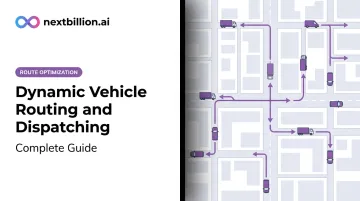
Dynamic vehicle routing (DVR) is a variant of the Vehicle Routing Problem (VRP) in which routes are not fixed at the start of a shift. Instead, they're updated continuously as new information arrives — new customer requests, cancellations, vehicle breakdowns, real-time traffic changes.
The academic definition, established by Pillac et al. in their widely cited VRP taxonomy, draws a clear line: static deterministic VRP assumes all inputs are known before execution begins. Dynamic routing means information evolves while routes are being executed — and the system responds accordingly.
Dispatching is the decision layer sitting on top of routing. While routing determines the optimal sequence of stops, dispatching decides which vehicle or driver gets which job — and when. In dynamic environments, both decisions get made and revised repeatedly throughout the day. For US carriers, dispatching decisions also need to stay compliant with driver hours-of-service limits and any applicable CDL or load-specific restrictions, since a reassignment that looks optimal on paper can put a driver out of compliance if those constraints aren't checked in real time.
How It Differs from Static Routing and Traffic Rerouting
These three things are often confused:
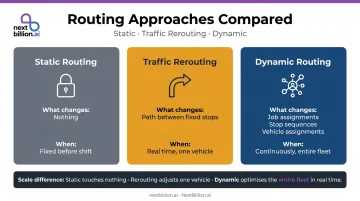
| Approach | What Changes | When It Changes |
|---|---|---|
| Static routing | Nothing | Routes are fixed before the shift |
| Traffic rerouting | Path between two fixed stops | In real time, but only for one vehicle |
| Dynamic routing | Job assignments, stop sequences, vehicle assignments | Continuously, across the entire fleet |
GPS navigation apps already handle traffic rerouting for a single vehicle. Dynamic vehicle routing is a fleet-level operation — it changes which driver goes to which stop, in what order, and sometimes reassigns jobs between vehicles entirely. That distinction matters: getting the path right for one truck is a navigation problem; getting the right truck to the right job across a fleet of 50 is an optimization problem.
Why Dynamic Routing and Dispatching Matters for Fleet Operations
The core problem is simple: real-world logistics doesn't stay still. Orders arrive throughout the day. Drivers run late. Roads close. Customers reschedule. A plan built at 5 AM doesn't account for any of this. In the US, that volatility is compounded by highway congestion patterns, regional weather disruptions, and driver availability limits set by federal hours-of-service rules — all of which can invalidate a static plan within the first few hours of a shift.
The cost of that gap is measurable. Loqate's 2021 failed-delivery research, based on 304 retail executives and 3,040 consumers, found that 8% of US first-attempt deliveries fail, at an average cost of $17.20 per failed delivery. 68% of e-commerce businesses reported failed or late deliveries as a significant cost driver.
What Static Planning Can't Handle
Those costs trace back to specific operational failures. Without dynamic routing, dispatchers face a set of problems that compound quickly:
- Manual re-sequencing — routes get rebuilt in spreadsheets when conditions change, slow and error-prone at scale
- Drivers receive instructions that no longer reflect current conditions by the time they're en route
- Wasted miles — vehicles cover unnecessary distance because the plan hasn't adjusted to reality
- Unreliable ETAs — customer-facing delivery windows become guesses rather than commitments
Where This Has Become the Baseline
Dynamic routing has shifted from a competitive differentiator to an operational expectation in industries including:
- Last-mile e-commerce and grocery delivery
- On-demand food delivery
- Non-Emergency Medical Transportation (NEMT)
- Field service management
- Ride-hailing
For these operations, the ability to absorb demand spikes, cover mid-shift driver absences, and hold service-level commitments across a moving fleet is simply what the work requires.
How Dynamic Vehicle Routing and Dispatching Works
The system continuously ingests real-time signals, runs a re-optimization algorithm against current constraints and fleet state, and pushes updated assignments to drivers — repeating this cycle throughout the operational window.
Three categories of inputs feed this process:
- Live vehicle data — GPS position, current stop progress, driver availability, hours of service
- Live demand data — new order arrivals, cancellations, priority escalations
- Road environment data — traffic conditions, road closures, time windows, access restrictions
Step 1: Event Detection and Trigger
The system monitors a continuous stream of inputs and identifies trigger events — moments when a route or assignment needs to be reconsidered.
Common triggers include:
- A new job booked within a vehicle's service zone
- A delivery running significantly behind its time window
- A driver reporting unavailability mid-shift
- A high-traffic corridor becoming impassable
Not every event triggers a full re-optimization. Well-designed systems apply rules to determine when an incremental update suffices versus when broader reconfiguration is needed. Unnecessary re-optimization creates driver churn and plan instability, so that distinction has real operational consequences.
Step 2: Constraint-Aware Re-Optimization
Once a trigger fires, the routing engine re-solves the assignment and sequencing problem against a current snapshot of the fleet. Constraint handling is where most systems either hold up or break down.
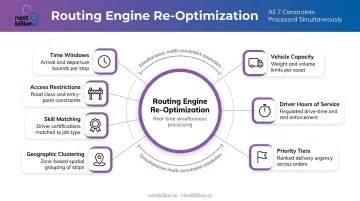
A production routing engine needs to factor in simultaneously:
- Time windows — delivery or appointment commitments
- Vehicle capacity — load weight, volume, compartment configurations
- Driver hours of service — shift limits, break requirements, tracked against FMCSA hours-of-service rules for US-based fleets
- Priority tiers — urgent orders versus standard
- Geographic clustering — keeping routes spatially efficient
- Skill matching — assigning tasks only to qualified drivers or technicians
- Access restrictions — truck dimensions, weight limits, emission zones
The quality of this step depends entirely on the solver's ability to handle multiple simultaneous constraints at low latency. Research published in the European Journal of Operational Research found that some dynamic VRP solvers require over 150 seconds — and up to six minutes — for large-instance re-optimization. A solver that takes several minutes to re-optimize is functionally useless in active dispatching.
Latency requirements push most general-purpose solvers to their limits. NextBillion.ai's Route Optimization API addresses this directly: it handles 50+ hard and soft routing constraints with sub-second response times, supports up to 10,000 stops per optimization run, and uses distance matrix caching to speed up re-optimization when fleet state only partially changes.
Step 3: Dispatch and Driver Notification
The output layer does three things in parallel:
- Updated route plans push to drivers via mobile app, in-vehicle device, or third-party telematics platform
- Dispatchers receive a change summary covering what changed, which vehicles were affected, and why
- Customer-facing ETAs recalculate automatically, without manual intervention
Good systems minimize churn: the number of driver assignments disrupted per re-optimization cycle. Excessive route changes frustrate drivers and reduce compliance. Rather than rebuilding routes from scratch on each trigger, NextBillion.ai inserts new orders into ongoing routes with minimal disruption to the original plan.
For driver notification, the platform supports its own driver app with turn-by-turn navigation and real-time job updates, direct integration with Samsara and Geotab driver apps, and native mobile SDKs for Android, iOS, and Flutter.
Where Dynamic Dispatching Is Applied
Dynamic routing isn't one-size-fits-all. The operational triggers that make it necessary vary by industry, and so does the implementation model.
Industries Where It's Actively Used
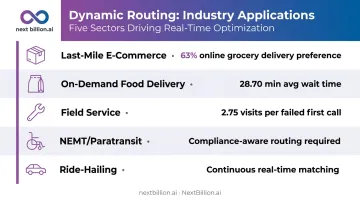
Last-mile e-commerce and grocery delivery — Order volume spikes unpredictably throughout the day. McKinsey found that online grocery delivery preference rose to 63% in late 2021, up from 48% the prior year, while a typical $100 online grocery basket can produce a -$13 margin with manual picking and delivery. Dynamic routing is a direct margin lever in these operations.
On-demand food delivery — Platforms like DoorDash match driver supply to demand in real time. Wait time research across DoorDash, Grubhub, Postmates, and Uber Eats found average consumer wait times of 28.70 minutes — and dispatch efficiency directly drives that number.
Field service management — Technicians handle both scheduled maintenance and emergency calls. A failed first visit typically results in 2.75 total visits (Aquant, 2023), making accurate dispatch assignment a direct cost control.
NEMT and paratransit — Same-day ride requests within strict compliance windows. The GAO has documented that Medicaid NEMT programs require GPS data, trip logs, and eligibility verification — making compliance-aware routing mandatory.
Ride-hailing — Continuous driver-to-passenger matching based on proximity and availability.
For NEMT specifically, NextBillion.ai's Route Optimization API handles multi-dimensional capacity constraints, accessibility attribute tagging (wheelchair lifts, stretcher tie-downs), and automated vehicle-to-patient matching based on medical and mobility requirements.
Autonomous vs. Human-Confirmed Dispatch
Not all dynamic dispatching runs without human oversight:
- Fully autonomous — Food delivery and ride-hailing platforms push assignments directly to drivers without dispatcher review
- Human-confirmed — Field service and NEMT operations often route algorithmic suggestions through a dispatcher before pushing to drivers, reflecting regulatory context and operational culture
Both are valid. The right model depends on the stakes of a wrong assignment and the speed at which decisions need to be made.
Key Factors That Affect Dynamic Routing Performance
Data Quality and Latency
The algorithm is only as good as the data feeding it. GTFS Realtime best practices specify that vehicle position feeds should refresh at least every 30 seconds, and trip data should not be older than 90 seconds. Real-world transit system research found average GTFS Realtime message latency of 13 seconds — meaning stale data is already in the system before optimization even begins.
Dynamic routing requires real-time integration between the routing engine and telematics systems — no workaround substitutes for live data flow. NextBillion.ai integrates directly with Samsara and Geotab, enabling bidirectional data exchange: pulling live vehicle positions and pushing optimized routes back to driver apps without manual CSV exports.
Constraint Complexity vs. Solver Speed
More constraints mean more computational load. The constraints that make a route plan operationally valid — time windows, vehicle dimensions, driver hours, load types — are also what slow down re-optimization. That tension is unavoidable; the question is how well a given engine manages it.
This is a meaningful differentiator between routing engines. Some systems become too slow under complex constraint sets to support mid-shift re-optimization at all. Buyers should request response time evidence tested against their own fleet size, stop count, and constraint mix — not vendor-selected benchmarks.
Fleet Size and Geographic Density
Dynamic routing scales differently across fleet sizes:
- Small, concentrated fleets — Re-optimization cycles are fast and disruption is minimal
- Large, dispersed fleets — Zone-based partitioning strategies reduce computational load without sacrificing responsiveness
NextBillion.ai addresses large-scale fleet segmentation through its Clustering API, which groups orders by depot catchment before routing runs — enabling parallel optimization within each zone and delivering more balanced workload distribution across drivers at network scale.
Trigger Frequency and Plan Stability
A system that re-optimizes too aggressively creates constant driver reassignments, confusion, and reduced adherence. Effective dynamic dispatch systems apply dampening logic — thresholds that determine when a new event warrants a plan change versus when absorbing the deviation is preferable.
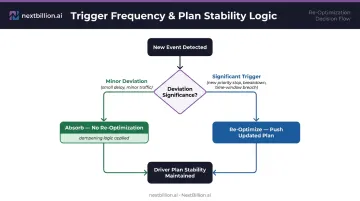
The practical target is optimization triggered by meaningful deviations — a new high-priority stop, a vehicle breakdown, or a time-window breach — not every minor delay or traffic fluctuation.
Common Misconceptions About Dynamic Vehicle Routing
"Dynamic routing just means real-time traffic rerouting." Traffic rerouting changes the path between two fixed stops for one vehicle. Dynamic vehicle routing changes which driver goes to which stop, in what order, and sometimes reassigns jobs across the entire fleet. These are different operations at entirely different scales.
"Any route optimization software can handle dynamic routing." Many route optimization tools are designed for batch planning — they produce a plan once before the day begins and can't efficiently re-solve mid-operation. Teams that expect batch-planning tools to behave dynamically typically run into problems:
- Slow response times when conditions change mid-route
- Failed re-optimizations that leave dispatchers without options
- Locked routes that treat new orders as overflow rather than assignments
Buyers should require proof of in-route re-optimization capability, not just pre-shift planning.
"More frequent re-optimization always produces better outcomes." Excessive re-optimization introduces driver churn, reduces plan predictability, and can create compounding instability — especially in time-window-sensitive operations. There are also cases where static routing is the better answer: predictable, high-volume fixed routes like scheduled postal delivery or recurring service visits, where stability is more valuable than real-time flexibility.
Frequently Asked Questions
What is the difference between dynamic and static vehicle routing?
Static routing generates a fixed plan before operations begin and doesn't change mid-shift. Dynamic routing continuously updates routes and assignments as new events occur. For dispatchers, the practical difference is that static plans require manual intervention when conditions change, while dynamic systems handle changes algorithmically. Static works for predictable last-mile or school-bus-style routes with fixed stops; dynamic is built for on-demand delivery, field service, and same-day fulfillment where order volume and road conditions shift throughout the shift.
What triggers a route change in dynamic vehicle routing?
Main trigger categories include new order arrivals, cancellations, vehicle breakdowns, driver unavailability, traffic incidents, and time-window violations. Not all triggers result in a full re-optimization — well-designed systems determine whether an incremental update is sufficient before running a full re-solve.
How does dynamic dispatching reduce delivery costs?
It reduces empty miles, prevents failed deliveries from poor sequencing, improves vehicle utilization, and reduces the dispatcher labor required to manually re-plan when conditions change. The $17.20 average cost per failed US delivery illustrates what's recovered when routing adapts rather than breaks down.
What data does a dynamic vehicle routing system need to function?
Three input categories are required:
- Real-time vehicle telemetry: GPS position, status, driver availability
- Live demand signals: orders, cancellations, priorities
- Road environment data: traffic conditions, closures, speed data
All three need to be current — stale data degrades re-optimization quality directly.
Can dynamic vehicle routing work for small fleets?
Yes — dynamic routing works for small fleets and is often simpler to implement at that scale. The ROI case is strongest for fleets handling unpredictable demand volumes, same-day delivery, or field service calls that come in throughout the day. Small fleets with predictable, recurring routes — like fixed daily delivery loops — may not see enough variability to justify the added system complexity, and static routing may serve them just as well.
How is dynamic dispatching different from automated dispatching?
Automated dispatching removes human intervention from the assignment decision. Dynamic dispatching refers to the frequency and responsiveness of re-optimization — how quickly the system responds to changing conditions. The two often overlap, but a system can be automated without being dynamic, and dynamic without being fully automated — they're not the same thing.
Should I enable dynamic routing?
Enable it if your operation deals with unpredictable order volume, tight delivery windows, variable traffic, or frequent last-minute changes — same-day delivery, field service, or on-demand fleets are typical fits. Skip it if your routes are fixed and repeatable, like a milk-run schedule with consistent stops and low variability. In that case, a static plan is simpler to manage and dynamic re-optimization adds cost without a matching benefit.
What is a VRP problem?
VRP stands for Vehicle Routing Problem — the classic optimization challenge of determining the most efficient set of routes for a fleet of vehicles serving a set of stops, subject to constraints like vehicle capacity, time windows, and driver hours-of-service limits. Dynamic vehicle routing is essentially a VRP that gets re-solved continuously as conditions change, rather than solved once before dispatch.