Introduction
Most fleet operations run on a patchwork of tools. Drivers toggle between a navigation app, a separate ELD, a dispatch text thread, and a paper inspection form — while dispatchers manually assign jobs and managers stare at a GPS screen that shows location but not context.
This fragmentation is expensive. According to Samsara's State of Connected Operations, 70% of physical operations leaders say siloed data decreases efficiency, and 94% called breaking down data silos critical to survival.
The fleet management software market is responding fast. Fortune Business Insights projects the market will grow from $27.55B in 2024 to $116.56B by 2032 — a 19.8% CAGR — driven by demand for workflow automation, compliance tooling, and AI-powered dispatch.
This guide breaks down five platforms — Samsara, Geotab, Verizon Connect, Teletrac Navman TN360, and NextBillion.ai — so you can identify which one actually eliminates the workflow gaps costing your operation time and money. For US private fleets, the stakes are higher than convenience: FMCSA hours-of-service rules, IFTA fuel tax reporting, and DOT inspection requirements all depend on accurate, timely driver data, and a platform that automates those workflows reduces both audit exposure and the administrative load on dispatch.
Key Takeaways
- Fleet management software for driver workflow automation unifies dispatching, route planning, compliance, and tracking in one place
- The best platforms combine a strong driver mobile app, deep TMS/ELD integrations, and AI-powered route optimization
- Top platforms covered: Samsara, Geotab, Verizon Connect, Teletrac Navman TN360, and NextBillion.ai
- Pricing ranges from $5 to over $42 per vehicle/month — model type (per-vehicle, per-order, fixed monthly) matters as much as the number
- Start automation with the highest-friction tasks: job assignment, HOS logging, and driver-dispatch communication
What Is Driver Workflow Automation in Fleet Management?
Driver workflow automation is the digitization of sequential, task-based processes: dispatching, navigation, stop check-ins, compliance logging, and end-of-shift reporting. Each step triggers automatically based on time, location, or event — no manual intervention required.
GPS tracking shows you where a driver is. Workflow automation goes further: it tells the driver what to do next, logs what happened, alerts the right people when something goes wrong, and updates the back office without a phone call.
Consider what a fully automated driver shift looks like:
- Driver opens the app — shift begins, HOS clock starts automatically
- Dispatch assigns jobs based on location, capacity, and priority
- Navigation routes around restrictions; re-routes on traffic
- Geofence triggers a customer arrival notification
- Digital inspection and proof of delivery completed at the stop
- End-of-shift report generates without manual entry
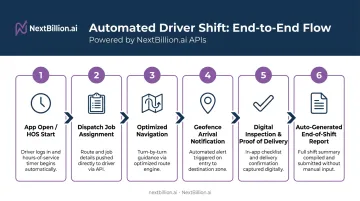
Without automation, most of those steps require a manual action — a phone call, a text, a form filled out by hand. That friction adds up fast: missed updates, billing delays, and compliance gaps that compound across a full fleet. For private fleets operating under FMCSA hours-of-service rules, manual HOS logging is also where violations tend to originate — a missed log entry or late edit can trigger a roadside inspection finding even when the driver's actual hours were compliant.
Best Fleet Management Software for Driver Workflow Automation
The tools below were evaluated on workflow automation depth, mobile driver app quality, integration ecosystem, configurability, and real-world applicability across logistics, field service, and last-mile delivery.
Samsara
Samsara is a cloud-native connected operations platform used by mid-to-large fleets across trucking, logistics, and field services. It combines telematics, AI video safety, and a driver-facing mobile app into one system.
Workflow automation strengths:
- Real-time dispatch board with instant status updates
- Automated HOS/ELD compliance — drivers log hours without manual entry
- AI dashcam-triggered coaching alerts surface in-cab, not just in reports
- Digital DVIRs completed from the driver app
- Route ETAs and job details in a single driver interface
The driver app is consistently cited as one of the most complete in the market, surfacing tasks, navigation, compliance, and coaching from one screen.
| Category | Details |
|---|---|
| Best For | Mid-to-large trucking and logistics fleets prioritizing safety automation alongside operational workflows |
| Key Features | Real-time dispatch, automated HOS logging, AI dashcam integration, DVIR, in-cab coaching, route ETAs |
| Pricing | Starting at ~$27/vehicle/month (billed annually, per Capterra); free trial available |
| Review Score | 4.5/5 from 1,004 Capterra reviews |
Geotab (MyGeotab + UNIFY)
Geotab serves over 100,000 customers globally. Its open platform (MyGeotab) and the UNIFY driver workflow app — built with Eleos — consolidate TMS, ELD, navigation, and task management into a single driver-facing tablet interface.
Where Geotab stands out: its open SDK lets fleet teams build custom driver workflow Add-Ins, connecting payroll systems like ADP, third-party TMS platforms, and specialized routing tools. Driver dashboard profiles can be tailored for long-haul vs. short-haul vs. new drivers, a level of role-based configurability that directly reduces driver cognitive load.
| Category | Details |
|---|---|
| Best For | Large or enterprise fleets needing highly configurable, open-platform driver workflows |
| Key Features | Customizable driver dashboard profiles, TMS/ELD integration, truck-safe navigation, HOS tracking, one-touch forms, open Add-In marketplace |
| Pricing | Four tiers: Base, Regulatory, Pro, ProPlus — contact vendor for pricing |
| Review Score | 4.4/5 from 98 Capterra reviews |
Verizon Connect
Verizon Connect targets enterprise-grade fleet operations with strong compliance depth — ELD, HOS, IFTA, and DVIR automation are its core workflow strengths. Its Reveal platform connects field workers to dispatch through a mobile app and automates job status updates via geofencing.
Where it fits: fleets where regulatory compliance is as operationally critical as throughput. Geofence-triggered alerts, automated IFTA mileage tracking, and structured dispatch scheduling reduce the manual burden on both drivers and compliance managers. This makes it a common fit for US private fleets running interstate routes, where IFTA quarterly filings and DOT-mandated ELD records need to be defensible without a dispatcher manually reconciling mileage logs.
| Category | Details |
|---|---|
| Best For | Enterprise trucking and logistics fleets with heavy compliance and regulatory reporting requirements |
| Key Features | Automated job dispatching, geofence-triggered status updates, ELD/HOS compliance, IFTA reporting, route optimization, driver-to-dispatcher messaging |
| Pricing | Quote-based; no published per-vehicle price |
| Review Score | 3.2/5 from 943 Capterra reviews |
Teletrac Navman TN360
TN360 is built for fleets that run both vehicles and equipment — construction, field services, and public sector operations where paper-based workflows are still common. Its workflow automation focus is structured digitization: replacing clipboards and run sheets with mobile-first tools.
Standout capability: TN360's SmartJobs feature delivers digital daily run sheets to drivers, while the Inspections App handles pre-trip and post-trip DVIRs from any mobile device — with data sent instantly to the back office. Multi-fuel monitoring covers conventional, CNG, EV, and hydrogen assets.
| Category | Details |
|---|---|
| Best For | Mixed fleets (vehicles + equipment) in construction, field services, or public sector |
| Key Features | Digital DVIRs, SmartJobs run sheets, automated compliance reporting, fuel monitoring, real-time job status updates |
| Pricing | Quote-based via TN360; Capterra lists DIRECTOR at $25/user/month (separate product) |
| Review Score | 3.6/5 on G2 from 25 reviews |
NextBillion.ai
NextBillion.ai is an AI-powered route optimization and location intelligence platform — now part of Velocitor Solutions — serving logistics, last-mile delivery, field service, and NEMT fleets. It integrates directly with Samsara, Geotab, and Motive to power driver workflow automation at the routing and dispatch layer.
Unlike general-purpose fleet platforms, NextBillion.ai specializes in the optimization engine that drives workflow automation. Its Route Optimization API handles 50+ hard and soft constraints — time windows, vehicle capacity, HOS compliance, hazmat routing, multi-depot dispatch, and skill matching.
The API processes up to 10,000 stops while generating dispatch-ready routes, making it suited for high-volume operations where standard tools hit their ceiling.
What sets it apart for operations teams:
- Processes a 5,000×5,000 distance matrix (25 million location pairs per request) vs. the 25×25 limit from standard providers
- Per-vehicle or per-order pricing — not per-API-call, so demand spikes don't create budget surprises
- Bidirectional sync with Samsara, Geotab, and Motive pulls vehicle and order data, then pushes optimized routes back automatically
- $11M+ in documented cost savings across 10.9M+ deliveries optimized for 150+ businesses
Real-world results include a health-tech firm achieving 25% cost savings and 35% more visits per rider, Xplor Technologies managing 30,000+ field technicians with automated job allocation, and Ride Care (NEMT) scaling operations without compromising patient care quality.
For teams building logistics platforms or embedding routing into existing fleet software, NextBillion.ai's API-first deployment lets developers go from trial key to production in about a week, with dedicated solutions engineers supporting integration at no cost during evaluation.
| Category | Details |
|---|---|
| Best For | Logistics platforms, last-mile delivery operations, field service fleets, and NEMT providers needing customizable, cost-predictable route optimization |
| Key Features | AI route optimization with 50+ constraints, truck-compliant routing, real-time re-routing, GPS tracking integration, field task scheduling, Samsara/Geotab/Motive compatibility |
| Pricing | Per-vehicle or per-order pricing; fixed monthly models available — no per-API-call billing |
| Review Score | 4.6/5 on G2 |
How We Chose the Best Fleet Management Software for Driver Workflow Automation
The Evaluation Framework
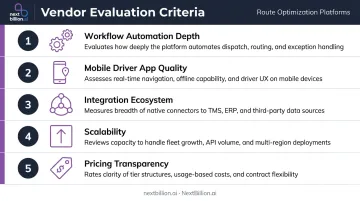
Tools were assessed on five dimensions:
- Workflow automation depth — how much manual intervention is actually eliminated
- Mobile driver app quality — UX, offline capability, task clarity, and how well it works in low-signal areas common on US rural and interstate routesty, single-screen access
- Integration ecosystem — TMS, ELD, payroll, telematics connectivity
- Scalability — performance across fleet sizes and operational complexity
- Pricing transparency — predictable costs vs. opaque quote-only models
The most common buyer mistake: selecting based on GPS tracking capability without testing the driver-facing workflow experience. Verizon Connect's 2025 Fleet Technology Trends Report found 69% of fleets use GPS tracking, but field service and workforce management tools are used by only 43% of medium fleets — a gap that shows how many operations still rely on manual processes for the actual work.
These criteria point to a clear implication: knowing what a platform tracks is only half the picture. The other half is how well it shapes what drivers actually do on the ground.
What to Prioritize
The highest-friction steps in driver workflow — the ones that consume the most time and create the most errors — are:
- Job assignment and re-assignment during shift
- HOS logging and break compliance
- Pre-trip and post-trip inspections
- Proof of delivery and task completion confirmation
- Driver-to-dispatch communication on delays or issues
The right platform depends on whether the primary need is compliance automation (Samsara, Verizon Connect), configurable enterprise workflows (Geotab), structured digitization for mixed assets (TN360), or optimization-layer intelligence for routing and dispatch (NextBillion.ai).
Integration depth is non-negotiable. A fleet tool that can't connect to your existing TMS, ELD, or route optimization engine doesn't reduce data silos — it adds new ones on top of the old ones.
Conclusion
No single platform is the right answer for every fleet. Samsara and Geotab lead for large, compliance-heavy operations that need all-in-one depth. Teletrac Navman suits mixed-asset fleets replacing paper workflows. Verizon Connect fits enterprise trucking with regulatory complexity. NextBillion.ai is the right layer when route optimization and dispatch intelligence are the core gap — particularly for teams building or scaling logistics platforms.
Before committing to any platform, run these three checks:
- Test the driver mobile app directly with your own drivers before signing
- Stress-test integrations against your actual TMS or ELD setup
- Evaluate pricing against projected fleet growth — per-API-call costs scale unpredictably, while per-vehicle or fixed-monthly models stay manageable
If route optimization and driver task automation are the gaps holding your fleet back, NextBillion.ai offers a free 14-day trial with solutions engineers supporting integration throughout.
Frequently Asked Questions
What is the best workflow automation platform?
The best platform depends on use case. Samsara and Geotab are strong all-in-one options for fleets needing compliance, safety, and dispatch automation in one system. For route-driven workflow automation (last-mile delivery, field service, or NEMT specifically), NextBillion.ai offers specialized optimization capabilities with predictable pricing. Evaluate against your actual bottleneck first: dispatcher time spent on manual routing, driver idle time between stops, or compliance paperwork, since each platform solves a different one of these.
What is the best fleet management software?
Top contenders are Samsara, Geotab, and Verizon Connect, each suited to different priorities. Samsara leads on driver app quality and AI safety features; Geotab on configurability; Verizon Connect on compliance depth. Fleet size, industry, and whether the priority is safety, compliance, or operational automation should drive the decision.
How much does fleet management software cost?
According to Capterra's fleet management pricing report, pricing ranges from $5 to over $42 per vehicle per month. Pricing models vary — per-vehicle subscription, per-API-call, or fixed monthly — with fixed monthly models more predictable for growing fleets. Verizon Connect and TN360 require custom quotes.
What is a fleet management dashboard?
A fleet management dashboard is the centralized interface where managers monitor vehicle locations, driver status, job progress, compliance alerts, and fleet KPIs in real time. Driver-facing dashboards differ from manager views — they surface individual tasks, active routes, and HOS status relevant to that driver's shift. For private fleets, the dashboard should also flag deviations from planned routes so dispatchers can intervene before a missed delivery window turns into a customer complaint.
How do you monitor fleet fuel consumption?
Fuel monitoring pulls telematics data (engine hours, idle time, trip mileage) through fleet management software. Automated alerts flag excessive idling, route deviation, or fuel card anomalies. Verizon Connect's 2025 report found GPS fleet tracking now delivers an average 16% fuel cost reduction, up from 8% in 2021. Route optimization compounds these savings by cutting total miles driven and reducing backtracking, which lowers fuel spend independent of any driver behavior changes.
How do you track expenses for a trucking company?
Fleet management software automates the highest-volume expense categories:
- IFTA mileage logging by state
- Fuel card integration
- Per-vehicle maintenance cost tracking
- Driver time card automation
These eliminate manual accounting errors and give operations managers accurate cost-per-route visibility without spreadsheet reconciliation.
What are the 5 pillars of fleet management?
Most fleet management programs are built around five areas: vehicle tracking and telematics, driver safety and compliance (including hours-of-service and DOT requirements), maintenance scheduling, fuel and cost management, and route or dispatch optimization. Private fleets automating driver workflows typically start with the last pillar, since routing and dispatch inefficiencies are often the most visible source of wasted driver hours and missed service windows.
What are the top 5 fleet management software?
Commonly cited options include Samsara, Geotab, Verizon Connect, Motive, and Fleetio, each with different strengths across telematics, compliance, and maintenance tracking. None of these are purpose-built for route and dispatch optimization at the core. Private fleets whose main pain point is driver routing and workflow automation, rather than vehicle diagnostics or compliance logging, often pair one of these platforms with a dedicated routing engine like NextBillion.ai.