Introduction
The benefits of a centralized platform for NEMT dispatch teams come down to one thing: replacing a fragmented stack of tools with a single system where scheduling, GPS tracking, driver communication, and billing all run off the same live data. Most NEMT dispatchers start their shift with the same stack: a spreadsheet open on one monitor, a phone in one hand, and a separate GPS tool running somewhere in the background. Trip assignments get texted to drivers, status updates come back via call, and billing gets reconciled at the end of the day from whatever notes survived.
That workflow has a real cost. Colorado's 2021 Medicaid NEMT audit found that 26% of completed trips were untimely, with over 11,000 trips marked no-show because providers couldn't locate the patient — often due to inaccurate pickup information or communication failures. That's not a technology problem. It's a coordination problem.
The operational lever that actually moves outcomes is centralization: scheduling, routing, GPS tracking, driver communication, and compliance documentation in one system where every stakeholder works from the same live data.
This article covers the practical, measurable advantages centralized dispatch platforms deliver for NEMT teams day-to-day.
Key Takeaways
- Centralized dispatch consolidates trip scheduling, GPS tracking, driver communication, and billing into one system of record
- Real-time visibility lets dispatchers intervene before problems escalate, not after patients are already waiting
- Route optimization reduces operating costs and enables more trips per shift without adding vehicles
- Automated trip documentation directly reduces Medicaid claim noncompliance and audit exposure
- Manual, fragmented dispatch creates a growth ceiling that coordination capacity cannot keep pace with as trip volume increases
What Is a Centralized Dispatch Platform?
A centralized dispatch platform manages the full NEMT trip lifecycle — from initial trip intake and scheduling through driver assignment, real-time monitoring, and post-trip billing — in one system, without requiring dispatchers to toggle between separate tools. This is the core distinction teams researching the best dispatch software for NEMT or transportation business should look for: whether scheduling, tracking, communication, and billing genuinely share one data layer, or whether they are separate modules bolted together under one login.
For most NEMT teams, it replaces a fragmented stack:
- Spreadsheets for scheduling
- Phone calls for driver coordination
- A standalone GPS tool for vehicle location
- Manual billing workflows handled after the fact
Each of those tools works in isolation. None of them share data automatically.
The operational value of centralization comes from every stakeholder working off the same live data. A dispatcher who sees a trip delay can push updated instructions to the driver instantly. Billing gets the GPS data and timestamps it needs the moment a trip closes out.
When an auditor asks for documentation, there's one record to pull — not three systems to reconcile. That's what makes the operational difference tangible: fewer handoffs, fewer gaps, less time spent chasing information across tools.
Key Advantages of Centralized Dispatch Platforms for NEMT Teams
The advantages below focus on outcomes NEMT providers actually track: on-time performance, cost per trip, billing accuracy, compliance posture, and staff productivity.
Advantage 1: Real-Time Trip Visibility and Coordinated Operations
Fragmented dispatch means dispatchers are constantly reconstructing what's happening — calling drivers for updates, cross-referencing texts with the schedule, finding out about a missed pickup only after the patient calls. Centralization replaces that reactive loop with a live operational dashboard.
Trip assignments, driver locations, ETAs, and status updates all flow through one system. When something changes, dispatchers see it immediately and can act — not after the fact. This shared visibility is one of the clearest, most measurable benefits of a centralized platform for NEMT dispatch teams, since it removes the delay between something going wrong and the dispatcher finding out about it.
Why this matters in practice:
- A delayed driver can be rerouted before the patient has been waiting 20 minutes
- A vehicle breakdown triggers immediate trip reassignment without a chain of phone calls
- A patient receives an updated ETA before they're left standing outside
Colorado's audit data makes the stakes concrete: 11,008 no-shows tied directly to providers being unable to locate patients due to communication failures. Real-time visibility addresses that failure mode directly.
In NEMT, a missed or late trip means a patient misses dialysis or a chemotherapy appointment. That's the cost of operating without it.
KPIs this influences:
- On-time trip completion rate
- Patient no-show rate
- Dispatcher-to-driver communication time
- Trip reassignment speed
When this matters most: Operations managing 50+ trips per day, geographically spread fleets, and peak demand periods where manual coordination breaks down fastest.
Advantage 2: Route Optimization and Operational Cost Reduction
NEMT routing isn't a shortest-path problem. Vehicle type, driver certifications, appointment windows, and patient needs all have to align — for every trip, simultaneously. Manually reconciling those constraints creates dispatcher bottlenecks that worsen as volume grows.
With centralized dispatch, the routing engine handles it automatically, because all of those variables exist in the same system.
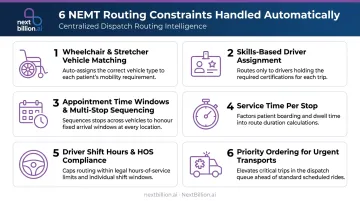
NextBillion.ai's route optimization engine supports 50+ hard and soft constraints specifically relevant to NEMT operations, including:
- Wheelchair-accessible and stretcher vehicle matching
- Skills-based driver assignment (certifications, medical transport credentials)
- Patient appointment time windows with multi-stop sequencing
- Service time per stop for patient boarding and equipment securing
- Driver shift hours, break requirements, and HOS compliance
- Priority ordering for urgent medical transports
Without that kind of constraint handling, dispatchers manually verify every vehicle-patient-driver match — manageable at 30 trips a day, untenable at 150.
What the evidence shows:
A 2023 USDOT ITS study of continuous dynamic optimization in ADA paratransit found that across 11 transit agencies, productivity improved 8% to 31%, average operating costs fell 13%, and 27% of agencies reported lower dispatcher and scheduler labor costs. These are paratransit-adjacent results, not guaranteed NEMT outcomes.
In documented NEMT deployments, NextBillion.ai's route optimization helped GOIN, an NEMT and paratransit provider, reduce driver idle time by 30% and achieve 95% accurate predictive ETAs. Ride Care, a mental health and substance use transportation provider, cut route planning time from half a night to two hours and scaled from 60 to nearly 200 rides per day.
KPIs this influences:
- Cost per trip
- Fleet utilization rate
- Trips completed per vehicle per day
- Driver overtime hours
When this matters most: Operations with recurring trips (dialysis, oncology, therapy) and mixed vehicle fleets, where Medicaid reimbursement rates make cost-per-trip efficiency critical to financial sustainability.
Advantage 3: Compliance Automation and Billing Accuracy
NEMT providers face two distinct but related risks: HIPAA violations and Medicaid claim noncompliance. Both are expensive. Both are largely preventable with clean documentation.
The problem with manual processes is where errors enter — mileage gets estimated, signatures get forgotten, trip timestamps don't match GPS records. Those gaps are manageable at low volumes. At scale, they become systemic audit exposure.
The documented billing risk:
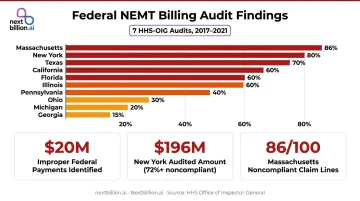
Seven HHS-OIG audits from 2017 to 2021 found 15% to 86% of NEMT claims in 10 states were noncompliant, resulting in approximately $20 million in improper federal payments. In New York alone, auditors estimated over $196 million — more than 72% of the audited amount — did not meet Medicaid requirements. In Massachusetts, 86 of 100 sampled claim lines were noncompliant.
HIPAA penalty exposure is also substantial: current HHS penalty tiers run from $145 per violation up to $2,190,294 per violation for the most serious tier.
How centralization addresses this:
When every trip runs through one system, documentation happens automatically. GPS breadcrumb trails, geofence-triggered pickup and drop-off timestamps, mileage calculations, and driver logs are all captured without manual entry. The data billing needs is already verified when a trip closes.
NextBillion.ai's Route Reconstruction API supports this directly. It converts raw GPS data into road-snapped, audit-defensible trip records built for NEMT proof-of-service reporting. SOC 2 Type II and ISO/IEC 27001 certifications cover the infrastructure HIPAA-compliant data handling requires.
KPIs this influences:
- Claim noncompliance rate
- Billing cycle time
- Audit readiness
- Reimbursement turnaround time
When this matters most: Providers working with Medicaid managed care organizations, multi-state brokers, or PACE programs, where documentation requirements are detailed, payer-specific, and subject to audit.
What Happens When Centralized Dispatch Is Missing
Manual, fragmented dispatch holds together until it doesn't. Once trip volume outpaces what the coordination method can handle, failures compound fast.
Common breakdowns include:
- Missed and overlapping trips from scheduling conflicts that no single tool catches in real time
- Billing delays and claim denials from incomplete trip records, missing signatures, or documentation gaps — patterns linked to $20M in improper payments identified in federal audits
- Compliance exposure that stays hidden in manual records until an auditor finds it
- Reactive management where dispatchers spend the day correcting problems rather than preventing them
- A hard growth ceiling — as trip volume grows, manual coordination breaks down faster, requiring proportional increases in administrative headcount to compensate
Colorado's audit put a dollar figure on this: the state paid $3.5 million to 66 providers that bypassed the required statewide contractor for scheduling and billing. A centralized system tracking provider compliance in real time would have caught those violations before payment — not after.
How to Get the Most Value from a Centralized Dispatch Platform
A centralized platform delivers its full benefit only when it becomes the actual system of record — not a tool used alongside old spreadsheets and phone workflows. Partial adoption means partial results.
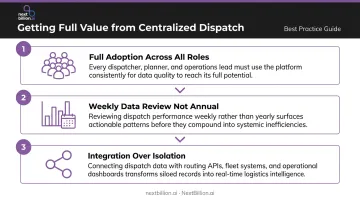
Three practices that compound value over time:
Full adoption across all roles. Dispatchers, drivers, and billing staff all working from the same system is the baseline. If billing is still reconciling trips from handwritten notes, centralization hasn't happened yet.
Weekly data review, not annual. Trip performance reports, on-time rates, cost-per-trip trends, and claim noncompliance patterns should inform operational decisions continuously. The data compounds — each trip captured improves future scheduling, routing, and billing decisions.
Integration over isolation. A platform that connects with existing fleet management systems, telematics, and payer portals closes the data silos that undermine centralization. Route optimization APIs like NextBillion.ai connect with Geotab and Samsara so that optimized routes flow into driver apps without manual re-entry — removing a common source of errors at the handoff point.
For NEMT teams evaluating platforms, integration capability matters as much as features. A system that requires separate tools for GPS visibility, driver communication, and billing hasn't solved the fragmentation problem — it's introduced a new version of it.
Conclusion
Centralized dispatch platforms give NEMT teams something fragmented tools can't: a single operational record that gets more useful over time. Real-time visibility, optimized routing, and compliance automation reinforce each other when they run through one system — each trip generates scheduling, billing, and route data that feeds the next decision.
Centralized dispatch isn't a one-time technology upgrade. The operations that get the most from it treat it as an ongoing practice: reviewing the data regularly, acting on what it shows, and letting the system absorb the coordination work that dispatchers currently handle manually.
Teams still running trips across spreadsheets and phone calls aren't just operating less efficiently — they're accumulating compliance and audit risk with every trip they log. The gap between those operations and centralized ones widens the longer the switch gets delayed.
Frequently Asked Questions
What are the key benefits of a centralized dispatch platform for NEMT teams?
A centralized platform unifies scheduling, driver coordination, and route optimization in one system — cutting cost per trip and reducing the data gaps that cause missed rides and billing noncompliance. Automated documentation handles HIPAA and Medicaid requirements, so cleaner billing comes from verified trip records rather than manual entry.
What are the must-have features of a centralized NEMT dispatch platform?
Core requirements include real-time GPS tracking and fleet visibility, NEMT-specific route optimization with vehicle type and driver credential constraints, automated trip documentation for billing and HIPAA compliance, two-way driver-dispatcher communication, and integration with Medicaid broker or payer systems. Dispatch teams should also confirm the platform supports FMCSA-aligned driver hours tracking and ADA-compliant vehicle assignment logic, since NEMT fleets often mix wheelchair-accessible and ambulatory vehicles under one dispatch queue.
What compliance tools should NEMT dispatch software include?
Look for HIPAA-compliant data storage with role-based access controls, automated audit trails capturing GPS data, timestamps, and trip events, and documentation outputs formatted to meet payer-specific billing requirements. Real-time Medicaid eligibility verification and noncompliance alerting are also important for providers operating under managed care contracts.
How does centralized dispatch reduce no-show rates in NEMT?
Centralized platforms send automated appointment reminders and give patients real-time ride ETAs, reducing missed connections. When cancellations occur, dispatchers reassign trips immediately with updated routing, skipping the chain of manual calls that fragmented tools require.
Can a centralized dispatch platform handle last-minute trip cancellations and schedule changes?
Yes. Centralized systems process cancellations in real time, notify the assigned driver instantly, and let dispatchers reassign the vehicle or time slot with updated routing — all without the manual back-and-forth that disjointed tools create. This matters most during high-cancellation windows, like early morning dialysis or same-day medical appointments, when a single missed reassignment can cascade into delays across the rest of a driver's route for the day.
How does centralized dispatch improve Medicaid billing accuracy?
Trip data — mileage, pickup and drop-off timestamps, driver credentials, and GPS coordinates — is captured automatically, so billing submissions draw from verified records rather than manually entered data. This directly addresses the documentation gaps federal audits have found in 15% to 86% of NEMT claims in some states.
What is the best dispatch software for NEMT business?
There is no single best option for every NEMT provider — the right fit depends on fleet size, payer mix, and compliance needs. Look for platforms built around NEMT-specific requirements: route optimization that accounts for wheelchair-accessible vehicles and driver credentials, HIPAA-compliant trip documentation, real-time GPS tracking, and integration with Medicaid broker systems. Evaluate based on how well it fits your existing dispatch workflow, not just feature lists.
Is starting an NEMT business worth it?
NEMT demand is tied to Medicaid-covered transportation needs, which creates steady demand in most states, but profitability depends on operational efficiency, not just trip volume. Providers running on manual dispatch or spreadsheets often lose margin to billing errors, no-shows, and inefficient routing. Before starting, evaluate local payer contracts, vehicle compliance requirements (ADA, state licensing), and whether you can operate with dispatch tools that keep documentation and routing accurate from day one.