One double-booked container or missed pickup can cascade quickly — an angry contractor, a lost rental day, a driver burning fuel on a wasted trip. The margin for manual error is thin, and it's getting thinner.
According to IBISWorld's 2025 industry analysis, the US dumpster rental market is projected to reach $654 million by 2026, growing at a 5.7% CAGR from 2020–2025. With 351 operators competing in the space, the difference between growing and stalling often comes down to whether your back-office systems can keep pace with demand.
Operators still running whiteboards and spreadsheets are leaving utilization, cash flow, and customer satisfaction on the table.
Key Takeaways
- Roll-off fleet management software consolidates dispatch, container tracking, billing, and driver communication in one platform
- Top 2025 options (Basestation, AMCS, CurbWaste, DRS, and Soft-Pak) each target different fleet sizes and operational profiles
- Must-have features: real-time container tracking, same-day dispatch flexibility, automated roll-off billing, and a driver mobile app
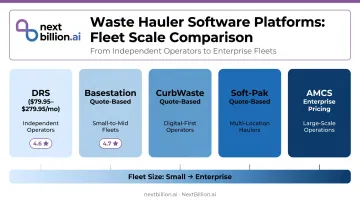
- Only DRS publishes pricing upfront ($79.95–$279.95/month); all other vendors require a direct quote
- Operators with high-volume routes can layer dedicated route optimization tools on top of their core platform to cut fuel costs and driver hours
What Is Roll-Off Dumpster Fleet Management Software?
Purpose-built roll-off software is designed around the specific workflows of roll-off operations: container lifecycle tracking, order dispatch, tonnage billing, demurrage charges, driver coordination, and weight-ticket capture. Generic field service or equipment rental platforms aren't built for this.
Generic platforms handle basic scheduling well enough, but break down at the edges — when you need to know whether a specific 20-yard container has been on a job site for 12 days, or bill a customer who went over their tonnage allowance.
What Manual Operations Actually Cost You
The operational costs of running without purpose-built software aren't always obvious until they compound, and they answer a common question operators ask when comparing dumpster rental CRM tools versus general truck fleet management software: purpose-built roll-off platforms track container-level detail that generic fleet systems simply don't capture.
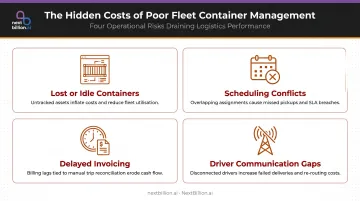
- Lost or idle containers sitting on-site with no status visibility, reducing available inventory
- Scheduling conflicts when dispatchers book containers that aren't actually available
- Delayed invoicing when billing depends on manual job completion confirmation
- Driver communication gaps from relying on phone calls instead of real-time app updates
Basestation customer A-1 Sanitation & Recycling reduced billing time by 50% after moving to purpose-built software. CurbWaste reports users save 5 hours per week on dispatch through real-time tools — vendor-stated figures, but consistent with what operators report in practice.
The sections below break down which platforms deliver on these workflows — and where each one falls short.
Best Software for Roll-Off Dumpster Fleet Management
These five platforms were evaluated across six criteria:
- Roll-off-specific functionality
- Ease of adoption for operators without IT teams
- Dispatch and tracking depth
- Billing capabilities
- Integration options
- How well core workflows connect in a single system
Basestation
Basestation is purpose-built for waste haulers — roll-off, portable toilet, and septic operators — and holds a 4.7/5 on Capterra, with reviewers frequently citing ease of use as the reason. Everything from dispatch to billing to customer notifications runs from a single dashboard.
What makes it stand out is the support model: users consistently cite a dedicated support team (not a generic call center) as a differentiator, particularly during onboarding and when operational questions come up mid-day.
| Field | Details |
|---|---|
| Key Features | Live dispatch & driver app, real-time container tracking, automated billing, customer notifications, reporting & analytics |
| Pricing | Quote-based; contact Basestation directly — no hidden module fees reported |
| Best For | Small to mid-sized roll-off and waste hauling fleets wanting an all-in-one, easy-to-adopt system |
| Capterra Rating | 4.7/5 from 27 reviews |
AMCS
AMCS is an enterprise-grade platform built for larger, more complex roll-off operations. It handles serialized container tracking using RFID tags, barcodes, or QR codes — with GPS location, activity history, and service records tied to each individual container. For multi-location operators managing complex billing scenarios (tonnage overages, fuel surcharges, multi-rate pricing), AMCS provides the reporting depth that smaller platforms don't.
| Field | Details |
|---|---|
| Key Features | Serialized container tracking (RFID/barcode/QR), advanced route planning, real-time dispatch, complex billing, customer self-service portal |
| Pricing | Enterprise pricing — contact AMCS directly for a custom quote |
| Best For | Large-scale or multi-location roll-off operations with complex logistics and billing requirements |
| Capterra Rating | 3.3/5 from 10 reviews |
CurbWaste
CurbWaste is a cloud-native platform built by people from the waste hauling industry. It covers roll-off, commercial, and residential operations with particular strength in real-time inventory visibility and embedded e-commerce — customers can book directly through the operator's website with integrated checkout.
The platform claims 15% more same-day revenue through online ordering and a 20% cash-flow improvement from automated payments, with one 20+ truck hauler dispatching jobs in under 3 minutes. These are vendor-stated figures; the online booking, automated payment, and real-time dispatch features that drive them are all included in the standard platform.
| Field | Details |
|---|---|
| Key Features | Order management, embedded e-commerce, live inventory & ETA tracking, real-time dispatch, automated invoicing, iOS/Android driver app |
| Pricing | Subscription-based; check CurbWaste for current plan tiers |
| Best For | Roll-off operators prioritizing digital customer experience, online booking, and real-time operational visibility |
| Rating | Not listed on major review platforms at time of publication |
Dumpster Rental Systems (DRS)
DRS is one of the few platforms built specifically for dumpster rental businesses — not broader waste hauling, not field service. It's also the only vendor reviewed here with publicly listed pricing, making it easier to evaluate against budget before booking a demo. For operators asking how much dumpster rental software costs, DRS's published tiers offer the clearest benchmark since every other vendor here requires a direct quote.
The tonnage billing workflow is particularly clean: drivers enter tonnage via the mobile app, the system calculates any overage, and the invoice updates automatically with no back-office reconciliation required.
| Field | Details |
|---|---|
| Key Features | 24/7 online booking & checkout, serial number inventory tracking, automated SMS/email notifications, mobile admin & driver apps, tonnage billing |
| Pricing | Launch: $79.95/month (no routing) · Standard: $195.95/month (up to 20 containers) · Pro: $279.95/month (20+ containers) |
| Best For | Independent dumpster rental businesses focused on online booking automation and reducing admin overhead |
| Software Advice Rating | 4.6/5 from 7 reviews |
Note: Web design, SEO, and some integrations (QuickBooks, WordPress) may be priced as add-ons depending on implementation complexity.
Soft-Pak
Soft-Pak has been in the waste hauling software space for more than four decades. It's a flexible, modular platform that adapts to complex roll-off workflows and is particularly well-suited for growing or multi-location haulers that need granular control over billing rules, dispatching logic, and operational reporting.
The modular architecture means you pay for what you need: core Soft-Pak functionality, plus optional add-ons like Map-Pak (mapping), Mobile-Pak (in-cab computing for roll-off trucks), Scale-Pak (scale house integration), and Route Optimization.
| Field | Details |
|---|---|
| Key Features | Dynamic roll-off dispatching, container tracking, modular add-ons (Map-Pak, Mobile-Pak, Scale-Pak), accounting integrations, reporting library |
| Pricing | Quote-based; pricing varies by modules selected — contact Soft-Pak directly |
| Best For | Growing or multi-location haulers needing a flexible, customizable platform with deep billing and dispatch control |
| Rating | Not listed on major review platforms at time of publication |
Key Features to Look for in Roll-Off Dumpster Fleet Management Software
Real-Time Container Tracking
This is the most operationally critical feature for any roll-off fleet. You need to know the status of every container — available, in transit, or deployed — and how long each deployed container has been on-site.
Without it, you're either over-purchasing containers to compensate for unknown availability, or sending drivers to pick up containers that are already gone. Platforms like AMCS track containers by serial number with RFID or QR codes; Basestation and CurbWaste use status-based inventory tracking. The right approach depends on fleet size and whether precise serialized tracking justifies the setup overhead.
Dispatch and Scheduling Depth
A calendar view isn't dispatch software. Look for:
- Same-day order insertion without rebuilding the whole route
- Drag-and-drop scheduling with conflict detection
- Instant updates pushed to drivers via mobile app
- Support for swaps (drop a new container, pick up the existing one in a single trip)
Automated Roll-Off Billing
Standard invoicing software won't handle roll-off billing scenarios. Your platform needs to manage:
- Rental duration fees and overages
- Tonnage-based charges with automatic overage calculation
- Demurrage billing for extended on-site time
- Disposal fees by waste type
Auto-generating invoices on job completion — rather than batching them at end of week — accelerates cash flow.
Route Optimization
Most platforms include basic routing. What separates basic from optimized: route optimization software can generate 15–20% operational savings through lower fuel use, reduced mileage, less overtime, and lower vehicle wear, according to Waste Today's 2024 analysis.
For high-volume or multi-stop operations, a dedicated optimization layer goes further than what's built into most fleet management platforms. NextBillion.ai, for example, handles the specific three-step logic of roll-off routes (pickup, empty, drop) with 50+ configurable routing constraints:
- Truck weight limits and vehicle dimensions
- Time windows and curbside approach direction
- Telematics integration with Samsara and Geotab — pulling vehicle data directly and pushing optimized routes to driver apps without manual re-entry
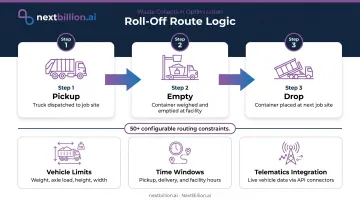
NextBillion.ai also offers a no-code Route Planner App for dispatch teams without API development resources.
Integration Ecosystem
A disconnected tech stack creates the same manual reconciliation problems you're trying to eliminate. At minimum, your software should connect to:
- GPS/telematics systems for real-time truck visibility
- Accounting software (QuickBooks is the most common)
- Scale houses for automatic weight capture
- Customer-facing booking portals
How We Chose the Best Roll-Off Dumpster Fleet Management Software
Evaluation Criteria
Platforms were assessed on three primary dimensions:
- Does the platform actually support roll-off workflows — container lifecycle, tonnage billing, same-day dispatch changes — or is it a generic field service tool with waste-adjacent marketing?
- Can an operator without a dedicated IT team get up and running in days, not months?
- Do core features — dispatch, tracking, billing, driver app — connect in a single system, or do they require juggling multiple tools?
Common Selection Mistakes
Operators consistently make the same errors when evaluating software:
- Choosing based on feature lists without testing real-world usability under actual operating conditions
- Underestimating support quality — slow response times cost more in downtime than a higher subscription fee ever would
- Ignoring total cost of ownership — base pricing often excludes onboarding, integrations, add-on modules, and per-location fees
Match Software to Fleet Size
A 10-container independent operator has fundamentally different requirements than a 100-truck multi-yard enterprise. Basestation and DRS are well-suited to the smaller end; AMCS and Soft-Pak are built for complexity and scale. Pick a platform that fits your current operation but won't force a full platform swap as you grow.
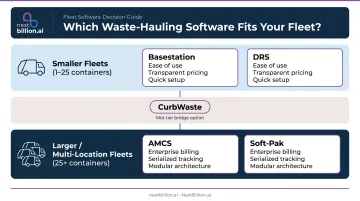
The reviews below are organized with that range in mind — from independent operators to multi-yard fleets.
Conclusion
The right fleet management software cuts through the manual friction that slows operations down — tightening container utilization, reducing billing errors, and keeping drivers and dispatchers in sync. Each of the five platforms reviewed here targets a distinct operator profile:
- Basestation — ease of use at small-to-mid scale
- AMCS — enterprise complexity and compliance
- CurbWaste — digital-first customer experience
- DRS — independent operators focused on booking automation
- Soft-Pak — configurable billing and dispatch control
Evaluate based on where your operation is today and where it's heading — not just on the feature checklist. Prioritize vendors with strong support, transparent pricing, and enough integration flexibility to connect with the tools you already use.
For operators looking to sharpen routing efficiency beyond what their core platform provides, NextBillion.ai's route optimization layer offers truck-compliant routing with 50+ optimization constraints, dynamic mid-route replanning, and integrations with major telematics platforms. It's designed to reduce fuel costs and driver hours without replacing the waste management platform you already run on.
Frequently Asked Questions
How much does roll-off dumpster fleet management software cost?
Pricing varies widely by platform and fleet size. DRS is the only vendor with public pricing at $79.95–$279.95/month. Other platforms (Basestation, AMCS, CurbWaste, Soft-Pak) use quote-based models — and onboarding fees, integration costs, and module add-ons can significantly increase what you actually pay.
How do you keep track of roll-off containers?
Purpose-built fleet management software logs each container's status (available, on-site, in transit), location, and on-site duration. AMCS supports RFID, barcode, and QR code identification for serialized tracking; Basestation and CurbWaste use real-time status-based inventory visibility. Mapping and geofencing layers can flag when a container leaves an authorized drop site or sits past its rental term, which helps with billing accuracy and theft prevention without manual yard checks.
What is the best roll-off dumpster fleet management software?
There's no single answer — it depends on fleet size and operational complexity. Basestation earns the strongest user reviews (4.7/5 on Capterra) and suits small-to-mid fleets. AMCS is built for larger enterprise operations. Prioritize roll-off-specific functionality over generic field service tools regardless of which direction you go.
What features should I look for in roll-off dumpster fleet management software?
Focus on five core capabilities:
- Real-time container tracking
- Dispatch with same-day conflict detection
- Automated billing that handles tonnage and duration charges
- A driver mobile app
- Integration with your GPS/telematics and accounting systems
Can roll-off fleet management software help with route optimization?
Most platforms include basic routing, but high-volume operators often benefit from a dedicated optimization layer. AI-powered tools account for truck type, weight limits, time windows, and road constraints — cutting fuel costs and driver hours beyond what built-in scheduling can deliver. A routing API can also factor in axle weight restrictions and low-clearance roads specific to roll-off trucks, and can be layered onto an existing dispatch system through integration rather than a full platform switch.
Is roll-off dumpster software suitable for small fleets?
Yes — Basestation, DRS, and CurbWaste are all well-suited for small operators. DRS starts at $79.95/month; Basestation and CurbWaste use tiered subscription models. Setup is straightforward and the workflows are simplified enough that small operators can self-manage without a dedicated IT function.
What is the best software for truck fleet management in a roll-off dumpster business?
There is no universal best fit. Roll-off operators generally need dispatch, container tracking, and driver hours-of-service compliance in one workflow, which differs from general truck fleet tools built for line-haul or last-mile delivery. If your existing fleet management software lacks roll-off-specific dispatch logic or routing built for heavy trucks, pairing it with a dedicated routing and mapping API can close that gap without a full platform replacement.
Is roll-off dumpster hauling a good business to run efficiently with software?
Roll-off hauling is a route- and asset-intensive business, so margins depend heavily on operational efficiency — truck utilization, container turnaround, and driver hours. Software will not change your customer demand, but it does reduce wasted mileage, missed pickups, and manual billing errors. Whether it is a good business depends on local market factors, but efficient dispatch and routing directly affect fuel spend and how many jobs a driver can complete within FMCSA hours-of-service limits.