Introduction
Most retailers know exactly what happened in their warehouse yesterday. Far fewer know why 8% of their deliveries ran late, which routes are quietly burning margin, or which drivers are consistently missing time windows. The final mile is where brand reputation gets tested — and most operations are still making decisions based on gut feel and next-day reports.
According to Grand View Research, the U.S. last-mile delivery market was valued at $43 billion in 2025 and is projected to reach $81.8 billion by 2033. At that scale, flying blind on delivery performance isn't just inefficient — it's expensive.
A last-mile delivery analytics solution turns route, driver, and delivery data into actionable insights, helping retailers track KPIs like on-time delivery rate so decisions aren't based on gut feel or next-day reports. Delivery analytics is now a core operational requirement. Retailers managing high order volumes, varied delivery windows, and rising customer expectations need platforms that convert route, driver, and delivery data into actions they can actually take. This guide compares five of the best platforms — NextBillion.ai, DispatchTrack, Onfleet, project44, and Locus — to help retailers evaluate which fits their operational needs before committing.
This guide covers five of the best last-mile delivery analytics solutions for retailers, how to evaluate them, and what to look for before you commit.
Key Takeaways
- Last-mile analytics platforms track KPIs like on-time delivery rate, cost-per-route, and first-attempt delivery success in real time
- Strong platforms pair route optimization and GPS tracking with exception management and BI-ready dashboards — not just one or two of these
- Prioritize integration depth (ERP, WMS, TMS), pricing predictability, and scalability during peak seasons
- Top solutions reviewed: NextBillion.ai, DispatchTrack, Onfleet, project44, and Locus
- Use analytics depth, retail use case fit, integration flexibility, and pricing model to decide which platform fits your operation
What Is Last-Mile Delivery Analytics and Why Retailers Need It
Last-mile delivery analytics is the collection, aggregation, and analysis of data generated from the final leg of the delivery journey — from dispatch to doorstep. The goal is to surface insights that reduce cost, improve speed, and strengthen customer experience.
Why Last-Mile Costs Demand Attention
This isn't a background operational problem. According to Statista, last-mile delivery's share of total shipping costs climbed from 41% in 2018 to 53% in 2023. For retailers managing dozens of routes daily, that figure compounds fast.
The problem is that without measurement, none of those costs look unusual. Inefficient routes, preventable failed deliveries, and idle time between stops all look like "normal operations" — until someone runs the numbers.
Core Use Cases for Retail Operations
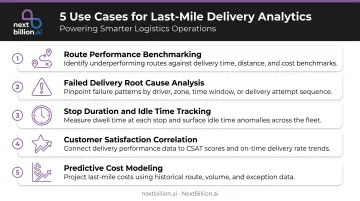
Last-mile analytics platforms address five specific problems retailers face:
- Route performance benchmarking — compares planned vs. actual routes to surface persistent inefficiencies
- Pinpoints whether failed deliveries stem from time window mismatches, address errors, or driver behavior
- Tracks stop duration, idle time, and task completion rates across the fleet
- Customer satisfaction correlation — ties on-time performance data directly to CSAT scores and repeat purchase rates
- Predictive cost modeling — forecasting delivery costs based on route density, volume, and seasonal demand
Which of these matters most to your operation determines which platform belongs on your shortlist.
Best Last-Mile Delivery Analytics Solutions for Retailers
These platforms were evaluated on analytics depth, retail use case fit, integration capabilities, and pricing transparency.
NextBillion.ai
NextBillion.ai is an AI-powered route optimization and last-mile intelligence platform built by former Grab engineers. It now serves 150+ businesses globally and has optimized over 10.9 million deliveries, with more than $11 million in documented cost savings across its customer base.
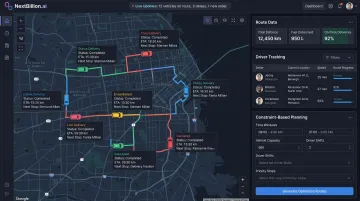
For retailers, the platform's 50+ hard and soft routing constraints produce highly granular route data — including time window adherence, vehicle capacity utilization, and skill-based task assignments. This level of constraint specificity means the analytics output reflects real operational conditions, not simplified models.
The platform integrates natively with fleet telematics systems including Samsara and Geotab, enabling two-way data flows: pull vehicle and order data in, push optimized route plans back to driver apps. Its API-first architecture connects with ERP systems including SAP, Oracle, and Microsoft Dynamics, making it practical for retailers with existing tech stacks.
On pricing, NextBillion.ai takes a different approach from standard per-API-call models. Customers pay per vehicle, per order, or via fixed monthly license — with no monthly caps, no per-seat fees on the Route Planner App, and up to 30% lower costs compared to traditional mapping API providers. For retailers running high delivery volumes, this predictability matters.
| Category | Details |
|---|---|
| Key Features | AI-powered route optimization, real-time driver tracking, 50+ routing constraints, distance matrix computation, telematics integrations (Samsara, Geotab), multi-stop planning, SLA-at-risk alerts |
| Pricing Model | Per-vehicle, per-order, or fixed monthly license; no per-API-call billing; annual commitment with monthly payment options |
| Best For | Retailers and logistics operators needing deep route analytics, fleet integration, and scalable delivery intelligence without unpredictable API costs |
DispatchTrack
DispatchTrack is a last-mile delivery management platform purpose-built for retailers and distributors. It covers end-to-end visibility from route planning through delivery confirmation and customer communication.
The platform's analytics capabilities focus on operational cost and customer experience simultaneously — covering delivery cost analysis, route profitability, and customer satisfaction measurement through survey collection and proof-of-delivery capture. DispatchTrack integrates with ERP and WMS systems including NetSuite, SAP, and STORIS.
A real-world example: ABC Warehouse deployed DispatchTrack across 47 retail locations and saw measurable improvements in operational visibility, reduced negative customer feedback, and higher satisfaction scores within the first few weeks of deployment.
Pricing is subscription-based; DispatchTrack does not publish public pricing tiers and directs buyers to request a demo for custom quotes.
| Category | Details |
|---|---|
| Key Features | Route planning with cost analytics, proof-of-delivery capture, customer satisfaction tracking, ERP/WMS integrations (SAP, NetSuite, STORIS), schedule confirmation reporting |
| Pricing Model | Subscription-based; custom quotes via demo request |
| Best For | Retail and distribution operations seeking analytics tied directly to customer experience and route cost visibility |
Onfleet
Onfleet is a delivery management platform built for mid-market retailers. Its analytics suite covers driver performance, delivery success rates, and operational efficiency through a clean, accessible dashboard.
Key analytics capabilities include on-time vs. delayed tracking, task completion metrics, service time per stop, and transit vs. idle time breakdowns. Admin dashboards surface fleet-wide patterns; driver-facing views give individual operators visibility into their own performance — keeping both sides of the operation aligned.
For e-commerce retailers, Onfleet's Shopify integration automates task creation and syncs fulfillment statuses (Out for Delivery, Delivered) directly into the platform — reducing manual handoffs between systems.
Onfleet publishes transparent tiered pricing:
- Launch: $619/month — 2,500 tasks
- Scale: $1,349/month — 5,000 tasks
- Enterprise: $3,099/month — 10,000+ tasks
Tasks are billed only when they reach Completed status.
| Category | Details |
|---|---|
| Key Features | Driver performance analytics, on-time delivery tracking, task completion reporting, customer ETA notifications, Shopify integration, API-based integrations with WMS/ERP/POS |
| Pricing Model | Task-based subscription tiers; Launch at $619/mo, Scale at $1,349/mo, Enterprise at $3,099/mo |
| Best For | Mid-market retailers and e-commerce brands that need accessible delivery analytics without heavy enterprise implementation overhead |
project44
project44 is an enterprise-grade supply chain visibility platform used by major retailers to track carrier performance, delivery exceptions, and order status across multi-carrier networks.
Its last-mile analytics capabilities are built for scale: 160+ last-mile carrier integrations, predictive ETA modeling trained on 21 billion shipment events, and a Last Mile Resolution feature that supports centralized exception workflows including automatic case creation for damages, returns, and incorrect addresses.
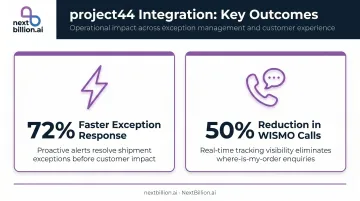
The platform's carrier scorecard reporting enables retailers to benchmark performance across their entire carrier network — not just a single fleet — essential for enterprise retailers managing multiple delivery partners. Documented outcomes include a 72% faster response to supply chain exceptions for a global home-improvement retailer, and up to 50% reduction in WISMO calls for e-commerce operations.
Pricing is enterprise contract-based, customized by shipment volume and carrier connections. No public tiers are listed.
| Category | Details |
|---|---|
| Key Features | Multi-carrier visibility (160+ integrations), predictive ETA analytics, exception management, carrier scorecard reporting, ERP/OMS integrations |
| Pricing Model | Enterprise contract pricing; customized by shipment volume and carrier connections |
| Best For | Enterprise retailers managing multi-carrier last-mile networks who need analytics at scale across carrier performance and delivery exceptions |
Locus
Locus is an AI-driven dispatch and delivery analytics platform with a strong record in retail and consumer goods. Its tools cover automated dispatch, route analytics, and real-time delivery intelligence through a control tower interface.
Locus stands out for geographic granularity. The platform supports delivery density analysis, SLA breach prediction with real-time alerts, and regional performance benchmarking — allowing operations teams to compare performance across territories, not just individual routes. Driver scorecards add accountability at the individual level.
Integration support spans WMS, OMS, ERP, and TMS systems through an API-first approach. Documented outcomes from retail and CPG customers include:
- 70% reduction in planning effort and 20% improvement in delivery rate (The Petshop)
- 25% productivity gain through automated dispatching (MaxAB)
- 1.22 billion+ optimized deliveries and $303 million in logistics cost savings across the platform
Pricing is SaaS subscription-based; specific tiers are not publicly listed and require a demo request.
| Category | Details |
|---|---|
| Key Features | Automated dispatch, SLA tracking and breach alerts, delivery density analytics, route performance benchmarking, driver scorecards, WMS/OMS/ERP integration |
| Pricing Model | SaaS subscription; custom pricing via demo |
| Best For | Retail and CPG companies seeking AI-powered dispatch analytics with geographic performance benchmarking and SLA management |
How We Chose the Best Last-Mile Delivery Analytics Solutions
Solutions were assessed across four dimensions: analytics depth, retail use case relevance, integration flexibility with existing retail tech stacks, and pricing transparency. A common mistake retailers make is choosing platforms based on name recognition rather than confirming the analytics capabilities match their specific delivery KPIs.
The Five Evaluation Factors
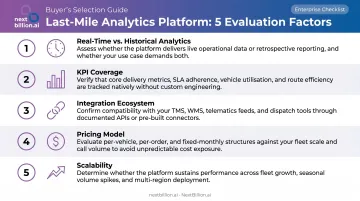
Real-time vs. historical analytics — Does the platform surface SLA-at-risk alerts and live driver deviations, or only deliver retrospective reports the next morning? Retailers managing same-day windows need both.
KPI coverage — On-time delivery rate, cost-per-route, failed delivery rate, perfect order performance, and driver utilization are the metrics that matter most. Platforms vary in how many they surface natively.
Integration ecosystem — How well does it connect with fleet telematics, e-commerce systems, and WMS or ERP tools? For most retailers, the analytics layer must fit an existing stack — not replace it.
Pricing model — Per-API-call billing gets expensive fast at scale. Per-vehicle or per-order pricing (as with NextBillion.ai) keeps costs predictable regardless of how many API requests a high-volume operation generates.
Scalability — Can the platform hold up during Q4 spikes or major promotional surges without performance degradation? Reliability matters most precisely when operations are most complex.
Features only tell part of the story. Support quality and integration speed determine how quickly a platform delivers value — dedicated solution engineers and integrations that go live in days, not months, shorten time-to-value considerably.
Conclusion
The right last-mile delivery analytics solution depends less on feature count and more on which platform delivers actionable insight for the specific operational gaps a retailer faces — whether that's route cost reduction, driver performance tracking, or multi-carrier exception management.
When shortlisting platforms, prioritize scalability, integration depth, and pricing predictability. Run a pilot with real operational data before committing — most platforms, including NextBillion.ai with its 14-day free trial, support evaluation periods specifically for this purpose.
NextBillion.ai combines AI-powered route optimization and delivery analytics under one platform with predictable per-vehicle pricing — and has helped businesses optimize over 10.9 million deliveries globally. Request a demo or start a free trial to see how it fits your operation.
Frequently Asked Questions
How to optimize last-mile delivery?
Last-mile optimization brings together route planning, real-time driver tracking, and delivery analytics. The goal: lower cost-per-stop, cut failed deliveries, and hit customer time windows consistently. Analytics platforms that surface recurring exception patterns — like time window mismatches or high-density zone bottlenecks — are what sustain those gains over time.
Which KPI is most important in last-mile delivery?
The most-watched KPIs are on-time delivery rate, cost-per-route, first-attempt delivery success, perfect order rate, and customer satisfaction score. Priority shifts depending on whether you're optimizing for cost or experience — but most retail operations need visibility into both. Retailers running high delivery volumes should also track exception rate by zone and driver-level variance, since these two metrics usually explain why aggregate KPIs move.
What is last-mile delivery analytics?
Last-mile delivery analytics is the systematic collection and analysis of data from the final delivery leg — covering route performance, driver behavior, delivery outcomes, and customer feedback — to generate insights that improve efficiency and reduce cost. It turns raw operational data into decisions.
How does route optimization software improve last-mile delivery analytics?
Route optimization software captures granular data on planned vs. actual routes, stop durations, and fuel use — all of which flows directly into analytics dashboards. Retailers can benchmark efficiency, flag underperforming routes or drivers, and act on specific operational gaps rather than guessing at root causes.
What should retailers look for when choosing a last-mile analytics solution?
Key criteria include integration with existing systems (WMS, OMS, telematics), real-time analytics capabilities alongside historical reporting, KPI coverage relevant to retail operations, pricing model transparency, and the ability to scale during peak seasons without performance issues.
How does last-mile analytics help reduce delivery costs?
Analytics surfaces cost drivers — inefficient routes, high failed-delivery rates, excessive idle time — that would otherwise stay hidden in aggregate numbers. By acting on these insights, retailers can reduce cost-per-delivery, improve route density, and lower fuel and labor expenditure over time. This matters most during peak season, when small inefficiencies per stop compound quickly across thousands of daily deliveries and put pressure on driver hours and vehicle capacity.
What is the best software for last-mile delivery management?
There is no single best platform for every retailer — the right choice depends on order volume, existing WMS/OMS stack, and whether you need real-time tracking, route optimization, or both. Look for software that combines dispatch and routing with analytics reporting, so you can see not just what happened on a route but why, and adjust dispatch logic accordingly.
What is the best software to track delivery?
Delivery tracking software should give dispatchers and customers real-time visibility into vehicle location, ETA, and delivery status, and feed that data back into analytics for post-route review. The strongest tracking tools integrate with route optimization and telematics so tracking data becomes part of a feedback loop, not just a live map, letting retailers spot delays before they affect customer experience.