Introduction
HGV route planning software is purpose-built routing technology that plans truck routes around vehicle height, weight, axle load, hazmat restrictions, and driver hours-of-service rules instead of treating a truck like a car. A missed turn in a passenger car is a minor annoyance. For an HGV driver, it can mean a 44-tonne lorry wedged under a low railway bridge — and Network Rail recorded 1,666 bridge strikes between April 2024 and March 2025, costing roughly £13,000 per incident and £23 million annually to UK taxpayers. Most vehicles involved were HGVs and buses. In the US, similar risk shows up as low-clearance bridge strikes, weight-restricted local roads, and FMCSA hours-of-service violations, all of which a truck-aware routing platform is designed to prevent rather than react to.
Standard navigation apps weren't built to prevent this. They don't know your truck's height, your axle load, or whether the shortcut through the city center is banned before 10 a.m.
This guide is built for fleet managers, logistics coordinators, and transportation technology providers who need straight answers on HGV route planning software. Here's what it covers:
- What HGV route planning software is and how it works
- Why it differs from standard GPS navigation
- The features that actually matter for commercial operations
- Operational benefits backed by real numbers
- How to evaluate solutions without getting burned by surface-level "truck modes" or unpredictable API pricing
Key Takeaways
- HGV route planning software balances vehicle dimensions, weight limits, bridge clearances, restricted roads, driver hours, and multi-stop delivery windows in a single pass.
- Standard navigation tools (including Google Maps) can't handle truck-specific constraints — no full vehicle profiling, no regulatory compliance, no commercial multi-stop optimization.
- Documented operational benefits include reduced mileage, lower compliance risk, better ETA accuracy, and the ability to scale fleet planning without proportional increases in dispatcher time.
- Top evaluation criteria: depth of HGV constraint handling, real-time data coverage, integration ecosystem, and pricing that stays predictable as your fleet grows.
What Is HGV Route Planning Software?
HGV route planning software is a specialized routing platform designed to plan the safest and most efficient routes for heavy goods vehicles — accounting for truck-specific regulations, physical infrastructure limits, and operational constraints that general navigation apps miss.
Apps like Google Maps optimize for passenger vehicles. They have no mechanism to account for:
- Bridge weight and height clearances
- Vehicle height, width, length, and axle load
- Hazardous materials routing restrictions
- Driver hours-of-service compliance
- Multi-stop delivery sequencing with time windows
Who Uses It
The user base spans two distinct groups:
- Fleet operators and logistics teams — fleet managers, dispatchers, and logistics coordinators planning and managing commercial vehicle operations daily
- Transportation technology providers — TMS vendors and logistics software companies embedding HGV routing via API into their own platforms
Both groups share the same core need: routes that are legally and physically valid for the specific vehicle. A route that sends a 13'6" trailer under a 12-foot bridge isn't just inefficient — it's a liability before the truck reaches the first stop.
Why HGV Routing Is Fundamentally Different From Standard Navigation
Four distinct dimensions separate HGV routing from consumer navigation. Each one carries real operational and legal consequences if ignored.
Physical Constraints Make Roads Selectively Accessible
An HGV's height, width, length, gross vehicle weight, and axle configuration determine which roads it can legally and safely use. The RAC Foundation found that 2,928 council-maintained bridges in Great Britain — about 1 in 25 — are substandard and cannot carry 44-tonne lorries. The maintenance backlog for these structures sits at £4.1 billion.
Consumer GPS provides no warning for any of this. According to GPS.gov, consumer devices and apps generally do not alert drivers about restricted roads, low bridges, or commercial motor vehicle-specific information. GOV.UK issued a specific warning to HGV operators questioning whether standard satnavs are "fit for purpose."
Regulatory Compliance Is Non-Negotiable
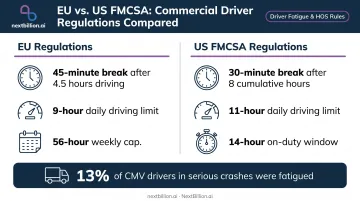
HGV drivers operate under strict hours-of-service (HOS) rules that vary by region:
| Region | Key Rule |
|---|---|
| EU | 45-minute break after 4.5 hours; 9-hour daily limit; 56-hour weekly cap |
| US (FMCSA) | 30-minute break after 8 cumulative hours; 11-hour daily driving limit; 14-hour on-duty window |
Routes must be structured around these constraints. FMCSA data shows that 13% of commercial motor vehicle drivers involved in serious crashes were fatigued at the time of the incident. Driver hours compliance is a safety function, not an administrative checkbox. For US fleets, this also means routing software needs to work alongside electronic logging device (ELD) data and DOT hours-of-service rules, since a route that looks efficient on paper is worthless if it forces a driver past their legal on-duty window.
Road Network Restrictions Are Granular and Variable
Hours compliance is only part of the picture. HGVs face a second layer of restrictions that standard GPS ignores entirely:
- Tunnel height and weight limits
- Weight-restricted local roads
- Time-of-day access bans in urban areas (ULEZ zones, London's Direct Vision Standard, city center restrictions)
- Seasonal road closures
- Abnormal load thresholds (National Highways defines these as weight over 44,000 kg, width over 2.9 m, or length over 18.65 m)
These restrictions change over time and vary by location. A route valid today may not be valid next quarter.
Multi-Stop Routing Adds Layered Complexity
HGVs rarely make single-stop deliveries. A typical commercial route involves dozens of stops, each with its own delivery time window, service time, and specific unloading requirements. Sequencing those stops while honoring every constraint is a combinatorial problem that generic routing tools aren't built to handle at commercial scale.
Add in wide turning radii, restricted reversing options, and the sheer cost of rerouting a loaded vehicle mid-run, and the margin for planning errors shrinks to near zero.
Must-Have Features in HGV Route Planning Software
Not all truck routing features are equal. Here's what separates enterprise-grade HGV software from a basic "avoid motorways" toggle.
Truck-Specific Vehicle Profiling
Full vehicle profile configuration is non-negotiable — a generic "truck mode" toggle won't cut it for commercial operations. Required parameters include:
- Height, width, and length
- Gross vehicle weight and axle load
- Load type (hazmat, refrigerated, oversized cargo)
- Vehicle body type (rigid vs. articulated)
- Special load permits for abnormal loads
Every parameter should automatically filter out non-compliant routes during generation, not flag issues after the fact. Platforms like NextBillion.ai support multi-dimensional capacity planning across weight, volume, and quantity simultaneously, with hazmat routing that avoids roads unsuitable for dangerous goods by cargo type. In the US, hazmat routing also needs to reflect PHMSA and state-level restrictions on placarded loads, which can bar certain trucks from tunnels, bridges, or urban corridors regardless of what a standard GPS route suggests.
Driver Hours and Compliance Automation
Rest breaks and maximum driving limits should be built directly into route generation — compliant routes produced upfront, not verified manually after the fact. Dispatchers shouldn't be cross-checking driver schedules against optimization outputs by hand.
Configurable parameters should include daily driving limits, on-duty windows, break timing, and multi-day layover planning for long-haul routes.
Real-Time Traffic Integration and Dynamic Rerouting
Live traffic integration matters, but the implementation detail is critical: when a disruption occurs on a planned HGV route, the system must suggest only HGV-compliant alternatives. A generic passenger car reroute that sends a loaded lorry onto a weight-restricted road creates more risk than the original disruption.
Multi-Stop Optimization and Delivery Scheduling
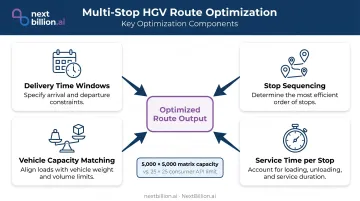
The optimization engine should handle:
- Delivery time windows: hard constraints on when each stop can be served
- Stop sequencing: minimizing travel time and distance across dozens or hundreds of stops
- Vehicle capacity: matching load weight, volume, and type to available vehicles
- Service time: accounting for unloading time at each location
At scale, this is computationally intensive. NextBillion.ai's Distance Matrix API supports up to 5,000×5,000 matrix sizes, far beyond the 25×25 limits of consumer mapping APIs. That capacity makes practical multi-stop planning for large fleets achievable in a single optimization pass.
Fleet Management and Systems Integration
Enterprise HGV routing software must connect to existing operational infrastructure without manual data re-entry. Key integrations include:
- Telematics platforms (Samsara, Geotab, Motive) for real-time vehicle location and ETA updates
- Transport Management Systems (TMS) with bidirectional route data flow
- Order management platforms for automatic import of delivery orders into planning workflows
NextBillion.ai offers native integrations with Samsara, Geotab, and Motive, enabling direct import of vehicles and orders with optimized routes pushed automatically back to driver apps.
Customizable Road Attribute Control
Map data rarely reflects the ground truth of active logistics corridors. NextBillion.ai's Road Editor App addresses this directly: fleet operators can mark custom speed limits, road closures, turn restrictions, no-entry zones, and truck-specific plying permissions scoped by vehicle type, time of day, and day of week.
All edits feed into routing and navigation APIs with no lag — critical for fleets operating in areas where commercial map data hasn't caught up to real-world conditions.
The Operational Benefits of HGV Route Planning Software
Fuel and Cost Reduction
Optimized routing reduces unnecessary mileage, idle time, and fuel burn. PIARC (the World Road Association) estimates that computerized vehicle routing and scheduling delivers a 10% improvement in routing and scheduling efficiency when implemented effectively. A USDA-hosted coordinated log-truck study found optimized dispatch reduced route length by approximately 20 miles per truck per day compared to human dispatch.
NextBillion.ai customers have documented outcomes including a 13% reduction in miles driven per month for one logistics software provider, and a 35% reduction in operating costs through combined route efficiency and lower API overhead.
Compliance and Safety Risk Reduction
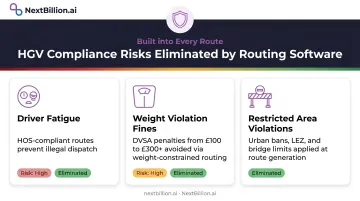
Automated compliance features reduce three categories of risk:
- Driver fatigue incidents — HOS-compliant route generation prevents drivers from being dispatched on routes they cannot legally complete
- Weight violation fines — DVSA graduated penalties range from £100 (under 10% overload) to £300 (15%+); automatic weight-constrained routing avoids these
- Restricted area violations — urban access bans, LEZ requirements, and bridge restrictions are handled at route generation, not discovered mid-journey
ETA Reliability and Customer Satisfaction
Constraint-validated routes produce more accurate ETAs because they account for actual driving time — including mandatory breaks, restricted roads, and realistic service times at each stop. In B2B logistics, delivery windows are often contractual obligations. A Europe-based TMS provider achieved a 30% improvement in ETA and ETD accuracy after integrating NextBillion.ai's routing capabilities.
Environmental Impact
Reduced mileage and lower idle time translate into lower CO2 emissions. One heavy-vehicle routing study found that optimized routes for 100 council trucks could reduce distance by 49,600 km/month, fuel consumption by 23,400 litres/month, and GHG emissions by 63.1 tonnes/month. Fleet size and duty cycle affect the exact figures, but the pattern holds across contexts.
Operational Scalability
Manual route planning caps fleet capacity at whatever a dispatcher can manage in a day. Software-driven optimization eliminates that constraint entirely. A leading TMS provider reduced scheduling time by 40% after integrating NextBillion.ai's route optimization, enabling them to scale operations without adding headcount at the same rate.
How to Choose the Right HGV Route Planning Software
Key Evaluation Criteria
When assessing platforms, work through these questions:
- Constraint depth — Does the platform support full vehicle profiling (height, weight, axle load, hazmat), or just a basic truck mode toggle?
- Real-time data coverage — How accurate and current is the traffic and restriction data in your operating regions?
- Integration ecosystem — Does it connect natively with your existing TMS, telematics, and order management tools?
- Support model — Are dedicated solutions engineers available during integration, or does support only kick in post-purchase?
- Pricing structure — Does the model scale predictably with fleet size, or do costs become unpredictable as API call volume grows?
API-First vs. Turnkey Dispatch Tools
Your answers to the criteria above will largely determine which product category fits. These two are not interchangeable:
Turnkey dispatch platforms are standalone tools suited to smaller fleets that need a ready-to-use interface without custom development work.
API-first platforms are built for logistics software companies, TMS vendors, fleet management providers, and enterprise operators embedding HGV routing into their own products or workflows.
NextBillion.ai sits in the API-first category. Key differentiators include:
- 50+ hard and soft routing constraints
- Truck-compliant, vehicle-specific routing
- Per-vehicle or per-order pricing instead of per-API-call billing
- Unlimited API calls within the pricing tier, eliminating cost unpredictability for fleets that recalculate routes frequently
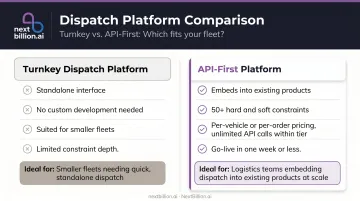
For teams evaluating API integration, NextBillion.ai provides trial API keys, free onboarding support, and go-live timelines of one week or less.
Red Flags to Watch For
Avoid platforms that exhibit any of these warning signs:
- Truck routing limited to simple "avoid motorways" settings with no vehicle profiling
- No support for hazmat, axle load, or oversized cargo constraints
- Poor or outdated restriction data in your specific operating regions
- Per-API-call pricing with no cap — costs can become prohibitive quickly for fleets that recalculate routes frequently
- No native integrations with major telematics providers
- Support that only begins after contract signature
Frequently Asked Questions
What is the best HGV route planning software?
The right choice depends on fleet size, operational complexity, and whether you need a standalone dispatch interface or an API to embed into existing logistics software. Compare platforms on HGV constraint depth, real-time data quality in your operating regions, integration ecosystem, and pricing at your expected volume. In the US, also check that map data covers state-specific weight limits, bridge laws, and hazmat restrictions, since these vary by jurisdiction and a generic global dataset may miss local rules.
Can you set Google Maps for HGV?
Google Maps offers a limited truck mode in some versions, but it does not reliably account for vehicle weight limits, bridge clearances, hazmat regulations, driver hours compliance, or multi-stop delivery optimization. For commercial fleet operations, dedicated HGV routing software is the only practical option — both for operational reliability and to maintain a defensible compliance record.
What is the difference between a regular route planner and an HGV route planner?
Standard route planners are built for passenger vehicles and ignore commercial constraints entirely — vehicle dimensions, bridge and tunnel restrictions, road weight limits, driver hours, and cargo-specific requirements. HGV route planners treat all of these as hard constraints, not optional filters.
What vehicle parameters does HGV routing software typically account for?
Core parameters include height, width, length, gross vehicle weight, axle load, load type (hazmat, refrigerated, oversized), and body type (rigid vs. articulated). A well-built platform applies these as automatic filters at route generation — not as post-processing warnings. In the US, this also means respecting state-by-state bridge formulas and posted weight limits, since a route legal in one state can violate axle load rules in the next.
How does HGV route planning software help with regulatory compliance?
It builds driver hours rules and mandatory rest breaks into route schedules automatically, routes vehicles around legally restricted roads and zones, and generates data that supports compliance audits and documentation requirements — reducing both the probability and the cost of violations. In the US, this typically aligns with FMCSA hours-of-service rules and supports the kind of trip records fleets need for DOT and IFTA reporting, though the software itself does not replace an ELD or a compliance program.
Does HGV route planning software support multi-stop delivery routes?
Yes. Advanced platforms optimize stop sequencing across dozens to hundreds of stops based on time windows, vehicle capacity, load type, and delivery priority. Basic navigation tools have no mechanism for this — they return a single path, not an optimized schedule across a constrained fleet.
Can I set Google Maps for truck routes in the US?
Google Maps has a truck mode in some regions, but US coverage is inconsistent and it does not reliably factor in state weight limits, bridge clearances, hazmat lane restrictions, or driver hours rules. Fleets that rely on it risk routing violations that a compliance-focused HGV platform is built to prevent, since dedicated tools apply these constraints as hard filters rather than optional layers.
Is there a free RV route planner suitable for HGV-style routing?
Free RV planners exist, but they are generally built for recreational vehicles, not commercial HGVs. They may account for height or length but typically ignore gross vehicle weight, axle load, hazmat restrictions, and driver hours compliance. For commercial fleet operations where routing errors carry regulatory and cost consequences, a dedicated HGV route planning platform is the more reliable option.
placeholder
placeholder