For taxi operators, fleet managers, and transportation technology buyers, that creates both urgency and opportunity. The operators who understand which trends are reshaping dispatch in 2026 — and act on them — will cut costs, win customers, and scale. Those who don't will find themselves competing with inferior infrastructure against platforms that have already modernized.
This report covers the five trends defining the taxi dispatch software market in 2026, what's driving them, how they're changing operations, and what signals to watch through 2028.
Key Takeaways
- The global ride-hailing market — the primary demand driver for dispatch software — is projected at $184.49B in 2026, growing toward $392.27B by 2031 at a 16.29% CAGR
- AI-powered dispatch is replacing manual and radio-based systems as the default for route optimization and driver matching
- Cloud-native SaaS platforms are lowering entry barriers; operators pay per vehicle, not per infrastructure build
- EV fleet integration is shifting from optional to compliance-required in major markets
- White-label ecosystems now give smaller operators the same enterprise-grade dispatch capabilities as top-tier platforms
Trend 1: AI-Powered Dispatch and Intelligent Route Optimization
From Radio Calls to Real-Time ML
Modern dispatch platforms no longer rely on dispatchers manually assigning trips or drivers responding to radio calls. Machine learning models now match riders to the nearest available driver in milliseconds — factoring in live traffic, driver history, vehicle capacity, and demand hotspots simultaneously. This shift is a core driver of taxi dispatch software market growth, since it lets operators serve more trips with the same fleet size and staffing levels.
Major platforms made this shift years ago. Gojek uses ML to continuously optimize driver-rider matching at scale. Lyft describes rideshare dispatch as an optimization problem where machine learning and optimization work together to produce dispatch decisions in real time. What's changed in 2026 is that smaller operators can access similar capabilities through third-party routing APIs, without building the infrastructure from scratch.
What the Research Shows
A 2024 peer-reviewed study published in Nature modeled AI-based ridesourcing dispatch using a minimum path cover approach with ML-driven arrival-time prediction. The results:
- 25.25% reduction in fleet size required to serve the same demand
- 21.65% lower pollutant emissions
- Trip-order reductions up to 34.18% during peak hours
- Arrival-time prediction accuracy above 87%
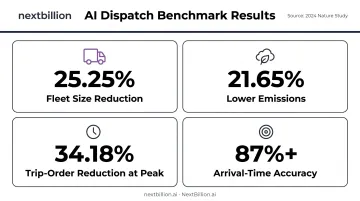
These figures come from a Beijing simulation, not a universal guarantee — but they establish a credible benchmark for what well-implemented AI dispatch can achieve.
How Smaller Operators Access This Capability
Those benchmarks are now within reach for operators who lack the engineering resources to build ML infrastructure internally. APIs like NextBillion.ai's Driver Assignment and Route Dispatch APIs bring sub-second driver matching to fleets of any size.
The Driver Assignment API auto-assigns the nearest available driver in under one second, evaluating:
- Driver location and shift timing
- Vehicle capacity and skills
- Customer preferences and service constraints
One ride-hailing operator documented an 82% reduction in API costs after switching to NextBillion.ai, while maintaining ETA accuracy. The route optimization layer supports 50+ hard and soft constraints — real-time traffic, time windows, ride-pooling, and departure time — directly relevant to on-demand taxi operations.
Trend 2: Cloud-Native and SaaS Platform Adoption
The End of On-Premise Dispatch
Taxi dispatch used to mean expensive server installations, IT overhead, and software that took months to deploy. SaaS changed that equation. Operators now pay per vehicle per month, deploy in days, and scale without infrastructure projects. This lower barrier to entry is a major reason the taxi dispatch software market now includes far more regional and independent operators than it did when on-premise systems dominated.
The pricing is transparent. TaxiCaller publishes a pay-as-you-go rate of $28 per vehicle per month with no setup cost, no contracts, unlimited dispatchers and drivers, and a 14-day free trial. Yelowsoft, Cabsoluit, and iCabbi have each built their market positions on cloud-native architectures targeting exactly this shift.
Why It Matters Beyond Cost
Cloud delivery changes more than the upfront price. It enables:
- Automatic software updates — operators always run current versions without manual patches
- Multi-region redundancy — uptime guarantees that on-premise hardware can't match
- API integrations — connect payment gateways, mapping APIs, telematics platforms, and CRM tools without custom middleware
- Instant scaling — add vehicles to a subscription, not to a server
The iCabbi and Apple Taxis case study illustrates what migration looks like in practice: Apple Taxis replaced a 14-year-old legacy platform with iCabbi's cloud dispatch, gaining modern routing, real-time tracking, and recurring booking automation. iCabbi reports 98% customer retention — a figure that reflects how rarely operators revert once they've made the move.
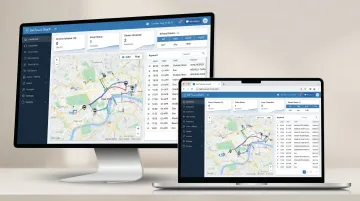
That platform depth extends beyond dispatch. iCabbi's 2023 integration with Google Fleet Engine brought the combined solution to more than 100,000 taxis worldwide, putting cloud-native dispatch on par with the mapping infrastructure backing global ride-hailing operators.
Trend 3: Multi-Modal and EV Fleet Integration
Dispatch Is No Longer Just About Taxis
The dispatch platforms gaining ground in 2026 manage more than standard sedans. Mixed fleets — EVs alongside ICE vehicles, wheelchair-accessible vans, bike taxis, corporate shuttles, and paratransit — increasingly operate within a single dispatch layer. Platforms like Jugnoo support mixed-vehicle models across 75+ countries for 350+ clients, covering taxi dispatch, bike rentals, and carpooling under one MaaS architecture.
EV Compliance Is Forcing Dispatch Evolution
New York City's Green Rides Initiative mandates that rideshare trips be performed by zero-emission or wheelchair-accessible vehicles by 2030, with interim targets of 25% by 2026 and 40% by 2027. NYC TLC recorded 1.08 million zero-emission high-volume for-hire trips in January 2024 — up from 157,000 in January 2023. That ramp is forcing dispatch platforms to evolve fast.
The operational complexity is real. NYC's 2024 driver expense report found that 28% of EV drivers waited 30–60 minutes for charger access, and 24% waited more than an hour. Dispatch systems that can't account for charge state, charger availability, and range constraints will route EVs into dead zones.
NextBillion.ai's routing APIs handle this with charge-state-aware routing that factors in:
- Battery levels and real-time depletion rates
- Charging station locations and live availability
- Charger type compatibility
- Terrain, speed profile, and temperature
The system also supports dynamic re-routing when charging conditions change mid-trip — the operational logic mixed EV fleets actually require.
Trend 4: Embedded Analytics and Predictive Demand Intelligence
Most dispatch systems respond to demand — they don't anticipate it. Analytics-driven dispatch changes that: the system forecasts where demand will surge, pre-positions drivers, and adjusts supply before the queue builds.
Modern SaaS dispatch platforms are embedding this intelligence directly into the operator interface. Fleet managers can monitor demand heatmaps, track revenue per vehicle, flag underperforming drivers, and adjust fleet distribution in real time — without exporting data to a separate BI tool.
What this shifts in practice:
- Dispatchers move from assignment work to exception management and strategy
- Fleet managers gain visibility into route profitability and customer patterns previously only available to large ride-hailing platforms
- Surge-zone forecasting reduces wasted driver hours during off-peak distribution mismatches
The cost and efficiency gains from these capabilities are measurable. GOIN, which connects riders to taxis, paratransit, and ride providers across multiple markets, implemented NextBillion.ai's Distance Matrix API for predictive routing and achieved a 40% cost reduction compared to their previous provider, with 95% accurate ETAs. Their dispatch system now processes nearly 2 million API calls monthly — almost double their previous volume.
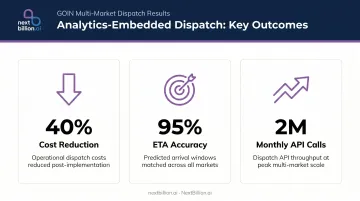
For operators running mixed fleets across multiple markets, that combination — lower routing costs, higher ETA accuracy, and headroom to scale call volume — is what separates analytics-embedded dispatch from legacy systems still relying on manual assignment logic.
Trend 5: Platform Consolidation and White-Label Ecosystem Growth
Two parallel forces are reshaping the competitive structure of the taxi dispatch software market.
At the enterprise end, features, integrations, and city coverage are concentrating among fewer players. The clearest 2025 example: Lyft acquired FREENOW from BMW and Mercedes-Benz for approximately $198.4 million, entering Europe and expanding across 150+ cities in 9 countries. Lyft described the deal as nearly doubling its addressable market — from 161 billion to more than 300 billion personal vehicle trips annually.
At the other end, a 10-vehicle taxi operator can now launch an app-based dispatch operation under their own brand — without custom software development. Several platforms already offer branded passenger apps and white-label dispatch configurations out of the box:
- TaxiCaller
- Jugnoo
- Cabsoluit
- Yelowsoft
The entry cost is a monthly subscription, not a six-figure development project.
That compression matters for the broader market: smaller fleets are no longer locked out of branded, app-based operations, while enterprise-level acquisitions keep pushing the ceiling on what integrated platforms can do.
What's Driving These Taxi Dispatch Software Trends
These trends share common underlying forces.
Technology and Innovation
McKinsey reports approximately $401 billion invested in future mobility since 2010, with post-2022 investment focused on electrified and autonomous technologies. Advances in AI, cloud infrastructure, and mapping APIs have lowered the cost of sophisticated dispatch systems to the point where SaaS vendors can offer them at $28/vehicle/month.
The route optimization software segment serving ride-hailing and taxi services is forecast to grow at 14.8% CAGR from 2024 to 2030 — a direct signal that AI routing is becoming a buying criterion, not an optional add-on.
Market Demand and Customer Expectations
Statista projects 2.34 billion ride-hailing users globally by 2026, with user penetration rising from 24.6% in 2026 to 28.7% by 2030. Those users expect app-based booking, real-time driver tracking, upfront fare estimates, and digital payments — standards set by Uber and Lyft that every taxi operator now competes against.
Cost Pressures and Compliance Requirements
Rising fuel costs and thin margins make route optimization a survival priority. Regulatory requirements add another layer of complexity, pushing operators toward dispatch platforms built to handle specific compliance constraints:
- NEMT compliance: CMS defines NEMT as a Medicaid transportation benefit, requiring documented trip management and eligibility verification
- ADA paratransit: FTA rules mandate comparable service for riders unable to use fixed-route transit, with strict scheduling and pickup-window requirements
- Emerging AV regulations: New autonomous vehicle frameworks are creating additional dispatch workflow requirements as fleets begin integrating mixed human-AV operations
These aren't preferences operators can defer — they're operational requirements that drive software specialization.
How These Trends Are Impacting the Taxi Industry
Operational Impact
AI dispatch has removed the dispatcher bottleneck for routine assignments. The Nature study benchmarks a 25.25% fleet-size reduction under optimized dispatch conditions — meaning the same demand can be served with fewer vehicles when matching and routing are running efficiently. For operators, that translates directly to idle mileage, fuel, and driver cost savings.
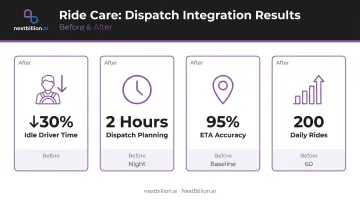
The Ride Care implementation offers a concrete example of what that looks like in practice. After integrating NextBillion.ai's routing and dispatch tools with their Samsara platform, the operation delivered:
- Idle driver time dropped by 30%
- Dispatch planning time cut from half a night to 2 hours
- ETA accuracy reached 95%
- Daily ride volume scaled from 60 to nearly 200
Business Impact
Results like these are pushing taxi companies to function as platform integrators — assembling best-in-class SaaS tools for dispatch, mapping, payments, and analytics rather than building proprietary systems.
The iCabbi-Google Fleet Engine partnership and the Lyft-FREENOW acquisition illustrate the pattern clearly: routing, mapping, local taxi supply, and app distribution are consolidating into ecosystems. Operators who navigate that ecosystem effectively gain a structural advantage.
Workforce Impact
AI dispatch shifts the dispatcher role from routine assignment to exception management and fleet strategy. Driver apps with turn-by-turn navigation have reduced the geographic knowledge required to onboard new drivers. The BLS projects taxi, shuttle, and chauffeur employment to grow 9% from 2024 to 2034 — indicating that automation is augmenting the workforce, not replacing it.
Future Signals for Taxi Dispatch Software (2026–2028)
Several developments will define the next phase of this market:
- Autonomous vehicle integration: Lyft and BENTELER Mobility announced plans to introduce autonomous shuttles across Lyft's network of 44M+ riders by 2026. Dispatch platforms are beginning to build API layers for AV fleet management; operators should evaluate vendor AV readiness now.
- NEMT and paratransit expansion: Compliance complexity in NEMT is driving specialization. Platforms with eligibility workflows, accessibility routing, and audit-grade trip documentation are positioned to capture this growing vertical.
- Deeper IoT integration: Real-time vehicle health data feeding into dispatch decisions — tire pressure, battery state, maintenance alerts — is already influencing dispatch decisions as telematics and dispatch layers converge
- Voice and conversational AI: Driver and passenger interaction via voice commands is emerging as a navigation and dispatch interface, reducing friction in the booking and assignment flow.
By 2028, the sharpest dividing line will likely be between vendors that built multi-modal dispatch from the ground up and those that bolted ride-hailing onto a legacy taxi core. Regulatory clarity around AVs will accelerate that split — creating new dispatch software categories that didn't exist in 2024. Operators evaluating platforms now are, in effect, choosing which side of that divide they'll be on.
Conclusion
The taxi dispatch software market in 2026 is being reshaped by five forces acting simultaneously:
The taxi dispatch software market in 2026 is being reshaped by five forces acting simultaneously:
- AI-driven routing that adapts to real-time demand and traffic
- Cloud-native SaaS adoption replacing on-premise dispatch infrastructure
- EV fleet integration demanding range-aware, charge-stop-optimized routing
- Embedded analytics turning trip data into operational decisions
- Platform consolidation reducing the vendor sprawl operators manage today
Together, these shifts represent a fundamental change in how mobility businesses operate — not a product cycle, but an infrastructure one.
Operators who modernize their dispatch infrastructure now — choosing scalable platforms with open APIs and investing in routing intelligence — will carry a measurable cost and service edge as the market accelerates through 2028. The window to close that gap on competitors running modern stacks narrows each quarter.
Frequently Asked Questions
What is the taxi dispatch software market size in 2026?
No single verified TAM exists for taxi dispatch software specifically. The closest proxy is the broader ride-hailing market, which Mordor Intelligence values at $184.49B in 2026, projecting growth to $392.27B by 2031 at a 16.29% CAGR. Route optimization software serving these fleets is forecast to grow at 14.8% CAGR through 2030, driven by app-based demand, fleet digitization, and AI routing adoption.
How is AI improving taxi dispatch operations?
AI enables real-time driver-rider matching using ML models that evaluate driver location, traffic, vehicle capacity, and demand hotspots simultaneously. A 2024 Nature study benchmarked AI dispatch at 25.25% fleet-size reduction and 87%+ arrival-time accuracy. In practice, operators report 30% reductions in driver idle time and ETA accuracy exceeding 95%. Underlying this is mapping and routing infrastructure that recalculates ETAs against live traffic and road conditions rather than static distance tables, which is what makes dispatch assignments and rider-facing arrival estimates hold up in dense urban traffic.
How much does a taxi dispatch system cost?
SaaS platforms offer transparent per-vehicle pricing — TaxiCaller publishes $28 per vehicle per month with no setup cost or contracts. Yelowsoft and Cabsoluit offer subscription plans at undisclosed per-vehicle rates. For most small and mid-size operators, cloud SaaS is the more accessible and cost-predictable path.
What is the best taxi dispatch system?
There is no single best platform. The right choice depends on fleet size, geographic focus, EV mix, and compliance requirements. Prioritize AI dispatch capability, EV routing support, API integration depth, scalability, and total cost of ownership over feature checklists. Operators building custom dispatch logic should also weigh whether the underlying mapping and routing engine is exposed via API, since off-the-shelf dispatch apps often lock routing behavior, making it hard to tune for local traffic patterns, curb access, or fleet-specific constraints.
What features should every modern taxi dispatch software include?
- Real-time GPS tracking and live driver monitoring
- Automated AI dispatch and driver assignment
- Route optimization with traffic-aware ETAs
- Mobile apps for drivers and passengers
- Multiple payment options and digital receipts
- Analytics and reporting dashboards
Is cloud-based taxi dispatch software better than on-premise solutions?
For most operators, yes. Cloud platforms offer lower upfront costs, automatic updates, easier scaling, and faster integration with third-party tools. On-premise solutions suit large enterprises with strict data sovereignty requirements, but the IT investment required is rarely practical for typical taxi operations. Cloud dispatch also makes it easier to swap or upgrade individual components, such as the routing or mapping engine, without a full platform migration, which matters as fleets add EVs or expand into new US metros with different traffic and regulatory conditions.
Do US taxi dispatch platforms need to account for FMCSA or DOT rules?
Taxi fleets are generally regulated at the state and municipal level rather than under FMCSA hours-of-service rules, which mainly target commercial trucking. However, larger fleets or those operating vehicles above certain weight thresholds may fall under DOT oversight for vehicle maintenance and driver qualification records. Dispatch software should support driver logs, vehicle inspection tracking, and reporting exports so operators can respond to state or local regulatory audits without manual recordkeeping.
Can taxi dispatch software route for wheelchair-accessible or ADA-compliant vehicles?
Yes, dispatch systems can be configured to tag vehicles by accessibility features and match ride requests to wheelchair-accessible vehicles specifically. This depends on the underlying routing engine supporting vehicle-attribute-based assignment rather than treating all vehicles as interchangeable. Many US municipalities require accessible-ride availability as a condition of operating licenses, so this matching capability is often a practical necessity rather than an optional feature for taxi and paratransit operators.