That final leg is last mile delivery. It's where customer satisfaction is won or lost, where operational costs spike, and where most of the complexity in modern logistics lives.
This guide covers what last mile delivery actually is, how it fits within the broader supply chain, why it's expensive, the challenges operators face, and the best practices and emerging trends that separate efficient operations from costly ones.
Key Takeaways
- Last mile delivery is the final step in shipping — moving packages from a local hub to the end customer's location.
- It accounts for 53% of total shipping costs, according to a 2024 WEF/Accenture report.
- Key challenges include traffic congestion, failed deliveries, rising customer expectations, and visibility gaps.
- Route optimization, strategic inventory placement, and real-time tracking are the highest-impact optimization levers.
- AI-powered routing is rapidly replacing static planning and is now table stakes for competitive last-mile operations.
What Is Last Mile Delivery?
Last mile delivery is the final stage of the logistics process: a package moves from a transportation hub, fulfillment center, or local delivery station to the end customer's location — a home, business, or pickup point. The "last mile" is metaphorical. The actual distance might be three city blocks or thirty rural miles. Carriers such as USPS, UPS, FedEx, Amazon's own delivery network, and regional or contracted courier fleets all operate in this final-mile role, and which one handles a given package depends on the shipper's carrier agreement. Amazon does not own last-mile delivery outright, but it has built a large proprietary network of delivery service partners and drivers alongside its continued use of USPS and other carriers for a portion of volume.
What makes last mile distinct is the structure of the work. Every other stage of shipping moves consolidated freight between fixed points in bulk. Last mile breaks that freight apart into individual deliveries across dispersed, unpredictable addresses. One driver, one vehicle, dozens of unique stops. That fragmentation drives most of the cost and complexity problems in last mile logistics.
Beyond cost complexity, last mile is the only stage of the supply chain that customers actually experience. Every other step — manufacturer to distribution center, distribution center to regional hub — is invisible to them. The driver who shows up at the door is the brand.
A late delivery, a missed window, or a package left in the rain lands as a brand failure — not a logistics one.
The Last Mile Delivery Process: Step by Step
A standard last mile operation follows five core steps:
- Order received and processed — the order is confirmed and picked, packed, and prepared for shipment
- Package arrives at delivery station — inbound freight is sorted at a local hub near the destination
- Orders assigned and routes planned — packages are grouped by geography and assigned to drivers with sequenced routes
- Packages scanned and loaded — drivers verify and load their manifests before departure
- Delivery and proof of delivery captured — the driver delivers to the recipient's address and records confirmation
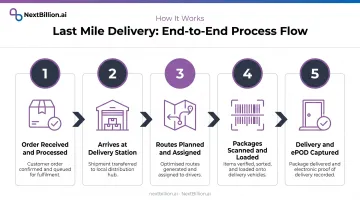
Each step depends on the one before it. Errors in sortation or route planning don't stay contained — they compound into missed deliveries downstream.
Where Last Mile Fits in the Supply Chain
The supply chain has three legs:
| Stage | Movement | Characteristics |
|---|---|---|
| First Mile | Manufacturer/supplier → distribution center | Bulk freight, fixed origin/destination |
| Middle Mile | Distribution center → regional sort facility | Consolidated shipments, high efficiency |
| Last Mile | Local hub → customer's door | Individual deliveries, variable routes |
The earlier stages are efficient because they move consolidated loads between known locations on predictable schedules. Last mile breaks that pattern entirely: disaggregated shipments, residential addresses, and real-time variables like traffic, access restrictions, and customer availability make it the least predictable leg of the three.
Last mile delivery stations are a distinct piece of this infrastructure worth clarifying. A delivery station is a local sort facility positioned close to dense customer populations, handling final sortation and dispatch — not order picking or inventory management. That's the fulfillment center's job. Delivery stations are optimized purely for throughput and route efficiency, which means the operational metrics that matter there (stops per route, dwell time, route density) are entirely different from those in a warehouse.
Why Last Mile Delivery Is So Expensive
The core inefficiency is structural. Bulk freight moves thousands of items between two fixed points on one truck. Last mile requires a driver, vehicle, and fuel for each individual stop — often to deliver a single small package.
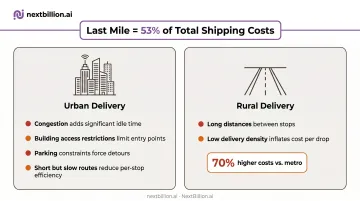
According to the WEF/Accenture 2024 urban logistics report, last mile delivery accounts for 53% of total shipping costs. MIT Sloan Management Review independently cited the same figure.
The primary cost drivers:
- Labor — driver wages, benefits, and associated employment costs dominate last mile expense
- Fuel and vehicle maintenance — frequent stop-and-go driving accelerates wear and increases consumption
- Failed deliveries — Loqate's research found that 8% of first-time U.S. deliveries fail, at an average cost of $17.20 per failed attempt — and each failure typically requires a redelivery or return-to-hub
- Low stop density — routes with few deliveries per mile stretch driver time without proportional revenue
Geography compounds these pressures in opposite directions. Urban routes deal with congestion, complex building access, and parking constraints despite short distances. Rural routes stretch across long distances with few stops per mile. A 2026 Journal of Transport Geography study found that rural parcel delivery costs run 70% higher than in metropolitan centers — a gap driven by lower delivery density and longer access distances that no amount of driver efficiency fully closes.
Key Challenges in Last Mile Delivery
Rising Customer Expectations
The Amazon Prime model reset what customers consider normal. Fast delivery is now an expectation, not a feature. A 2025 Sifted consumer survey found that 37% of consumers prioritize fast delivery (same-day, next-day, or two-day) above other shipping factors. More telling: 76% said a positive delivery experience influenced their decision to repurchase from a brand.
McKinsey's 2025 data adds nuance. Delivery speed has actually dropped from the top consumer priority — free or low-cost shipping now matters more than raw speed for many shoppers. The real pressure on operators is the combination: customers want both speed and price, with real-time visibility as a baseline expectation throughout.
Route Complexity and Traffic
Urban traffic makes even short routes unpredictable. A two-mile delivery can take twelve minutes or forty-five, depending on the time of day. Static or manually planned routes cannot adapt to road closures, accidents, or variable service times at individual stops.
Rural routes present the opposite problem: long stretches between stops mean high fuel and time cost per delivery, with little opportunity to consolidate.
Failed Deliveries and Returns Management
When a delivery fails, the costs multiply fast. Each failure means a sunk delivery cost, a full redelivery attempt (labor, fuel, vehicle), and potentially a return to the hub. At $17.20 per failure and an 8% first-attempt failure rate, the aggregate impact on a high-volume operation is substantial.
Common failure triggers include wrong addresses, no one home, and access restrictions at the delivery point. If a package is already with the last-mile provider, the delivery window quoted at checkout or in the tracking notification is generally the most reliable estimate available, and contacting that provider's customer service or tracking portal directly is the fastest way to get an update, since the original retailer typically has no more visibility into the driver's route than the customer does. restrictions at the drop-off point.
Returns management (reverse logistics) adds a parallel operational burden: collecting returns, hub processing, and restocking or disposal — at a cost that's harder to forecast than outbound delivery.
Visibility and Tracking Gaps
Many delivery operations lose visibility the moment a driver leaves the depot. That gap hits operations on two fronts:
- Customers get no accurate ETA updates, which drives inbound support inquiries.
- Dispatchers can't detect or respond to delivery exceptions in real time.
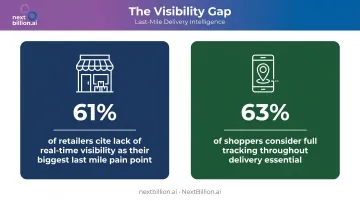
The data shows how significant this gap is: a Bringg survey found that 61% of retailers cited lack of real-time visibility as the biggest pain point when scaling delivery. On the consumer side, 63% of shoppers consider full tracking throughout the delivery process essential, per Sifted's 2025 research.
Sustainability and Environmental Pressure
Urban delivery fleets — multiple vehicles, frequent idling, residential routes — generate disproportionate emissions relative to the goods delivered. The WEF/Accenture 2024 report projects that, without action, emissions from urban deliveries could rise 60% by 2030. The EU is already responding with zero-emission urban freight logistics policies and Sustainable Urban Logistics Plans. Operators who don't plan now will face regulatory pressure later.
Best Practices to Optimize Last Mile Delivery
Invest in Intelligent Route Optimization
Effective route optimization accounts for traffic history, delivery time windows, vehicle capacity, driver skills, mandatory breaks, and dozens of operational constraints — all at once. Basic tools calculate distance. The real value comes from platforms that model how deliveries actually work.
NextBillion.ai's Route Optimization API supports 50+ hard and soft constraints — covering time windows, multi-dimensional capacity (weight, volume, pallets), driver skill matching, vehicle type restrictions, and SLA compliance — with sub-second response times for complex, multi-stop planning.
For operations scaling volume without scaling costs proportionally, the platform offers per-vehicle and per-order pricing instead of per-API-call billing, keeping costs predictable as delivery volume grows.
Use Strategic Inventory Positioning
Placing inventory closer to end customers — through regional warehouses or fulfillment centers — reduces shipping zones, shortens transit times, and shrinks the last mile route itself. Fewer miles per route, fewer stops per driver, lower cost per delivery. Those savings multiply fast across a large fleet.
Provide Real-Time Tracking and Proactive Customer Communication
Customers who know when to expect their delivery are more likely to be available to receive it — which directly reduces failed delivery rates. An effective tracking experience includes:
- Dispatch notification when the driver begins their route
- Narrowed delivery window as the driver approaches
- Live driver location visible to the recipient
- Delivery confirmation with timestamp and proof
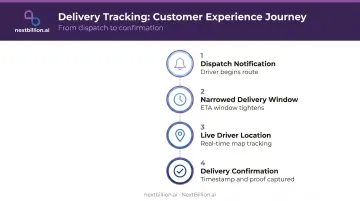
NextBillion.ai's Live Tracking API delivers real-time vehicle and driver location with up to 1-meter accuracy, geofence-triggered customer alerts, and configurable notifications — the core infrastructure behind a customer-facing tracking experience.
Implement Electronic Proof of Delivery (ePOD)
ePOD captures digital signatures, photos, OTP validation, and timestamps at the point of delivery. This creates a verified record that reduces disputes, protects against false claims, and closes the loop on each stop.
Key ePOD capabilities to look for in any delivery platform:
- Photo capture at the point of delivery
- Digital signature collection
- OTP validation for high-value or age-restricted items
- Automatic timestamp and location stamp per stop
Diversify Carriers and Leverage 3PL Partnerships
No single carrier is optimal for every parcel type, route density, or service level. A diversified mix — matched to parcel weight, destination, and required speed — reduces cost and increases resilience.
Route optimization platforms that support mixed-fleet and multi-carrier scenarios let you optimize across owned and contracted vehicles simultaneously — accounting for different cost models (distance-based, per-order, fixed) and keeping both cost and coverage predictable across your entire carrier mix.
Trends Shaping the Future of Last Mile Delivery
AI and Machine Learning in Route and Dispatch Optimization
AI-powered routing is moving from a differentiator to an operational baseline. The 2025 MHI and Deloitte Annual Industry Report found that 28% of supply chain respondents are already using AI, with another 54% planning to adopt it — the highest adoption signal the report has recorded.
In practice, AI-powered routing enables:
- Real-time rerouting based on live traffic data
- Dynamic stop resequencing when cancellations or new orders arrive mid-route
- Predictive ETAs accurate enough to support customer-facing delivery windows
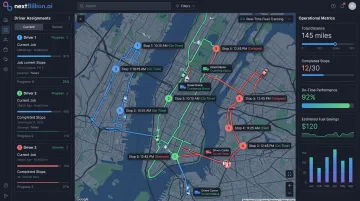
NextBillion.ai's platform applies ML-driven routing to handle these scenarios at scale — with documented outcomes including 95% accurate ETA predictions and the ability to process large-scale routing requests in milliseconds. Customers like Xpress Global Systems have achieved a 35% reduction in operating costs and a 13% reduction in miles driven monthly through the platform.
Electric Vehicles and Sustainable Fleet Adoption
EV adoption in last mile delivery fleets is accelerating fast. Recent data illustrates the shift:
- Electric light commercial vehicle sales grew more than 50% in 2023, reaching nearly 5% of all LCV sales globally (IEA)
- USPS has committed to deploying over 66,000 electric vehicles by 2028
- Replacing combustion vans with EVs can reduce carbon emissions by up to 85% (WEF/Accenture)
Route planning for EV fleets adds new constraints — charging schedules, range limits, charging station locations — requiring constraint-aware optimization software.
Autonomous and Alternative Delivery Methods
Drones and sidewalk robots are reaching commercial scale in select markets. Recent deployments illustrate the pace:
- Walmart expanded drone delivery to cover up to 1.8 million additional households in Dallas-Fort Worth in 2024
- Starship Technologies surpassed 8 million autonomous sidewalk robot deliveries the same year
These are not imminent replacements for driver-based delivery at scale. For most operators today, they're supplemental channels suited to specific use cases — dense urban areas, short-distance high-frequency deliveries, or campus environments. That said, operators planning fleet and network investments now should factor in where these channels will absorb volume within the next 3–5 years.
Frequently Asked Questions
What is last mile dispatch?
Last mile dispatch is the process of assigning delivery orders to drivers and vehicles from a local hub or delivery station, including route sequencing and driver communication. It's the operational bridge between a sorted package and a driver heading out for delivery.
Why is last mile delivery so expensive?
Last mile breaks consolidated freight into individual deliveries across dispersed residential locations, requiring separate driver time, vehicle use, and fuel for each stop. Failed deliveries add further cost through redelivery attempts — at roughly $17.20 per failure in the U.S.
What is the difference between last mile and first mile delivery?
First mile covers the movement of goods from a manufacturer or supplier to a distribution center. Last mile covers the final delivery from a local hub to the end customer — the shortest but most expensive and complex stage of the supply chain. First mile moves in bulk on predictable routes between fixed facilities, while last mile involves dispersed addresses, narrow delivery windows, and driver-level decisions, which is why dispatch software focuses most of its optimization effort there.
What is last mile delivery tracking?
Last mile tracking is the real-time monitoring of a package from the point it leaves a delivery station until it reaches the customer's door. It typically includes dispatch notifications, live driver location, estimated delivery windows, and proof-of-delivery confirmation. Dispatchers use this data to flag delayed stops, reroute drivers around traffic or closures, and answer customer status questions without calling the driver directly, which keeps the route moving on schedule.
How can route optimization improve last mile delivery?
Route optimization reduces fuel consumption, shortens delivery times, and increases stops per shift by automatically calculating the most efficient sequence — accounting for traffic, time windows, vehicle capacity, and driver constraints. Platforms like NextBillion.ai handle these calculations at sub-second speeds, even across hundreds of stops and vehicles.
Who delivers last-mile packages?
Last-mile packages move through a mix of national carriers, regional couriers, and independent contractor fleets, depending on the retailer or shipper. Many companies also run their own delivery stations and dispatch their own drivers rather than handing off to a third-party carrier for the final stretch. Dispatch software sits underneath all of these models, assigning stops to whichever drivers and vehicles are available for that route or zone.
How long until I get my package if it's with the last-mile provider?
Once a package is with the last-mile provider, delivery timing depends on the driver's route sequence, current stop load, and local conditions like traffic or delivery windows tied to the address. Dispatch systems generate an estimated delivery window based on the optimized route, but this can shift if a driver hits delays, failed delivery attempts, or added stops earlier in the run.