This guide is written for IT decision-makers, operations leaders, and cloud architects in logistics, healthcare, financial services, and field services who are evaluating whether private cloud is the right infrastructure choice. You'll find a clear explanation of what private cloud is, how it works architecturally, why organizations adopt it, and — critically — when it may not be the right fit.
According to a Forrester Consulting study commissioned by IBM, 56% of IT decision-makers keep infrastructure outside public cloud because of data residency challenges, and 46% cite unmet security needs. Those numbers tell you exactly who private cloud is built for.
Key Takeaways
- Private cloud is a single-tenant environment where compute, storage, and networking are dedicated exclusively to one organization
- It can be hosted on-premises, at a third-party facility, or as a logically isolated environment within a public cloud provider
- Primary adoption drivers: data control, regulatory compliance (HIPAA, GDPR, SOC 2), predictable performance, and security isolation
- Key trade-offs: higher upfront costs, limited scalability, and greater IT management overhead
- Private cloud justifies its cost only when workloads genuinely require isolation, strict compliance enforcement, or consistent performance guarantees
What Is the Private Cloud Deployment Model?
According to NIST SP 800-145, private cloud is infrastructure "provisioned for exclusive use by a single organization," managed by the organization itself, a third party, or both — and deployable on or off premises.
The defining characteristic is single tenancy: no other organization shares your compute, storage, or networking resources. In public cloud, multiple customers run on shared physical hardware simultaneously. In a private cloud, that hardware is yours alone. That separation directly determines what your security team can audit, what controls you can enforce, and how you demonstrate compliance to regulators.
The Four Types of Private Cloud
Private cloud is not a single architecture. IBM identifies four variants:
| Type | Where It Lives | Who Manages It |
|---|---|---|
| On-premises | Your own data center | Your IT team |
| Hosted private cloud | Third-party data center | Shared (provider handles hardware) |
| Managed private cloud | On-prem or hosted | Third-party provider operates it for you |
| Virtual private cloud (VPC) | Public cloud infrastructure | Public cloud provider |
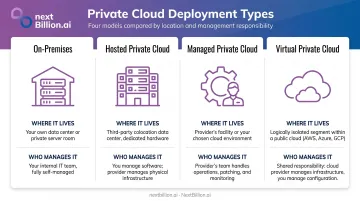
The VPC deserves a caveat: it provides network-level isolation within shared physical infrastructure, not dedicated hardware. It's a practical middle ground — but not the same as dedicated single-tenant infrastructure.
Private Cloud vs. Public vs. Hybrid
- Public cloud: shared infrastructure, managed by the provider, billed on consumption (AWS, Azure, GCP)
- Private cloud: dedicated infrastructure, controlled by or for one organization, accessed via internal networks
- Hybrid cloud: combines both, routing workloads to whichever environment fits their requirements
An on-premises data center is not automatically a private cloud. It becomes one only when it incorporates cloud-native capabilities — virtualization, automation, self-service provisioning, and orchestration. Traditional on-prem servers without those layers are just conventional IT infrastructure. The deployment model that uses a private and public cloud together is the hybrid cloud, which routes workloads to whichever environment best matches their compliance, cost, or performance requirements at any given time.
How Private Cloud Deployment Works
A private cloud has two fundamental layers, as defined by NIST: a physical layer (servers, storage, networking) and an abstraction layer (software that delivers cloud-like behavior on top of that hardware).
Provisioning and Infrastructure Setup
The first phase involves procuring or renting dedicated server hardware, installing a hypervisor (the virtualization layer), and configuring isolated networking — either on-premises or at a hosted facility. This establishes the physical foundation before any cloud-like features can operate on top of it.
Virtualization and Resource Pooling
Virtualization divides physical hardware into multiple virtual machines (VMs), each with its own operating system and resource allocation. This lets organizations maximize hardware utilization while keeping workloads logically separated. A single physical server can host dozens of VMs, each operating as if running on independent hardware.
Orchestration and Self-Service Management
This is where private cloud actually behaves like a cloud. Management platforms such as OpenStack — described by Red Hat as an open source platform that uses pooled virtual resources to build and manage private clouds — give administrators centralized control over provisioning, access policies, and scaling.
Kubernetes handles containerized workload deployment and autoscaling. Mercedes-Benz, for example, runs 900 on-premises Kubernetes clusters across four global data centers using OpenStack , a real illustration of what enterprise-scale private cloud orchestration looks like in production.
That same orchestration layer matters for any enterprise software deployed inside a private cloud. NextBillion.ai's routing and mapping platform, for instance, deploys directly into a customer's own Kubernetes environment: AWS EKS, GCP GKE, Azure AKS, or a self-managed cluster on bare-metal servers. The platform ships with an open-source utility called k10s and Helm chart templates to simplify deployment. SOC 2 Type II and ISO/IEC 27001:2013 certifications cover enterprise security review requirements.
Why Enterprises Choose Private Cloud Deployment
Data Control and Regulatory Compliance
Regulated industries face a structural problem with public cloud: sharing physical infrastructure with unknown tenants creates audit complexity and potential compliance exposure. Healthcare organizations handling electronic protected health information (ePHI) must meet HIPAA's administrative, physical, and technical safeguard requirements. Financial services firms operate under PCI-DSS and SOX. Organizations with EU customers must comply with GDPR's data transfer restrictions under Article 44.
Private cloud addresses this by giving organizations direct control over:
- Where data is stored (specific data center, specific geography)
- How data is processed (custom encryption standards, isolated compute)
- Who can access it (granular access controls, audit logging)
- How compliance is demonstrated (full visibility into infrastructure)
Consistent, Predictable Performance
Public cloud environments can suffer from what's called the "noisy neighbor" effect: co-resident virtual machines competing for shared CPU, memory, and network bandwidth. Research published in a 2025 empirical assessment confirms that multi-tenant public IaaS can produce performance unpredictability due to these shared-resource dynamics.
For logistics operations, NEMT scheduling, or healthcare applications where response latency directly affects outcomes, that variability has real consequences — missed pickups, failed SLAs, degraded patient care. Private cloud eliminates the shared-resource variable by dedicating compute and network capacity to a single tenant. The trade-off is worth naming directly: private cloud typically requires higher upfront capital investment, offers less elastic scalability than public cloud, and demands more in-house IT expertise to manage hardware, patching, and capacity planning over time.
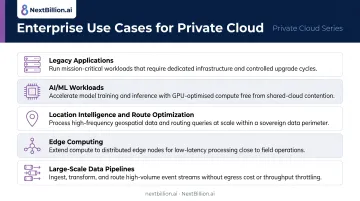
Use Cases That Drive Adoption
- Legacy applications that cannot migrate to public cloud without expensive re-architecture
- AI/ML workloads requiring custom hardware configurations (GPUs, high-memory nodes)
- Location intelligence and route optimization platforms with data sovereignty requirements, where routing queries, location data, and route history must stay within a controlled environment
- Edge computing for distributed operations such as fleet tracking or remote patient monitoring
- Large-scale data pipelines where data residency rules prohibit cross-border transfers
Key Factors That Shape Private Cloud Deployment
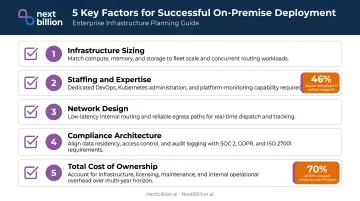
Five dimensions determine whether a private cloud deployment succeeds or stalls — and each one deserves honest scrutiny before you commit:
Size infrastructure for peak demand, not average load. Hardware quality, server density, and storage architecture set hard performance limits — and public cloud bursting isn't available by default, so under-provisioning has real consequences.
Staff for virtualization, networking, and security — or contract it out. Understaffing leads directly to configuration drift and unpatched vulnerabilities. IDC's 2025 server refresh white paper found 46% of organizations require virtualization software support and 37% require container orchestration compatibility when selecting infrastructure.
Design the network before provisioning hardware. Internal bandwidth, inter-node latency, and secure external access (VPN, private interconnects) determine whether distributed teams and remote workloads can actually reach the environment.
Architect compliance controls in from day one. HIPAA, GDPR, and SOC 2 each impose specific encryption standards, audit logging, and access management requirements — retrofitting them later is far more expensive and disruptive.
Model total cost of ownership across 3–5 years, not just upfront CapEx. Hardware, licensing, facilities, power, and cooling are the visible costs; staffing, patching, and hardware refresh cycles are where budgets quietly erode. The same Forrester study found 70% of firms had delayed infrastructure refreshes over the prior five years — and 44% of those cited higher costs as a direct result.
Common Misconceptions About Private Cloud
"Private cloud is just on-premises infrastructure."
On-premises IT without self-service provisioning, automation, and virtualization is traditional infrastructure — not cloud. NIST's definition requires on-demand self-service, resource pooling, rapid elasticity, and measured service. Hardware alone doesn't qualify.
"Private cloud is automatically more secure than public cloud."
Isolation reduces exposure from shared tenancy, but security outcomes still depend on operational discipline. Misconfigured access controls, unpatched systems, and weak internal monitoring can make a private cloud more vulnerable than a well-managed public environment. Security must be actively maintained, not assumed based on physical separation.
"Private cloud means unlimited scalability."
Scaling is constrained by physical hardware capacity. Adding capacity means procurement lead time — not a configuration change. TCO is also routinely underestimated. Beyond hardware purchase costs, the real bill includes:
- Staffing and internal IT labor
- Software licensing and support contracts
- Facility operations (power, cooling, physical space)
- Hardware refresh cycles — IDC data shows 44% of organizations replace server infrastructure every three years or less
When Private Cloud Deployment May Not Be the Right Choice
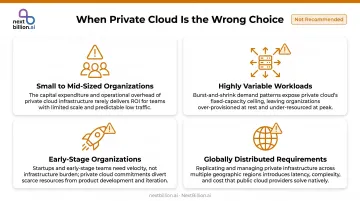
Private cloud is the wrong fit for several common scenarios:
- Small to mid-sized organizations without a dedicated team capable of managing virtualization, networking, and security operations
- Highly variable workloads that require rapid elastic scaling — public cloud's elasticity (acquiring and releasing resources automatically) is genuinely difficult to replicate on fixed hardware
- Early-stage organizations prioritizing speed to market, where procurement and setup cycles add friction
- Globally distributed data requirements — private cloud data centers are geographically fixed, which creates latency and data-access challenges for globally distributed users
Some organizations pursue private cloud because it's perceived as the enterprise standard, not because the workload demands it. For applications that aren't sensitive, aren't regulated, and don't require custom configurations, public cloud almost always delivers better cost efficiency, scalability, and built-in redundancy.
Hybrid Cloud as a Pragmatic Middle Ground
For most organizations, the practical answer is a hybrid model: place only the most sensitive or performance-critical workloads in a private environment, and let public cloud handle everything else.
NextBillion.ai takes exactly this approach with its deployment options. Organizations can run the routing and mapping platform in multi-tenant cloud (shared, zero setup), private cloud (dedicated infrastructure in AWS, GCP, or Azure), or fully on-premise (behind the customer's firewall in their own data center).
Enterprises with data-residency requirements or government-procurement rules can keep all routing queries and location data within their own environment, while less sensitive workloads use cloud-hosted infrastructure. The platform deploys on any Kubernetes cluster, so teams aren't locked into a single model as requirements evolve.
Conclusion
Private cloud delivers a dedicated, single-tenant environment that gives organizations direct control over their data, security posture, and infrastructure configuration. For regulated industries and security-sensitive operations, that control has real value.
The key decision principle: private cloud is the right choice when workloads genuinely require data isolation, compliance enforcement, or performance predictability that shared environments cannot guarantee. It's the wrong choice when those requirements don't apply and the costs and management overhead can't be justified.
Start from the workload requirements, not the deployment model. When isolation and compliance are genuine constraints, private cloud earns its cost. When they aren't, a well-architected public or hybrid setup usually delivers more flexibility for less. Some logistics and fleet technology platforms — including those with on-premise Kubernetes or VPC deployment options — make this decision easier by letting you match the deployment model to the workload, rather than committing your entire stack to one approach.
Frequently Asked Questions
What is a private cloud deployment model?
A private cloud deployment model is a single-tenant cloud environment where all computing resources — servers, storage, networking — are dedicated exclusively to one organization. It can be deployed on-premises in the organization's own data center or through a hosted third-party provider, accessed via private networks rather than the public internet.
What are the 5 cloud deployment models?
NIST SP 800-145 formally recognizes four deployment models: public cloud, private cloud, community cloud, and hybrid cloud. Many industry taxonomies also reference multi-cloud as a fifth category, though it is technically a sourcing strategy that draws from multiple providers, not a distinct deployment model under the NIST framework.
What are the 4 types of private cloud?
The four types are:
- On-premises — hosted and managed in your own data center
- Hosted private cloud — dedicated infrastructure at a third-party facility
- Managed private cloud — a provider deploys and operates it on your behalf
- Virtual private cloud — logically isolated environment within public cloud infrastructure
They differ primarily in where the hardware lives and who manages it.
Is a private cloud the same as on-premises infrastructure?
No. On-premises infrastructure becomes a private cloud only when it incorporates cloud-native capabilities: virtualization, automation, self-service provisioning, and orchestration. Traditional on-premises servers without these operational features are conventional IT infrastructure, not a cloud environment.
What industries benefit most from private cloud deployment?
Healthcare, financial services, government, and logistics benefit most. These sectors share common requirements: data residency controls, regulatory compliance (HIPAA, PCI-DSS, GDPR), and consistent performance for workloads where downtime or latency has direct operational consequences. For fleet and logistics operators, this also covers routing and dispatch systems that must stay operational and auditable to support DOT and FMCSA compliance processes, even though private cloud itself does not certify compliance.
What are the main disadvantages of private cloud?
The primary disadvantages are higher upfront capital costs, limited scalability relative to public cloud, dedicated IT management expertise requirements, and the risk of underutilized resources during low-demand periods. Scaling to meet seasonal demand, such as peak delivery volumes, typically requires advance capacity planning rather than on-demand elasticity. Each of these trade-offs must be weighed against the control and compliance benefits private cloud delivers.
Which deployment model uses a private and public cloud together?
A hybrid cloud deployment model combines private and public cloud environments, allowing data and applications to move between them. Organizations typically keep sensitive workloads, such as customer data or compliance-regulated routing records, on private infrastructure while using public cloud for less sensitive or burst-capacity needs. This lets fleet and logistics operators balance data control with the flexibility to scale compute during peak demand periods.
What are the downsides of using a private cloud?
Private cloud requires greater upfront investment in hardware, licensing, and specialized IT staff compared with public cloud subscriptions. Scaling is slower since capacity must be provisioned in advance rather than drawn on demand. Resources can also sit underutilized outside peak periods, raising the effective cost per workload. These downsides are typically accepted by organizations that prioritize data control, latency consistency, and compliance requirements over pure cost efficiency.