Route optimization software has moved firmly into mainstream logistics operations. The market was valued at $8.51 billion in 2023 and is projected to reach $21.46 billion by 2030, according to Grand View Research. Yet despite wide adoption, many fleet and logistics managers don't fully understand how the software generates the claimed fuel savings of up to 30% — they know it works, but not why.
This guide breaks down the specific mechanisms behind those savings: what the software actually does, how each feature reduces fuel consumption, and how to measure the results.
Key Takeaways
- Route optimization cuts fuel costs through compounding mechanisms: shorter mileage, less idle time, congestion avoidance, and smarter vehicle-to-job matching
- No single feature produces 30% savings; the gains stack across several dimensions simultaneously
- Modern platforms reroute dynamically mid-trip, preventing fuel waste when conditions change
- Beyond fuel, optimized routing also lowers maintenance costs, improves on-time rates, and increases driver utilization
- Track ROI through KPIs: miles driven, fuel cost per stop, idle time percentage, and empty-mile rate
What Is Route Optimization Software?
Route optimization software is a planning and execution system that uses algorithms, real-time data, and operational constraints to calculate the most cost-efficient routes for a fleet — not simply the shortest or fastest paths.
Planning vs. Optimization: Why the Difference Matters
Basic route planning sequences stops from A to B. True route optimization solves a multi-variable problem: given this vehicle type, this load, these time windows, this traffic forecast, and these driver hours — the system finds the sequence that minimizes total fuel consumption.
The algorithmic foundation is the Vehicle Routing Problem (VRP), an extension of the classic Traveling Salesman Problem. Where a GPS finds a path, a VRP solver evaluates thousands of possible combinations simultaneously to find the one that performs best against real-world constraints.
What route optimization software is not:
- A GPS navigation tool
- A static mapping application
- A one-time planning exercise
It is a continuous operational system. Routes adjust to live conditions — traffic, cancellations, new stops, road closures — and that continuous adjustment is what produces sustained fuel reduction, not a one-time efficiency gain.
NextBillion.ai's Route Optimization API, for example, supports 50+ hard and soft constraints across:
- Vehicle dimensions and weight limits
- Load type and temperature requirements
- Driver shift regulations and hours-of-service rules
- Time windows, road restrictions, and turn-by-turn penalties
A system that reflects this many real-world variables can minimize fuel consumption at the individual vehicle and load level — not just the average route.
How Route Optimization Software Reduces Fuel Costs
Fuel savings don't come from a single feature. They compound across four distinct mechanisms, each targeting a different source of waste. Fleets that track results across all four typically see the mechanisms reinforce one another — fewer miles driven also means less idle time and fewer congestion delays, which is why cumulative savings often exceed what any single lever would produce on its own.
Minimizing Total Miles Through Smarter Stop Sequencing
Manual route planning (even from experienced dispatchers using spreadsheets or basic GPS) typically produces routes with unnecessary backtracking, redundant cross-town legs, and suboptimal stop ordering. Optimization algorithms evaluate thousands of possible sequences to find the one that covers all stops with the least total distance.
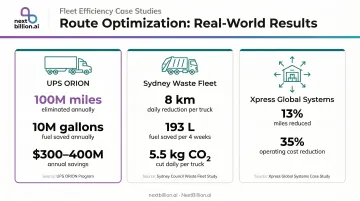
The results are well-documented in real operations. UPS's ORION system, which applies optimized delivery sequencing to driver routes, was projected at full deployment to eliminate 100 million miles per year, avoid 10 million gallons of fuel, and generate $300–$400 million in annual savings or cost avoidance, according to INFORMS.
At a smaller scale, a municipal waste fleet study on Sydney routes found that a single pilot truck reduced its daily distance by 8 km, saving 193 liters of fuel per four-week period and cutting CO₂ output by 5.5 kg daily. A separate 2024 waste collection study reported a 36.8% distance reduction after optimization.
For NextBillion.ai customers, documented results include Xpress Global Systems — a Tennessee-based distribution provider — which achieved a 13% reduction in miles driven per month while maintaining existing service levels. That mileage reduction fed directly into a 35% reduction in overall operating costs.
Those mileage reductions feed directly into fuel bills. The next lever works differently: it targets fuel burned while vehicles aren't moving at all.
Eliminating Idle Time and Congestion Losses
Idle time is a hidden but significant fuel drain. According to the DOE's Alternative Fuels Data Center, a heavy-duty truck consumes approximately 0.8 gallons of fuel per hour at idle. A typical long-haul truck idles roughly 1,800 hours annually, burning around 1,500 gallons without moving a single load.
Route optimization addresses idle time through two mechanisms:
- Time-window synchronization — arrival times are aligned with customer availability windows, reducing wait time at docks and stops. NextBillion.ai's platform factors in loading-bay windows, service durations, and appointment slots to prevent drivers from arriving before a facility is ready
- Congestion avoidance — real-time traffic integration allows the system to reroute drivers before they enter slow traffic, not after. Stop-and-go driving can reduce fuel economy by 10–40% compared to steady-speed driving, according to DOE data — so avoiding it has material impact
GOIN, a paratransit and NEMT provider using NextBillion.ai, reduced driver idle time by 30% through automated dispatch and smarter scheduling, contributing to a 40% reduction in total costs.
Dynamic Rerouting and Constraint-Based Optimization
Static routes become suboptimal the moment conditions change. A customer cancels. A road closes. An urgent stop appears. Without dynamic rerouting, drivers continue on a now-inefficient plan, burning fuel on a path that no longer reflects reality.
Dynamic route optimization continuously adjusts routes when inputs change. As CIRRELT's review of dynamic vehicle routing describes, these systems redefine routes in real time as customer requests, travel times, or vehicle availability evolve.
NextBillion.ai's platform processes these recalculations in milliseconds, generating updated dispatch-ready routes without disrupting the rest of the delivery plan.
Constraint-based optimization amplifies this further. Real fleets involve dozens of variables that generic routing ignores. A platform supporting 50+ constraints accounts for:
| Constraint Category | Examples |
|---|---|
| Vehicle specs | Dimensions, weight, cargo type, HAZMAT |
| Time | Delivery windows, driver shift limits, max visit lateness |
| Load | Multi-dimensional capacity, incompatible load types |
| Skills | Required certifications, equipment qualifications |
| Road restrictions | Truck-prohibited roads, weight bridges, residential bans |
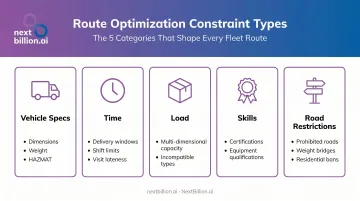
The more precisely a route reflects actual constraints, the less fuel is wasted on detours, returns, and non-compliant road choices.
Vehicle-Specific and Load-Aware Route Assignment
NACFE research documents 0.5–0.6% fuel savings for every 1,000 lb of weight reduction. That means assigning a lighter van to a suburban multi-stop run instead of an oversized box truck produces measurable savings on every single trip. Over a full fleet and a full year, that per-trip difference in vehicle-to-load matching adds up to a meaningful share of total fuel savings from route optimization software, even without changing the underlying routes themselves.
NextBillion.ai's platform configures vehicle profiles across dimensions, weight, cargo type, and capacity constraints. The route assignment engine matches jobs to the most appropriate vehicle, preventing a common source of avoidable fuel waste: sending the wrong vehicle type down the wrong road with the wrong load.
Backhaul optimization extends this logic to return legs. Rather than driving empty back to depot (deadhead miles accounted for 16.7% of trucking miles in 2024), the system identifies return-load opportunities in real time. Eliminating even a portion of empty return trips removes pure fuel waste with no service-level tradeoff.
Beyond Fuel: Compounding Benefits of Route Optimization
The same mechanics that reduce fuel consumption produce secondary benefits across the operation.
Three secondary gains compound the fuel savings:
- Maintenance costs drop as fewer miles and less stop-and-go driving reduce brake wear, tire degradation, and engine strain. Mileage-linked maintenance exposure falls in direct proportion to miles eliminated.
- Driver utilization improves when routes are tighter and more predictable. Drivers complete more stops per shift without overtime, and Xpress Global Systems found that confidence in optimized routes made drivers' jobs measurably faster and easier.
- On-time delivery rates rise as a direct byproduct of smarter scheduling. A Europe-based TMS provider using NextBillion.ai achieved a 30% improvement in ETA and ETD accuracy. GOIN reached 95% accurate arrival times through predictive ETA modeling.
Fuel savings are the headline — but for most fleets, the operational gains that follow are what close the ROI argument.
Measuring the ROI of Route Optimization Fuel Savings
Understanding the mechanisms is one thing. Proving the savings to stakeholders requires tracking the right metrics.
Key KPIs to Track
Establish baselines before implementation — without them, the ROI is invisible even when real.
- Total miles driven (weekly and monthly trend)
- Fuel cost per delivery or per stop
- Idle time as a percentage of total engine-on hours
- Empty-mile percentage
- Gallons consumed per route
The Sustainability Dimension
Those same miles-and-gallons numbers translate directly into carbon data — which matters beyond the finance team. NextBillion.ai's platform includes a CO₂ reduction metric in its ROI calculator, letting businesses quantify environmental impact alongside financial savings for ESG and sustainability reporting.
EPA data shows that burning one gallon of diesel emits 10,180 grams of CO₂. When UPS's ORION system avoided 10 million gallons of fuel annually, that translated to 100,000 metric tons of CO₂ reduction per year. For fleets with sustainability targets or customer-facing ESG commitments, that math matters.
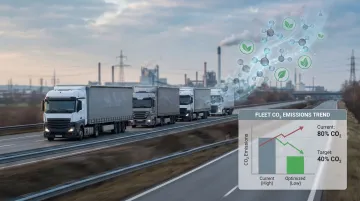
The Sydney waste-fleet study found that applying optimized routing to 400 trucks was projected to eliminate 300–600 tonnes of CO₂ per year — based on savings measured from a single pilot vehicle.
Track miles and gallons consistently, and the carbon story writes itself — giving operations teams, finance, and sustainability leads a single source of truth from the same underlying data.
Conclusion
Route optimization software reaches fuel savings of up to 30% through several compounding mechanisms working simultaneously:
- Smarter stop sequencing cuts total miles driven
- Synchronized scheduling reduces idle time between stops
- Real-time traffic integration keeps vehicles clear of congestion
- Constraint-based assignment matches the right vehicle to the right job
- Dynamic rerouting prevents mid-route waste when conditions shift
Fleet and logistics managers who understand how these savings are generated can evaluate platforms more rigorously, set realistic targets, and prioritize the capabilities that matter most for their specific operation.
NextBillion.ai's route optimization platform has delivered over $11 million in documented cost savings across 150+ businesses, optimizing more than 10.9 million deliveries globally. If you want to see how constraint-rich, AI-powered routing applies to your fleet, explore NextBillion.ai's free route analysis to get started.
Frequently Asked Questions
How much fuel can route optimization software realistically save?
The commonly cited range is 10–30%, with actual results depending on how inefficient current routing is, fleet size, and which optimization features are deployed. Operations moving from fully manual planning to algorithmic optimization typically see the largest gains, since there's more baseline inefficiency to address.
How quickly will I see fuel savings after implementing route optimization software?
Initial improvements are typically visible within the first 30–45 days. NextBillion.ai customers can go live within a week, and mileage reductions plus idle time decreases become measurable once drivers and dispatchers are fully adapted to optimized workflows.
What are the main benefits of route optimization software beyond fuel savings?
Key benefits include reduced vehicle maintenance exposure from fewer miles and less hard-stop driving, improved on-time delivery rates, better driver utilization, lower cost per delivery, and stronger customer satisfaction. Optimized routing also supports FMCSA hours-of-service compliance by planning stops and driving windows around legal limits, and gives dispatchers better visibility for IFTA mileage reporting across jurisdictions.
Does route optimization software work for small fleets, or only large ones?
Even fleets with 5–10 vehicles benefit significantly — proportional fuel waste from inefficient routing affects all fleet sizes. Smaller operations often see faster ROI due to simpler implementation, and NextBillion.ai's usage-based pricing means they're not locked into enterprise-scale costs.
Does route optimization software help reduce vehicle maintenance costs?
Fewer miles driven and less stop-and-go driving directly reduces brake wear, tire degradation, and engine strain. Fleet managers commonly report maintenance cost reductions alongside fuel savings, though exact figures vary by fleet type and duty cycle. Smoother, optimized routes also reduce unplanned downtime, since vehicles spend less time idling in traffic or making inefficient detours that add engine hours without adding delivery value.
What should I look for in route optimization software to reduce fuel costs?
Prioritize these core capabilities:
- Real-time traffic integration for accurate, current routing
- Constraint-based optimization covering vehicle type, load weight, time windows, and road restrictions
- Dynamic rerouting to handle mid-trip changes
- Native integrations with your existing fleet management systems
NextBillion.ai is built specifically for logistics and fleet use cases with all of these included.
How does route optimization software affect fuel savings for fleets using diesel versus electric vehicles?
Diesel fleets see fuel savings directly through reduced gallons burned from shorter, less congested routes and lower idle time. Electric fleets benefit differently: optimized routing reduces energy consumption per mile and helps planners account for charging stops and range limits within delivery windows. In both cases, the underlying driver is fewer miles and less inefficient driving behavior, not the fuel type itself.
Can route optimization software help with IFTA fuel tax reporting?
Route optimization software itself is not a tax filing tool, but the mileage and routing data it generates can support IFTA reporting by giving fleets accurate per-jurisdiction mileage records. Since IFTA calculations depend on miles driven in each state, cleaner routing data reduces manual reconciliation work, though fleets still need dedicated fuel tax software or processes to file returns.