Key Takeaways
- OEM distribution networks span truck, rail, upfitter, and dealer legs — blind spots between any leg create compounding delays downstream
- Real-time GPS tracking provides continuous position updates, automated milestone alerts, and carrier performance data across every leg
- Cargo theft increased 27% in 2024 and is predicted to rise another 22% in 2025; high-value OEM assets in transit are prime targets
- OEM-embedded and aftermarket GPS work best as a hybrid, unified through a single platform layer
- GPS data drives actionable dispatch decisions only when connected to route optimization, exception alerting, and ERP/TMS integrations
What Is Real-Time GPS Tracking for OEM Distribution?
Real-time vehicle tracking for OEM distribution means monitoring every vehicle, part, or unit of equipment continuously — with sub-minute position updates — as it moves from plant to dealer, rather than checking status once or twice a day. OEM distribution is the logistics chain that moves finished goods — vehicles, parts, industrial equipment — from manufacturing plants to dealers, distributors, or end customers.
That chain typically crosses multiple legs: rail yards, upfitter facilities, regional distribution hubs, and final-mile delivery to dealers or buyers.
GPS tracking in this context means monitoring those assets in transit across the entire chain — not just managing your own fleet vehicles. Every unit moving through every leg of that chain is a trackable asset, and knowing where each unit is at any moment is the operational foundation for everything downstream.
Real-Time vs. Periodic Tracking
Not all GPS tracking is equal. The key distinction is update frequency:
- Periodic/passive tracking — position updates every few hours or at end of day. Adequate for loose inventory audits, useless for managing live distribution handoffs
- Real-time tracking — position updates at sub-minute intervals, giving logistics teams a continuously refreshed view of every asset
For OEM distribution, the difference matters most at handoff windows. When a carrier arrives early at a railhead, or a truck is running two hours behind on a dealer delivery run, end-of-day reporting tells you what happened — real-time tracking lets you act before the downstream schedule collapses.
How It Works Operationally
GPS devices — either OEM-embedded or aftermarket — transmit location, speed, and status data at set intervals to a central platform, and this is how to track a vehicle in real time at scale: continuous device pings feeding a unified dashboard rather than manual driver check-ins. From there, the platform gives logistics teams:
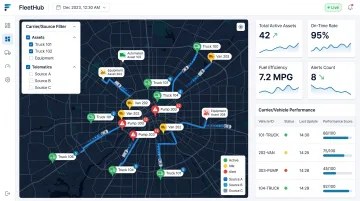
- A live map of every asset across the network
- Automatic alerts when assets hit (or miss) key milestones
- A running carrier performance record that identifies late patterns before they become systemic problems
Why OEM Distribution Networks Demand Real-Time Visibility
The Multi-Leg Compounding Problem
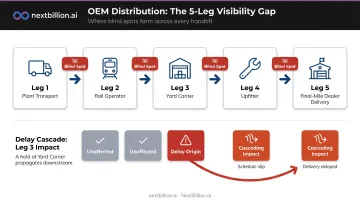
A typical vehicle distribution move crosses four or five carriers — the plant transport carrier, the rail operator, the yard carrier, the upfitter, and the final-mile driver. Each handoff is a potential blind spot. When leg three runs late and nobody knows until leg four is already staged and waiting, you've lost hours you can't recover.
Without continuous visibility, one delayed leg creates a chain of downstream delays with no early warning. Downstream partners — dealers scheduling recon bays, service teams preparing units for delivery — get no notice until the failure is already in motion.
Dealer Inventory Carrying Costs
Every day a unit sits in transit or at a staging facility instead of on a dealer lot costs money. Ford recognized this explicitly: in Q2 2025, Ford increased the floorplan credit paid to dealers by 25% for most gasoline vehicles — moving the upfront credit from 1.00% to 1.25% of sticker price. That adjustment signals how materially OEMs treat dealer inventory carrying costs.
Dealers can't prepare recon bays, schedule sales appointments, or update online listings accurately without reliable ETAs. Poor visibility doesn't just create operational friction — it hits dealer revenue directly.
Theft Risk for High-Value Assets
Vehicles, heavy equipment, and industrial OEM products are high-value targets. Cargo theft increased 27% in 2024, with losses exceeding $1 billion in 2023 and the average individual theft valued at more than $202,000. A further 22% increase is projected for 2025.
Real-time GPS enables immediate detection of unauthorized route deviations. When a unit leaves a planned corridor without authorization, an alert fires within minutes — not hours. That early alert gives logistics coordinators time to notify law enforcement while the unit is still in motion — a window that closes fast.
Compliance, Liability, and SLA Documentation
Route deviation data doesn't just matter for theft — it's also the backbone of carrier accountability. OEM distribution involves multi-party contracts and SLA commitments that are nearly impossible to enforce without documentation. GPS tracking creates a timestamped record of where every carrier was, when, and whether they adhered to planned routes and delivery windows.
That audit trail matters in two scenarios:
- Carrier disputes — when a carrier claims on-time delivery and your data shows a two-hour discrepancy
- Damage claims — when a unit arrives damaged and you need to establish which leg and which carrier had custody
On the legality question fleet operators often raise: tracking devices installed on company-owned vehicles used for business purposes are generally lawful in the US, since the vehicle and the trip data belong to the business, not the driver personally. Employers should still disclose tracking in company policy and avoid tracking personal vehicles or off-duty use without consent.
NextBillion.ai's Route Reconstruction API converts raw GPS breadcrumb sequences into road-snapped, audit-defensible trip records — directly comparable against planned routes for SLA verification.
Core Capabilities Every OEM GPS Tracking System Should Have
Live Location Tracking at Useful Update Frequencies
Hourly position pings are insufficient for active distribution management. OEM logistics operations need updates frequent enough to catch route deviations and idle time events before they affect downstream schedules.
The regulatory floor is low: FMCSA ELD rules require position records at minimum once every hour under 49 CFR 395.26. For active OEM distribution monitoring, most operators configure tracking significantly more frequently than that minimum, with update intervals set by the handoff coordination requirements of each specific lane.
Geofencing and Automated Milestone Alerts
Geofences eliminate manual check-in calls. Place virtual boundaries around plants, railheads, upfitter facilities, and dealerships, and the system auto-triggers arrival and departure alerts to all relevant parties the moment an asset crosses the boundary.
NextBillion.ai's Geofencing API supports polygons, circles, corridors, and custom shapes, so any facility footprint can be mapped. The API sends automated alerts when drivers or assets enter or exit specific geofenced locations, including time-of-day and day-of-week scheduling for facilities with defined operating windows. Downstream stakeholders get instant milestone confirmation with no dispatcher involvement.
Route Optimization Integration
Raw GPS position data becomes far more actionable when connected to a route optimization engine. Rather than just showing where vehicles are, the system responds to what the data means: automatically rerouting drivers around delays and rebalancing multi-stop distribution runs based on live conditions.
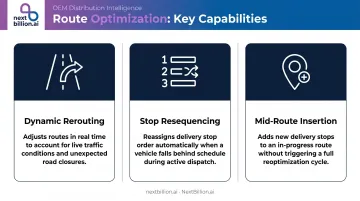
NextBillion.ai's Route Optimization API handles that response layer with:
- Dynamic rerouting that adjusts in real time to traffic conditions and road closures
- Stop resequencing when a vehicle falls behind, reassigning deliveries to keep the overall run on target
- Mid-route insertion for new stops added in progress, without requiring full reoptimization
Historical Reporting and Carrier Performance Analytics
Accumulated GPS data builds a carrier performance record:
- On-time delivery rates by lane
- Dwell time at each facility
- Idle patterns and unauthorized stops
- Route adherence by carrier and by lane
OEMs use this data to benchmark transport partners, renegotiate SLAs, and identify chronic bottlenecks. Georgia-Pacific, using multimodal visibility data, reduced manual efforts by 80% and improved on-time delivery by 50% after implementing supply chain visibility tools.
OEM-Integrated vs. Aftermarket GPS for Distribution
OEM-Integrated Telematics
Factory-installed telematics offer no-hardware-install tracking with deep vehicle data integration. Major manufacturers have deployed this at scale:
- Ford Pro Telematics — available on vehicles with embedded modems, covering live GPS, vehicle health, driver behavior, and API access through Ford Pro Data Services
- GM OnStar Business — OnStar Fleet Basics comes standard with most model year 2025 or newer GM vehicles, providing vehicle health, fuel levels, and engine hours
- Stellantis Pro One — real-time telematics covering driving patterns, fuel consumption, and vehicle performance
The trade-off: OEM telematics only covers newer vehicles from supported manufacturers, and the OEM manufacturer controls data access and software update timing rather than the logistics operator.
Aftermarket GPS Devices
Plug-and-play OBD units or hardwired devices can be installed across mixed fleets, older vehicles, trailers, and non-vehicle assets like containers or machinery. They work regardless of make, model, or age.
The trade-off: installation downtime and hardware management across a potentially large mixed fleet.
The Hybrid Model
Most large-scale OEM distribution networks use a combination:
| Asset Type | Tracking Method |
|---|---|
| Newer company vehicles | OEM embedded telematics |
| Carrier trucks | Aftermarket plug-in devices |
| Trailers and containers | Hardwired aftermarket units |
| Legacy equipment | Aftermarket asset trackers |
All of these feed into a single fleet management platform for unified visibility. That's where the hybrid model pays off — or falls apart. Platforms like NextBillion.ai pull tracking data from Samsara, Geotab, Motive, Netradyne, and Verizon Connect into one operational layer, giving distribution teams a single view across every asset type. Without that integration layer, mixed-source telematics produce fragmented data that's difficult to act on at scale.
Turning GPS Data Into Distribution Intelligence
From Tracking to Actionable Exceptions
Raw GPS coordinates show you where assets are. What logistics managers actually need is to know when something is wrong — and to know before it cascades into a missed delivery window.
Rules-based exception alerting handles this automatically. Configure thresholds like:
- Asset hasn't moved in X hours
- Carrier has deviated more than Y miles from planned route
- ETA has slipped beyond Z-minute threshold
- Unit has been at a facility longer than expected dwell time
NextBillion.ai's tracking platform supports speed-based and geofence-based alerts, configurable for excessive idling, route deviations, and asset movement exceptions. Alerts fire automatically — logistics managers intervene only when the system flags a real problem, not by manually reviewing every vehicle on a map.
ETA Sharing With Downstream Partners
Live tracking data enables automatic ETA updates pushed to dealers, fleet purchasers, or end customers. Dow's shipment visibility implementation demonstrated this effect directly: real-time tracking reduced the volume of status emails and phone calls received by customer-facing employees by giving stakeholders 24/7 access to shipment information — part of a $400 million digital capability investment.
For OEM distribution, dealers receive accurate ETA updates automatically as each distribution leg completes — no calls to the logistics team required. NextBillion.ai's Live Tracking API calculates ETAs from live traffic data and integrates with SAP, Salesforce, and Microsoft Dynamics 365, pushing updates without manual data entry.
Integration With Existing Logistics Software
Tracking data only drives decisions when it reaches the systems your team already works in. When evaluating any platform, verify these integration capabilities:
- REST APIs connecting to your TMS, ERP, and dealer management systems
- Pre-built connectors for Samsara, Geotab, SAP, and Salesforce — no custom middleware required
- Bidirectional data flow that pulls vehicle and order data in while pushing optimized routes and status updates back out
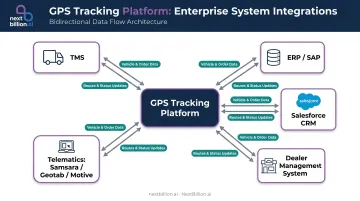
NextBillion.ai provides REST APIs and native SDKs (Android, iOS, Flutter) for the Live Tracking API, along with pre-built integrations with major telematics and enterprise platforms. The platform is available on AWS, Google Cloud, and Azure Marketplace, supporting enterprise procurement and cloud-agnostic deployment.
How to Choose and Implement a GPS Tracking Solution for OEM Distribution
Key Evaluation Criteria
| Criteria | What to Look For |
|---|---|
| Scalability | Handles mixed-asset fleets across hundreds or thousands of units |
| Update frequency | Configurable intervals suited to your handoff coordination needs |
| Integration APIs | REST APIs, pre-built TMS/ERP/DMS connectors |
| Geofencing | Custom shapes, automated alerts, time-of-day scheduling |
| Historical reporting | Carrier performance data by lane, facility dwell time, idle patterns |
| Pricing model | Per-vehicle pricing avoids cost spikes at scale vs. per-API-call billing |
| Support model | 24/7 engineer-led support for multi-hub operations |
| Data governance | Clear data ownership terms, storage location, on-premise options |
For OEM distribution networks specifically, pricing model and support depth matter more than they might appear. NextBillion.ai uses per-vehicle pricing with fixed monthly fees, so costs stay predictable as tracking frequency increases rather than growing with every API call. The platform also includes 24/7 engineer-led support at no additional cost, with implementation support from testing through production deployment.
Phased Implementation Approach
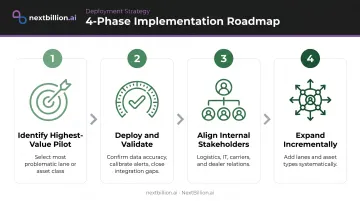
Once you've selected a platform, resist the temptation to roll it out network-wide immediately. A phased approach reduces integration risk and surfaces problems before they affect live distribution lanes:
- Identify the highest-value pilot — pick your most problematic distribution lane or highest-value asset class
- Deploy and validate — confirm data accuracy, calibrate alert thresholds, identify integration gaps
- Align internal stakeholders — logistics, IT, carrier partners, and dealer relations all need to be involved before network-wide rollout
- Expand incrementally — add lanes and asset types systematically, applying lessons from the pilot
Data Governance and Privacy
After implementation sequence, data governance is the other contractual detail that OEM logistics teams most commonly overlook until it becomes a problem. Before signing with any tracking platform, confirm:
- Who owns the GPS and location data generated through the platform
- Where data is stored geographically
- Whether on-premise or private cloud deployment is available for sensitive operations
NextBillion.ai is SOC 2 Type II, ISO/IEC 27001:2013, and GDPR certified, with full on-premise deployment options within a customer's own Kubernetes environment or private data center. The platform acts as a data processor on behalf of customers — it does not sell customer location data or share it with other customers.
Frequently Asked Questions
What is an OEM tracker?
An OEM tracker is a GPS and telematics device built directly into a vehicle by the manufacturer during production rather than added as an aftermarket device. It provides factory-calibrated tracking of location, speed, engine diagnostics, and vehicle health data with no external hardware needed, and is standard on most new vehicles from major manufacturers including Ford, GM, and Stellantis. For distribution fleets, this built-in data still needs a routing and tracking layer on top to turn raw signals into ETAs, exception alerts, and dealer-facing visibility.
Is it illegal to put a tracking device on a company vehicle?
Tracking company-owned vehicles is generally legal in the U.S. — employers have the right to monitor their own assets. Best practice requires informing drivers of the tracking policy, and several states including New Jersey require written employee notice before deploying tracking devices on vehicles used by employees.
How does real-time GPS tracking improve OEM distribution efficiency?
Live location data eliminates blind spots between distribution legs, enabling proactive delay management before downstream schedules are affected. Automated milestone alerts notify downstream partners without dispatcher involvement, and accumulated carrier performance data lets OEMs benchmark transport partners, renegotiate SLAs, and identify chronic bottlenecks in their network. In practice, this means fewer manual status calls to carriers, earlier detection of at-risk deliveries, and dealer teams that can plan lot space and staffing around confirmed arrival windows instead of static ETAs.
What is the difference between OEM GPS tracking and aftermarket GPS devices?
OEM GPS is factory-embedded and accesses native vehicle systems with no hardware install needed, but it's limited to supported newer vehicles. Aftermarket devices work across any asset type regardless of age or brand, offering more flexibility at the cost of installation time and ongoing hardware management.
How can OEMs integrate GPS tracking data with their existing logistics software?
Most enterprise GPS platforms provide REST APIs and pre-built connectors that push location and status data directly into TMS, ERP, or dealer management systems. NextBillion.ai integrates with SAP, Salesforce, Microsoft Dynamics 365, and major telematics platforms, automating ETA updates, exception alerts, and carrier performance reporting without manual data entry.
How to track a vehicle in real-time?
Real-time vehicle tracking requires a location source (an OEM-embedded module or an aftermarket GPS device), a data connection that reports position at regular intervals, and a platform that plots that data on a map with route and ETA context. For distribution fleets, the tracking layer should also flag route deviations, delays, and milestone events automatically rather than requiring dispatchers to watch a map continuously.
Is there a real-time GPS tracker for cars available?
Yes. Most new vehicles ship with an OEM telematics module capable of real-time GPS reporting, and aftermarket plug-in or hardwired GPS trackers are available for older vehicles or fleets that need consistent tracking across mixed vehicle ages and brands. For OEM distribution operations, the choice usually comes down to whether the fleet is new enough for factory telematics or needs aftermarket coverage for legacy units.