For logistics managers, e-commerce operators, and fleet teams, understanding how this stage works isn't just useful background. Last mile delivery consumes a disproportionate share of total shipping costs, and the operational decisions made here directly determine whether customers come back or churn.
This guide explains what last mile delivery is, what happens inside a dispatch facility, how packages move from hub to doorstep step by step, and what drives the complexity that makes this leg so difficult to optimize.
Key Takeaways
- Last mile delivery = the final stage of shipping, moving packages from a local dispatch facility to the customer's door — shortest distance, highest per-unit cost
- Dispatch facilities sort inbound packages by delivery route and stage them for driver loading — they are not fulfillment centers
- According to Capgemini Research Institute, last mile services account for 41% of overall supply chain costs
- 86% of consumers define fast delivery as two days or less — and meeting that bar is expensive
- Route optimization technology, distributed inventory positioning, and carrier diversification are the three primary tools for improving last mile performance
What Is Last Mile Delivery?
Last mile delivery is the final leg of the supply chain: the point where a package leaves a local distribution or dispatch facility and travels to its end destination, typically a residential or commercial address. "Last mile" is metaphorical — the actual distance can be three city blocks or thirty rural miles.
Where It Fits in the Supply Chain
To understand why last mile is uniquely hard, it helps to see where it sits relative to the stages before it:
| Stage | Movement | Characteristic |
|---|---|---|
| First mile | Manufacturer/supplier → first warehouse | Bulk movement, controlled origin |
| Middle mile | Warehouse → regional sort hub | High-volume consolidation, long haul |
| Last mile | Local hub → customer address | Dispersed stops, high per-unit cost |
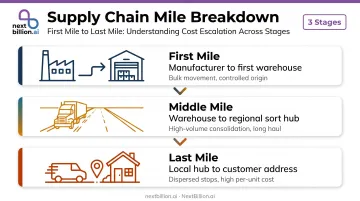
The first two stages move large consolidated shipments between fixed points. Last mile breaks that consolidation apart, scattering one truck's worth of packages across dozens or hundreds of individual stops.
That fragmentation is what drives up cost — and it's also what makes last mile the only delivery stage a customer ever directly experiences. A package can travel 2,000 miles through the middle mile without a hitch. One missed delivery window or a damaged drop-off is what sticks. Research by Convey found that 84% of shoppers won't return to a retailer after a single poor delivery experience, which means last mile execution has a direct line to customer retention.
What Is a Last Mile Dispatch Facility?
A last mile dispatch facility — also called a delivery station, local hub, sort facility, or last mile carrier facility — is the final distribution point before packages go out for delivery. Inbound shipments arrive from regional sort centers, get organized by delivery route, and are staged onto driver vehicles. This is the facility that delivers last mile packages to the end customer, whether that's a national carrier like USPS, UPS, and FedEx, or a regional courier network contracted for local coverage.
What Happens Inside
The operational flow inside a dispatch facility is distinct from a fulfillment center (where orders are picked, packed, and labeled). By the time a package reaches a dispatch facility, it's already labeled and ready. What happens here is sortation and sequencing:
- Inbound scan — packages arriving from linehaul vehicles are scanned to update tracking status
- Zone sortation — packages are sorted by delivery area, either manually or via automated conveyor systems
- Route sequencing — sorted packages are organized in driver-load order for each specific route
- Vehicle staging — packages are loaded onto driver vehicles, often in reverse delivery order so the first stop is most accessible
- Out-for-delivery scan — departure triggers customer notifications
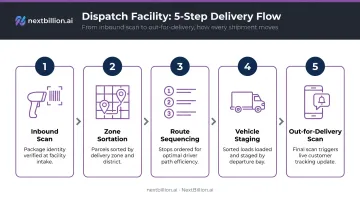
Sortation accuracy at this stage carries real consequences. A single scan error can send a driver to the wrong zone, blow the delivery window, and force a re-delivery attempt that cuts into the day's route capacity.
Why Facility Location Is Strategic
Dispatch facilities are deliberately positioned close to dense customer populations to minimize the distance each driver covers per stop. Amazon's investment strategy shows the scale of this logic: the company is investing over $4 billion to expand its rural delivery network and plans to triple its rural network size by end of 2026. That expansion also includes same-day and next-day Prime delivery to over 4,000 smaller cities and rural communities.
What Your Tracking Status Actually Means
When your package status shows "arrived at last mile dispatch facility" or "at last mile carrier facility," it means the long-haul portion of the journey is complete. The package is now in the local delivery network. Delivery is typically expected within 1–2 business days, depending on carrier and route schedule. If your tracking instead shows the package "being sorted" at the facility, it simply means the package has been scanned in and is moving through zone sortation before route assignment — this is a normal, temporary status and does not indicate a delay unless it persists for more than a day.
Carrier-specific terminology for reference:
- USPS — Destination Delivery Unit (DDU) or Sorting and Delivery Center (S&DC)
- Amazon — Delivery Station
- FedEx — Stations and hubs (local pickup and delivery facilities)
- UPS — Operating facilities and sorting facilities
How Last Mile Delivery Works: From Dispatch Facility to Doorstep
Once a package enters a dispatch facility, it follows a defined operational flow through to delivery.
Inbound Receiving and Sorting
Packages arrive from regional sort centers on linehaul vehicles. Each package is scanned on arrival — this is the tracking update that consumers see — and then sorted into route groupings. Larger facilities use automated conveyor systems; smaller ones rely on manual sortation. The output either way: packages organized by zone and route cluster, ready for driver assignment.
Sortation accuracy at this stage is non-negotiable. A misplaced package either misses its route entirely or forces an out-of-sequence delivery that disrupts the entire driver's stop order.
Driver Assignment and Route Loading
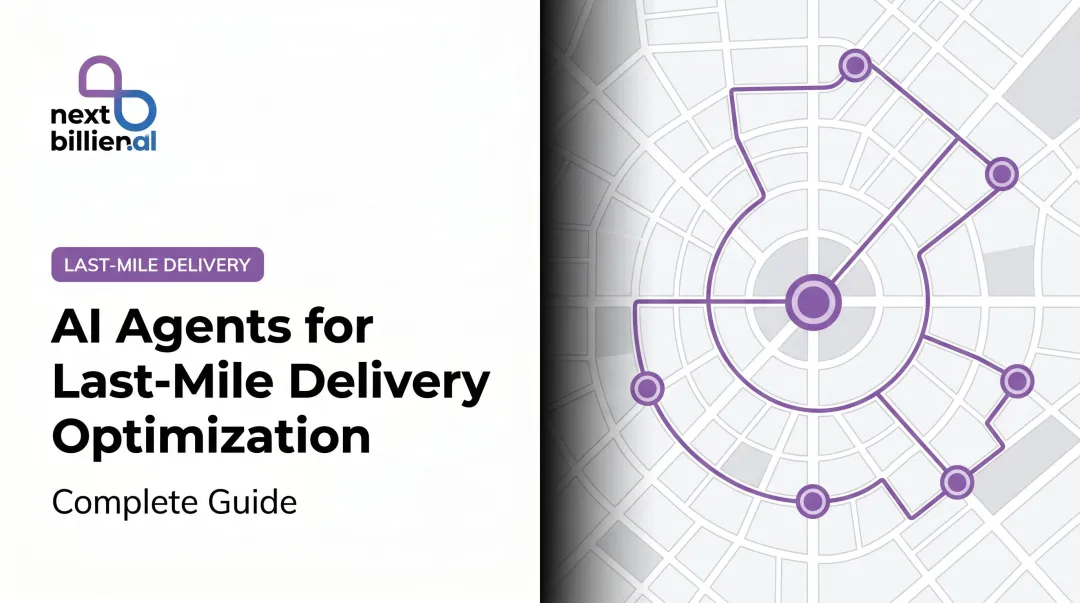
Sorted packages are assigned to drivers based on their route territories. The sequence in which stops are made isn't arbitrary — it's optimized to minimize backtracking, respect time windows, and account for traffic patterns.
- Successful delivery — handed to recipient or placed in a pre-approved safe location; stop closed
- Safe drop — left at door, mailbox, or access point when no signature is required
- Access failure — gated building or locked entry with no delivery instructions; stop flagged for re-attempt
- Recipient not home — triggers exception workflow: re-attempt scheduling or carrier notification
Proof of Delivery and Exception Handling
Proof of delivery closes the loop on each stop: photo capture, digital signature, OTP validation, or geolocation stamp confirms the package reached its destination. This documentation protects both the carrier and the customer.
When delivery fails, the cost doesn't disappear — it shifts. The package returns to the facility, a re-attempt gets scheduled, and the carrier absorbs the incremental cost. In the UK, IMRG data puts re-arranged failed first deliveries at £11.73 per event, with failed and lost order scenarios reaching £184.95 per event. US carriers face comparable exposure — failed deliveries routinely cost $15–$25 per re-attempt once labor, fuel, and scheduling overhead are factored in.
Why Last Mile Delivery Is Expensive and Challenging
The core economic problem is structural. Middle-mile shipping consolidates thousands of packages onto one truck moving between two fixed points. Last mile inverts that: the same truck disperses across dozens or hundreds of individual stops, each requiring driver time, fuel, and a separate package scan — all for a single recipient.
According to Capgemini's research, last mile services account for 41% of overall supply chain costs — a direct consequence of this stop-by-stop dispersal model.
Primary Cost Drivers
- Labor — driver wages represent the largest cost component; McKinsey notes labor costs have risen in line with inflation and frontline retention remains challenging
- Fuel and vehicle maintenance — dispersed routing means more miles driven per package than any other supply chain stage
- Failed delivery attempts — re-attempts, return-to-facility processing, and re-delivery scheduling are pure cost with no revenue offset
- Rural stop distances — widely spaced addresses in rural areas dramatically increase cost per stop compared to urban density
The Consumer Expectation Gap
Customers expect fast delivery. The infrastructure required to deliver it is expensive — and businesses increasingly absorb that cost rather than passing it on.
A 2025 McKinsey survey of over 1,000 US consumers found 90% are willing to wait two or three days, particularly to avoid shipping fees. But a 2023 OnTrac/Hanover Research survey found 86% define fast delivery as two days or less — and 63% said they'd switch retailers if that window couldn't be met.
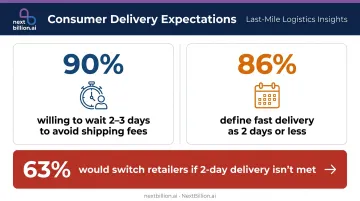
Two days is the de facto standard. Meeting it requires local dispatch facilities close to population centers, expanded driver networks, and real-time tracking infrastructure — none of which are cheap to build or maintain.
Urban vs. Rural Complexity
Neither environment is inherently efficient:
- Urban areas — traffic congestion, parking restrictions, building access issues, and apartment complexes requiring floor-by-floor delivery
- Rural areas — long distances between stops, low delivery density, and limited infrastructure for access control
Route planning must account for both environments simultaneously — and that's where the gap between consumer mapping tools and purpose-built logistics optimization becomes most visible. Generic tools lack the constraint modeling to handle real-world delivery complexity at scale.
How to Optimize Last Mile Delivery Operations
Strategic Inventory Positioning
The most effective optimization happens before last mile even begins. Placing inventory closer to customer concentrations — through distributed fulfillment centers or regional hubs — directly reduces the shipping zone a package must cross before entering the last mile network. Shorter zones mean lower carrier costs and faster transit times.
Route Optimization Technology
On a per-delivery basis, intelligent routing is the most direct lever available. Optimized stop sequencing reduces miles driven, fuel consumption, and time per route. The gap between manual or basic routing and enterprise-grade optimization is measurable, and it widens as delivery volume grows.
NextBillion.ai's Route Optimization API handles the real-world complexity that manual planning can't account for:
- Live traffic integration with dynamic re-routing mid-route
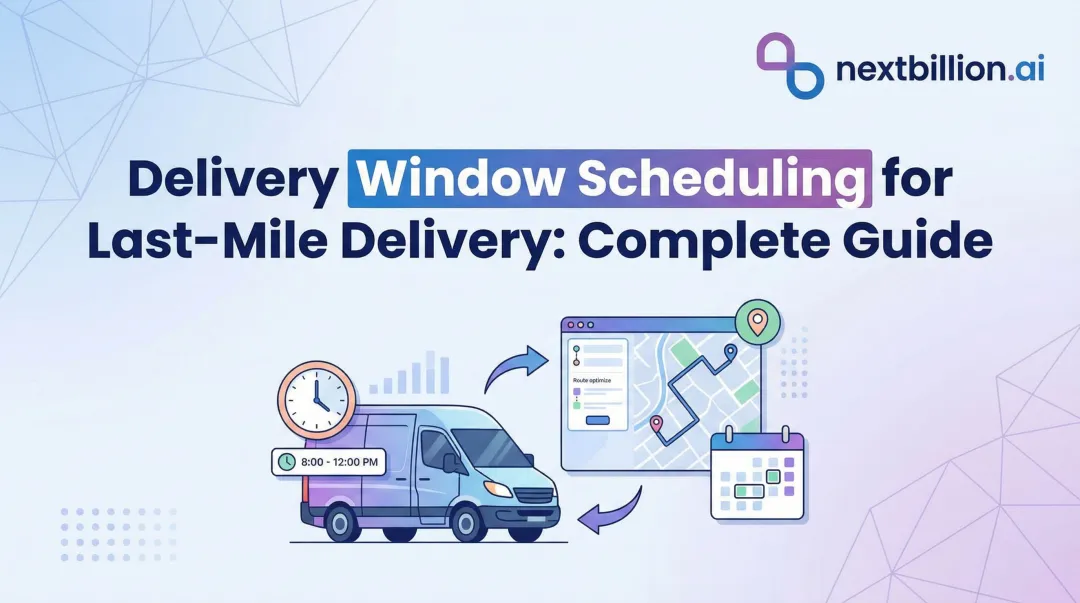
- Time window compliance across multi-stop runs
- Multi-vehicle fleet optimization in a single request
- Up to 10,000 stops per optimization run
- Direct integration with Samsara and Geotab, pushing routes to driver apps
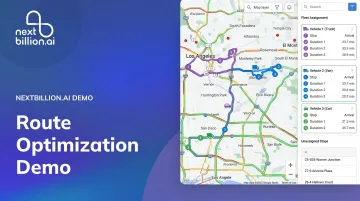
For operations already running, the platform also supports real-time dispatch updates — inserting new orders into active routes without disrupting the rest of the delivery plan.
Carrier Diversification and Tracking Transparency
No single carrier is optimal for every parcel, destination, or service level. Matching carrier selection to parcel weight, delivery density, and required speed reduces cost without sacrificing service. For same-day urban deliveries, a regional carrier or gig-economy provider may be more cost-effective than a national carrier. For rural routes, USPS often outperforms alternatives on unit economics.
Carrier selection shapes cost structure. What customers see after dispatch shapes satisfaction. Real-time tracking visibility from dispatch facility to doorstep reduces "where is my order" support volume. Customers with live visibility into their delivery status generate fewer inquiries — and report higher satisfaction even when deliveries run slightly late.
Frequently Asked Questions
What is a last mile dispatch facility?
A last mile dispatch facility is the final sorting and staging hub in the delivery network. It receives already-labeled packages from regional sort centers, organizes them by route, and hands them off to drivers for the final leg to the customer's door — no picking or packing, purely sortation and dispatch.
What does it mean if my package is at a last mile dispatch facility?
It means the long-distance portion of your package's journey is complete. The package is now in the local delivery network assigned to your area, and delivery is typically expected within 1–2 business days depending on the carrier, service level, and local route schedule.
Who delivers parcels from a last mile dispatch facility?
Delivery is handled by whoever operates that facility — a national carrier (USPS, UPS, FedEx), a retailer's own network (Amazon Logistics), a regional carrier, or a gig-economy provider, depending on the shipper's contract and destination geography.
How long does last mile delivery take from a last mile dispatch facility?
For qualifying same-day orders, delivery can be completed within hours of facility processing. Standard last mile delivery is typically 1–2 business days from when a package arrives at the facility, though route density and carrier schedules can shift that window. Route optimization software also factors in here: dispatch facilities using automated routing and ETA tools can sequence stops more efficiently, which tends to tighten delivery windows compared to manual dispatch planning.
What is the difference between a last mile dispatch facility and a fulfillment center?
A fulfillment center is where orders are received, picked, packed, and labeled for shipment. A dispatch facility receives packages that are already packed and labeled, and focuses solely on final route sortation and driver dispatch. It's the last stop before your door — not where the order was assembled.
What are the biggest challenges of last mile delivery?
Last mile is the most expensive supply chain stage due to dispersed residential stops, high labor costs, traffic and access complications, and failed delivery attempts — all compounded by consumer expectations for two-day delivery windows. In the US, dispatch facilities also have to plan around driver hours-of-service limits under FMCSA rules where applicable, local delivery windows tied to residential or commercial zoning, and address-verification issues that cause misroutes, all of which routing and dispatch software is built to reduce.
Who delivers last mile packages?
Last mile delivery in the US is handled by a mix of national carriers (USPS, UPS, FedEx), retailer-owned networks like Amazon Logistics, regional couriers, and gig-economy delivery providers. Which one handles a given package depends on the shipper's carrier contract, the delivery address, and service level selected at checkout. Dispatch facilities assign the final-leg driver based on route zone, package volume, and delivery deadline for that day.
What is the last mile dispatch facility responsible for once a package arrives?
Once a package arrives, the facility scans it into the local network, sorts it by delivery route or zone, and assigns it to a driver for that day's run. This is a sortation and dispatch function only — no picking, packing, or repackaging happens here. The goal is to get each package onto the correct outbound route as fast as possible to meet the delivery window.