The problem compounds fast. According to ATRI's 2025 trucking cost analysis, average trucking operating costs hit $2.26 per mile in 2024, with empty miles averaging 16.7% of total mileage — waste that effective multi-city routing directly addresses.
This guide evaluates five tools specifically for agency-scale, multi-city operations. The criteria aren't UI polish or onboarding smoothness — they're algorithm depth, constraint flexibility, API capability, distance matrix scale, and whether the pricing model stays rational at volume.
Key Takeaways
- Multi-city route optimization solves cross-depot, cross-territory VRP problems — not just stop sequencing
- Agencies need 50+ routing constraints, large-scale distance matrix support, multi-depot handling, and API-first architecture
- The five tools that meet agency-grade requirements: NextBillion.ai, Route4Me, Routific, OptimoRoute, and Onfleet
- Per-API-call billing compounds unpredictably at scale; per-vehicle or per-order models are more cost-stable
- The right tool should embed into your existing fleet infrastructure, not require you to rebuild around it
What Multi-City Route Optimization Is and Why Agencies Need It
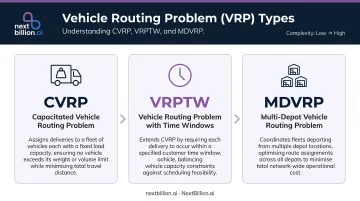
Multi-city route optimization is an enterprise Vehicle Routing Problem (VRP) — not a map-with-stops interface. The VRP family includes:
- CVRP — routes vehicles with limited carrying capacity
- VRPTW — adds customer time windows to delivery scheduling
- MDVRP — allocates orders across multiple depots, manages return rules, driver costs, and penalties simultaneously
Standard tools fail at this scale for measurable reasons. Google's Routes API caps its Compute Route Matrix at 625 non-transit elements, and Mapbox caps standard matrix profiles at 25 coordinates. Both work for consumer navigation. Neither scales to agencies optimizing hundreds of vehicles across multiple cities in a single batch.
The cost of getting this wrong is measurable: FreightWaves puts a failed delivery at $17.20, against an 8% first-attempt failure rate industry-wide. At volume, that's not a rounding error. This is also where AI-driven route optimization earns its keep: modern solvers can recompute multi-depot routes in seconds as conditions change, rather than requiring dispatchers to manually rebalance territories after every delay or cancellation.
That's why the tools below are evaluated on constraint depth, matrix size limits, and pricing structure — not dashboard polish.
The 5 Best Multi-City Route Optimization Tools for Agencies
These tools were evaluated on their ability to handle multi-city routing at volume — meaning real multi-depot VRP, high stop counts, and pricing structures that don't punish agencies as they scale. Each entry also covers how well it supports agencies that embed optimization into their own platforms versus those running operations directly.
NextBillion.ai
Background: NextBillion.ai is an API-first route optimization and mapping platform built by ex-Grab engineers, designed specifically for logistics and fleet-tech companies. The platform has optimized 10.9M+ deliveries, navigated 557M+ miles, and delivered $11M+ in aggregated cost savings across 150+ global clients.
What sets it apart at agency scale:
- Supports 50+ hard and soft routing constraints including time windows, driver skills, vehicle capacity, hazmat rules, order incompatibility, break scheduling, and depot assignment
- Distance Matrix API handles 5,000 × 5,000 matrices — 200x larger than the consumer-standard 25×25 cap
- Processes up to 10,000 stops per optimization request with dispatch-ready routes generated in seconds
- Multi-depot VRP supported natively, including cross-docking, zone-based handoffs, and reverse logistics
- Truck-compliant routing with height/weight restrictions, bridge avoidance, hazmat routing, and HOS compliance built in
- Pre-built integrations with Geotab, Samsara, Motive, and Netradyne — with bidirectional data flow
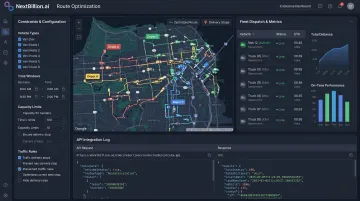
Pricing: Per-vehicle, per-order, or per-API-call — agencies can choose the model that matches their operational structure. Annual commitments with monthly payments available; no monthly caps on usage within plan limits.
For agencies building platforms: NextBillion.ai explicitly supports embedding its optimization engine into third-party TMS or logistics SaaS products. The integration workflow typically takes about a week and includes hands-on support from solution engineers.
| Feature Area | Details |
|---|---|
| Key Features | Multi-depot VRP, 50+ constraints, 5,000×5,000 matrix, truck routing, Road Editor, HOS compliance |
| Pricing Model | Per-vehicle, per-order, or per-API-call; annual fixed-fee options available |
| Best For | Agencies embedding optimization into their own platforms; high-volume multi-city fleets |
Route4Me
Background: One of the longer-standing enterprise route optimization platforms, Route4Me uses a marketplace architecture that lets agencies add capabilities — time window management, curbside pickup, territory balancing — as needed.
Where it excels:
- Multi-depot, multi-driver routing with configurable business rules: max routes, duration, distance, weight, volume, and revenue constraints
- Open API for custom integrations with an established ecosystem
- Handles field service and delivery use cases simultaneously
Worth knowing: Auto-vehicle-minimization logic and ETA accuracy have drawn critical reviews in multi-city deployments. Advanced features like time windows and customer notifications are paid add-ons, which affects total cost at scale. Agencies comparing apps for routing between multiple destinations should factor these add-on costs into any per-driver or per-route pricing comparison before committing.
| Feature Area | Details |
|---|---|
| Key Features | Multi-vehicle dispatch, territory management, real-time tracking, add-on marketplace, open API |
| Pricing Model | Starts at ~$199/month; many advanced features are paid add-ons |
| Best For | Agencies needing a configurable platform with a large integration ecosystem |
Routific
Background: Routific is a delivery-focused route optimization platform with a strong reputation for route quality and a clean dispatch interface. Rated 4.9/5 across 144 Capterra reviews.
Where it excels:
- Supports time windows, capacity, skills, breaks, priority stops, multi-day routes, and multi-depot
- Unlimited drivers and dispatchers included; GPS tracking and proof of delivery bundled
- Per-order pricing (free up to 100 orders/month; $150/month for 101–1,000 orders) makes it cost-predictable for growing teams
Worth knowing: Best suited for agencies with defined daily delivery operations within consistent service regions. No independent benchmarks comparing Routific's route quality to enterprise-scale competitors have been published.
| Feature Area | Details |
|---|---|
| Key Features | Multi-route optimization, drag-and-drop editing, one-click dispatch, customer notifications, proof of delivery |
| Pricing Model | Per order/month; volume discounts beyond 1,000 orders |
| Best For | Delivery agencies running daily multi-vehicle operations within defined service regions |
OptimoRoute
Background: OptimoRoute is a flexible route optimization platform serving both delivery and field service agencies, with strong capabilities around individual driver profiles and multi-week planning.
Where it excels:
- Highly granular driver setup: shifts, skills, service areas, vehicle types, capacity constraints, and unique start/end locations per driver
- Multi-week planning up to 5 weeks ahead — valuable for scheduled field service operations
- Custom tier supports dynamic mid-route depot assignments
Order limits by tier:
| Tier | Order Limit |
|---|---|
| Lite | 700 orders/month |
| Pro | 1,000 orders/month |
| Custom | Thousands (quote-based) |
Pricing: Starts at $39/driver/month (Lite) or $49/driver/month (Pro).
| Feature Area | Details |
|---|---|
| Key Features | Driver profiles with shift/skills/zones, multi-week planning, service areas, real-time tracking |
| Pricing Model | Per driver/month; Custom tier for higher volumes |
| Best For | Field service agencies managing cross-city technician dispatch with complex scheduling |
Onfleet
Background: Onfleet is an enterprise-focused last-mile delivery management platform combining route optimization, driver dispatch, live tracking, and deep API access. Rated 4.6/5 on both G2 and Capterra.
Where it excels:
- Live dispatcher-driver chat built in — practical for multi-city coordination across time zones
- Barcode scanning, automated customer notifications, and proof-of-delivery workflows included
- White-labeled customer tracking page (logo/colors); robust API and webhooks for custom integrations
- Route optimization supports up to 1,000 tasks per request — sufficient for most deployments, though very large multi-city batches may require partitioning
Pricing scales by task volume across three tiers:
| Plan | Monthly Cost | Included Tasks |
|---|---|---|
| Launch | $619 | 2,500 tasks |
| Scale | $1,349 | 5,000 tasks |
| Enterprise | $3,099 | 10,000+ tasks |
| Feature Area | Details |
|---|---|
| Key Features | Auto driver assignment, dispatcher-driver chat, barcode scanning, API access, real-time tracking |
| Pricing Model | Per task/month by tier |
| Best For | Mid-market to enterprise delivery agencies prioritizing execution, proof, and dispatch management |
Key Features Agencies Should Evaluate
Constraint Depth and Multi-Depot Support
Tools with fewer than 20 configurable constraints will hit limits quickly in real-world deployments. Agencies need:
- Multi-depot VRP (not single-origin routing)
- Time windows per stop and per driver shift
- Vehicle-specific rules: capacity, dimensions, cargo type
- Driver skill matching and service area assignment
- Soft constraints for overtime, lateness penalties, and wait time management
Scalable Distance Matrix and Stop Limits
Consumer-grade tools typically break down here:
| Tool | Matrix Size | Stops per Request |
|---|---|---|
| Google Routes API | 625 elements | N/A (routing only) |
| Mapbox Matrix | 625 elements | N/A |
| NextBillion.ai | 5,000 × 5,000 | 10,000 |
| OptimoRoute (Pro) | N/A | 1,000/month |
| Onfleet | N/A | 1,000 per request |
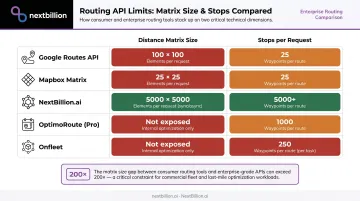
Test against your largest daily batch. Average routes and vendor demo scenarios will not surface capacity ceilings until you're already in production.
API-First Architecture and Integration Depth
Agencies either embed optimization into their own platforms or connect it to existing fleet tools. Confirm before committing:
- Does the API support bidirectional data sync with telematics systems (Geotab, Samsara, Motive)?
- Can the optimization engine be embedded in a white-label or OEM context?
- Is the API documentation production-grade or primarily demo-oriented?
Pricing Model at Volume
Per-API-call billing scales quadratically as origin-destination pairs multiply across depots and cities. The cost compounds fast:
- 50 vehicles across 20 depots can generate thousands of matrix calls daily during re-optimization cycles alone
- 500 vehicles across multiple cities makes per-call costs nearly impossible to forecast month-to-month
Per-vehicle or per-order pricing grows linearly with your operations — which matters when you're quoting fixed-cost contracts to clients and can't absorb billing spikes.
How We Chose These Tools
The evaluation framework prioritized agency-scale requirements, not individual or small-business use:
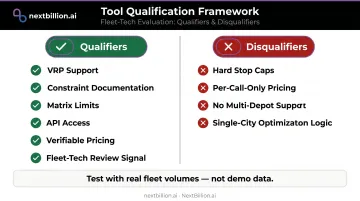
What qualified tools:
- Published VRP support (CVRP, VRPTW, MDVRP)
- Documented constraint count or constraint categories
- Verified distance matrix or stop-limit figures
- API access with confirmed telematics integrations
- Pricing models with verifiable cost structures
- Review signal from logistics or fleet-tech deployments
What disqualified otherwise popular tools:
- Hard caps on stop counts incompatible with fleet-wide optimization
- Per-API-call pricing with no per-vehicle or per-order alternative
- No documented multi-depot support
- Optimization logic built for single-city or last-mile-only scenarios
These disqualifiers point to the most common agency evaluation mistake: testing tools with small stop counts in a single city. Real performance gaps — in algorithm quality, response time, and constraint handling depth — only surface when you run actual fleet volumes across multiple territories at once.
Conclusion
The right multi-city route optimization tool for your agency depends on one question answered honestly: what does your largest daily optimization batch actually look like?
If you're managing hundreds of drivers across multiple cities with complex constraint sets, the distance matrix ceiling and constraint depth matter more than the interface. If you're primarily running delivery operations with predictable daily routes, a well-built execution platform may serve you better than a raw optimization API.
Test with real volumes. Use actual stop counts, real depot configurations, and your peak-day order numbers — not the demo dataset the vendor provides. Confirm whether the vendor offers dedicated implementation support at go-live, not just documentation — that distinction separates tools built for demos from tools built for production.
For agencies building or scaling logistics platforms, NextBillion.ai is built specifically for this use case: API-first architecture, 50+ routing constraints, a 5,000×5,000 distance matrix, and per-vehicle pricing. Solution engineers are available 24/7, and deployment covers both cloud and on-premise environments.
Frequently Asked Questions
What is the difference between multi-stop and multi-city route optimization?
Multi-stop optimization sequences stops within a single trip or service area. Multi-city optimization manages routes across different regions, depots, and driver pools simultaneously — it requires VRP solvers, large-scale distance matrix computation, and multi-depot logic. Single-area tools don't support this. Agencies operating across state lines also need to account for jurisdictional differences, such as varying local delivery windows or DOT-regulated driving hours, which single-city tools rarely factor into route sequencing.
Can route optimization tools handle thousands of stops across multiple cities simultaneously?
Enterprise-grade tools can — but verify the specifics. NextBillion.ai supports 10,000 stops per request; Onfleet caps optimization requests at 1,000 tasks. Consumer apps are typically limited to 10–25 stops. Match the tool's published limits to your actual peak-day batch size before committing.
What pricing model works best for agencies with high delivery volumes?
Per-vehicle or per-order pricing is more cost-stable than per-API-call billing for high-volume agencies. Per-call costs compound with re-optimization frequency, matrix size, and depot count. Monthly costs become unpredictable fast as operations scale across cities.
How do multi-city route optimization tools integrate with fleet management systems?
Most enterprise tools offer open APIs; some have pre-built integrations with telematics platforms like Samsara, Geotab, and Motive. Before selecting a tool, confirm whether the integration supports bidirectional data sync or only one-way export — the difference matters for real-time dispatch.
What is multi-depot routing and why does it matter for agencies?
Multi-depot routing optimizes routes across multiple starting and ending points — warehouses, branch offices, or distribution centers. For agencies managing cross-city fleets where drivers don't all originate from a single location, this capability is essential rather than optional.
How do agencies evaluate route quality beyond shortest distance?
Geographic coherence matters as much as distance efficiency. Routes that overlap illogically or force drivers to backtrack across territories will cost you time even if the mileage looks acceptable. Also weigh driver hours-of-service limits and rest requirements, since a route that looks efficient on paper can force a driver into non-compliant hours. Before full deployment, test candidate tools with your actual stop data and compare planned vs. actual completion times from initial dispatches.
Can AI do route optimization for agencies operating across multiple cities?
Yes. AI-driven solvers can process large distance matrices and thousands of stop combinations far faster than manual planning or basic mapping apps. For agencies, this means routes can be recalculated as new orders come in, traffic shifts, or a driver is delayed, rather than being fixed at the start of the day. The value depends on whether the solver supports multi-depot, multi-vehicle constraints, not just single-route sequencing.
What is the best app for routing multiple deliveries across different cities?
There is no single best app — it depends on stop volume, number of depots, and integration needs. Consumer navigation apps handle a handful of stops in one area but cap out quickly and lack multi-depot logic. Agencies running deliveries across cities need software built for VRP-scale optimization, with API access to plug into existing dispatch and fleet management systems rather than a standalone consumer app.