Which type of hazmat requires a written route plan?
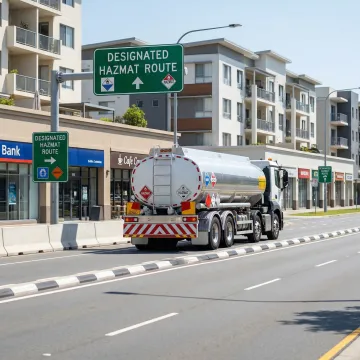
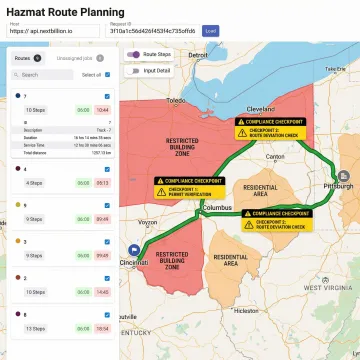
Certain high-hazard materials—including explosives (Division 1.1, 1.2, 1.3), radioactive materials (highway route controlled quantities), and select poison-by-inhalation substances—require a written route plan under federal regulations such as 49 CFR Part 397. These plans must specify pre-approved routes, avoid populated areas and tunnels where required, and be retained for regulatory inspection. Carriers are also expected to account for state and local supplemental restrictions, which can add building setback or curfew rules on top of the federal baseline. NextBillion.ai's routing engine can enforce these pre-approved corridors automatically, applying both the federal route plan and any local overlays at the road-segment level so drivers cannot be routed outside the approved path.
How does NextBillion.ai handle hazardous material routing restrictions near buildings?
NextBillion.ai's routing engine supports cargo-type specifications including hazardous materials, which trigger automatic avoidance of restricted tunnels, bridges, and building-proximity zones. Operations teams can also use the Road Editor App to mark custom no-go zones around specific structures or districts, ensuring every generated route respects both regulatory requirements and site-specific building restrictions without manual intervention from dispatchers.
Can the routing engine enforce different hazmat rules for different vehicle types?
Yes. NextBillion.ai supports vehicle-class-specific routing rules, meaning a 40-tonne hazmat tanker and a light delivery van carrying Class 3 flammable liquids can receive completely different route instructions from the same planning system. Vehicle dimensions, axle load, cargo class, and municipal permit status are all configurable parameters that shape every route calculation independently per vehicle type.
Does NextBillion.ai support time-of-day hazmat routing restrictions near buildings?
Yes. Road attribute edits in the Road Editor App—including hazmat no-entry zones near buildings—can be scoped to specific times of day and days of the week. For example, a restriction preventing hazmat trucks from passing a school or hospital during peak hours can be configured to apply only during those windows, without affecting routing at other times or for other vehicle classes.
How does NextBillion.ai generate audit-ready hazmat route documentation?
The Route Reconstruction API rebuilds complete, road-snapped trip histories from GPS data, producing time-stamped journey records with road segment identifiers and distance data. For hazardous materials logistics—where regulators may require proof of route compliance—this provides verifiable documentation of the exact path traveled, suitable for regulatory audits, incident investigations, and insurance claims without additional manual record-keeping.
What happens if a hazmat driver deviates from the approved route near a restricted building?
NextBillion.ai's Live Tracking API can be configured to send automated alerts the moment a vehicle deviates from its planned route. Operations managers receive real-time notifications, enabling immediate intervention to redirect drivers before they enter restricted building zones or non-compliant corridors. All deviation data is logged and available for post-trip compliance review and driver performance analysis.
Can NextBillion.ai integrate hazmat routing rules with our existing TMS or fleet management system?
Yes. NextBillion.ai integrates with leading TMS, ERP, and fleet management platforms including Samsara, Geotab, and Motive. The full routing and compliance stack—including hazmat-aware route calculation, real-time tracking, and route documentation—can be deployed within your existing operational environment. On-premise deployment is also supported for organizations with data residency or private cloud requirements. Integration typically goes live within one week.
How does pricing work for hazmat routing APIs at scale?
NextBillion.ai's pricing for routing and mapping APIs is typically usage-based, scaling with factors such as request volume, number of vehicles, and which APIs are active in your stack—routing, live tracking, route reconstruction, and Road Editor access can be combined based on operational needs. Because hazmat routing often requires additional configuration for building no-go zones and time-based restrictions, exact costs depend on deployment scope. Contact NextBillion.ai directly for a quote based on your fleet size and requirements.
Who is required to comply with hazardous materials regulations (HMR)?
Under federal hazardous materials regulations, compliance obligations extend to anyone involved in transporting hazmat by road, including shippers, carriers, and drivers who package, label, load, or operate vehicles carrying regulated materials. This includes fleets delivering near buildings, construction sites, or urban infrastructure, where local building codes and municipal restrictions may add further requirements. NextBillion.ai's routing engine helps carriers meet these overlapping obligations by encoding both federal and local rules into route generation.
What is the National Hazardous Materials Route Registry?
The National Hazardous Materials Route Registry is a federal listing of state- and locally-designated hazmat routes, including preferred routes and restrictions that carriers must follow when transporting certain hazardous materials, particularly near populated areas, tunnels, and bridges. Because these designations vary by jurisdiction and can include building-proximity restrictions, fleets operating across multiple states benefit from routing systems that keep local designations current. NextBillion.ai's Road Editor App lets operations teams maintain and update these restrictions as designations change.