The best route planning software for foodservice is built specifically for the industry's constraints — vehicle size restrictions, tight receiving windows, and recurring delivery accounts — rather than generic routing tools that only calculate the fastest path. Generic routing tools weren't designed for this. They find the fastest path — they don't know that your 26-foot reefer can't clear that downtown bridge, that Tuesday's route locks in 40 recurring accounts, or that one emergency add-on stop needs to slide in without disrupting the rest. Software built for foodservice accounts for these operational realities instead of ignoring them.
According to IFDA's 2023 Economic Impact Study, U.S. foodservice distribution moves 12 billion cases per year across 168,300 vehicles and 135,000 drivers — with 34% of cases frozen and 26% refrigerated. That's not a last-mile delivery problem. That's a specialized logistics operation that needs specialized software.
This article covers the best truck routing and delivery tracking software built for foodservice operations, plus a framework for choosing the right fit.
Key Takeaways
- Foodservice routing needs time windows, recurring stop management, load constraints, and real-time rerouting — consumer GPS won't cut it
- Top tools covered: NextBillion.ai, DispatchTrack, Samsara, Onfleet, and Route4Me
- No single platform fits every fleet; the right choice depends on fleet size, telematics needs, and route complexity
- Evaluate on truck-specific constraints, pricing model, fleet system integration, and recurring route support
- Per-API-call pricing inflates costs at scale; per-vehicle or per-order models offer more predictable economics
Why Foodservice Truck Routing Is Uniquely Complex
Standard last-mile delivery software optimizes for speed. Foodservice distribution optimizes for something harder: precision within a network of recurring B2B commitments.
Most wholesale food distributors run a mix of static routes (locked accounts that receive on fixed days) and dynamic additions (emergency orders, substitutions, seasonal spikes). A tool that handles one but not the other creates daily operational headaches for dispatch teams.
The Constraints Generic Tools Ignore
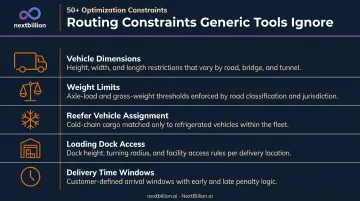
Consumer GPS and standard routing APIs treat all vehicles the same. Foodservice fleets don't have that luxury. Real-world constraints include:
- Vehicle dimensions — height, width, and length restrictions that determine which roads, bridges, and tunnels a truck can legally use
- Weight limits — bridge weight restrictions matter on multi-drop urban routes
- Reefer vehicle assignment — cold-chain loads need temperature-controlled assets, not just any available truck
- Loading dock access — some restaurant receiving areas require rear approach; others have height bars
- Delivery time windows — restaurant receiving hours, cafeteria cut-off times, and chain account schedules that can't be missed without consequences
FHWA data shows U.S. bridges are struck approximately 15,000 times per year — a direct consequence of routing tools that don't account for vehicle clearance requirements.
Those operational constraints don't exist in isolation — they sit alongside a regulatory layer that adds its own documentation burden.
The Compliance Layer
The FDA's Sanitary Transportation rule (21 CFR Part 1, Subpart O) requires shippers, carriers, and receivers to maintain written procedures covering temperature control, vehicle condition, and training records — retained for 12 months. Routing software that captures actual delivery timestamps, temperature excursion flags, and vehicle condition notes at the stop level gives compliance teams something concrete to hand an auditor — not a reconstructed spreadsheet.
Best Truck Routing & Delivery Tracking Software for Foodservice
These platforms were selected based on their ability to handle foodservice-specific routing complexity, real-time tracking reliability, integration depth with fleet systems, and overall cost-to-value for operators running regular routes to food business accounts.
NextBillion.ai
An AI-driven routing and mapping platform built for logistics and fleet operations, trusted by food and beverage operators including AB InBev, DoorDash, and Mars. NextBillion.ai uses an API-first architecture that integrates directly into existing fleet management or TMS systems — no full platform replacement required.
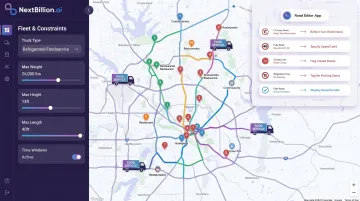
The platform supports 50+ hard and soft routing constraints: vehicle height, width, weight, hazmat restrictions, and custom road attributes managed through its Road Editor App.
Operators can flag low-clearance bridges, restrict road segments for heavy trucks, mark loading dock access points, and set time-of-day plying permissions — all without touching code.
Pricing uses a per-vehicle or per-order flat model, which eliminates the unpredictable per-API-call costs that inflate bills when order volumes spike. Native integrations with Samsara, Geotab, and Motive enable two-way data flow: pull vehicle and order data from your telematics platform, push optimized routes directly to driver apps — no middleware required.
The platform also supports recurring route templates with dynamic replanning. Dispatchers can lock regular stop sequences for weekly or monthly routes, then insert ad hoc orders with minimal re-optimization. A free 2–3 week trial with solutions team support is available for operators evaluating the platform against their own data and routing constraints.
| Category | Details |
|---|---|
| Key Features | Truck-compliant routing (height, weight, hazmat), 50+ route constraints, Road Editor App for custom map attributes, recurring route templates with dynamic additions, real-time GPS fleet tracking, proof of delivery (photo, signature, OTP), native Samsara/Geotab/Motive integrations, 5000×5000 distance matrix |
| Best For | Mid-to-large foodservice distributors and logistics platforms needing API-level route control, truck-specific constraint depth, and cost-predictable pricing |
| Pricing Model | Per-vehicle or per-order flat pricing (not per-API-call); contact for enterprise quote |
DispatchTrack
A purpose-built delivery management platform with a dedicated Food & Beverage focus. DispatchTrack's core differentiator is its hybrid routing model — users can pin recurring stops to fixed days and time windows while the optimizer fills remaining capacity around them. This directly addresses the static-plus-dynamic challenge that wholesale food distributors face daily.
Verified foodservice customers include Merit Foods (an Arizona broadline distributor), S. Bertram (kosher food distribution), and Quirch Foods. The platform includes branded customer notifications with live ETAs, exception management alerts when routes deviate, and operational KPIs like cost-per-route and cost-per-case.
| Category | Details |
|---|---|
| Key Features | Hybrid static/dynamic routing, recurring route templates, real-time fleet visibility, customer delivery notifications, exception management alerts, compliance tracking, driver mobile app |
| Best For | Wholesale food and beverage distributors managing recurring B2B routes with frequent daily variations |
| Pricing Model | Quote-based; contact DispatchTrack for pricing |
Samsara
An enterprise fleet management and telematics platform with a strong Food & Beverage vertical. Samsara combines GPS fleet tracking, ELD compliance, AI dash cams, and reefer temperature monitoring under a single hardware-plus-software platform — making it the strongest option for cold-chain documentation.
The reefer monitoring capability integrates with Carrier and Thermo King systems, providing continuous temperature records, custom threshold alerts, and historical reefer reports — directly supporting FSMA compliance documentation for temperature condition tracking.
Commercial navigation accounts for truck-specific road restrictions, and driver coaching tools help reduce risky behavior across large fleets.
| Category | Details |
|---|---|
| Key Features | Real-time GPS tracking, continuous reefer/temperature monitoring, ELD compliance, commercial navigation, AI driver coaching, routing & dispatch, fuel management |
| Best For | Large foodservice fleets needing combined telematics, cold-chain compliance documentation, and routing in a single hardware-plus-software platform |
| Pricing Model | Subscription-based per vehicle; hardware costs apply (contact for quote) |
Onfleet
A last-mile delivery management platform built for high-volume operations. Onfleet's strengths are auto-dispatch, clean driver UX, and transparent task-based pricing — making it accessible for food delivery businesses that need fast setup and predictable costs.
The platform handles real-time GPS tracking, automated customer SMS/email notifications, route optimization, and proof of delivery. Capterra reviewers give it 4.6/5 overall (from 95 reviews), with Delivery Tracking rated at 4.8. Pricing is published: Launch at $619/month for 2,500 tasks, Scale at $1,349/month for 5,000 tasks, Enterprise at $3,099/month for 10,000+ tasks.
| Category | Details |
|---|---|
| Key Features | Auto-dispatch, real-time GPS tracking, customer SMS/email notifications, route optimization, analytics dashboard, driver mobile app, proof of delivery |
| Best For | Food delivery operations and urban foodservice distributors with high daily order volumes and straightforward last-mile routing |
| Pricing Model | Tiered subscription: $619/mo (2,500 tasks), $1,349/mo (5,000 tasks), $3,099/mo (10,000+ tasks) |
Route4Me
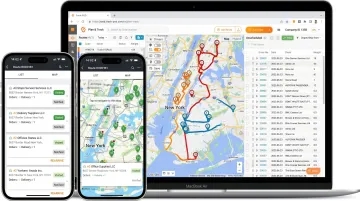
A modular route optimization platform built for multi-stop complexity. Route4Me's Commercial Truck Routing add-on adds compliant vehicle routing for trucks, while its Feature Manager architecture lets operators buy only the modules they need — time windows, capacity constraints, territory management, proof of delivery, and API access are all available as discrete additions.
Capterra reviewers give it 4.5/5 from 409 reviews. Pricing uses packages, custom enterprise plans, and volume options for 10–1,000 vehicles, though exact plan prices require a quote. The broad integration marketplace connects with third-party TMS platforms common in food distribution.
| Category | Details |
|---|---|
| Key Features | Multi-driver route optimization, commercial truck routing (add-on), delivery time windows, vehicle capacity constraints, real-time tracking, territory management, proof of delivery, API access |
| Best For | Mid-sized foodservice distributors needing flexible, constraint-rich route planning across multiple vehicles and territories |
| Pricing Model | Subscription packages; add-on modules priced separately; contact for exact pricing |
How We Chose the Best Truck Routing Software for Foodservice
The most common mistake buyers make is prioritizing price or brand recognition over whether the tool actually handles their operational reality. A tool that works for parcel delivery often falls apart on a 35-stop foodservice route with reefer trucks, locked delivery windows, and recurring accounts that can't be disrupted.
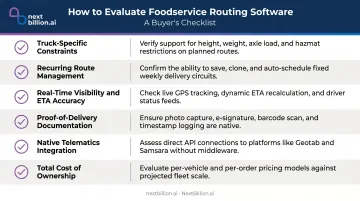
Evaluation criteria used:
- Handles truck-specific constraints — height, weight, road type, and cargo restrictions that standard routing tools ignore
- Supports recurring route management, including locking static stops while absorbing daily order additions
- Delivers real-time visibility and ETA accuracy that dispatchers and customers can act on
- Captures proof-of-delivery documentation (photo, signature, timestamp) relevant to FSMA audit requirements
- Integrates natively with fleet telematics platforms — Samsara, Geotab, Motive, and comparable systems
- Accounts for total cost of ownership: per-API-call versus flat pricing, and how costs behave as order volume grows
We also weighed scalability and implementation support. Vendors with dedicated solution engineers and structured onboarding make a measurable difference when integrating routing software into an existing dispatch workflow mid-season — a detail that's easy to overlook until you're three weeks into a go-live.
Conclusion
The routing software you run directly affects on-time delivery rates, driver efficiency, fuel spend, and whether your restaurant accounts renew or quietly switch distributors. Generic tools rarely match the operational complexity of foodservice operations — recurring B2B routes, temperature-sensitive loads, and truck constraints that consumer-grade GPS simply doesn't account for.
Before evaluating any platform, map your own fleet profile:
- Vehicle types and load configurations in your fleet
- Average stops per route and delivery frequency
- Whether recurring route management or dynamic rerouting is your bigger daily challenge
- What telematics hardware you're already running
For food and beverage logistics teams managing truck fleets at scale, NextBillion.ai's combination of 50+ truck-specific routing constraints, flat per-vehicle pricing, native telematics integrations, and recurring route support with dynamic replanning makes it worth evaluating. If per-API-call costs are scaling faster than your order volume, the per-vehicle pricing model alone is worth the conversation.
Frequently Asked Questions
What is the best routing and logistics software for foodservice distribution?
It depends on fleet size and complexity. DispatchTrack fits wholesale distributors with recurring B2B routes; Samsara suits large fleets needing telematics, ELD compliance, and cold-chain documentation in one system. NextBillion.ai is the stronger fit for teams that need API-level route optimization with truck-specific constraints and predictable flat-rate pricing.
What features should truck routing software for foodservice include?
Look for truck-specific constraint support (vehicle height, weight, and loading dock access), time window management for restaurant delivery schedules, real-time GPS tracking, native integration with your existing fleet telematics hardware, and proof-of-delivery documentation for FSMA compliance purposes. Also confirm the platform can re-sequence stops when drivers run behind, since restaurant receiving windows are tight and a missed slot often means a refused delivery or a rescheduled dock appointment.
How does route optimization reduce costs for foodservice distributors?
Optimized routes reduce fuel consumption, cut idle time, and increase stops per driver per shift, lowering cost-per-case across your network. A Paragon-attributed case study reported one food distributor achieving a 20% reduction in cost-per-case after implementing route optimization (results vary by fleet size and network complexity).
What is the difference between truck routing software and standard delivery routing software?
Truck routing software applies vehicle-specific constraints — weight limits, bridge clearances, road type restrictions, and loading dock compatibility — that standard delivery routing ignores. For foodservice fleets running heavy or refrigerated trucks on multi-stop commercial routes, those constraints aren't optional features; they're operational requirements.
Can foodservice routing software handle temperature-sensitive deliveries?
Yes. Samsara includes reefer monitoring with continuous temperature logging, custom threshold alerts, and historical records that support FSMA documentation. Routing platforms like NextBillion.ai can also be configured to match temperature-controlled vehicles to specific cold-chain loads, ensuring reefer assets are assigned to orders that require them.
How does delivery tracking software improve customer service for food distributors?
Live ETAs and proactive delay notifications let restaurant clients prepare receiving staff and storage space before a truck arrives. That reduces dock wait times, limits delivery disputes, and builds the reliability perception distributors need when accounts are weighing whether to consolidate vendors. Tracking data also gives dispatch a record to resolve short-shipment or late-delivery disputes quickly, instead of relying on driver recollection after the fact.
What is the best software for food delivery dispatch?
The right dispatch software depends on order volume and route complexity. For high-frequency, multi-stop commercial routes, look for platforms that support truck-specific routing constraints, dynamic re-sequencing when orders change, and real-time driver tracking rather than generic last-mile dispatch tools built for parcel or single-item deliveries. NextBillion.ai fits foodservice fleets that need API-level control over these constraints alongside flat-rate pricing.
What is the best software to track delivery?
For foodservice distribution, the best tracking software combines real-time GPS location, live ETA updates, and proof-of-delivery capture in one view, so dispatch and customer service teams work from the same data. Samsara covers this well for fleets that also need telematics and reefer monitoring, while routing platforms like NextBillion.ai can feed tracking data directly into route optimization workflows.