Introduction
U.S. parcel shipments reached 23.1 billion in 2025, up 3.3% year-over-year — roughly 732 packages every second — and that number keeps rising.
The cost of getting routing wrong is steep. U.S. highway congestion added $108.8 billion in costs to the trucking industry in 2022, wasting more than 6.4 billion gallons of diesel and creating the equivalent of 430,000 truck drivers sitting completely idle for a full work year.
Real-time route optimization is the continuous recalculation of vehicle routes using live traffic, order, and driver data, so a fleet responds to disruptions as they happen instead of following a static plan built hours earlier. GPS and telematics have given fleets visibility. But visibility alone doesn't stop a delayed driver from missing four delivery windows. It won't catch a new urgent order sitting unassigned while nearby vehicles run underloaded routes. Real-time route optimization closes that gap — embedding continuous, constraint-aware decision-making into every mile your drivers cover.
Key Takeaways
- Real-time route optimization continuously recalculates each vehicle's path using live traffic, weather, order changes, and driver status.
- It runs as a four-stage loop: data ingestion → constraint-based optimization → route dispatch → continuous monitoring.
- Results are measurable: fewer miles driven, lower fuel costs, higher stop completion rates, and more accurate customer ETAs.
- It connects GPS, telematics, and order management so every routing decision reflects current fleet conditions.
- Fleets operating in real time don't just respond to disruptions faster — they prevent many from becoming costly in the first place.
What Is Real-Time Route Optimization?
Real-time route optimization is the automated, continuous process of calculating and recalculating the most efficient route for vehicles while they are in motion, using live operational data rather than pre-built static plans. This is what people mean when they ask whether AI can do route optimization: the engine applies algorithms and solvers to live data continuously, rather than a human dispatcher recalculating manually. It differs from asking Google Maps for directions, which optimizes a single trip for one driver and has no awareness of fleet-wide constraints like capacity, time windows, or driver hours.
The Problem with Static Planning
Traditional route planning assumes conditions remain stable from dispatch to delivery. They don't. Traffic backs up, new orders arrive, drivers run late, customers cancel — and a plan built at 6 a.m. is often outdated by 9 a.m.
Static systems have no mechanism to respond. Wasted miles, missed windows, and dispatchers manually patching schedules all day — that's the operational cost of a plan that was never designed to flex.
Route Optimization vs. GPS Navigation
Real-time route optimization is not GPS navigation. Turn-by-turn directions tell a driver how to get somewhere. Route optimization decides which stops to visit, in what order, on which vehicles, and when — while satisfying a set of operational constraints that GPS apps don't touch.
Those constraints include:
- Vehicle load capacity and multi-compartment configurations
- Delivery time windows and service duration per stop
- Driver hours-of-service limits and mandatory breaks
- Road type restrictions, vehicle dimensions, and hazmat rules
- Customer priority tiers and order incompatibility rules
A system that only minimizes distance will generate routes that look efficient on a map but fail in the field — ignoring a driver who's already at their hours limit, or routing a heavy truck onto a restricted road.
That gap between map-efficient and operationally viable is where real-time optimization earns its place.
A Spectrum of Capability
Real-time route optimization exists on a spectrum. Basic systems update routes on a fixed schedule using traffic feeds. More advanced platforms recalculate continuously, applying vehicle-specific rules, access restrictions, and custom business logic without slowing down dispatch. NextBillion.ai's route optimization engine, for example, handles 50+ hard and soft constraints per route — covering everything from hazmat restrictions to customer priority tiers.
How Does Real-Time Route Optimization Work?
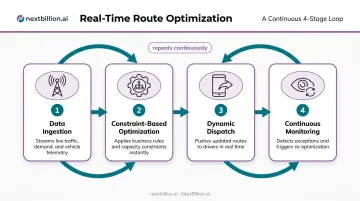
Real-time route optimization is a closed-loop system, not a one-time calculation. Four interdependent stages repeat continuously as conditions change.
Stage 1: Data Ingestion
The system continuously pulls from multiple live data streams:
- GPS/telematics units — vehicle location, speed, and heading
- Traffic and weather APIs — road conditions, incidents, closures
- Order management systems — new deliveries, cancellations, priority changes
- Driver app inputs — stop completion status, availability, delay flags
Data quality and latency determine how responsive the system can be. A platform receiving GPS pings every 30 seconds reacts to road changes very differently than one processing telematics data in near real time. NextBillion.ai's Live Tracking API tracks assets to within one meter accuracy and maintains location continuity even in low-connectivity areas.
Stage 2: Constraint-Based Optimization
Once data is ingested, the optimization engine runs Vehicle Routing Problem (VRP) solvers that evaluate all active routes simultaneously. The purpose of VRP is to determine the lowest-cost set of routes that serves every required stop while respecting vehicle capacity, time windows, and driver constraints — the same core problem real-time optimization solves continuously rather than once. Research from a 2021 dynamic VRP survey confirms that dynamic requests appear in roughly 80% of real-world routing problems, meaning the engine is almost always working with incomplete or changing information.
The engine doesn't find the shortest path. It finds the path that satisfies the most constraints at the lowest operational cost, balancing fuel efficiency, on-time performance, and vehicle utilization across the whole fleet at once.
A system limited to distance and time will fail the moment real-world complexity outpaces its constraint set. NextBillion.ai's engine handles 50+ hard and soft constraints — skills-based assignment, custom cost matrices, order sequencing rules — with recalculation completing in seconds.
Stage 3: Dynamic Dispatch and Driver Communication
After recalculation, the updated route pushes directly to the driver's mobile app — revised stop sequences, updated ETAs, and turn-by-turn navigation — without dispatcher intervention.
NextBillion.ai supports one-click dispatch to major fleet platforms including Samsara, Geotab, Motive, and Netradyne, as well as its own Driver App. The integration is bidirectional: live vehicle data flows into the routing engine, and optimized routes flow back out to driver apps and telematics systems without manual CSV exports or data re-entry.
This shifts dispatcher behavior. Instead of spending the day manually rerouting drivers, dispatchers monitor exceptions while drivers follow an always-current plan.
Stage 4: Continuous Monitoring and Re-Optimization
The loop doesn't close after dispatch. The system monitors actual vehicle progress against the planned route, detecting deviations, emerging delays, or new orders — and triggers recalculation when conditions cross defined thresholds.
This is the distinction between real-time and scheduled optimization. Course-correcting mid-route — not just pre-route — is what prevents a single delayed driver from cascading into four missed delivery windows.
What Makes a Fleet "Smart"? The Role of Continuous Optimization
A connected fleet has GPS visibility — managers can see where every vehicle is. A smart fleet uses that data to make decisions automatically, in real time, across every active vehicle simultaneously. Real-time route optimization is the operational layer that converts visibility into intelligence.
Integration That Eliminates the Gap
Smart fleet management requires optimization to be embedded into telematics, not bolted on afterward. When route optimization integrates directly with platforms like Samsara, Geotab, or Motive, live vehicle data flows into the routing engine without manual export or import — every routing decision reflects actual vehicle status, driver availability, and road conditions.
NextBillion.ai's native integrations with these platforms make that data flow automatic. Fleet operators fetch vehicle and order data in one click, optimize, and dispatch back to drivers without touching a spreadsheet.
What Continuous Optimization Unlocks
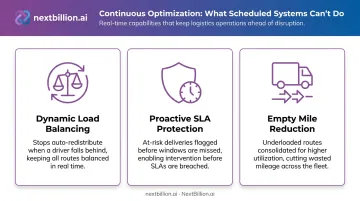
At the fleet level, continuous optimization enables three things that scheduled optimization cannot:
- Dynamic load balancing — stops automatically redistribute when one driver falls behind, keeping the fleet's total throughput on target
- Proactive SLA protection — at-risk deliveries get flagged before they miss windows, not after
- Empty mile reduction — underloaded routes get consolidated, improving overall vehicle utilization
AI That Learns from History
Reacting to live conditions is only half the picture. NextBillion.ai's AI Route Optimization also learns from each customer's historical fleet data: actual driver completion times at specific addresses, observed traffic patterns on regularly-used corridors, and recurring deviation patterns. The result is routes calibrated to how an operation actually runs, not how a generic algorithm assumes it should.
The platform builds a unique AI-trained instance per customer, teaching the algorithm on that operation's own data. Over time, it identifies road segments that consistently run slow, time windows that are reliably tight, and delivery zones that need buffer time built in. Planning stops being a reaction to problems and becomes a way to prevent them.
Key Benefits of Real-Time Route Optimization for Fleet Operations
Fuel and Mileage Reduction
Shorter, more efficient routes directly reduce fuel consumption and total miles per shift. Idle time drops when routing accounts for live congestion rather than routing vehicles into known bottlenecks. Xpress Global Systems, using NextBillion.ai's platform, achieved a 13% reduction in miles driven per month while maintaining service levels — and a 35% reduction in operating costs combining better routes, lower fuel consumption, and more cost-effective APIs.
Higher Completion Rates Without Adding Vehicles
By continuously resequencing stops around real-world delays and capacity constraints, fleets complete more jobs per vehicle per day on the existing fleet. A health-tech logistics firm using NextBillion.ai enabled 35% more visits per rider while reducing conveyance expenses by 25%.
Improved On-Time Performance and Customer Experience
Live ETA recalculation means customers receive accurate delivery windows — and updates when conditions change — rather than static estimates made hours earlier. Most operators underestimate how much this matters: a 2024 last-mile delivery study found 69% of customers consider delivery tracking details important, while 44% who avoid a retailer after a bad delivery experience don't complain or leave a review — they simply stop ordering.
A leading European TMS provider using NextBillion.ai achieved a 30% improvement in ETA and ETD accuracy, directly improving customer satisfaction scores.
Reduced Operational Costs Beyond Fuel
The savings extend well past the fuel bill:
- Fewer miles mean less vehicle wear and lower maintenance frequency
- Routes finishing closer to schedule reduce overtime hours
- Accurate ETAs cut failed delivery attempts and re-delivery costs
Data-Driven Continuous Improvement
Every completed route generates performance data — actual versus planned drive times, stop durations, deviation patterns — that feeds back into optimization reviews. Fleet managers use this data to tighten future plans: identifying which stop sequences consistently run long, which zones generate re-deliveries, and where driver behavior diverges from planned routes.
Where Real-Time Route Optimization Is Applied
Last-Mile Delivery
Last-mile is where real-time optimization delivers the most visible impact. Stop density is high, delivery windows are commitments rather than estimates, and new orders or cancellations arrive throughout the day.
A 15-vehicle fleet managing 200 daily stops can automatically resequence around traffic delays and redistribute stops from a delayed driver to others mid-shift. The result: the same delivery volume, with fewer overtime hours.
Field Service Operations
Field service — utilities, pest control, HVAC, facilities maintenance — adds complexity that last-mile doesn't face: job duration is variable, technician skills must match task requirements, and new service calls arrive throughout the day.
Hawx Pest Control used NextBillion.ai's Route Optimization API to cut technician drive times. Five minutes saved per technician per day translated to millions of dollars annually across their fleet.
Long-Haul and Regional Distribution
Long-haul routing must layer regulatory compliance — driver hours-of-service, weight restrictions, truck dimension limits — on top of standard optimization logic. NextBillion.ai's truck-compliant routing handles vehicle dimension specs, hazmat rules, and safe parking constraints as native optimization constraints, not post-processing filters.
Emerging Applications
Beyond established verticals, real-time optimization is gaining traction in three growth areas:
- EV fleet routing — optimizing for battery charge levels and charging stop placement alongside delivery windows. NextBillion.ai integrates charging stop constraints directly into route planning, reducing range anxiety for mixed EV/ICE fleets.
- On-demand and gig-driver networks — where driver availability changes by the minute. The platform's low-latency dispatch API auto-assigns the closest available driver while rebalancing active routes in real time.
- Paratransit and NEMT — where passenger-specific scheduling requirements add complexity on top of routing. NextBillion.ai's constraint engine handles these requirements within the same unified platform, without requiring a separate configuration for each fleet type.
Conclusion
Real-time route optimization is a continuous decision-making system — one that keeps every vehicle on the most operationally efficient path as road conditions, traffic, and job statuses shift throughout the day.
Fleet operators who understand how data ingestion, constraint-based optimization, dynamic dispatch, and continuous monitoring actually work together can make sharper platform decisions, set constraint parameters that reflect real operational needs, and build processes around what the technology actually does — not what the marketing says it does.
Frequently Asked Questions
How to optimize transportation routes?
Define your key constraints — delivery windows, vehicle capacity, driver hours — and feed live data (traffic, GPS, order status) into an optimization engine that recalculates continuously. The critical step most operators skip: don't lock in a static plan at the start of each day. Treat the route as a living plan that updates as conditions change. Also account for FMCSA hours-of-service limits and any HOS-linked scheduling rules so routes stay compliant, not just efficient.
What is an example of route optimization?
A last-mile delivery fleet with 15 vehicles and 200 daily stops uses route optimization to automatically sequence stops and account for traffic delays on key corridors. When a driver falls behind, stops redistribute to available drivers mid-shift — completing the same volume with fewer overtime hours and no manual dispatcher intervention.
How does real-time route optimization differ from static route planning?
Static planning sets routes once before the day begins and cannot respond to mid-route changes. Real-time optimization continuously monitors conditions and recalculates routes as traffic, orders, or driver status shifts, responding to disruptions as they happen rather than waiting for the next day's plan.
What data inputs does real-time route optimization rely on?
Four primary data streams power the system:
- GPS/telematics — vehicle location and speed
- Live traffic and weather feeds — real-time road condition updates
- Order management systems — new or changed delivery instructions
- Driver app data — stop completion status and availability
What industries benefit most from real-time fleet route optimization?
Last-mile delivery (e-commerce, grocery, pharma), field service operations (utilities, pest control, HVAC), and regional distribution see the highest impact — any operation where stop volume is high, conditions change during the day, or delivery windows are commitments rather than estimates. Regulated freight, such as hazmat carriers under PHMSA rules or interstate fleets tracking IFTA fuel-tax mileage, also benefit since route accuracy affects both compliance reporting and operating cost.
How does route optimization software integrate with existing fleet systems?
Modern platforms connect via APIs to fleet telematics providers (Samsara, Geotab, Motive, Netradyne), order management systems, and driver mobile apps — no manual data transfer required. NextBillion.ai's direct integrations with these platforms let the optimization engine act on live fleet status automatically, dispatching updated routes to driver apps in a single step.
Can AI do route optimization?
Yes. AI-driven systems handle route optimization by solving the underlying vehicle routing problem continuously rather than once per day. Machine learning models forecast traffic patterns and delivery durations, while optimization algorithms recompute sequences and assignments as new data arrives. The result is routing that adapts to live conditions instead of relying on a fixed plan set before drivers leave the depot.
What is the purpose of VRP?
The vehicle routing problem (VRP) is the mathematical foundation behind route optimization. Its purpose is to determine the most efficient set of routes for a fleet of vehicles serving multiple stops, given constraints like vehicle capacity, time windows, and driver hours. Solving VRP well minimizes total distance, time, or cost while making sure every stop is served within its required window.