What are pharmacy delivery route optimization services?
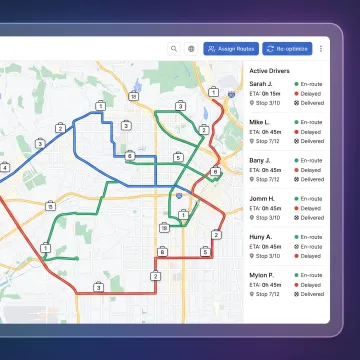
Pharmacy delivery route optimization services use routing algorithms, traffic data, constraints, driver availability, and delivery priorities to plan efficient medication delivery routes. For pharmacies and healthcare logistics teams, this can include scheduled prescriptions, same-day deliveries, cold-chain shipments, proof-of-delivery workflows, live tracking, geofenced arrivals, and audit-ready trip histories for operational and compliance visibility.
How does route optimization help pharmacy delivery operations?
Route optimization helps pharmacy delivery teams reduce driving time, fuel use, late deliveries, and manual dispatch work. NextBillion.ai supports multi-stop planning with 50+ hard and soft constraints, including time windows, driver shifts, vehicle capacity, multi-depot routing, and real-time changes. This matters for pharmacy operations balancing patient wait expectations against driver hours, service-area coverage, and vehicle limits, since manually built routes rarely account for all of these at once. Automated re-optimization keeps courier schedules realistic as conditions shift and gives dispatchers a clearer basis for communicating delivery windows to patients.
Can NextBillion.ai support cold-chain pharmaceutical delivery?
Yes. NextBillion.ai supports pharmaceutical cold-chain delivery workflows through routing, live tracking, geofencing, and route reconstruction capabilities. Operators can monitor vehicle movement, create delivery or depot geofences, document arrival and departure events, and reconstruct road-snapped trip histories. These tools help create audit-grade chain-of-custody records for sensitive medication and healthcare logistics operations.
Does the platform integrate with existing fleet or pharmacy systems?
NextBillion.ai is API-first and built to integrate with fleet management systems, telematics platforms, dispatch tools, and custom applications. Native integrations include Geotab, Samsara, Salesforce, SAP, and Microsoft Dynamics 365. Teams can also use SDKs, routing APIs, or white-label deployment options to embed routing intelligence directly into existing operational workflows.
How quickly can a pharmacy delivery team go live?
NextBillion.ai offers a trial API key for one to two weeks of evaluation and testing. With solutions engineering support, production go-live can happen within one week for many deployments. Implementation timing depends on integration scope, data readiness, workflow complexity, and whether the team uses APIs, SDKs, the no-code Route Planner App, or on-premise deployment.
What pricing models are available?
NextBillion.ai offers per-vehicle, per-order, and per-API-call pricing models, including predictable fixed monthly fees designed to absorb fluctuations in API volume. Annual contracts can include flexibility to modify allocated API usage. Enterprise pricing is available for large fleets and high-volume operations, and free integration support is available during evaluation.
Can routes be updated when urgent prescriptions are added?
Yes. NextBillion.ai supports dynamic route optimization, driver assignment, and route dispatch workflows. When urgent orders, cancellations, driver absences, or vehicle issues occur mid-shift, routes can be re-optimized and pushed to driver apps or fleet systems. This helps pharmacy delivery teams respond quickly without manually rebuilding every courier route.
Is NextBillion.ai secure enough for healthcare logistics?
NextBillion.ai is designed for enterprise-grade deployments and supports SOC 2 Type II, GDPR, CCPA, and ISO/IEC 27001:2013 certified operations. Cloud hosting is available across regional infrastructure, and on-premise deployment can be used for organizations with data residency, private-cloud, or stricter security requirements. Pharmacy and healthcare logistics teams handling patient delivery data typically layer these infrastructure controls with their own internal policies for protected health information, since platform-level security certifications address infrastructure and data handling but do not by themselves determine an organization's regulatory compliance posture.
How do you optimize delivery routes?
Route optimization works by combining live and historical traffic data, delivery locations, time windows, vehicle capacity, and driver constraints into an algorithm that sequences stops to minimize drive time and delays. For pharmacy deliveries, this also factors in priorities like urgent same-day orders and cold-chain handling. Routes can be recalculated in real time as new orders, cancellations, or delays occur during a shift.
What should a pharmacy look for in a route optimizer?
A route optimizer for pharmacy delivery should handle time-sensitive and same-day orders, support multiple real-world constraints such as driver shifts and vehicle capacity, provide live tracking and geofencing for chain-of-custody records, and integrate with existing pharmacy or fleet systems through APIs or SDKs. Flexible deployment options, including on-premise, matter for teams with data residency or infrastructure requirements.