Introduction
AI for field service dispatch and routing works by matching technicians to jobs against live constraints — skills, location, SLA deadlines, and parts inventory — while simultaneously sequencing each technician's stops to cut drive time. Picture a dispatcher managing 20 technicians and 80 jobs on a Monday morning. Each job has a skill requirement, a customer time window, an SLA deadline, and a specific location. Each technician brings different certifications, a different starting location, and whatever parts happened to make it onto the truck Friday afternoon. Traffic is already moving.
Manually balancing all of this — in minutes, before the first job starts — is where field service operations routinely break down. The wrong technician goes to a complex job. A routing backtrack burns 40 minutes of drive time. An SLA slips because no one caught the conflict before the board was locked. According to a 2023 field service industry report by Salesforce, 86% of decision-makers say they need better tools to manage field technician scheduling — and that gap is precisely where AI enters.
This guide covers how AI addresses both sides of that problem — dispatch (who gets assigned, and when) and routing (how they travel between stops). You'll find out how these systems work, what data they depend on, where they break without preparation, and where the measurable ROI actually comes from.
Key Takeaways
- AI dispatch uses constraint matching to assign the best-fit technician based on skills, location, availability, SLA priority, and parts readiness
- AI routing solves multi-stop sequencing problems to minimize travel time and protect time-window commitments, distinct from single-destination GPS navigation
- Together, these systems shift dispatchers from routine assignment work to exception handling
- Output quality depends almost entirely on data accuracy; bad job duration estimates and incomplete skill profiles degrade results regardless of platform
- Clearest ROI appears in mid-to-large operations with recurring job types, high daily volume, and SLA accountability
What Is AI for Field Service Dispatch and Routing?
These are two related but distinct optimization problems. Conflating them leads to tool mismatches and unmet expectations.
AI dispatch answers: who gets this job and when? It applies optimization algorithms to match service jobs to technicians based on skills, certifications, current location, schedule availability, SLA deadlines, and parts inventory. The output is an assignment recommendation — or in automated setups, a direct assignment.
AI routing answers: how do they get there, and in what order? It calculates the most efficient sequence of stops across a technician's full workday, accounting for time windows, traffic, job durations, and travel distances simultaneously.
Traditional field service management (FSM) software handles both processes manually: a dispatcher makes judgment calls, builds routes visually, and adjusts by hand. AI solves both computationally against a defined constraint set — which is why generic navigation tools fall short the moment you move beyond a single driver. When evaluating dispatch software for a service company, the deciding factor is whether the platform actually solves this constraint-based assignment and multi-stop sequencing problem, rather than simply digitizing a paper schedule or offering single-driver navigation.
Why Consumer Navigation Tools Don't Apply Here
Google Maps solves a single-destination routing problem for one driver. That's a fundamentally different computation from what field service requires.
Enterprise field service routing must:
- Sequence multiple stops across an entire team simultaneously
- Enforce time windows, skill requirements, and SLA deadlines as hard constraints
- Reoptimize dynamically when conditions change mid-day
- Scale to thousands of jobs without degrading response time
NextBillion.ai's Route Optimization API handles up to 10,000 tasks per request and supports distance matrix calculations up to 5,000×5,000 elements. At that scale, a dispatcher managing 50 technicians across a metro area gets optimized assignments in seconds rather than spending an hour building routes by hand.
Why Field Service Operations Need AI for Dispatch and Routing
The Combinatorial Explosion Problem
Even a modest operation creates an optimization problem that exceeds human cognitive capacity. If 80 jobs can each be assigned to any of 20 technicians, the assignment space alone is approximately 20⁸⁰ — roughly 1.2 × 10¹⁰⁴ combinations. That's before accounting for route sequence, time windows, skill filters, parts availability, SLA priorities, and real-time traffic.
Academic research classifies this as the Technician Routing and Scheduling Problem (TRSP) — an NP-hard extension of the Vehicle Routing Problem that incorporates time windows, skills, tools, and spare parts. No human dispatcher evaluates this space exhaustively. They make reasonable approximations, and those approximations have costs.
What Manual Dispatch Gets Wrong
Common failure patterns in manual dispatch operations include:
- Proximity bias: assigning the nearest technician instead of the best-fit one, driving repeat visits
- Static routes: plans built at the start of the day that ignore real-time traffic and job duration variance
- Geographic backtracking: poor stop sequencing that looks reasonable on a map but burns unnecessary miles
- Skill mismatches: sending a generalist to a specialized job, then dispatching again when the job requires escalation
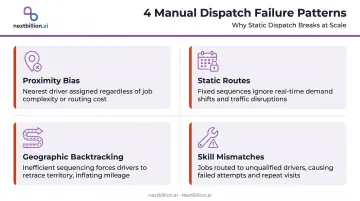
Aberdeen Group's field service research found that the average first-time fix rate across 156 organizations was 75%, meaning one in four service calls required a repeat visit. Their 2013 data put the cost of a single truck roll at $200–$300 (treat as a directional baseline; current operating costs in your market will vary). 51% of repeat visits were caused by parts unavailability — confirming that dispatch optimization is a skills-plus-parts-plus-routing problem, not just a map problem.
Why AI Adoption Is Accelerating
A 2023 WBR Insights survey of 100 European field service leaders found 62% already use AI for scheduling and routing and 61% use AI for job prioritization. Among large field service organizations, this is no longer an emerging experiment.
The drivers are concrete: customer expectations for precise arrival windows are tightening, field service teams are expanding geographically, and SLA accountability is rising across utilities, HVAC, pest control, and home services. This shift changes dispatcher work rather than eliminating it — dispatchers move from manually building every assignment to reviewing AI-generated recommendations and handling exceptions, cancellations, and edge cases the system flags. That distinction matters directly for anyone asking whether dispatchers get replaced by AI: the role shifts toward oversight, not disappearance.
The same WBR report noted that 52% of respondents cited data quality as a key AI implementation challenge — worth flagging because data readiness matters more than platform selection for most teams getting started.
How AI Field Service Dispatch and Routing Works
The AI engine continuously ingests live data — job requirements, technician GPS location, real-time traffic, parts inventory, and SLA deadlines — and solves an optimization problem against a defined constraint set. The output is either ranked assignment recommendations (dispatcher reviews and approves) or, in automated setups, direct assignments pushed to technician devices.
Step 1: Job Intake and Constraint Mapping
When a service request enters the system, the AI parses:
- Required technician skills and certifications
- Estimated job duration (drawn from historical benchmarks by job type)
- Customer-specified time windows and SLA deadline
- Parts or equipment required
- Geographic location
Simultaneously, the system queries the live technician pool — GPS location, current schedule load, verified skill set, remaining shift availability, and on-vehicle parts inventory. The match logic eliminates disqualified technicians before ranking the remaining pool.
This is where data quality directly determines output quality. Missing job duration history, stale skill profiles, or undefined SLA rules don't just reduce accuracy — they propagate into every downstream assignment decision.
Step 2: Optimization and Assignment
The AI runs a combinatorial optimization — specifically a variant of the Vehicle Routing Problem (VRP) framework. The system finds the assignment configuration that best satisfies all constraints while minimizing a defined target (total travel time, SLA compliance rate, or technician utilization).
Hard constraints are non-negotiable filters — a technician must hold a specific certification, a job must start within a defined window. Soft constraints influence ranking when multiple technicians qualify — prefer the closer option, minimize overtime. NextBillion.ai's Route Optimization API supports 50+ configurable hard and soft constraints — covering everything from skill-certification matching and time-window enforcement to parts availability and shift-hour limits.
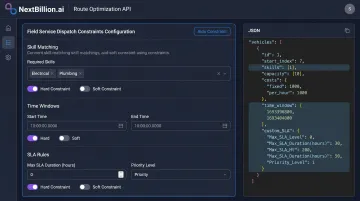
For large-scale operations, this computation needs to happen fast. NextBillion.ai's per-vehicle and per-order pricing models make high-frequency computation economically sustainable — unlike per-API-call pricing, which scales costs exponentially as daily job volumes and reoptimization frequency increase.
Step 3: Real-Time Reoptimization
Static route plans fail the moment conditions change. Reoptimization triggers include:
- Emergency job added to the board
- Technician delayed at a previous job
- Traffic incident on a planned route
- Customer cancellation
- Parts shortage discovered in the field
When any of these occur, the system re-solves the constraint problem for the remaining unexecuted schedule. Updated route instructions go to affected technicians, impacted customers get rescheduled, and no dispatcher intervention is required.
The performance gains from this approach are measurable. A 2023 Transportation Research Part E study on dynamic technician routing found tactical planning reduced driving distance by nearly 11% in synthetic instances and improved real-world route length per task by approximately 9%.
Hawx Pest Control — one of the largest pest control providers in the US, with 30+ offices across 16 states — described exactly this problem before deploying NextBillion.ai: manual scheduling done once daily made it nearly impossible to accommodate same-day cancellations and new bookings. After implementation, they could update job schedules and routes multiple times per day, improving both technician efficiency and customer NPS within the first month.
Key Factors That Affect AI Dispatch and Routing Performance
Data Quality Comes First
The optimization engine performs only as well as the data it ingests. Before deploying AI dispatch, the following data must be clean and current:
- Technician skill and certification records
- Historical job duration benchmarks by job type
- Customer time-window preferences and SLA rule definitions
- Real-time GPS reliability from telematics integrations
- Parts and inventory availability by vehicle
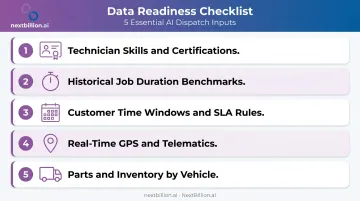
New deployments require a calibration period — typically 30 to 90 days — before output quality stabilizes. Teams that skip data cleanup before go-live and expect immediate ROI typically draw misleading conclusions about AI performance.
Constraint Configuration Depth
The value gap between AI dispatch and manual scheduling scales with the number of constraints the system evaluates simultaneously. A system that only weighs proximity and availability will outperform manual dispatch — but it misses the gains available from incorporating skill tiers, inventory status, SLA risk scoring, and customer preference weighting.
The practical approach: audit your highest-cost dispatch failures before configuring constraints. That audit reveals which variables drive the most expensive outcomes in your specific operation. NextBillion.ai's solution engineers work with customers through this configuration process, helping identify which constraints matter most before the system goes live.
Scale and Job Volume
AI dispatch infrastructure has a setup cost: data loading, constraint configuration, and integration with existing FSM and telematics systems. That investment yields modest returns at very low job volumes where manual scheduling remains tractable. Returns increase significantly at scale, where optimization complexity exceeds human capacity to evaluate.
Hawx Pest Control's implementation, managing over 10,000 customers per region with hundreds of technicians, is a clear example of where that scale threshold gets crossed. At that volume, manual dispatch creates compounding errors that no amount of experienced scheduling can reliably prevent.
Common Misconceptions About AI Dispatch and Routing
"AI dispatch replaces human dispatchers."
AI automates routine combinatorial matching — the work that consumes most dispatcher bandwidth. Dispatchers shift to managing exceptions, customer escalations, complex multi-technician scenarios, and edge cases where human judgment adds more value than algorithmic optimization.
Teams that frame AI as a headcount reduction tool see lower adoption and worse outcomes than teams that position it as a capacity multiplier.
"Any route optimization tool delivers the same results."
Consumer GPS apps, basic fleet telematics routing, and enterprise AI routing engines solve fundamentally different problems. Multi-stop field service routing with skill constraints, SLA time windows, dynamic reoptimization, and technician-specific restrictions requires purpose-built VRP infrastructure.
Deploying a consumer mapping tool for enterprise routing and then calling the failure "AI skepticism" misdiagnoses the problem. That's evaluating the wrong class of software against enterprise requirements.
"AI dispatch produces full results immediately after deployment."
AI optimization systems improve as they accumulate operational data — historical job durations, technician performance patterns, and route execution outcomes. Early deployment output reflects the quality of pre-loaded data, not the system's full potential.
Set realistic expectations from the start:
- Establish a 30–90 day calibration baseline before drawing ROI conclusions
- Invest in data cleanup before go-live, not during it
Frequently Asked Questions
Can AI organize delivery and field service routes?
Yes. AI route optimization solves multi-stop sequencing problems for both delivery and field service by accounting for time windows, traffic, vehicle type, and stop-specific requirements. This requires route optimization infrastructure built on VRP frameworks — basic GPS navigation is not sufficient.
What is the difference between AI dispatch and AI routing in field service?
Dispatch determines who gets assigned to a job — technician matching against skills, availability, and SLA requirements. Routing determines how they travel between jobs — multi-stop sequencing and path optimization. Both are AI-powered but solve distinct optimization problems.
Does AI dispatching replace human dispatchers?
No. AI handles routine assignment matching and routing; dispatchers focus on exceptions, escalations, and complex multi-technician scenarios. The dispatcher role shifts toward exception management, not elimination. Dispatchers still own customer communication, judgment calls on priority conflicts, and decisions that involve local knowledge AI systems do not have, such as site access issues or customer relationship history.
What data does AI need to optimize field service dispatch and routing?
Core inputs include:
- Technician skill profiles and certifications
- Real-time GPS location
- Historical job duration benchmarks by job type
- Customer time windows and SLA deadline rules
- Parts or inventory availability by vehicle
How does AI handle last-minute job changes or emergencies?
The system reoptimizes the remaining schedule in real time. It reassigns jobs, recalculates routes, and pushes updated instructions to affected technicians through integrated fleet management and driver apps — no dispatcher intervention required. This includes accounting for FMCSA hours-of-service limits when reassigning drivers, so a reoptimized route does not push a technician past legal drive-time limits or into a mandated rest period.
What are the main benefits of AI route optimization for field service teams?
Key benefits include:
- Reduced total travel time and fuel costs
- Higher first-time fix rates through better technician-job matching
- Improved SLA compliance through dynamic reoptimization
- Increased technician utilization across the workday
Will truck dispatchers be replaced by AI?
Unlikely in full. AI for field service dispatch and routing automates repetitive assignment and sequencing work, but dispatchers still handle exception management, customer escalations, and judgment calls involving compliance factors like FMCSA hours-of-service or DOT requirements. The realistic shift is toward fewer dispatchers managing more technicians, with AI handling the routine optimization work that used to consume most of their time.
What is the best dispatch software for service companies?
There is no single best option — it depends on fleet size, job complexity, and existing systems. Field service companies should evaluate dispatch software on route optimization accuracy, real-time reoptimization capability, integration with fleet management and mapping APIs, and how well it handles technician skill matching against job requirements. Software built on proven VRP and routing infrastructure typically outperforms basic scheduling tools for multi-stop, time-window-constrained work.